

Software quality Memes

Posts tagged with Software quality

My Software Just Got Recruited Into A College Basketball Team

My Software Just Got Recruited Into A College Basketball Team
So your code has reached that special level of brokenness where it's literally got "a million bugs" and somehow that qualifies it for a D2 basketball scholarship. The recruiting process must've been wild - "What's your vertical?" "About 500 stack traces per second." Real talk though, we've all shipped code that could probably start at point guard for a mid-tier college team based purely on its bug count. The production environment is just a different kind of court where your software commits fouls every possession and the refs (users) are not happy about it. At least when you have a million bugs, you can't be accused of having just one critical issue - you've got diversity in your failures. That's called being well-rounded.

How Did They Make It This Bad

How Did They Make It This Bad
Someone searched for "246/247" in Windows search and it confidently suggested "246/248" as the best match. Like... that's not even close? The search bar had ONE job: find the thing that literally matches what you typed. Instead, it's out here playing "closest without going over" like it's on The Price is Right. Windows Search has achieved the impossible—it's somehow worse at finding exact matches than a drunk person trying to remember their ex's phone number. You could probably type your own name and it would suggest your neighbor's WiFi password instead. Fun fact: Windows Search indexes your entire drive but still manages to find everything except what you're actually looking for. It's the digital equivalent of asking someone where your keys are and they hand you a stapler.

Well At Least They Are Honest About It

Well At Least They Are Honest About It
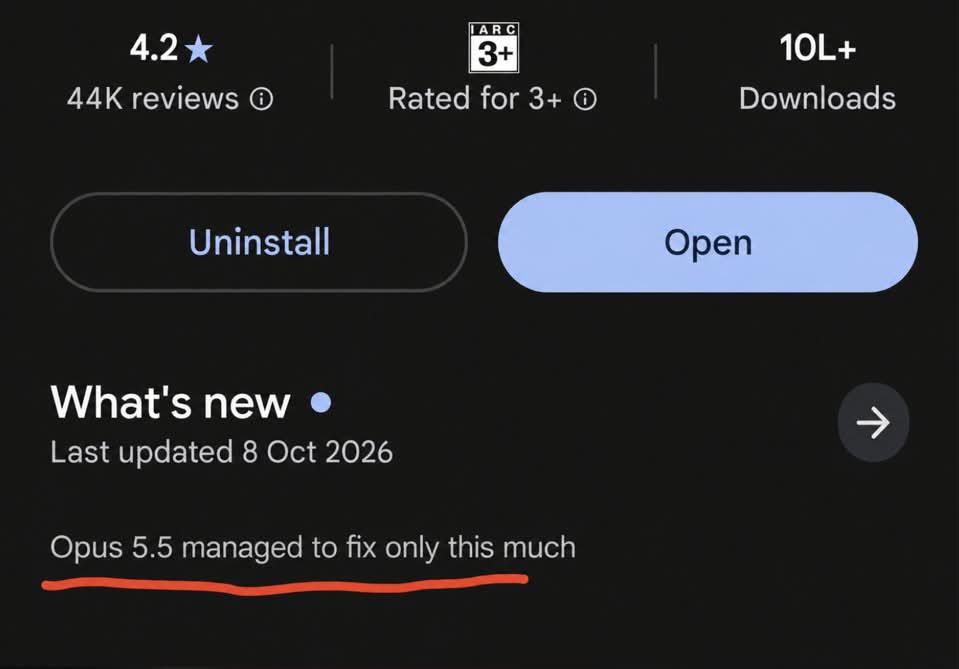
When your release notes are basically a shrug emoji in text form. The devs really said "we tried, we really did, but the bugs won" and just... shipped it anyway. With 10 MILLION downloads, this app update is giving major "we fixed like three things but broke seven others so let's just call it even" energy. The brutal honesty is almost refreshing though – no corporate speak, no "improved stability and performance," just pure unadulterated defeat. Somewhere, a product manager is crying into their Jira board.

Loop Until All Tests Pass And Make No Mistakes

Loop Until All Tests Pass And Make No Mistakes
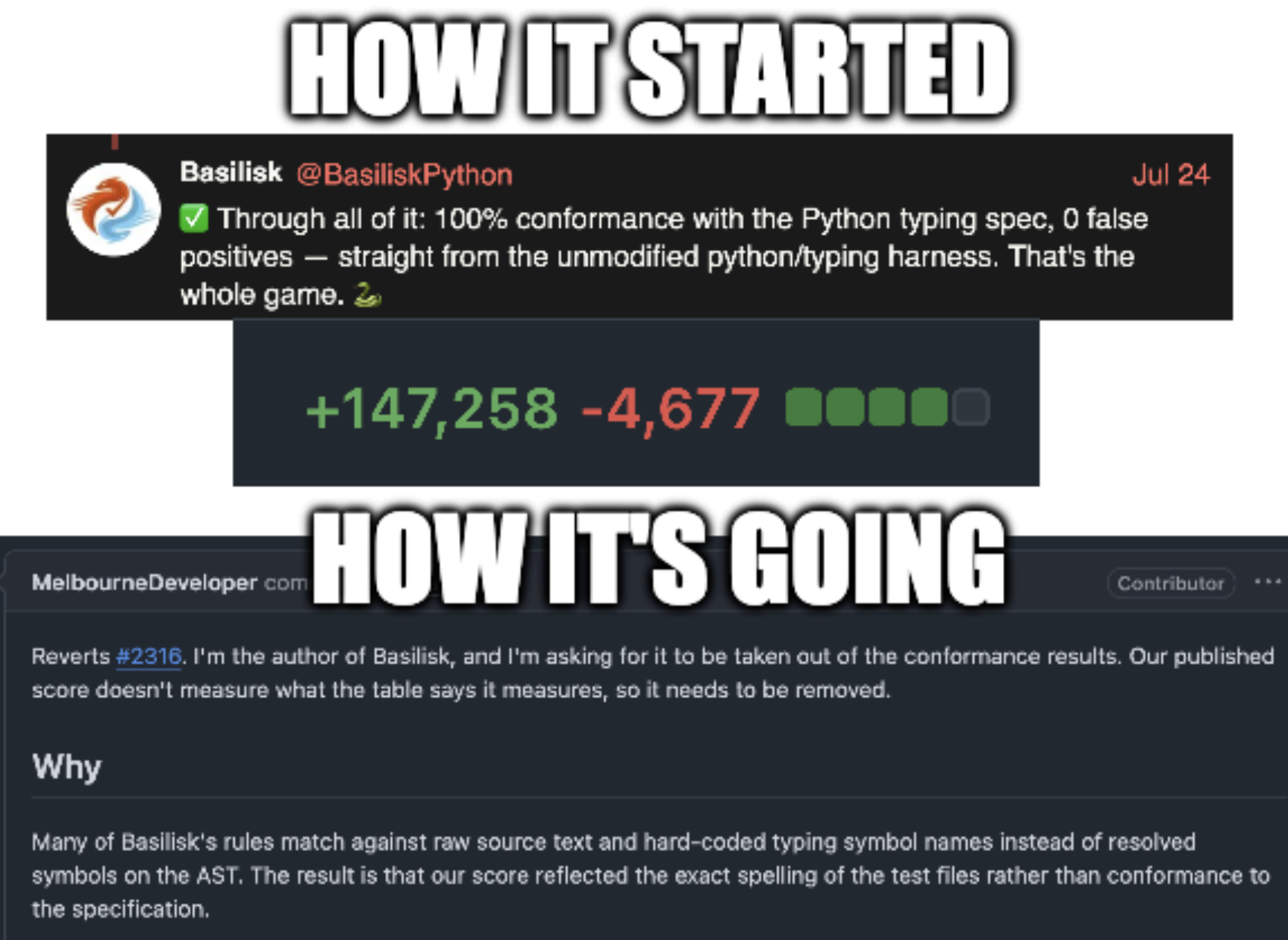
Oh, the absolute GLORY of achieving 100% conformance with 147,258 passing tests and zero false positives! Truly a monument to human achievement! What could possibly go wrong? Well, turns out when you're testing against the LITERAL STRING NAMES of typing symbols instead of, you know, the actual AST (Abstract Syntax Tree), you're basically just spell-checking your test files. It's like celebrating that you wrote "def" correctly 147,258 times instead of actually validating Python type hints. So naturally, the author had to come crawling back asking to be removed from the conformance results because their "perfect score" was measuring... absolutely nothing meaningful. From hero to zero faster than you can say "false positive." The confidence! The fall! The chef's kiss of irony! 💀

NordVPN

NordVPN
Encrypt your traffic on public Wi-Fi, stream from anywhere, and cover up to ten devices with one plan. 30-day money-back guarantee.

Bunderstandable Wishful Thinking

Bunderstandable Wishful Thinking
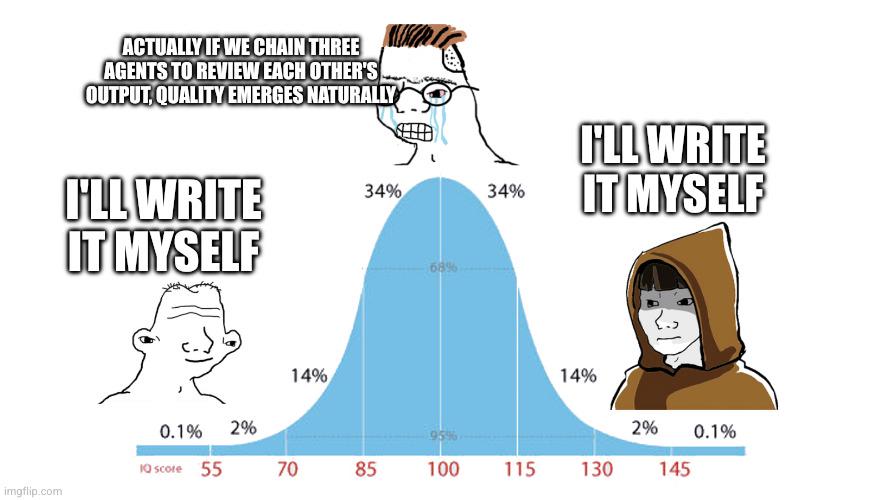
You know that manager who thinks implementing peer reviews will magically produce pristine code? Yeah, they're living in the tiny 0.1% tail of this IQ distribution curve. Meanwhile, the remaining 99.8% of us are sitting comfortably in "I'll write it myself" territory because we all secretly believe we're the only competent developer on the team. The brutal truth: code review is theoretically brilliant. Three devs reviewing each other's work should create a beautiful feedback loop where bugs get caught, patterns improve, and quality ascends to the heavens. But in practice? Everyone's either too busy, too passive-aggressive with their comments, or just rubber-stamps everything with "LGTM" so they can get back to writing their own "obviously superior" code. The bell curve doesn't lie—we're all equally convinced that collaborative quality is someone else's job and that our solo genius is the real path forward. Spoiler: it's not, but we'll keep pretending until the production bugs prove otherwise.

Removed From The Meeting

Removed From The Meeting
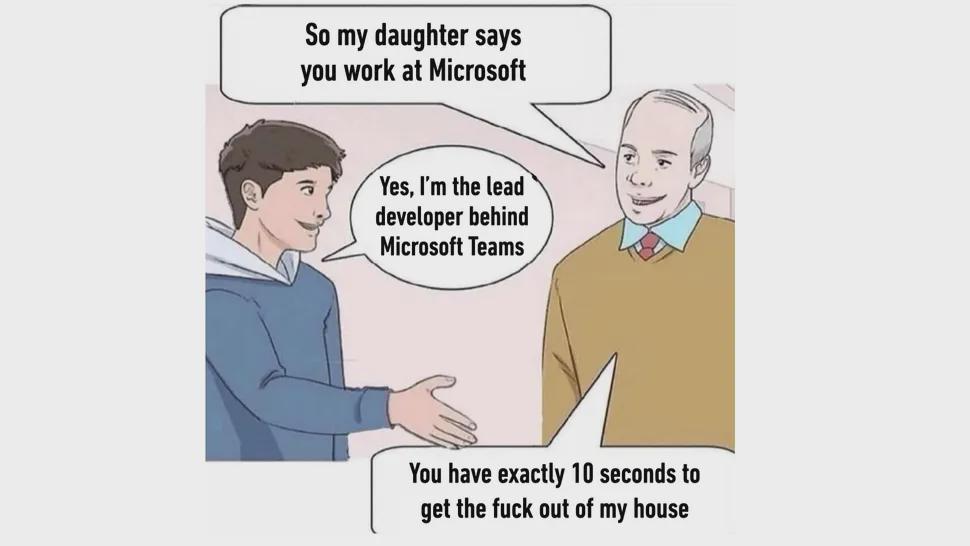
Imagine proudly announcing you're the lead developer behind Microsoft Teams and expecting a handshake, only to get immediately yeeted out of someone's house like you just admitted to being a war criminal. The audacity! The betrayal! The sheer RAGE this man feels towards Teams is palpable through the screen. And honestly? Completely justified. Because let's be real, whoever built Teams clearly never had to USE Teams. The app that crashes during important meetings, eats your RAM like it's an all-you-can-eat buffet, and somehow manages to be both bloated AND missing basic features. Sir, you have 10 seconds to leave before this becomes a criminal investigation.

Enshittiflation

Enshittiflation
The perfect word to describe modern tech in 2024. Your cloud provider just raised prices by 40% while simultaneously removing features you actually used and adding three new AI integrations nobody asked for. Remember when software just... worked? When you bought a license and owned it? When APIs didn't deprecate every six months? When "updates" meant improvements instead of "we removed offline mode and now require an internet connection to open a text file"? The tech industry discovered they can charge you more for less and call it "optimization" or "streamlining the user experience." Your $200/month SaaS subscription now has a worse UI than the $50 version from three years ago, but hey, at least the loading spinner is smoother. It's the circle of tech life: disrupt the market with a cheap, good product → gain monopoly → jack up prices → cut costs → profit. Rinse and repeat until developers are paying $99/month for a code editor that used to be free.

Which Game Or Game Series Is Best Example Of This

Which Game Or Game Series Is Best Example Of This
The brutal truth about game development captured in two frames. When the original devs are still around, the game is polished, innovative, and actually works. But once they peace out? Welcome to bug city, population: your entire codebase. New devs inherit a mess of undocumented features, spaghetti code held together by prayers and duct tape, and zero institutional knowledge about why that one function is named "doTheThing()". It's like trying to renovate a house when the architect took all the blueprints to their grave. The passion dies, the vision gets lost, and suddenly you're shipping updates that break more than they fix. Classic examples? Looking at you, every beloved franchise that got acquired or had mass exodus of talent.

CanaKit Raspberry Pi 5 16GB Starter Kit PRO - Turbine Black (128GB Edition) (16GB RAM)

CanaKit Raspberry Pi 5 16GB Starter Kit PRO - Turbine Black (128GB Edition) (16GB RAM)
Includes Raspberry Pi 5 16GB with 2.4Ghz 64-bit quad-core CPU (16GB RAM) · Includes 128GB Micro SD Card pre-loaded with 64-bit Raspberry Pi OS, USB MicroSD Card Reader · CanaKit Turbine Black Case fo…

Ah Yes More Bugs!

Ah Yes More Bugs!
Nothing says "quality software development" quite like an app update that literally promises to add bugs instead of fixing them. The developer's honesty is refreshing though—most apps just add bugs silently and call it "performance improvements." The "to fix later" part is the real kicker here. It's the developer equivalent of "I'll start my diet on Monday" or "I'll refactor this code next sprint." Spoiler alert: they won't. Those bugs are going straight into production where they'll live rent-free alongside the other 47 bugs from previous updates. Also, can we talk about how this update is dated April 2026? Either someone's time traveling or their CI/CD pipeline is really optimistic about deployment schedules.

A Reminder To Every Company Who's Made A Storefront: We Want Steam To Have Competition. Y'all Just Keep Making Crappy Competitors.

A Reminder To Every Company Who's Made A Storefront: We Want Steam To Have Competition. Y'all Just Keep Making Crappy Competitors.
You know what's wild? Epic, EA, Ubisoft, and everyone else saw Steam's 30% cut and thought "we can do better!" Then they proceeded to launch storefronts with missing features, terrible UX, and the performance of a potato running Crysis. Steam's "monopoly" isn't because they're evil—it's because they actually built something people don't hate using. Cloud saves that work, a refund policy that doesn't require a lawyer, community features, and a client that doesn't feel like it was coded during a hackathon at 3 AM. Meanwhile, Epic buys exclusives instead of fixing their shopping cart. Origin somehow made buying games feel like filing taxes. And don't even get me started on the Microsoft Store, which still can't figure out where it installed your game. Competition is great when the competitors aren't speedrunning how to alienate users. Build something actually good, and gamers will show up. Until then, Gabe Newell gets to keep printing money.

The Mythical Two-Minute Miracle

The Mythical Two-Minute Miracle
The eternal fantasy of management: cook a perfect product in 2 minutes with "vibe coding." Left to right, we have the reality of software development—properly cooked at reasonable temperature and time, burnt to a crisp when rushed, or a magical rainbow unicorn chicken that exists only in fever dreams and sprint planning meetings. Nothing says "I've never written a line of code" quite like believing that throwing more developers at a problem or using the latest trendy framework will somehow bend the laws of software physics. The universe has rules, and one of them is that good code takes actual time to develop—no matter how many times you use the word "synergy" in the standup.

When Do We Ever Learn?

When Do We Ever Learn?
The eternal cycle of game development hell, illustrated through Omni-Man's bloody lecture. That moment when management keeps throwing money at broken, unfinished ports instead of giving devs proper time to finish the product. Just another day in the industry where the "ship now, patch later" mentality reigns supreme. Meanwhile, QA testers sit in the corner, reports ignored, muttering "I literally warned you about this exact bug three months ago."