

Reality check Memes

Posts tagged with Reality check
True

True
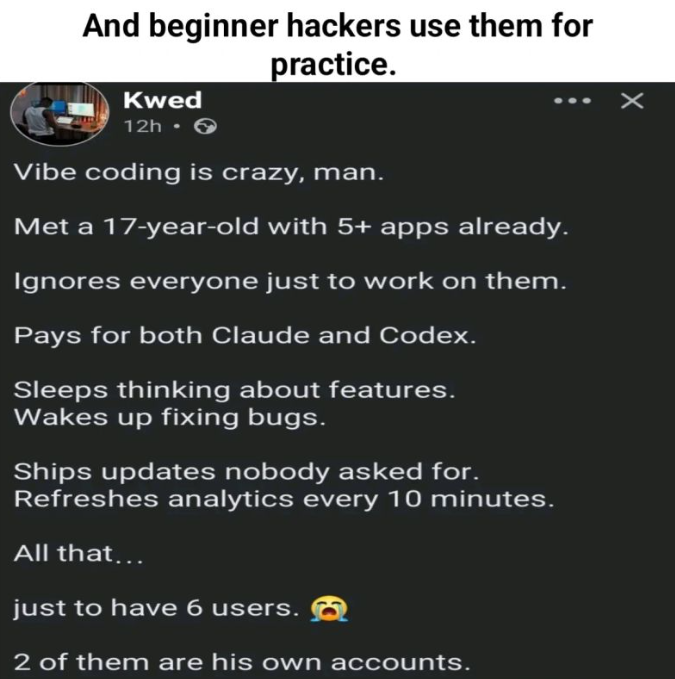
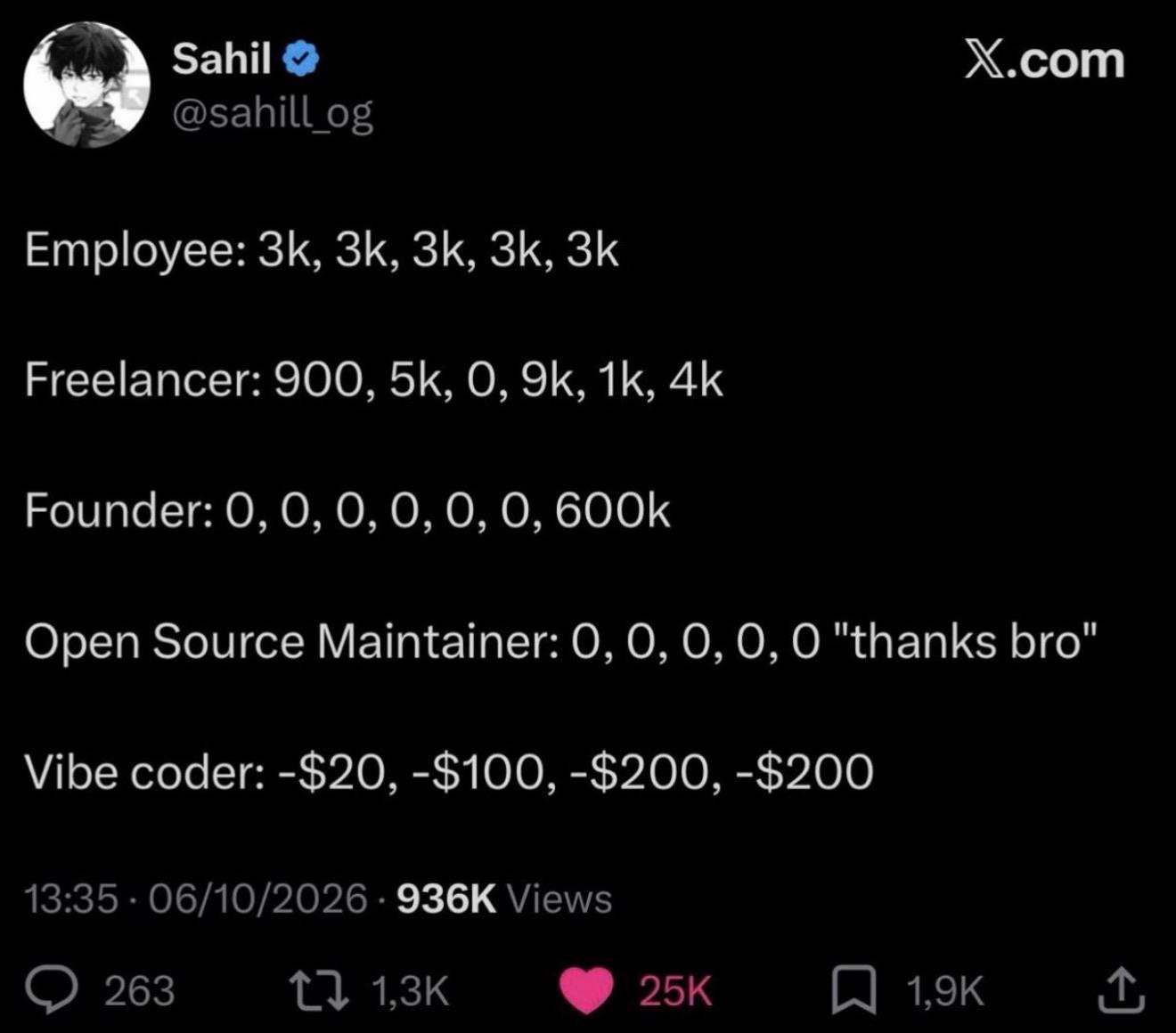
You know what's funny? We spend months building features, writing clean code, optimizing performance, fixing edge cases... and then launch day hits and exactly three people show up. Meanwhile, that intern who slapped together a landing page with a gradient background and "AI-powered" in the title somehow has a waitlist of 10,000. This is the tech industry's dirty little secret: building it doesn't mean they'll come. You can have the most elegant architecture, perfect test coverage, and documentation that would make senior devs weep with joy, but if nobody knows about it or cares, you're just screaming into the void. The real kicker? Those "vibe coders" probably spent more time on their Twitter presence than their actual product, and guess what—it worked. Sometimes I wonder if we should just replace our CI/CD pipeline with a TikTok account.

Real Coder Auto Revealed

Real Coder Auto Revealed
Writing code? You're basically a majestic creature, gracefully gliding through elegant solutions, feeling like the architect of digital worlds. But the moment something breaks and you fire up the debugger? You're curled up in the fetal position questioning every life choice that led you to this moment. The transformation from confident developer to existential crisis speedrun champion is truly something to behold. That giraffe went from "I got this" to "why do I even exist" real quick, and honestly, same energy when stepping through 47 nested callbacks trying to find why the button is three pixels off.

Oh You Sweet Summer Child

Oh You Sweet Summer Child
You finished 81% of the project in four hours? Congrats, you've just discovered the 80/20 rule's evil twin: the 80/80 rule. That's where 80% of the work takes 20% of the time, and the remaining 20% takes the other 80% of your lifespan. That last 19% isn't just code—it's edge cases, browser compatibility issues, stakeholder "minor tweaks," the QA team finding bugs in features that don't even exist yet, and documentation nobody will read. Six months sounds about right. Maybe even optimistic. Those who've been through the grinder know that "almost done" is the most dangerous phrase in software development. It's where projects go to age like fine wine, except the wine turns to vinegar and everyone pretends not to notice.

Morning Reality

Morning Reality
You know that feeling when you're riding the caffeine-and-adrenaline high at 4AM, cranking out what feels like the most elegant, architecturally sound code of your career? You're basically building the Hanging Gardens of Babylon in your IDE. Then morning comes. You open the file with fresh eyes and a functioning brain, only to discover you've actually constructed a plastic toy castle being assaulted by a confused lizard. The variable names make no sense, the logic is held together by duct tape and prayer, and there's a comment that just says "// TODO: fix this abomination." Sleep deprivation is one hell of a drug. Your 4AM self and your 10AM self are basically two different developers, and they're not on speaking terms.

Does Have The Same Ring To It

Does Have The Same Ring To It
Remember when everyone thought 3D printers would revolutionize manufacturing and we'd all be printing replacement parts at home? Yeah, that aged about as well as "everyone will code their own apps now that no-code tools exist." Both started as these utopian tech predictions that completely ignored human nature: most people don't want to fiddle with G-code calibration any more than they want to mess with API endpoints and state management. The comparison is chef's kiss because both technologies democratized access to creation, yet somehow the masses still prefer buying stuff on Amazon and downloading apps from the App Store. Turns out convenience beats DIY empowerment every single time.

Surprise

Surprise!
You spend months crafting your "unique" app idea, convinced you're about to revolutionize the market. Launch day arrives, you hit publish, and then reality slaps you harder than a null pointer exception. Turns out there are literally thousands of apps doing the exact same thing. The app store is basically a graveyard of identical ideas, each developer thinking they were the chosen one. Vibe coders really out here discovering that their groundbreaking innovation has been done 3,847 times before, with better UI and actual users. The entrepreneurial dream dies faster than your motivation to fix that one bug you've been ignoring for weeks.

Surprise Surprise

Surprise Surprise
You spend months crafting your "unique" app idea, convinced you're about to revolutionize the industry. Launch day arrives, you hit publish, and suddenly discover the app store has approximately 47,000 clones of your masterpiece already sitting there. Turns out your groundbreaking to-do list app wasn't quite as groundbreaking as you thought. The real kicker? Half of them have better UI than yours and the other half are somehow ranked higher despite looking like they were designed in MS Paint. Welcome to app development, where originality goes to die and everyone's building the same weather app.

Does This Marketing Strategy Work?💀

Does This Marketing Strategy Work?💀
Indie game devs be out here thinking "maybe if I refresh the Steam page ONE more time, someone will buy it." Meanwhile, they've completely abandoned any semblance of actual marketing—like posting on social media, building a community, or literally doing anything that might attract players. Five minutes into your first release and you're already checking the sales dashboard like it's a heart rate monitor. Spoiler alert: refreshing the page doesn't magically generate sales. But hey, at least you're getting really good at hitting F5. That's a skill, right? The real kicker is watching the "actually marketing the game" exit fly by while you speed down the highway of denial and compulsive page refreshing. Classic developer move—spend 2 years building the game, 0 minutes learning how to sell it.

So Where Are The Users

So Where Are The Users
You spent months architecting the perfect backend, wrote pristine documentation, deployed with zero downtime, and even set up monitoring dashboards that look absolutely gorgeous. Launch day comes and goes. Week one passes. Week four hits and you're still staring at your analytics dashboard showing a grand total of... *checks notes* ...your mom, your best friend who felt obligated, and what's probably a bot from Russia. The painful reality: building the app is only like 20% of the battle. Marketing, user acquisition, finding product-market fit—that's the other 80% that most devs conveniently forget exists. You can have the most elegant codebase in the world, but if nobody knows it exists, you're just fishing in an empty pond while your server costs keep ticking up. Fun times!

CS Majors Be Like

CS Majors Be Like
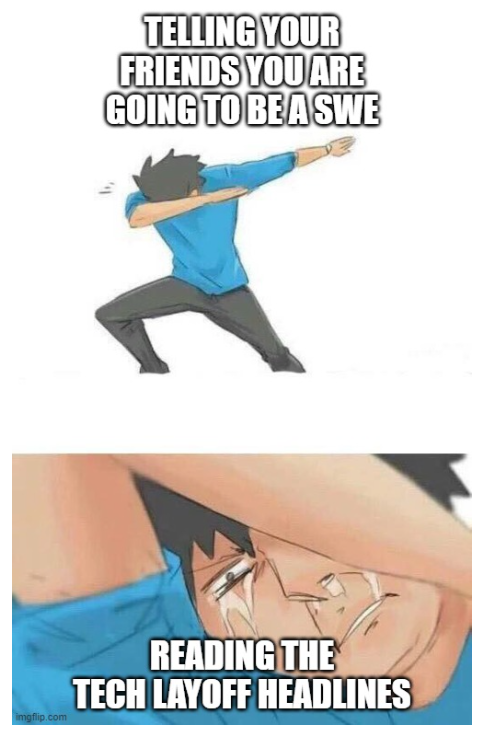
Picture this: bright-eyed freshman walks into their first CS lecture thinking they're about to become the next tech billionaire with FAANG offers raining from the sky like confetti. Cut to reality—they're one of approximately 47,000 other CS majors with the exact same dream, all competing for the same positions. It's giving "main character syndrome meets brutal market saturation." The confidence? Astronomical. The job market? Absolutely RUTHLESS. Nothing says delusion quite like thinking a degree alone is your golden ticket when there are literal armies of clones with identical résumés flooding every entry-level position. But hey, at least they're all suffering together in their data structures class!

Nobody's Paying Fifteen A Year For Your Slop Buddy

Nobody's Paying Fifteen A Year For Your Slop Buddy
That moment when a junior dev spends 40 minutes explaining their "revolutionary" microservices architecture for a to-do app that's basically CRUD with extra steps. The nervous sweating intensifies as they realize nobody's impressed by their buzzword salad of "event-driven serverless containerized blockchain-ready" nonsense. Sir, this is a Wendy's. Your app does what a spreadsheet could do, and you want people to subscribe? The delusion is strong with this one.

45 Minutes Of My Life I Will Never Get Back

45 Minutes Of My Life I Will Never Get Back
Every Linux evangelist swears their distro can do "everything" and is "super convenient" until someone asks the most basic question imaginable. Signing a PDF? That simple task your grandma does on Windows without thinking? Suddenly you're knee-deep in terminal commands, installing dependencies, reading StackOverflow threads from 2009, and questioning every life decision that led you here. The beauty here is the instant realization that they've been caught in their own hype. "Modern distros are very convenient" immediately crumbles when faced with real-world office tasks. Sure, Linux can compile kernels and run Docker containers like a dream, but signing a PDF? That's apparently asking too much. Those 45 minutes were probably spent trying LibreOffice, Xournal, pdftk, and eventually giving up and using a sketchy online tool.