Nasa Memes

Posts tagged with Nasa
Progress

Progress
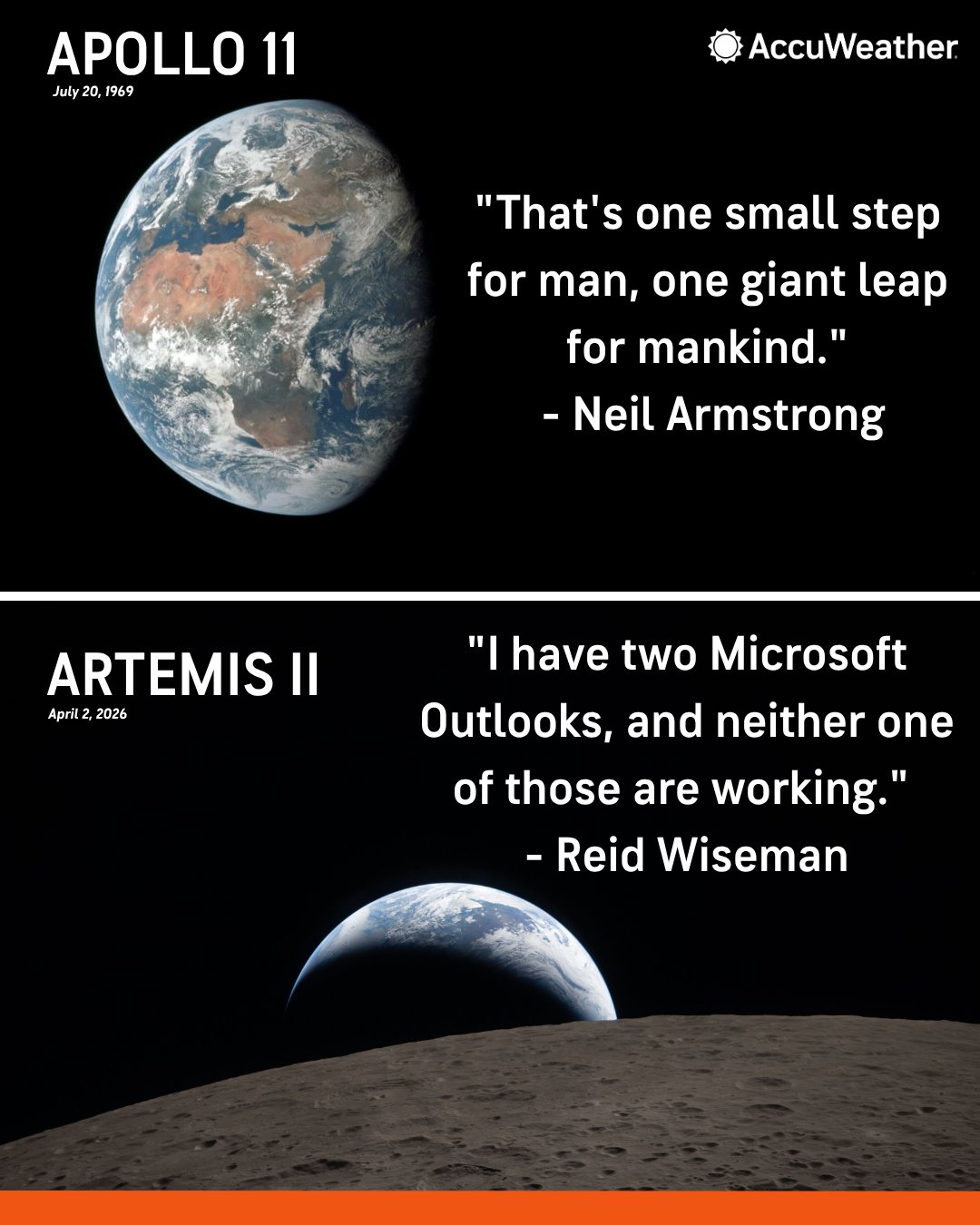
From landing on the moon with 4KB of RAM to landing on the moon with two instances of Outlook that won't even open. Humanity went from calculating orbital trajectories on computers less powerful than a toaster to being unable to manage email on machines that could run the entire Apollo program a thousand times over. The irony is beautiful: we've got exponentially more computing power, yet somehow we're struggling with basic productivity software. Armstrong made history with less computational power than your smart fridge, while modern astronauts are probably rebooting Outlook in orbit. Nothing screams "technological advancement" quite like needing two broken instances of the same email client. Fun fact: The Apollo Guidance Computer had 64KB of memory and got humans to the moon. Meanwhile, Outlook uses about 200MB just to tell you "Not Responding." Progress, indeed.

To The Brave Astronauts Taking Us Back To The Moon, We Feel Your Pain

To The Brave Astronauts Taking Us Back To The Moon, We Feel Your Pain
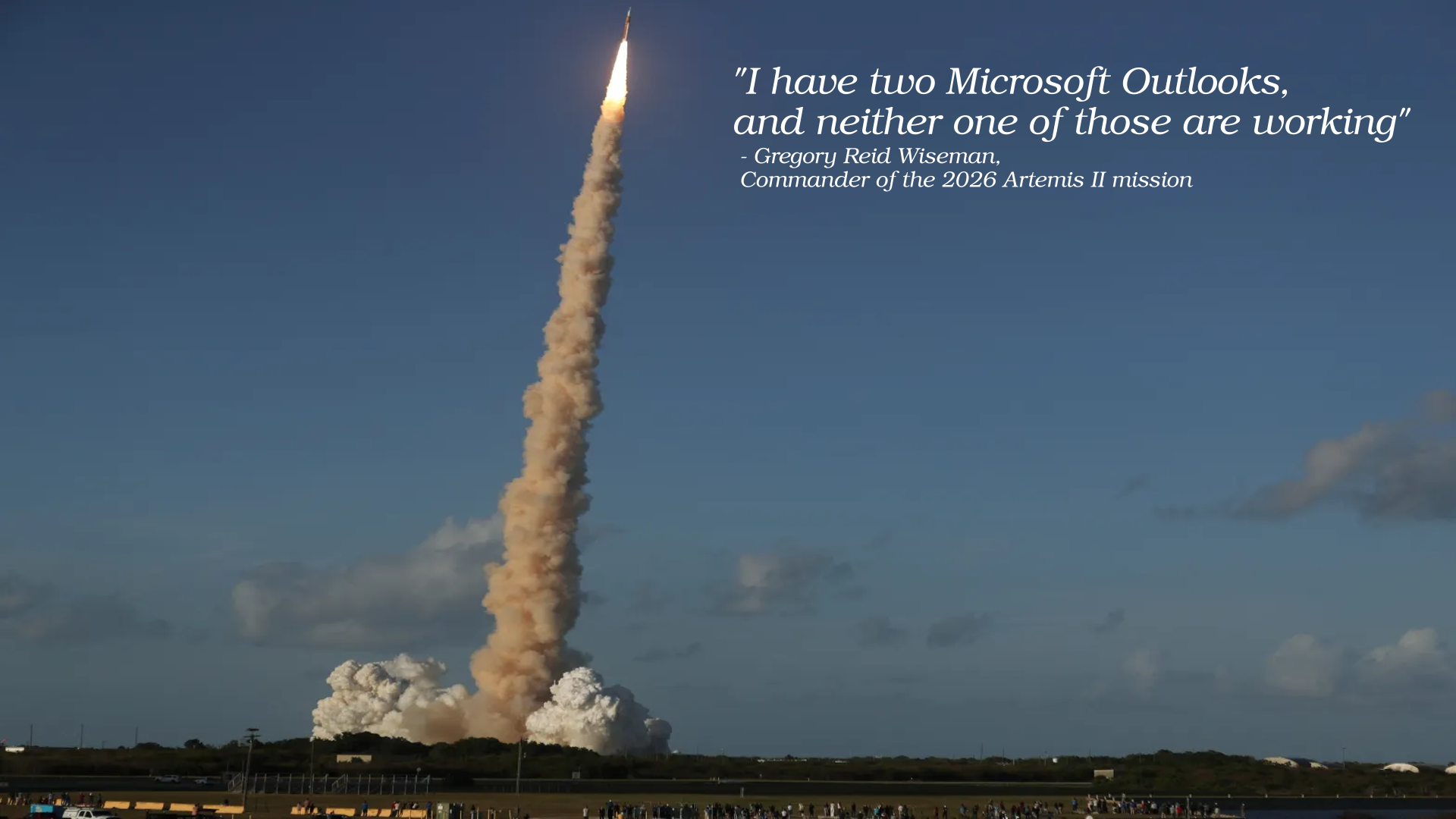
You're literally hurtling through space in a billion-dollar rocket, trusting your life to cutting-edge aerospace engineering, and somehow Microsoft Outlook is still your biggest problem. Both instances broken. Classic. Nothing says "humanity's greatest achievement" quite like fighting with email client software while preparing for lunar orbit. The commander of a moon mission dealing with Outlook issues is the most relatable thing NASA has ever produced. Forget Tang and freeze-dried ice cream—the real space program legacy is enterprise software that refuses to work even in zero gravity. At least when the rocket fails, you know why. When Outlook fails, it's just vibes and prayer. Godspeed, Commander Wiseman. May your inbox sync better than your trajectory calculations.

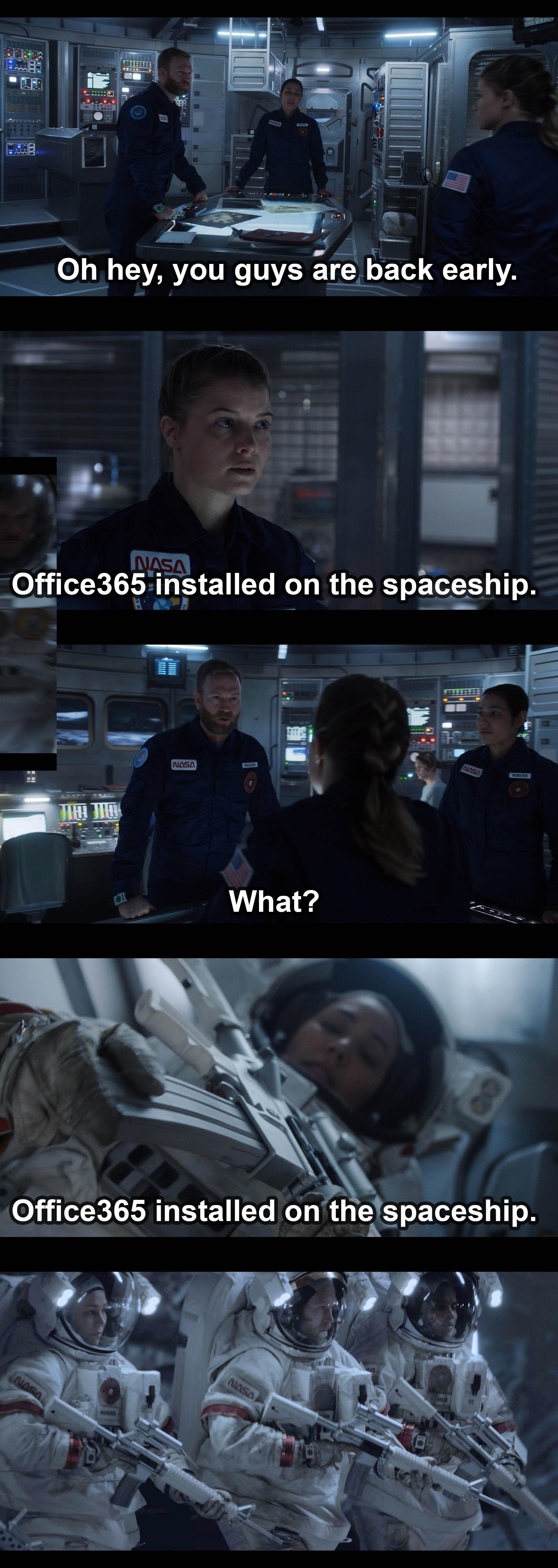
Breaking: NASA Is Using Office 365 Uninstaller Version 5.56 In Response To The Outlook Issues Onboard The Artemis II Spacecraft

Breaking: NASA Is Using Office 365 Uninstaller Version 5.56 In Response To The Outlook Issues Onboard The Artemis II Spacecraft
When you're literally going to the moon but someone in IT decided Office 365 was mission-critical software. The astronauts return early only to discover Microsoft's bloatware has somehow infected their spacecraft. The sheer horror on their faces when they realize they'll be receiving Outlook meeting invites at 250,000 miles from Earth is priceless. Nothing says "advanced space exploration" quite like dealing with Outlook crashes during re-entry. The crew's reaction escalates from confusion to full-on existential dread faster than a forced Windows update. At least they can uninstall it... oh wait, you need admin privileges for that, and IT is back on Earth. Houston, we have a problem, and it's asking us to restart to complete the installation.

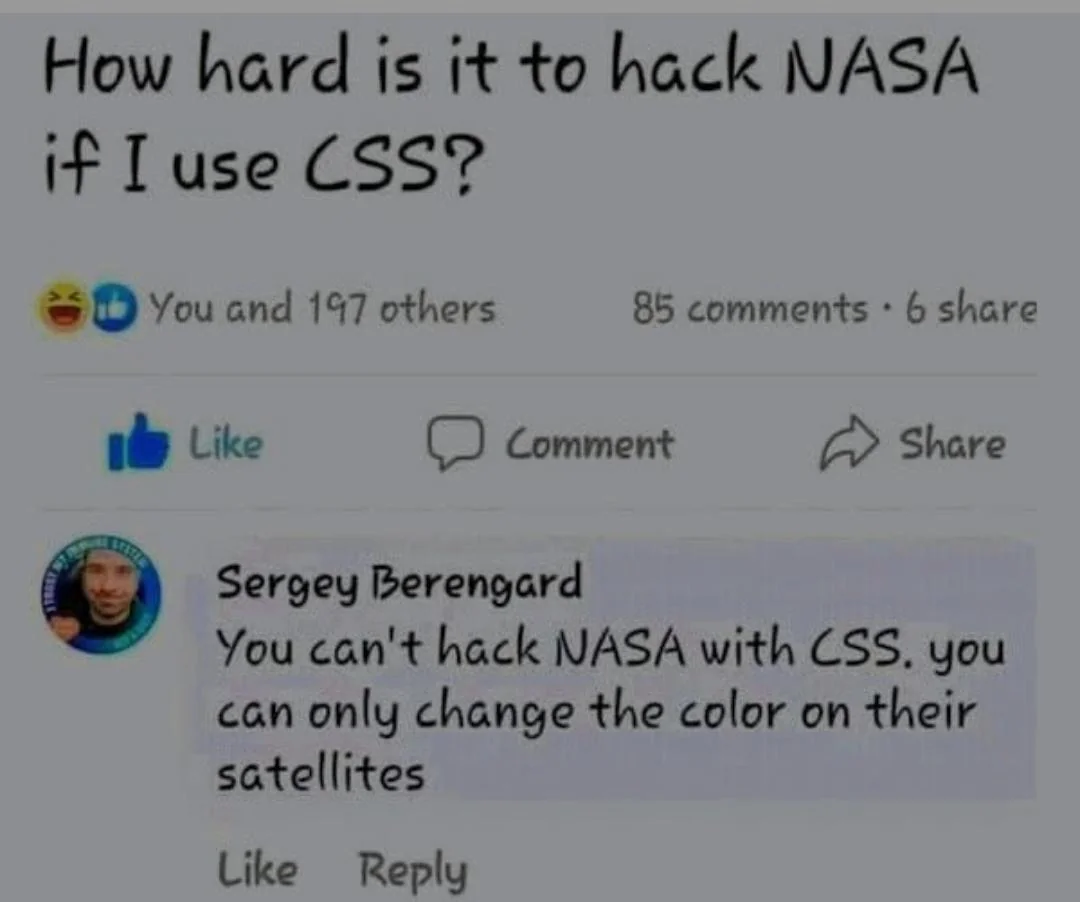
You Can't Hack NASA With CSS

You Can't Hack NASA With CSS
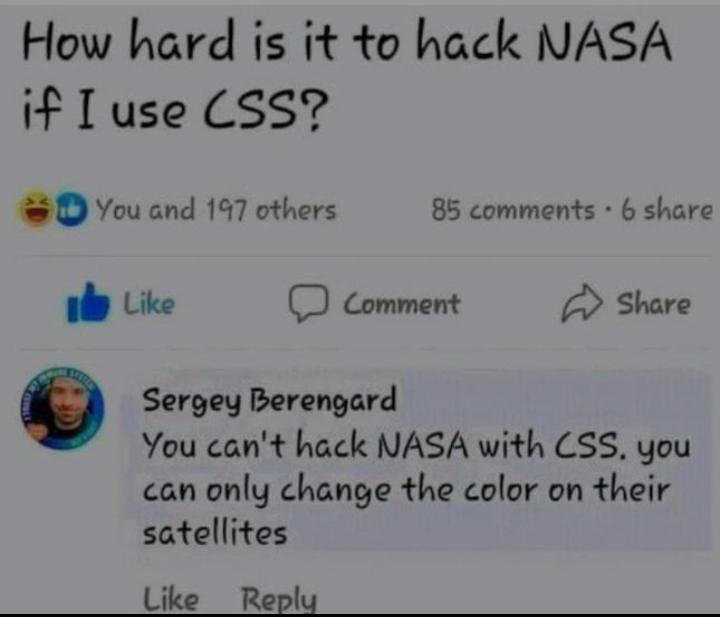
Someone really thought CSS was their gateway to becoming a black hat hacker. You know, because nothing says "elite cyber warfare" like color: #FF0000; and margin-left: 10px; The response is chef's kiss though. "You can only change the color on their satellites" – technically accurate if you manage to inject CSS into their UI, which means you'd already need to have hacked them to... hack them. Circular logic at its finest. Frontend devs catching strays again. Meanwhile, the 197 people who reacted probably include at least 50 junior devs who genuinely weren't sure if this was possible.

Oh Yes!

Oh Yes!
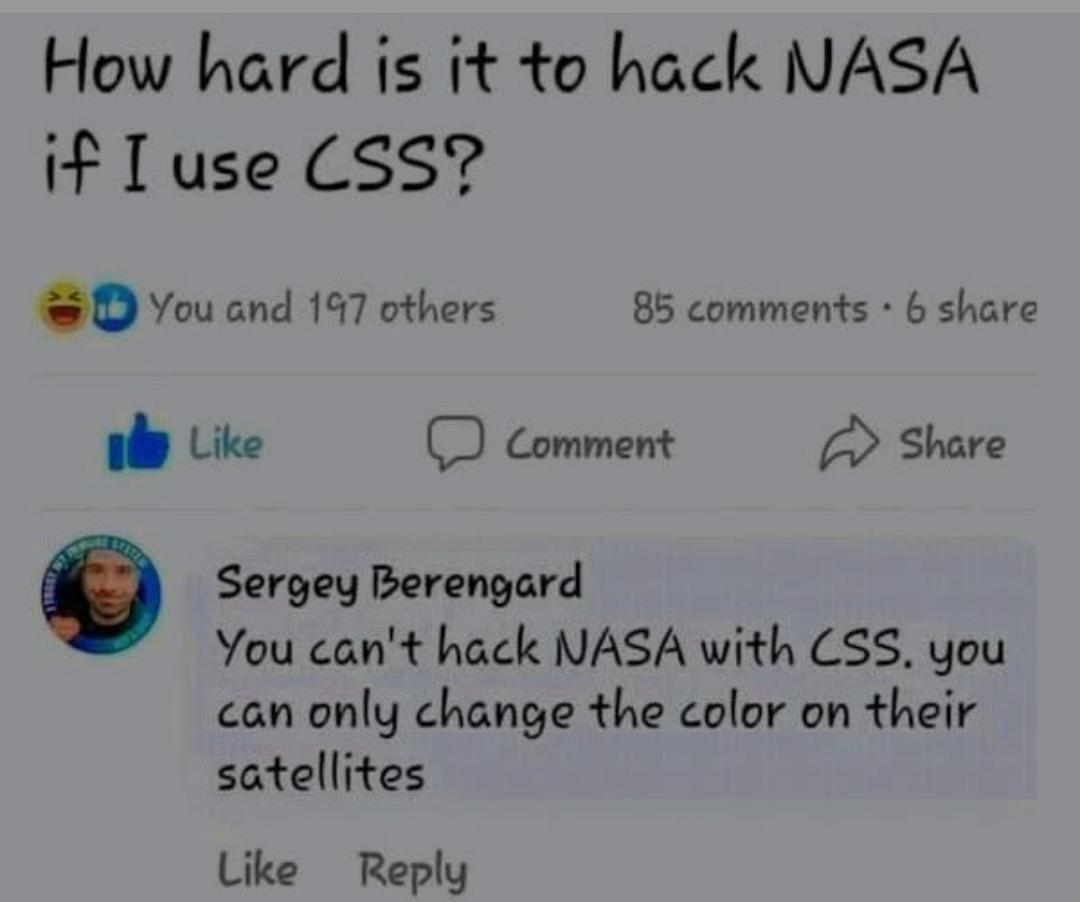
Someone genuinely asked how hard it would be to hack NASA using CSS, and honestly, that's adorable. It's like asking if you can rob a bank with a paintbrush. Sure, you could make their website look *fabulous* with some gradient backgrounds and smooth transitions, but breaking into their systems? Not quite. The response is brutally accurate: the only thing you're hacking with CSS is the color scheme of their satellites. Maybe add some box-shadow to make them pop? Perhaps a nice hover effect when they orbit Earth? The fact that 197 people liked the original question is the real security vulnerability here. CSS is a styling language, folks. It makes things pretty. It's the makeup artist of the web, not the lockpick. But hey, if NASA's satellites suddenly start displaying in Comic Sans, we'll know who to blame.

Bros Gonna Hack Nasa

Bros Gonna Hack Nasa
Someone out here thinking they're about to breach NASA's cybersecurity infrastructure with CSS... you know, the styling language that makes buttons pretty and centers divs (if you're lucky). Sergey Berengard swoops in with the reality check: buddy, CSS isn't going to get you past NASA's firewalls, but hey, you might be able to give their satellites a fresh coat of paint. Maybe throw in some border-radius on those solar panels while you're at it. The confusion between CSS (Cascading Style Sheets) and actual hacking tools is peak beginner energy. It's like showing up to a bank heist with a paintbrush. The comment section roasting this person with 197 reactions says it all—the internet has no mercy for those who think color: #FF0000; is a security exploit.

NASA Scientists Built Different

NASA Scientists Built Different
You think YOUR internet is bad? Gamers have the AUDACITY to complain about 100 ping while NASA scientists are over here casually driving $2.5 billion rovers on MARS with ping times that would make your router spontaneously combust! 💀 We're talking LITERAL MINUTES of lag—not milliseconds—between clicking "go forward" and the rover actually moving. That's not lag, that's practically time travel! Meanwhile, gamers are throwing controllers when their character takes an extra 0.1 seconds to respond. THE DRAMA! NASA engineers just sipping coffee like "that's cute" while piloting machinery across the solar system with what's essentially interplanetary dial-up. PATHETIC MORTAL GAMERS, BOW TO YOUR NETWORKING GODS!

Why Do Astronauts Use Linux?

Why Do Astronauts Use Linux?
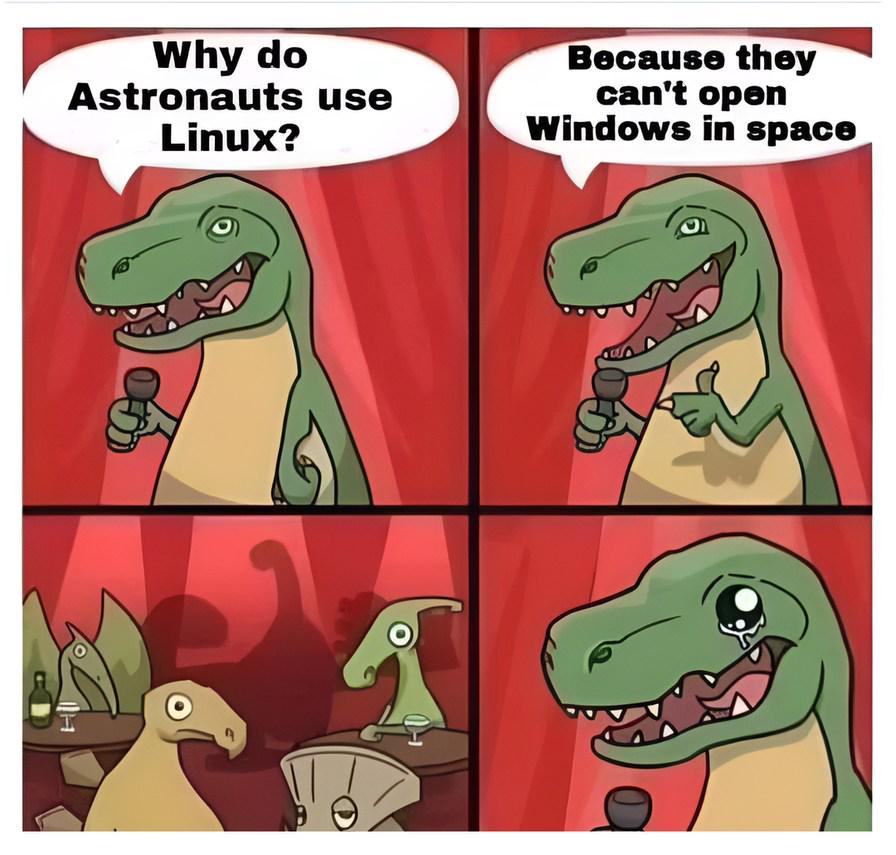
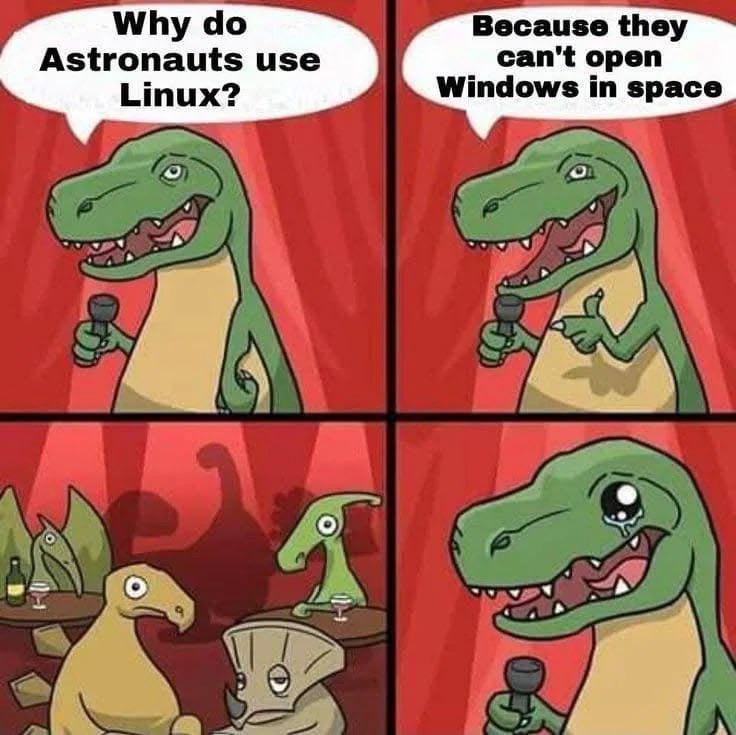
The oldest joke in the OS wars still hits different after all these years. NASA actually does use Linux in space because it's reliable, customizable, and doesn't randomly decide to update when you're trying to not die in the vacuum of space. Meanwhile, the rest of us are just trying to convince management that rebooting the production server during business hours is, in fact, a terrible idea. But hey, at least we're not trying to open Windows in space.

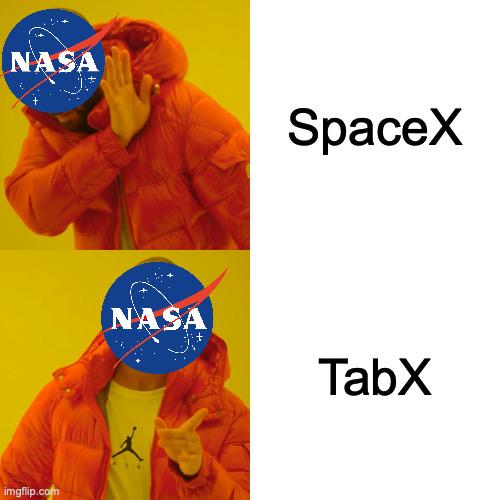
Space Agency Discovers True Rocket Science: Tab Indentation

Space Agency Discovers True Rocket Science: Tab Indentation
When NASA engineers reject SpaceX but embrace TabX, you know they've finally discovered the true rocket science of code indentation. Sure, launching humans to Mars is impressive, but have you ever seen a perfectly aligned codebase? That's the real moonshot. Developers will literally fight interstellar wars over spaces vs. tabs while their code is still riddled with nested if-statements that look like the aftermath of a keyboard explosion.

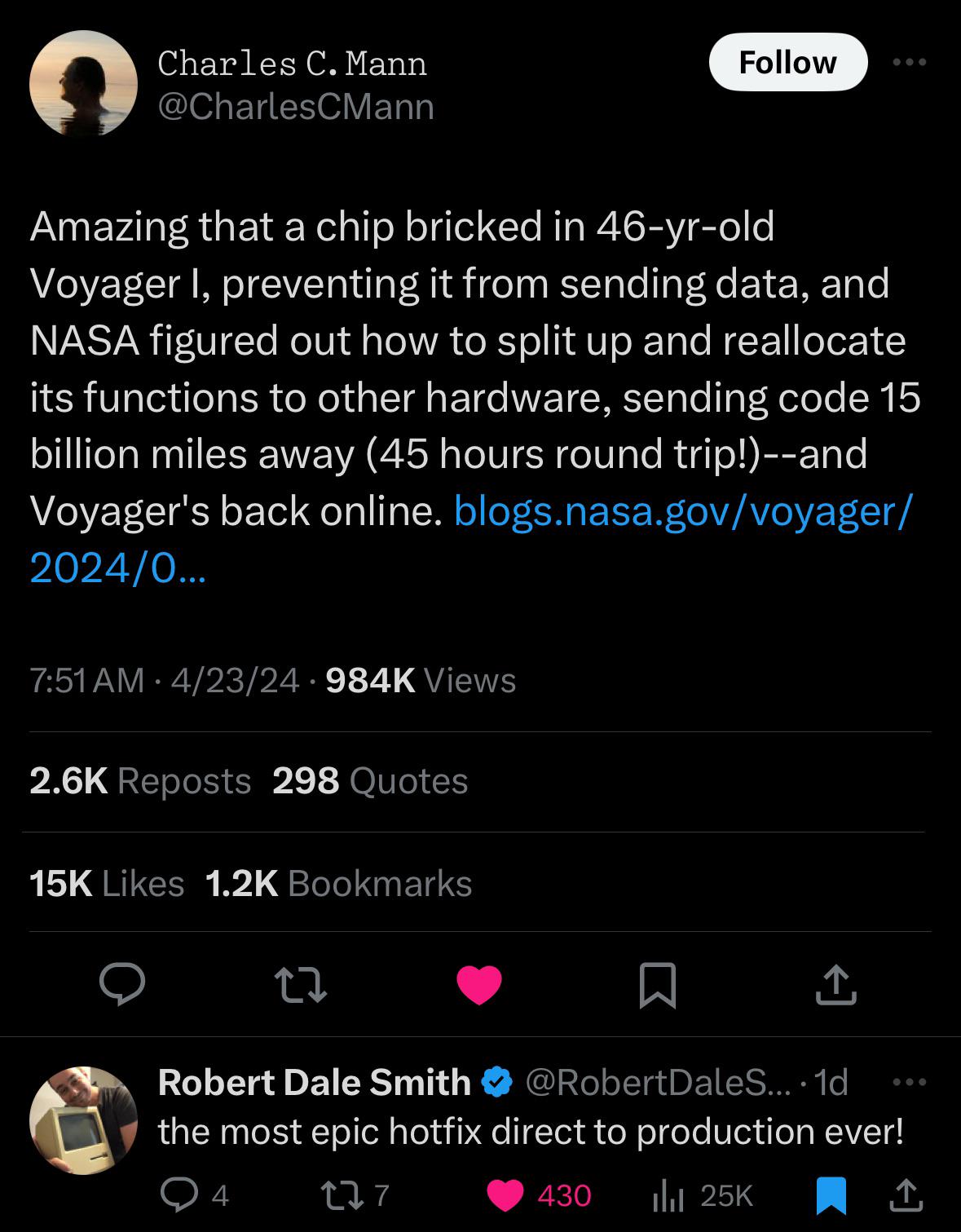
The Most Epic Hotfix In The Universe

The Most Epic Hotfix In The Universe
NASA engineers just performed a remote firmware update on a 46-year-old spacecraft 15 billion miles away with a 45-hour round-trip latency. Meanwhile, I have to restart my IDE three times to get syntax highlighting working properly. The comment about it being "the most epic hotfix direct to production ever" is pure gold—imagine pushing code straight to prod when your rollback plan involves a 45-hour wait to see if it worked. That's not continuous deployment, that's interstellar deployment.

Computers In 1969 Vs Now

Computers In 1969 Vs Now
NASA sent humans to the actual moon using computers with 4KB of RAM—roughly the size of a modern email signature. Meanwhile, your beast of a machine with an RTX card and 16GB of RAM crashes because you dared to open a second Chrome tab while Photoshop was running. The digital equivalent of a Ferrari that stalls when you turn on the radio. Progress?

Modern Computing Priorities

Modern Computing Priorities
In 1973, NASA sent humans to the literal moon with just 4KB of RAM. Fast forward to 2019, and your beastly machine with 16GB RAM and maxed-out CPU is brought to its knees by... an Excel dialog box lurking in the background. Nothing captures modern software bloat quite like this perfect comparison. We've gone from accomplishing humanity's greatest feats with minimal resources to having our supercomputers paralyzed by spreadsheet popups. Progress?