Mathematics Memes

Posts tagged with Mathematics
Ayee Maths Sneaked In

Ayee Maths Sneaked In
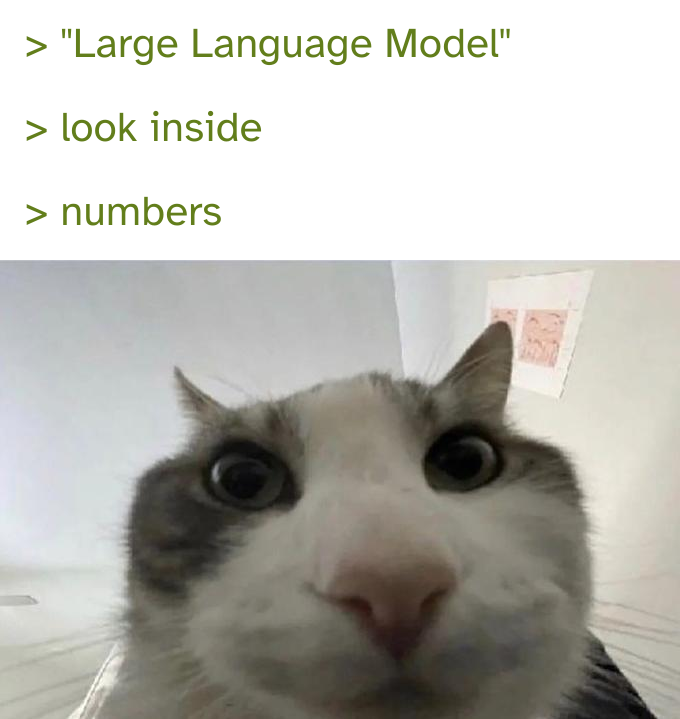
So you thought AI was all about fancy neural networks and transformers? Plot twist: it's just linear algebra wearing a trench coat. Open up any "Large Language Model" and surprise! It's matrices multiplying themselves into oblivion, vectors doing vector things, and calculus derivatives having the time of their lives. The cat's horrified expression perfectly captures that moment when CS majors realize they can't escape math by going into "software." You dodged calculus in college? Cool story, but now you're doing gradient descent for breakfast. The "language" in LLM is just numbers cosplaying as words in high-dimensional space. Everything is numbers. It always was. Your English degree can't save you now.

First Time

First Time
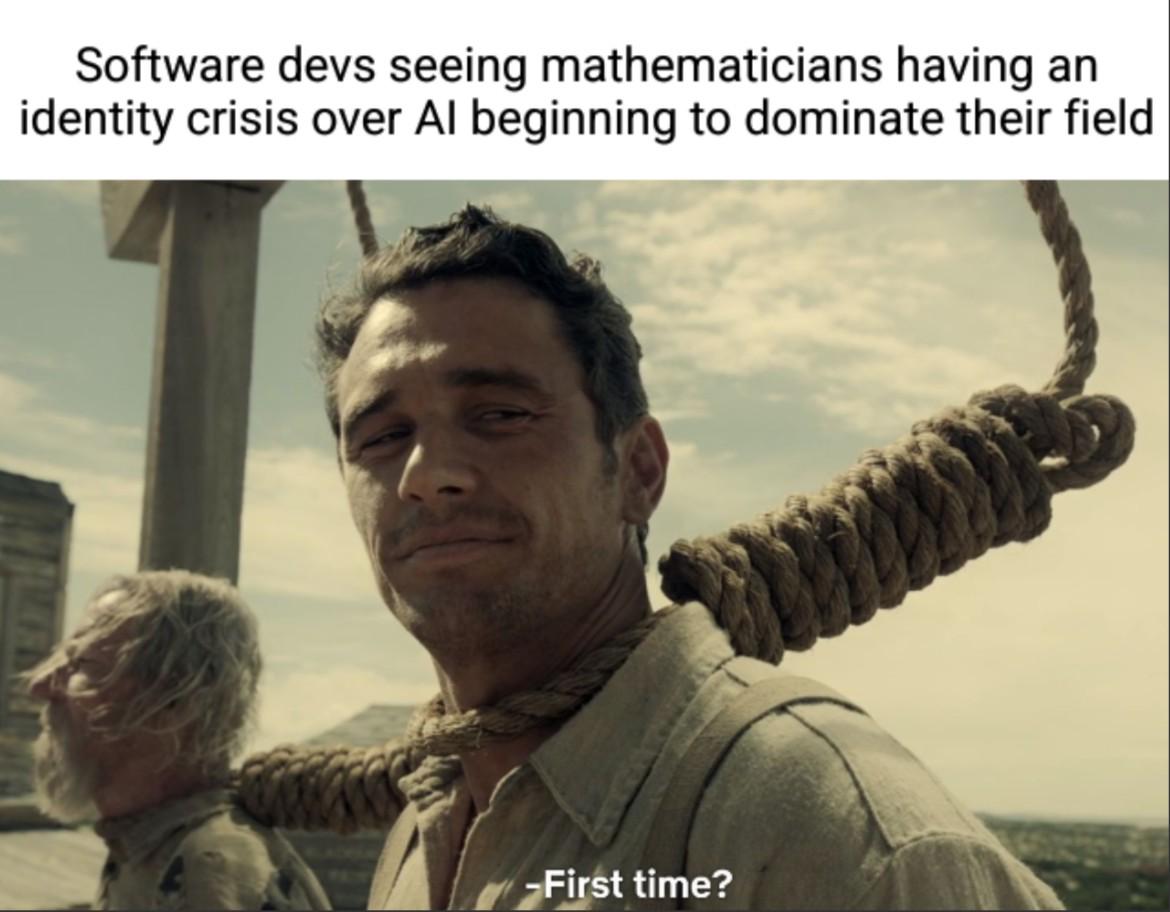
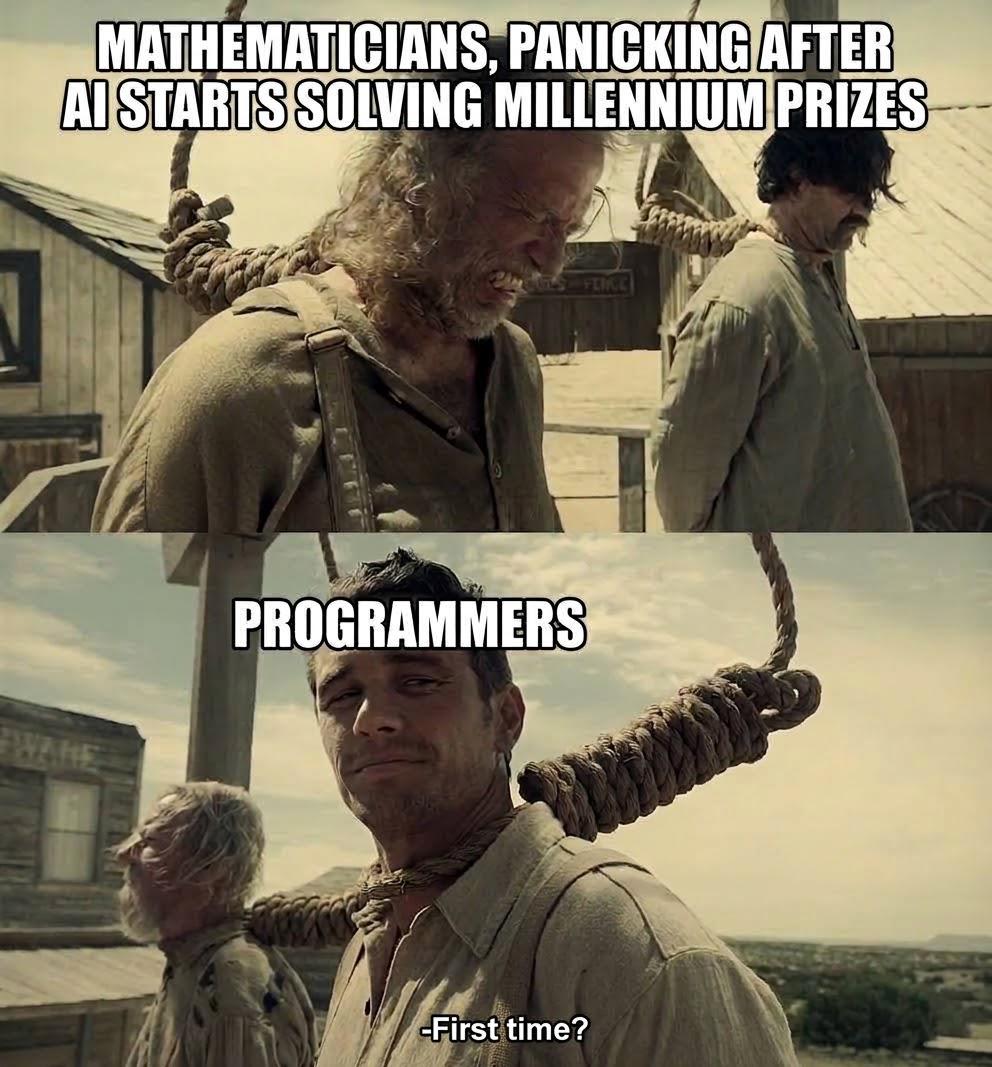
Mathematicians are out here having existential crises because AI might actually crack the Millennium Prize Problems—you know, those seven unsolved math problems worth $1 million each that have been haunting humanity since 2000. Meanwhile, programmers are just casually adjusting their nooses like "yeah, welcome to the club." For context: The Millennium Prize Problems include gems like the Riemann Hypothesis and P vs NP—problems so hard that only one has been solved in 24 years. But programmers? They've been getting replaced by increasingly sophisticated autocomplete since GitHub Copilot dropped. Junior devs have been sweating about AI taking their jobs for years now, so watching mathematicians finally join the unemployment anxiety support group is almost... therapeutic? The gallows humor here is chef's kiss. Programmers have already gone through the five stages of grief about AI and landed somewhere between "acceptance" and "might as well learn prompt engineering." First time facing obsolescence, math nerds? Pull up a chair. We've got plenty of room on the chopping block.

Is Falsetorial

Is Falsetorial
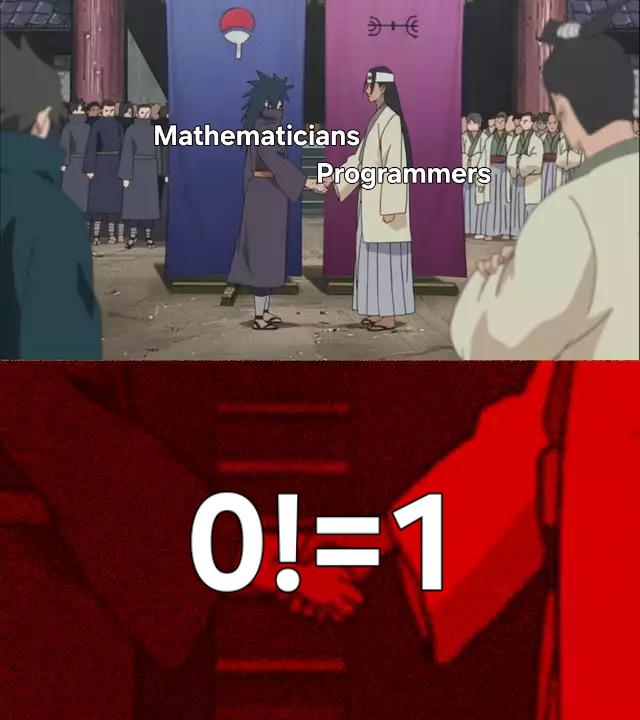
Mathematicians and programmers shaking hands over the beautiful agreement that 0! equals 1. For the uninitiated, factorial of 0 is defined as 1 in mathematics (because of the empty product convention), and programmers just nod along because it makes our recursive functions work without exploding. It's one of those rare moments where math people and code monkeys are on the same page—no Stack Overflow thread needed, no heated debates, just pure harmony. Both sides benefit: mathematicians keep their combinatorics clean, and we avoid writing ugly edge cases in our factorial functions. Win-win.

It Really Is That Easy

It Really Is That Easy
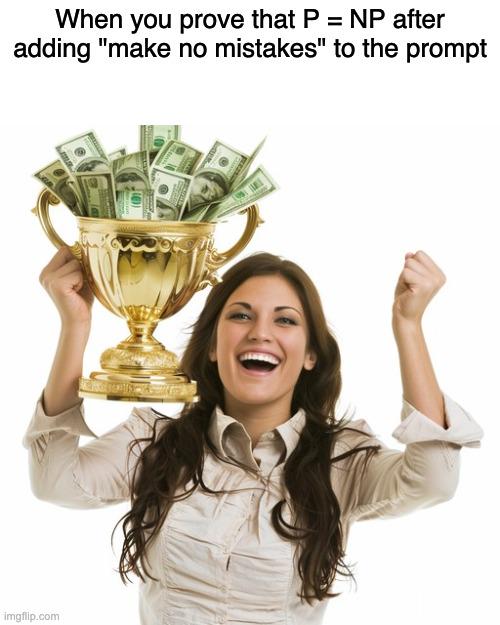
So you just casually solved one of the most famous unsolved problems in computer science—whether P equals NP—by telling your AI to "make no mistakes"? Genius move. Why didn't the thousands of mathematicians and computer scientists think of that over the past 50 years? For context: P = NP is literally a million-dollar Millennium Prize Problem. If P equals NP, it means every problem whose solution can be quickly verified can also be quickly solved. But sure, just add "make no mistakes" to your ChatGPT prompt and collect your trophy filled with cash. The Clay Mathematics Institute will be sending you a check any day now. Peak AI era energy right here—where people think prompt engineering is the same as mathematical proof. Next up: solving the Riemann Hypothesis by asking nicely.

Who Would Win

Who Would Win
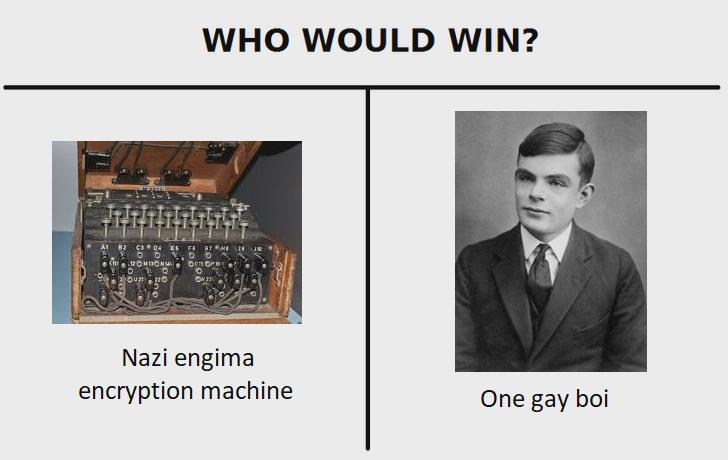
So we've got the Nazi Enigma machine—this legendary piece of encryption hardware that was supposed to be unbreakable—versus Alan Turing, who basically invented computer science while casually breaking said "unbreakable" code and helping end World War II. Spoiler alert: the gay boi won. Turns out all those rotors and plugboards were no match for pure mathematical genius and a bunch of British nerds with slide rules. The Enigma machine was so confident in its complexity that it forgot to account for someone actually being smart enough to crack it. Turing didn't just win—he revolutionized computing in the process. The machine never stood a chance.

Based Haskell Bluesky Account

Based Haskell Bluesky Account
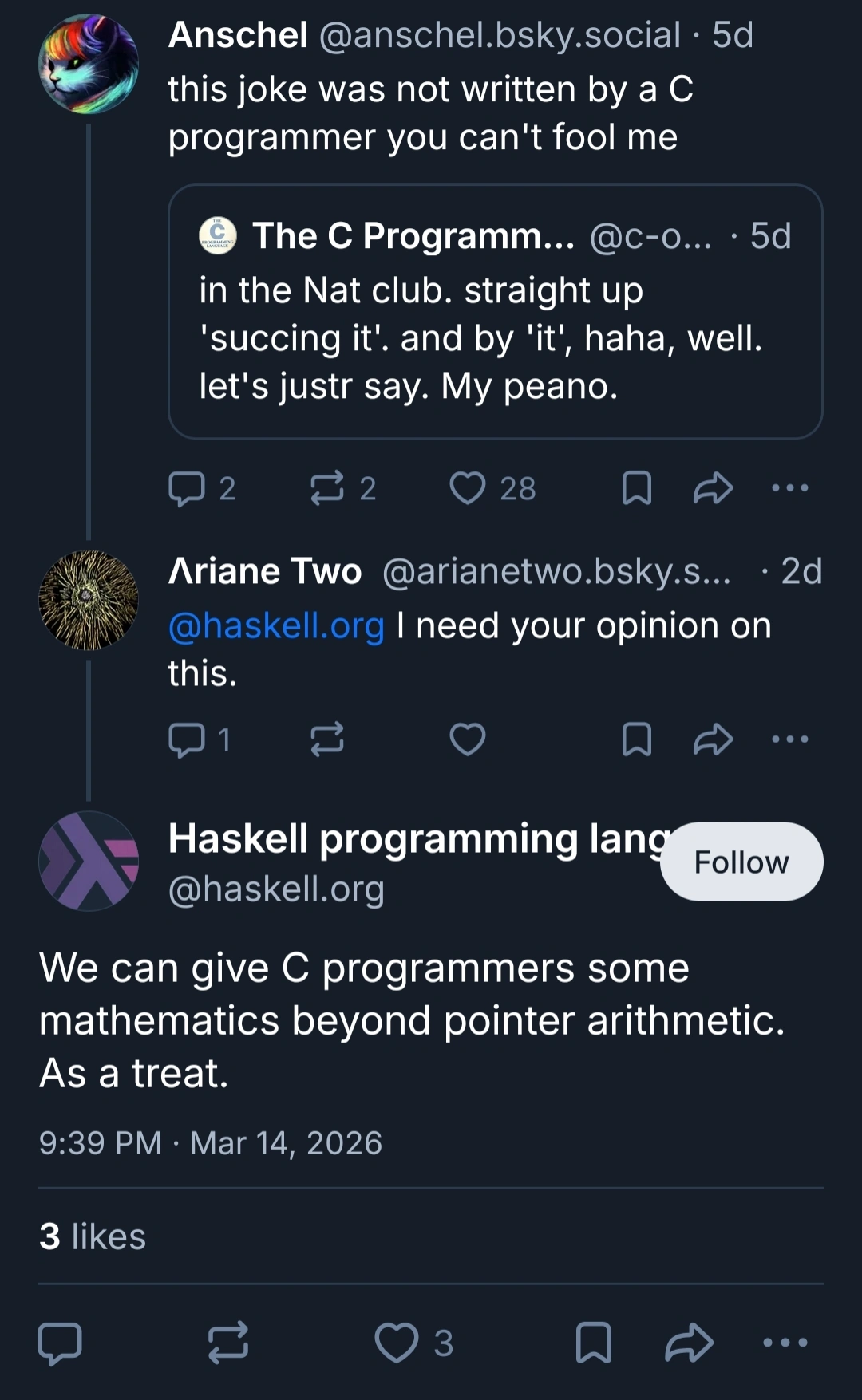
The official Haskell account just casually dropped the most DEVASTATING roast in programming history. A C programmer makes a joke about being "in the Nat club, straight up succinc it" (because C programmers are known for their... *compact* code, shall we say), and someone immediately calls them out saying "this joke was not written by a C programmer." Then someone tags Haskell for their expert opinion, and Haskell's response? PURE VIOLENCE. "We can give C programmers some mathematics beyond pointer arithmetic. As a treat." The shade is ASTRONOMICAL. Haskell basically said "aww, look at you C programmers playing with your little pointers like they're actual math. How cute. Want us to show you what REAL mathematics looks like?" It's giving condescending parent energy, and I'm here for it. The functional programming elitists have spoken, and they chose CHAOS.

Keychron Q3 Max Wireless 2.4 GHz Bluetooth Custom Mechanical Keyboard

Keychron Q3 Max Wireless 2.4 GHz Bluetooth Custom Mechanical Keyboard
Upgraded Wireless Full Metal Keyboard: The Q3 Max combines advanced 2.4 GHz wireless, Bluetooth, and Type-C wired connectivity, and enhances workspace efficiency with a classic 80% TKL layout. Featur…

No Knowledge In Math == No Machine Learning 🥲

No Knowledge In Math == No Machine Learning 🥲
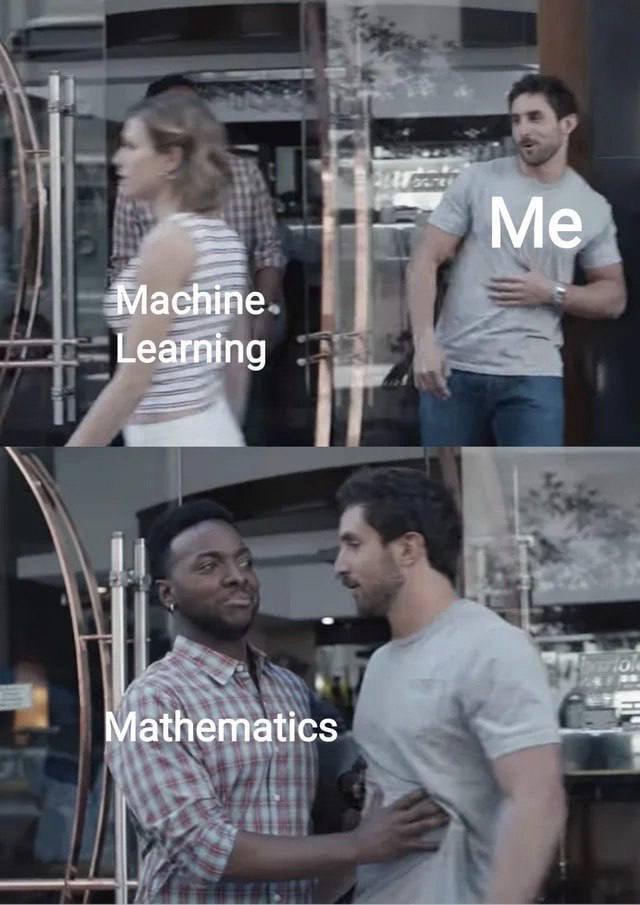
So you thought you could just pip install tensorflow and become an ML engineer? Plot twist: Machine Learning ghosted you the moment you walked in because Mathematics was already waiting at the door with linear algebra, calculus, and probability theory ready to have a serious conversation. Turns out you can't just import your way out of understanding gradient descent, eigenvalues, and backpropagation. Mathematics is the possessive partner that ML will never leave, no matter how many Keras tutorials you watch. Sorry buddy, but those neural networks aren't going to optimize themselves without some good old-fashioned derivatives and matrix multiplication. The harsh reality: every ML paper reads like a math textbook had a baby with a programming manual, and if you skipped calculus in college thinking "I'll never need this," well... the universe is laughing at you right now.

Programmer Vs Mathematician

Programmer Vs Mathematician
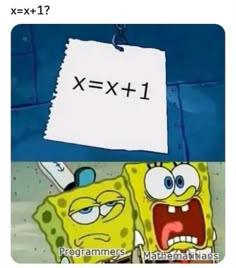
Behold the eternal battlefield where programmers and mathematicians lock horns over the most innocent-looking equation: x = x + 1 . Mathematicians see this and their souls literally leave their bodies. "THAT'S IMPOSSIBLE!" they shriek, clutching their proofs and theorems. "If you subtract x from both sides, you get 0 = 1, which means THE UNIVERSE IS COLLAPSING!" Meanwhile, programmers just shrug and go "yeah bro, that's called incrementing a variable, we do it like 47 times before breakfast." In math land, this is a contradiction that would make Euclid weep. In programming land, this is literally Tuesday. It's not an equation—it's an assignment . We're taking the old value of x, adding 1 to it, and storing it back in x. Revolutionary stuff. 🙄 SpongeBob (the programmer) is tired but accepting of this reality, while Patrick (the mathematician) is having a full-blown existential crisis about the laws of algebra being violated right in front of his eyes.

$I, J, K$ In Math Vs. Programming

$I, J, K$ In Math Vs. Programming
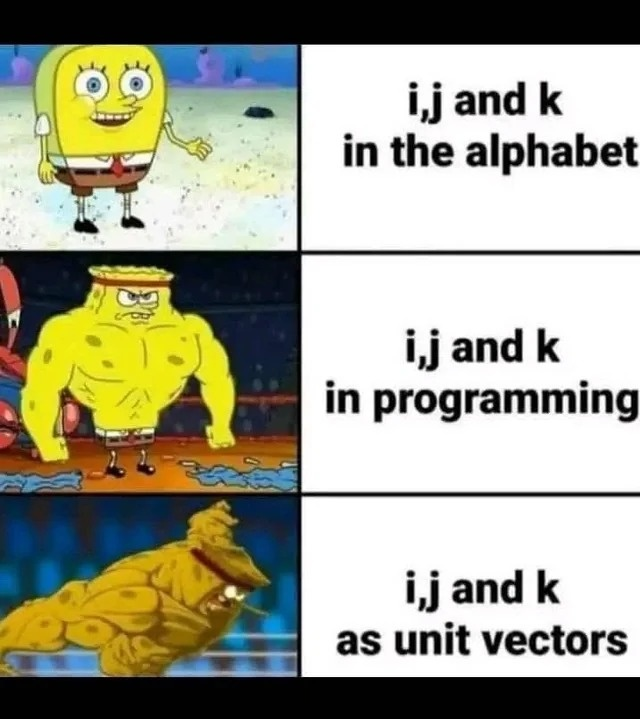
So i, j, and k start out as innocent alphabet letters, minding their own business. Then they hit programming and suddenly become the holy trinity of nested loop variables—battle-hardened from iterating through arrays, matrices, and every conceivable data structure known to humanity. But wait, there's more! When they ascend to their final form as unit vectors in 3D space (î, ĵ, k̂), they achieve ultimate enlightenment, representing the fundamental basis of vector mathematics. The progression from wimpy SpongeBob to buff SpongeBob to godlike SpongeBob captures the increasing complexity and power these three letters wield. In programming, they're your go-to variables for nested loops—you know, when you're doing O(n³) operations and your code reviewer gives you that look. But as unit vectors? They literally define the coordinate system of 3D space. That's like going from counting apples to bending reality itself. Fun fact: Using i, j, k for loops is so ingrained in programming culture that seeing something like "for (int x = 0...)" feels wrong on a spiritual level. It's like putting pineapple on pizza—technically possible, but why would you do that to yourself?

Don't Be Afraid... Math And Computing Are Allies

Don't Be Afraid... Math And Computing Are Allies
Look, that intimidating Sigma and Pi notation you avoided in college? Yeah, they're just fancy for-loops with better PR. Summation is literally sum += 3*n and Product is prod *= 2*n . That's it. Mathematicians really said "let's make simple iteration look like ancient Greek spellcasting" and then wondered why people have math anxiety. Meanwhile, your average dev writes these same operations daily without breaking a sweat. The real plot twist? Once you realize math notation is just verbose pseudocode written by people who peaked before computers existed, algorithms suddenly become way less scary. Your CS degree just demystified centuries of mathematical gatekeeping in one tweet.

I Am Your Father - Floppy Disk Computer Engineer Programmer T-Shirt

I Am Your Father - Floppy Disk Computer Engineer Programmer T-Shirt
Are you a coder or programmer who spends endless hours debugging? This funny design is perfect for software engineers, developers, IT professionals, and computer science students who love coding chal…

Programming Logic Vs. Algebraic Reality

Programming Logic Vs. Algebraic Reality
Programmers casually write x = x + 1 and sleep like babies. Mathematicians see it and immediately reach for their weapons because in their world, that equation implies 0 = 1 , which would unravel the entire universe. But flip it to x + 1 = x and suddenly both groups are losing their minds. Programmers realize they've created an infinite loop of lies, and mathematicians are still screaming because it's still algebraically cursed. In programming, the equals sign is assignment. In math, it's a sacred bond of equality. Two professions, one symbol, endless existential dread.

I've Seen Things

I've Seen Things
A mathematician stands at a crossroads, facing two programming paths. To the left, Python's sunny castle beckons with its friendly syntax and gentle learning curve. To the right, Haskell's dark fortress looms with lightning, pure functions, and monads that will make your brain melt. The mathematician just stands there, calculating which language will cause the optimal amount of suffering per line of code. Spoiler: they'll choose Haskell because apparently mathematicians enjoy pain.