

Math Memes

Posts tagged with Math
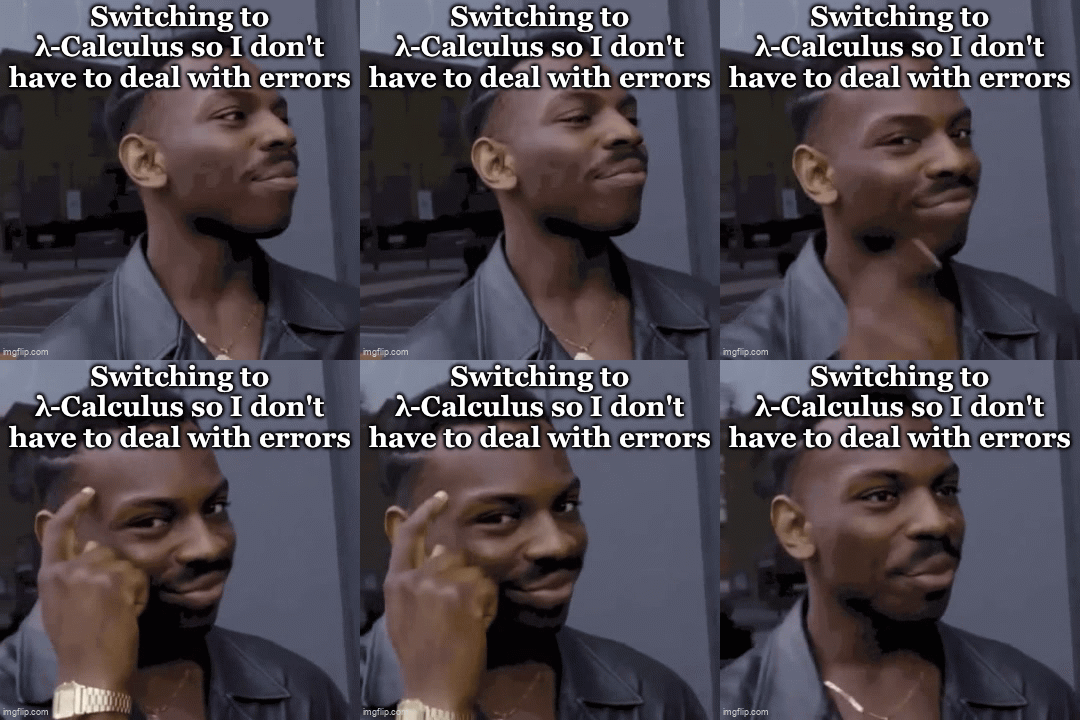
Switching To Lambda-Calculus So I Don't Have To Deal With Errors

Switching To Lambda-Calculus So I Don't Have To Deal With Errors
Imagine thinking you can escape runtime errors by diving into pure lambda calculus. Sure, nothing can throw a NullPointerException if everything is just functions composing other functions into oblivion. No variables to mutate, no state to corrupt, no exceptions to catch—just you, some parentheses, and the crushing realization that you've traded debugging for deciphering what (λx.λy.x) actually does at 3 AM. Lambda calculus is basically the mathematical foundation of functional programming—pure, elegant, and completely impractical for building anything your boss wants by Friday. You can't have errors if your entire program is just function application, right? Wrong. Now your errors are just "non-terminating reductions" and "type mismatches in your Church encodings." Congratulations, you've achieved enlightenment and unemployment simultaneously.

Okay Buddy Agentic Workflows

Okay Buddy Agentic Workflows
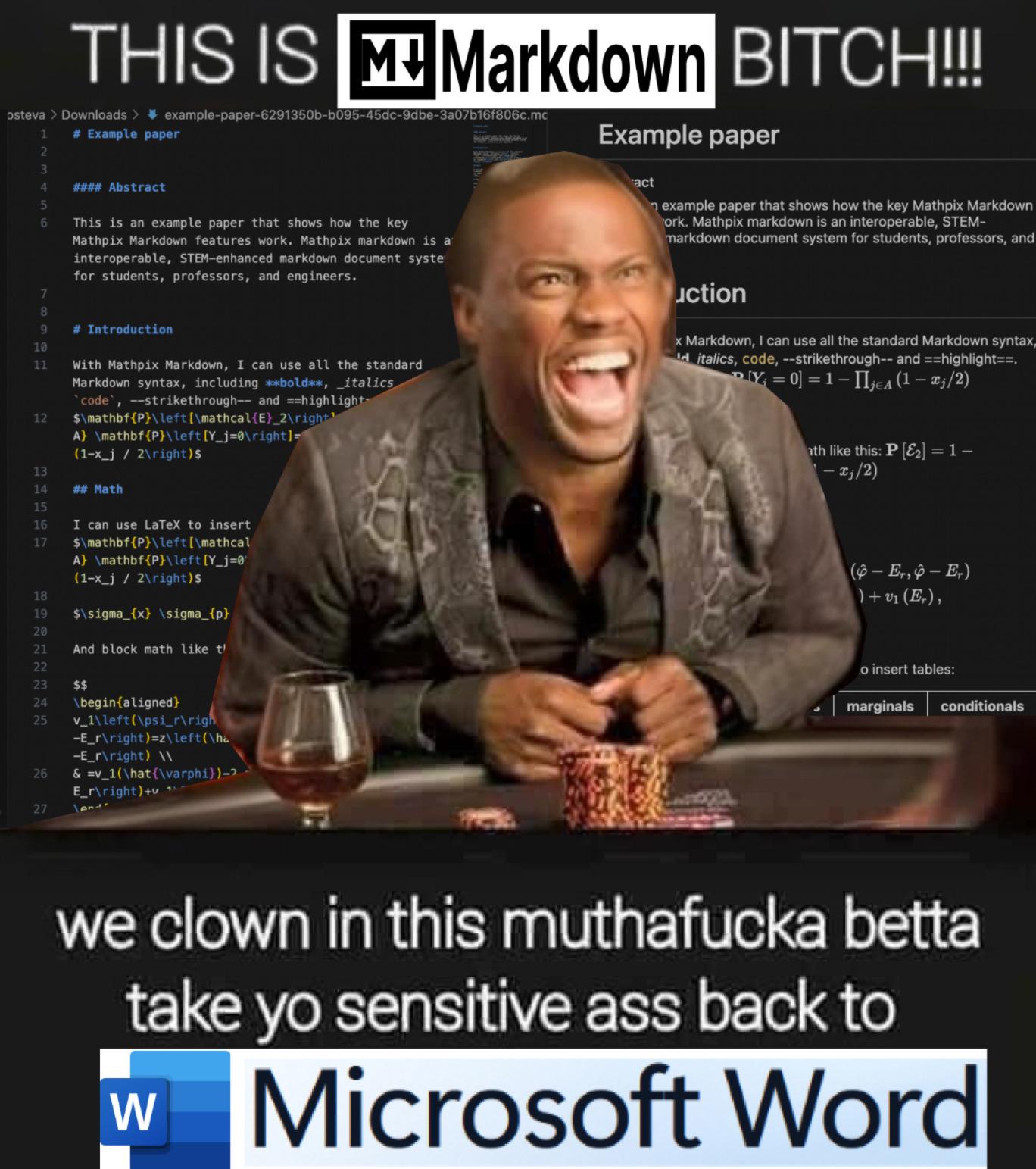
Someone really woke up and decided to reinvent Markdown with "Mathpix Markdown" - an "interoperable, STEM-enhanced markdown document system" - because apparently regular Markdown wasn't complicated enough. The meme perfectly roasts this overcomplicated solution by showing someone getting way too hyped about LaTeX math rendering and syntax highlighting, only to tell them to go back to Microsoft Word. It's the tech equivalent of building a rocket ship to cross the street. Sure, your markdown can render complex mathematical equations and has fancy syntax highlighting, but at the end of the day, most people just need to write some damn text. The "agentic workflows" in the title is chef's kiss - mocking the AI hype cycle where everything needs to sound revolutionary when really we're just adding features nobody asked for. Sometimes Word is fine, and that's the hardest pill for developers to swallow.

Regex Moment

Regex Moment
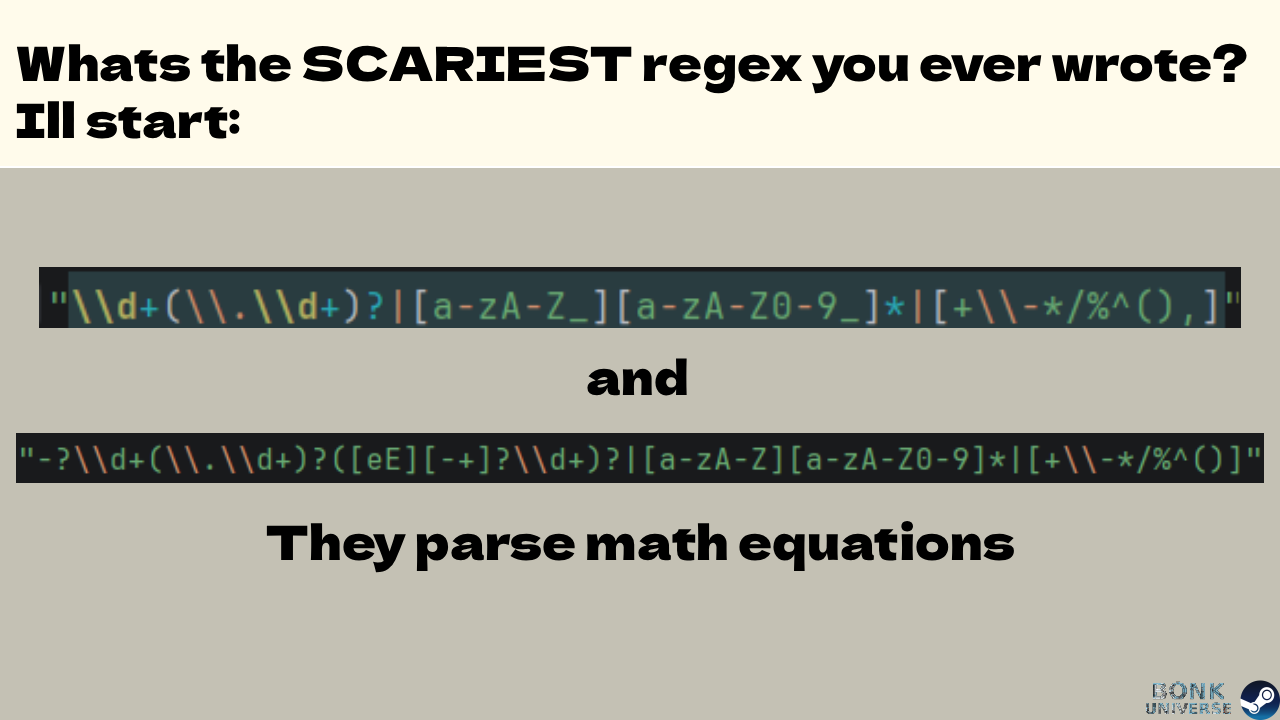
You know you've reached peak developer insanity when your regex patterns look like someone smashed their keyboard while having a seizure, yet somehow they successfully parse mathematical equations. These two absolute monstrosities are the kind of patterns you write at 2 AM, test once, confirm they work, and then never touch again because even you don't understand what you created. The best part? They probably started as something simple like ^\d+$ and evolved into eldritch horrors through "just one more edge case" syndrome. Future you will open this file, see these patterns, and immediately close it while questioning your life choices. But hey, they parse math equations, so who's the real genius here?

Seems Trivial

Seems Trivial
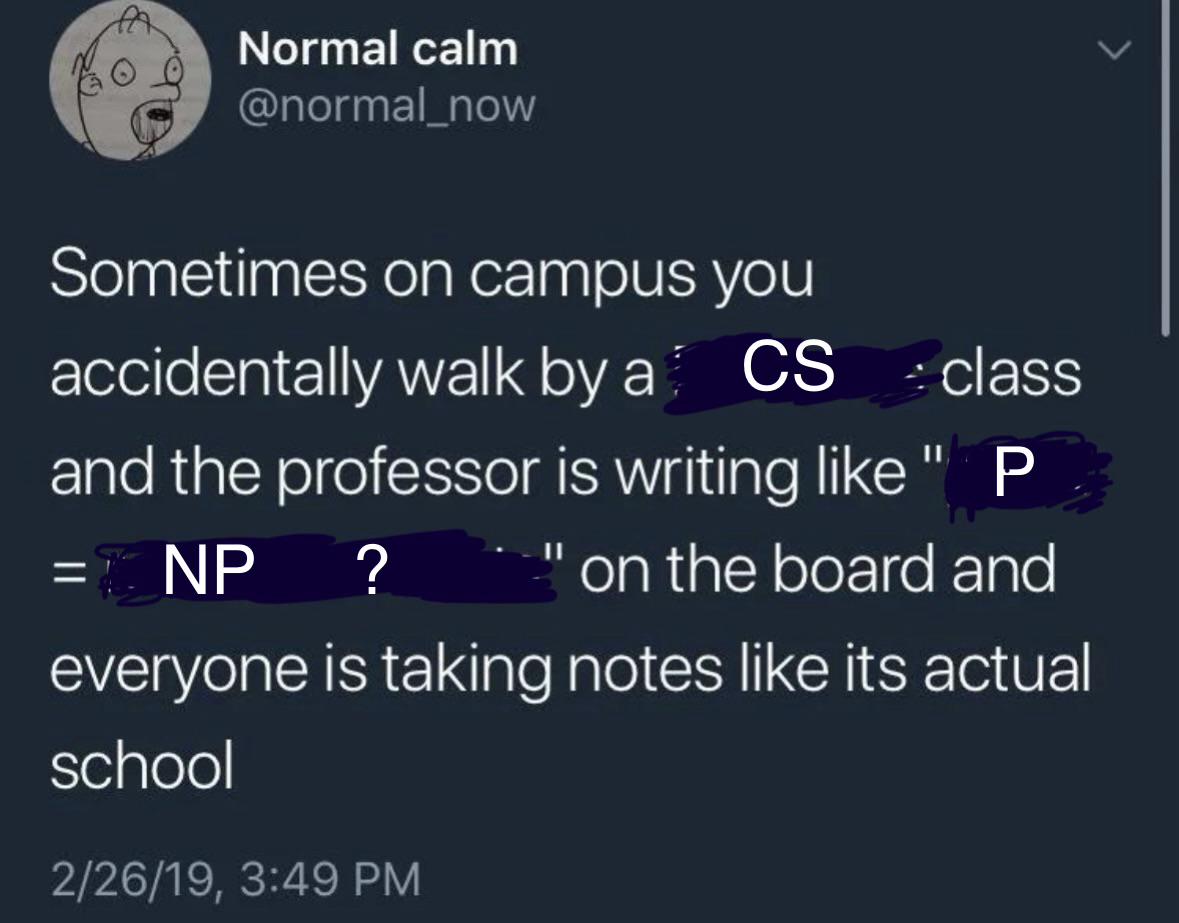
You're just walking past a CS classroom when you catch a glimpse of the professor casually scribbling "P = NP ?" on the board. The entire class is frantically taking notes like it's some routine homework problem. Meanwhile, you're standing there knowing this is literally one of the seven Millennium Prize Problems with a $1 million bounty from the Clay Mathematics Institute. For context: P vs NP is one of the most important unsolved problems in computer science and mathematics. If P = NP, it would mean every problem whose solution can be quickly verified can also be quickly solved—which would revolutionize cryptography, optimization, and basically break the internet as we know it. Mathematicians have been wrestling with this for decades. So either this professor just solved the most significant problem in computational complexity theory during office hours, or those students are about to be very confused when they realize their "trivial proof" has a slight flaw.

There's Always Math

There's Always Math
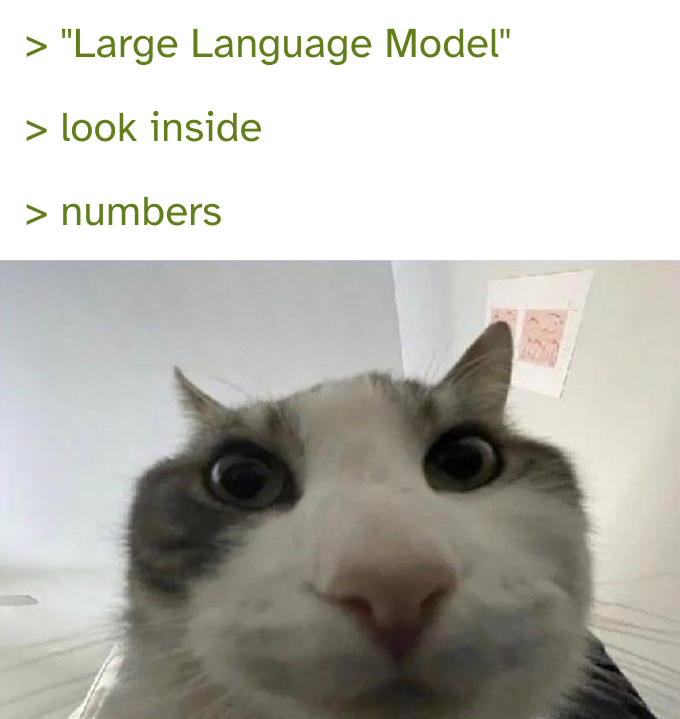
You thought you escaped calculus by becoming a programmer. You thought "Large Language Models" were just fancy autocomplete with better PR. Then you peek under the hood and find matrices, tensors, linear algebra, gradient descent, and enough differential equations to make your college nightmares come back. The cat's face says it all—that moment when you realize AI is just spicy matrix multiplication and you can't escape the numbers. They're everywhere. They always were.

A Million Open AI Monkeys Produce Millennium Prize Solution

A Million Open AI Monkeys Produce Millennium Prize Solution
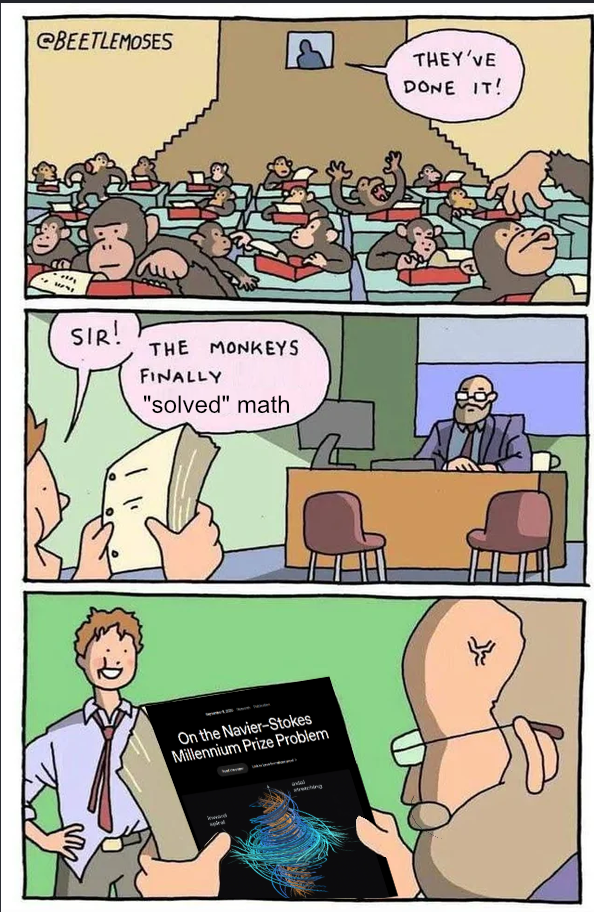
The infinite monkey theorem meets Silicon Valley's favorite toy. Someone finally gave a room full of monkeys laptops instead of typewriters, and naturally they "solved" one of the seven Millennium Prize Problems worth $1 million. The Navier-Stokes equations have stumped mathematicians for centuries, but sure, ChatGPT's hallucination engine probably cracked it between generating fake legal citations and confidently explaining why 9.11 is larger than 9.9. The quotes around "solved" are doing more heavy lifting than a load balancer on Black Friday. When AI generates a proof, it's less "elegant mathematical breakthrough" and more "statistically plausible word salad that sounds smart." But hey, at least the monkeys are productive now. Shakespeare can wait.

Micro ATX Case PC Case: MATX Case Mini PC ITX Desktop Computer Case Support Micro ATX MATX DTX ITX Mini PC with USB3.0, Support 3.5'' HDD (Black)

Micro ATX Case PC Case: MATX Case Mini PC ITX Desktop Computer Case Support Micro ATX MATX DTX ITX Mini PC with USB3.0, Support 3.5'' HDD (Black)
Micro ATX Case: The case fits for Micro ATX Mohterboard (Max 25.5x25.5cm) and ITX Motheroard (17x17cm) · Compatibility Accessories: Supports standard ATX Power Supply (150*140*86mm), Supports Graphic…

Maths Is The Enemy

Maths Is The Enemy
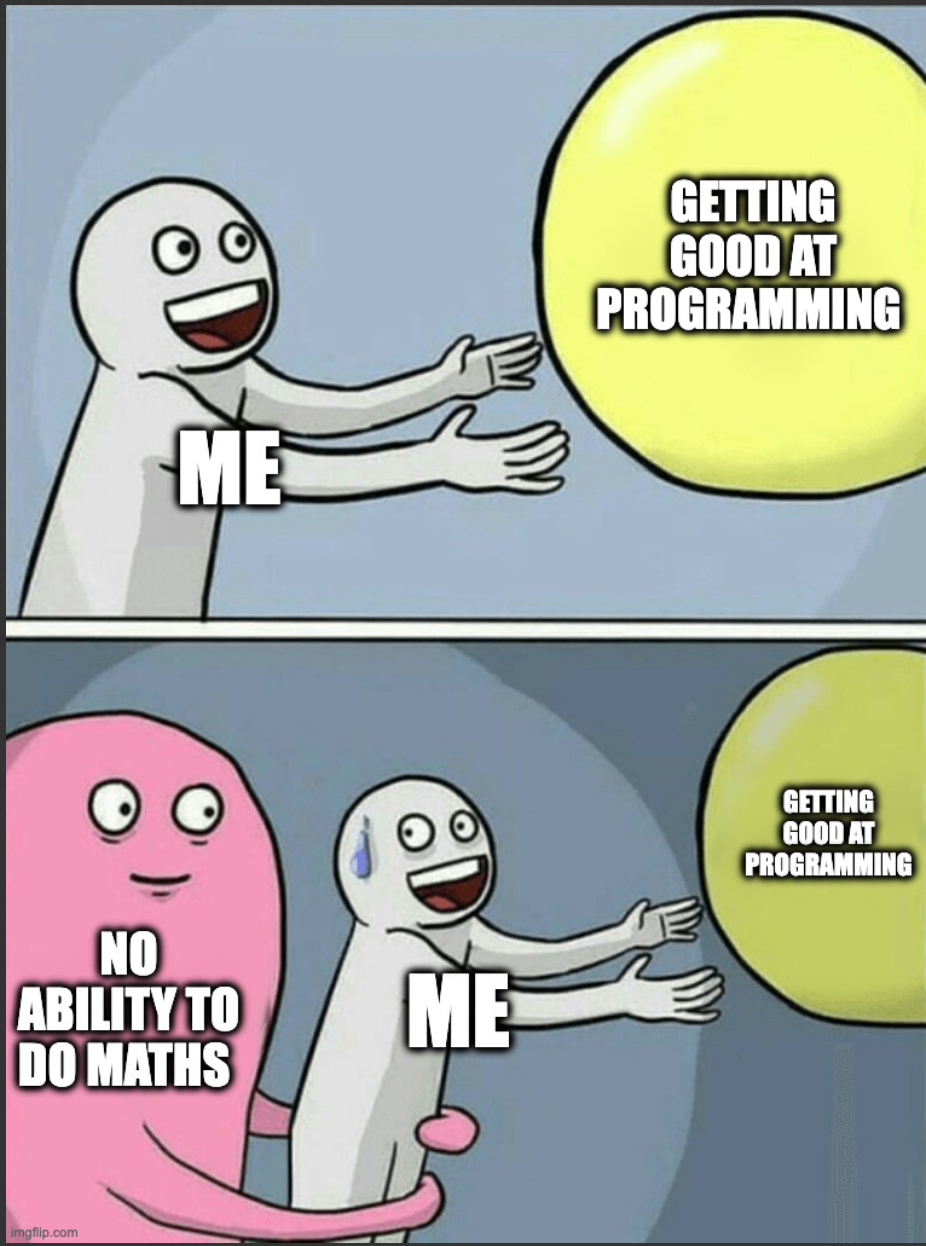
You can write a perfect REST API, architect microservices, and debug race conditions in your sleep. But the moment someone asks you to implement a rotation matrix or calculate Big O notation without Googling, suddenly you're back in high school pretending to understand logarithms. The beautiful irony is that computers literally run on mathematics, yet here we are, copying linear algebra formulas from StackOverflow like we're smuggling state secrets. Most of us got into programming because we could Google things, not because we enjoyed derivatives. Fun fact: Your brain can hold the entire AWS service catalog but somehow division by zero still causes an existential crisis.

Fun With Floating Point IO

Fun With Floating Point IO
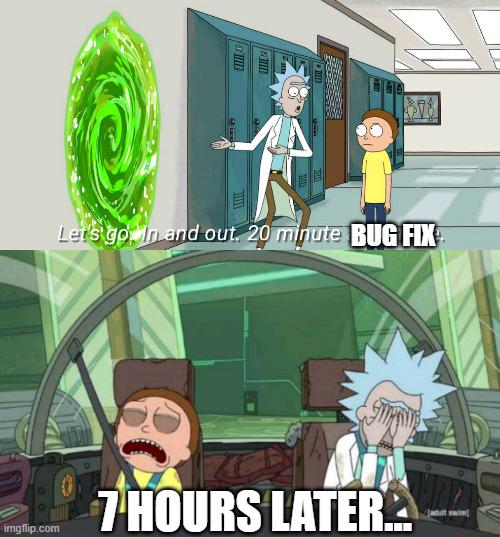
You think you'll just quickly test some floating point I/O operations. Should take 20 minutes tops, right? Wrong. Seven hours later you're still debugging why 0.1 + 0.2 doesn't equal 0.3, why your decimal precision is doing interpretive dance, and questioning every life choice that led you to this moment. Floating point arithmetic is one of those "simple" things that will absolutely destroy your soul. Binary representation can't accurately store most decimal fractions, so you end up with rounding errors that compound faster than technical debt at a startup. What starts as a quick bug fix becomes an existential crisis about IEEE 754 standards. Pro tip: Use decimal types for money, embrace epsilon comparisons, and never, EVER assume floating point equality will work the way math class taught you.

Runk

Runk
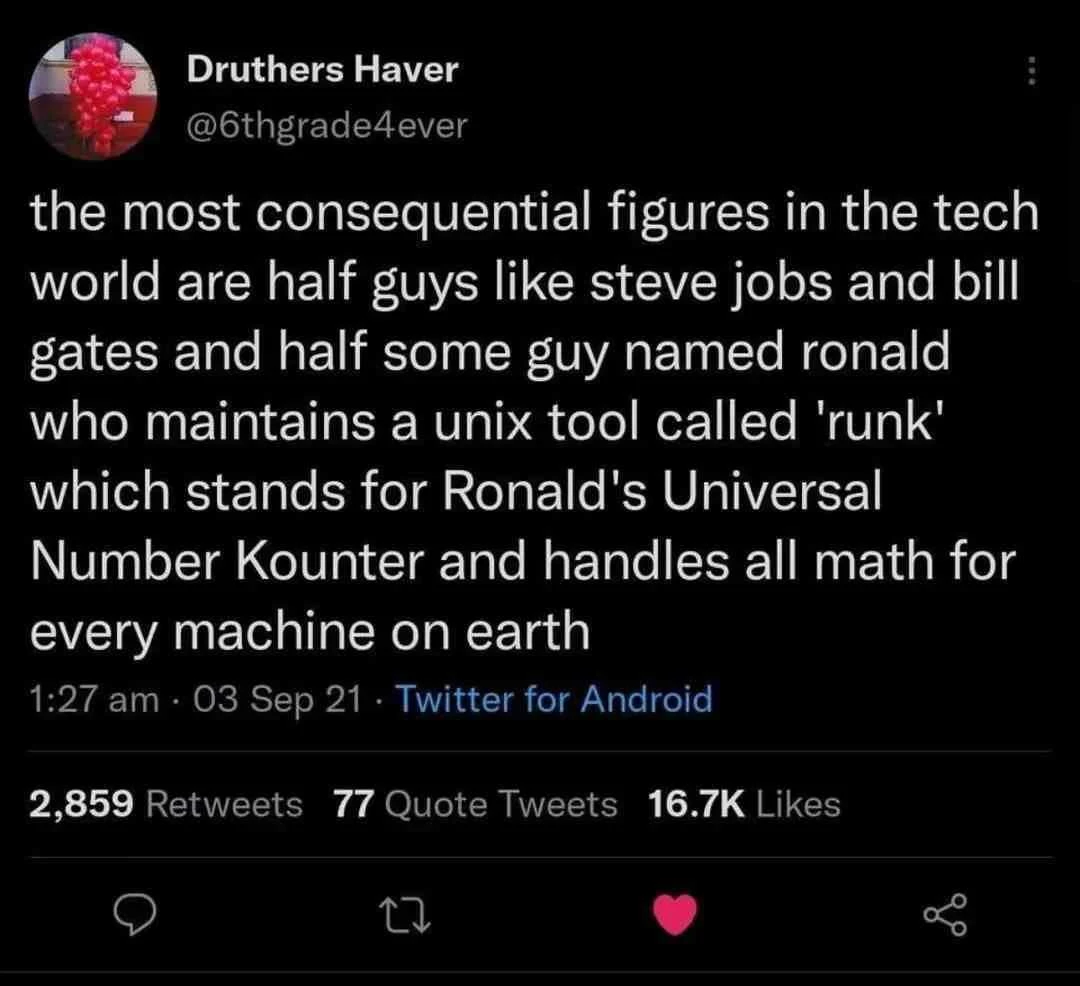
The unsung hero of computing. While everyone worships at the altar of Jobs and Gates, there's some absolute legend named Ronald maintaining a Unix tool that literally every machine depends on for basic arithmetic operations. It's like discovering the entire internet runs on a Perl script written by a guy named Dave in 1987. For context: runk is a real random number generator utility that's been quietly doing its job since forever. Ronald's out here maintaining critical infrastructure while the rest of us argue about tabs vs spaces on Twitter. Peak open-source energy: one person holding up the entire digital civilization with a tool nobody knows exists until it breaks.

Vibe Mathing Meets Dunning Kruger

Vibe Mathing Meets Dunning Kruger
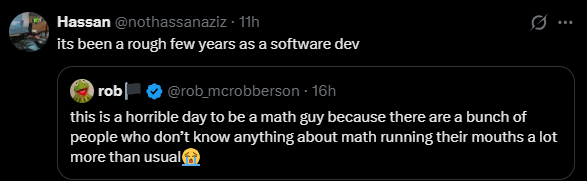
The eternal struggle of being the one person who actually understands Big O notation while your coworkers confidently explain why their nested for-loop inside a while-loop is "probably fine for production." Rob's lamenting the rise of developers who've mastered the art of sounding authoritative about computational complexity without actually knowing the difference between O(n) and O(n²). Meanwhile, Hassan's "rough few years" comment hits different—watching people confidently ship algorithms that would make Dijkstra weep while you're over here trying to optimize that binary search tree. The Dunning-Kruger effect is in full force: those who know the least about algorithmic complexity are often the most confident about their "intuitive" solutions. It's like watching someone insist their bubble sort is "fast enough" because it worked on their sample data of 10 elements.

NordVPN

NordVPN
Encrypt your traffic on public Wi-Fi, stream from anywhere, and cover up to ten devices with one plan. 30-day money-back guarantee.

Millennium Prize Winning Answer

Millennium Prize Winning Answer
Someone just googled "p np problem" and Google's AI cheerfully responded with "No problem at all! How can I help you today?" Congrats, Google just solved one of the seven Millennium Prize Problems worth $1 million. The Clay Mathematics Institute has been real quiet since this dropped. For context: P vs NP is literally one of the most important unsolved problems in computer science and mathematics. Thousands of researchers have spent decades trying to prove whether every problem whose solution can be quickly verified can also be quickly solved. But sure, Google AI says "no problem" so I guess we're done here. Time to collect that million dollars and retire. Thanks, AI.

Is Intelligence Just Computation

Is Intelligence Just Computation
Technically correct, which is the best kind of correct. If you define "sufficiently large" as approaching infinity, then yeah, every algorithm becomes O(1) constant time because all those pesky polynomial, exponential, and logarithmic terms just... disappear into the void of mathematical hand-waving. Your bubble sort? O(1). Your traveling salesman brute force? Also O(1). That recursive Fibonacci implementation you wrote in your first CS class? Believe it or not, O(1). It's the ultimate performance optimization—just redefine what "large" means until your Big-O notation looks good on paper. Computer science professors hate this one weird trick! Fun fact: This is basically the algorithmic equivalent of saying "everything is free if you have infinite money." Sure, the logic checks out, but your production server running on actual finite hardware might have some objections.