Leetcode Memes

Posts tagged with Leetcode

New To Programming How Accurate Is This

New To Programming How Accurate Is This
So you're grinding LeetCode for FAANG interviews and stumble into the Data Structures & Algorithms gauntlet? Yeah, you're competing against people who've been optimizing binary trees since they could walk, and grandmas who casually drop O(log n) solutions while knitting. The playing field is... diverse, let's say. The reality is spot-on though. You've got literal children who started coding at age 5 and treat graph traversal like it's Candy Crush. Then there's the shredded competitive programmer who probably does dynamic programming exercises between sets at the gym. And finally, the seasoned veterans who've seen more sorting algorithms than you've had hot meals. Meanwhile, you're just trying to remember if it's a stack or a queue you need. Fun fact: competitive programming doesn't care about your age, your physique, or your decades of experience. It only cares if you can figure out why your solution is getting TLE (Time Limit Exceeded) on test case 47 of 50. Welcome to the thunderdome, where everyone's a champion and you're just happy your code compiled.

Back To Leetcode Grinding It Is

Back To Leetcode Grinding It Is
Getting approached by a recruiter from a multinational corporation feels like winning the lottery. You're excited, motivated, ready to finally escape your current job. They mention DSA questions and technical interviews, and suddenly you're dusting off your binary trees and practicing "reverse a linked list" for the thousandth time. Then the plot twist hits harder than a segfault in production: the recruiter themselves got axed in a workforce reduction. The same company that was supposedly hiring just laid off their recruiting team. Nothing says "we're growing" quite like firing the people who find talent. So now you're back to grinding LeetCode mediums at midnight, wondering if any of these job opportunities are real or just elaborate pranks orchestrated by the tech industry's collective commitment to chaos.

Can You Make The Button Bounce

Can You Make The Button Bounce
You spend weeks grinding LeetCode like you're training for the coding Olympics, inverting binary trees in your sleep, optimizing algorithms to O(log n) perfection. You ace the whiteboard session. You get the offer. You show up on day one ready to architect the next distributed system. Then reality hits: your actual job is renaming tempData2 to userData and figuring out why the third-party API randomly returns 500 on Tuesdays. No dynamic programming required. Just you, a legacy codebase, and the crushing realization that you'll never use that red-black tree implementation you memorized. The interview process is basically hazing at this point. They make you solve problems NASA engineers don't face, then hand you a ticket that says "button not centered on mobile." Welcome to software engineering.

Hiring

Hiring
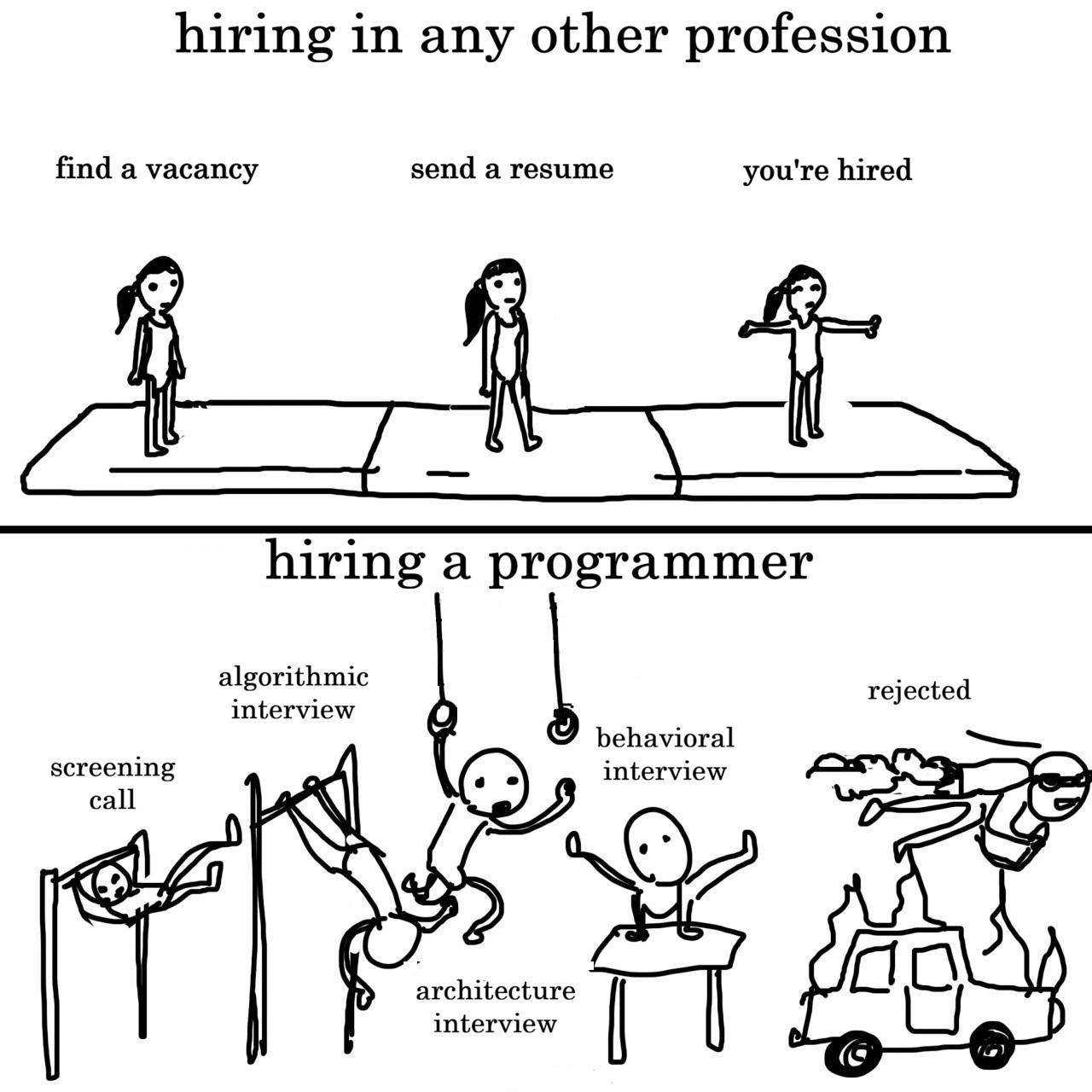
The eternal dance of tech recruiting: where companies demand you've built the next Facebook in your basement, grinded through a thousand LeetCode problems, contributed to Linux kernel development, and possess "DSA skills" that would make Donald Knuth weep—all for an entry-level position that pays in pizza and equity worth less than Monopoly money. The candidate literally checks every single box on their impossible wishlist, and the response? "We're moving forward with other candidates." Translation: you're either overqualified, we found someone cheaper, or Karen from HR doesn't like your GitHub profile picture. The hiring process is basically performance art at this point—everyone's pretending it makes sense while knowing it's completely broken.

Chipotle Gpt

Chipotle Gpt
Imagine being so desperate to order a burrito that you're willing to solve LeetCode problems for it. Someone literally asked Chipotle's support bot to help them reverse a linked list before they can eat. The bot—bless its corporate soul—actually delivers a full Python solution with O(n) time complexity analysis, then casually pivots back to "would you like to start with a burrito?" The best part? The bot is genuinely more helpful than most Stack Overflow answers. No passive-aggressive "marked as duplicate" nonsense, no "this question shows lack of research," just pure algorithmic assistance followed by customer service. Chipotle out here providing better tech support than actual tech companies. Plot twist: turns out you don't need Claude Code or GitHub Copilot subscriptions—just a craving for guac and a chatbot that's way too good at its job.

Burrito Code

Burrito Code
Someone just asked Chipotle's support bot to reverse a linked list in Python because they needed to solve it before ordering their bowl. The bot delivered a full algorithm explanation with O(n) complexity analysis, then casually asked if they'd like to start with a burrito instead. Look, if you're desperate enough to ask a fast-food chatbot for coding help, you're either procrastinating hard or you've finally found the perfect study buddy. Either way, that bot just gave better technical support than most senior devs during code review. The seamless transition from pointer manipulation to "would you like to start with a burrito" is *chef's kiss*. Pro tip: Next time you're stuck on LeetCode, just open every customer service chat you can find. Somewhere between tracking your DoorDash order and complaining about your internet speed, you might just crack that binary tree problem.

Chipotle Support Bot Solves Linked List Now

Chipotle Support Bot Solves Linked List Now
Someone just casually asked Chipotle's customer support chatbot to help them reverse a linked list in Python before they can order their bowl. The bot, named Pepper, doesn't even flinch—it just drops a complete solution with proper syntax, explains the O(n) time complexity, and then pivots back to asking if they'd like to order a burrito. The joke here is twofold: first, the absurdity of blocking your lunch order on solving a LeetCode problem (peak developer anxiety right there), and second, the fact that AI chatbots have gotten so good that even a fast-food support bot can handle data structure questions better than some technical interviewers. Chipotle's bot just became your new coding mentor, and it doesn't even charge for Claude Code or Copilot subscriptions. The LinkedIn flex about ditching expensive AI coding tools for a burrito chain's free chatbot is *chef's kiss*. Who needs Stack Overflow when Pepper's got your back?

*2050

*2050
Junior dev positions requiring 5 years of experience? Cute. Try explaining to your unborn child that they need to start grinding LeetCode yesterday if they want a shot at an entry-level gig in 2026. The tech hiring market has officially jumped the shark—companies want you to solve dynamic programming problems in your sleep before you're even potty trained. Meanwhile, the same companies will ask you to center a div on day one. The dystopian future where fetuses are expected to have a GitHub portfolio with 10k stars is closer than you think.

Genuinely Genuine Answer To Genuine Question

Genuinely Genuine Answer To Genuine Question
Someone asks Jeff Dean—literally a LIVING LEGEND at Google who helped build MapReduce and half the infrastructure that runs the internet—how much DSA (Data Structures and Algorithms) knowledge helped him create these world-changing systems. His response? "What is DSA hard?" The man is so far beyond the grind of LeetCode medium problems that he doesn't even recognize the acronym. While the rest of us are out here grinding binary trees at 2 AM trying to pass interviews, Jeff Dean is casually rewriting search indexing pipelines and genuinely confused about what "DSA hard" even means. It's like asking Michelangelo how many YouTube tutorials he watched before painting the Sistine Chapel. The beautiful irony? He probably invented half the algorithms we're studying to get hired at the company he works at. The sheer cosmic comedy of it all is just *chef's kiss*.

The Hardest Problem

The Hardest Problem
You know that moment when you're in a technical interview and confidently start explaining your dynamic programming solution, only to realize mid-sentence that it's actually a graph traversal problem in disguise? Meanwhile, your interviewer is sitting there like a very patient shiba inu, having just speed-run LeetCode's "Top 10 Graph Nightmares" article 5 minutes before your interview started. The beautiful irony here is that both of you are completely winging it. You're having an existential crisis realizing your memoization table is useless when you need to track visited nodes. They're silently praying you don't ask for hints because their entire knowledge comes from skimming a blog post while you were introducing yourself. It's like two people playing chess where one doesn't know the rules and the other just learned them from a YouTube short. The real hardest problem? Figuring out who's more terrified in this scenario.

Vibe Coders Giving Interviews

Vibe Coders Giving Interviews
You know those developers who can somehow vibe their way through LeetCode by pattern-matching solutions they've seen before? Yeah, they're getting praised for that O(1) solution while sweating bullets knowing they literally just memorized the test cases. The interviewer thinks they're witnessing algorithmic genius, meanwhile our hero is internally screaming because they spent 3 hours hardcoding edge cases the night before. The best part? This actually works until someone asks "can you explain your approach?" and suddenly it's like watching someone try to explain why their code works after copying it from StackOverflow. The uncomfortable handshake really sells the "I'm in danger" energy.

Superiority

Superiority
When you discover that finding the top K frequent elements can be done in O(n) time using bucket sort or quickselect, and suddenly you're looking down on everyone still using heaps like it's 2010. The party guy in the corner just learned about the O(n log n) heap solution and thinks he's clever, while you're out here flexing your knowledge of linear time algorithms like you just unlocked a secret level in LeetCode. For context: Most people solve this problem with a min-heap (priority queue), which gives O(n log k) complexity. But the galaxy brain move is using bucket sort since frequencies are bounded by n, giving you that sweet O(n) linear time. It's the difference between being invited to the party and owning the party.