Exceptions Memes

Posts tagged with Exceptions

Beware Of Lists

Beware Of Lists
That wheelchair icon getting absolutely wrecked by the rocks below is basically every junior dev who thought they could just casually iterate through a list without checking for edge cases first. You know what's coming: off-by-one errors, index out of bounds exceptions, null references hiding in there like landmines, and that one time you forgot lists are zero-indexed and spent 2 hours debugging why everything was shifted. Lists will humble you faster than a production deployment on a Friday afternoon. The sign knows what's up. Lists are treacherous terrain. One wrong move with your iterator and you're face-first in a ConcurrentModificationException or worse—modifying the list while looping through it. The rocks don't lie.

Just Hope And Pray It Works Out

Just Hope And Pray It Works Out
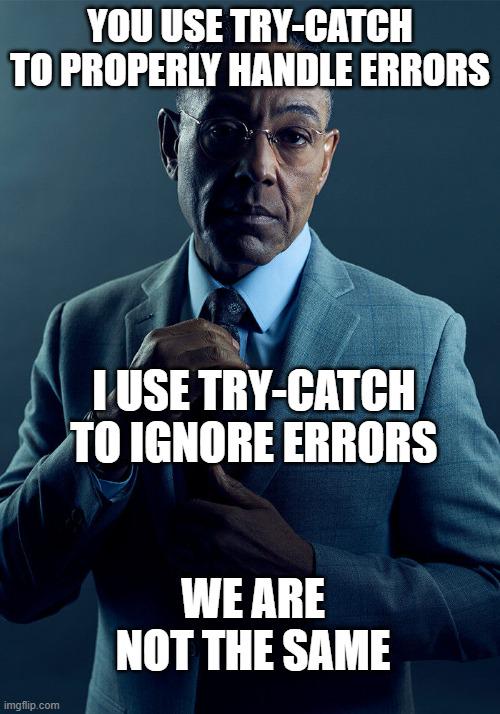
You know you've reached peak software engineering when your try-catch block becomes a crime scene cover-up tool instead of actual error handling. There's a special place in code review hell for developers who wrap everything in try-catch and just... do nothing with the exception. No logging, no recovery strategy, no user feedback—just swallowing errors like they never happened. The worst part? It actually works until it doesn't. Your app silently fails, users report weird behavior, and you spend three days debugging only to find a lonely empty catch block mocking you from line 247. Meanwhile, the "proper" error handling folks are over here with their custom exception classes, graceful degradation, and detailed error logs like they're writing a dissertation. Pro tip: If your catch block is emptier than your coffee cup at 4 PM, you're doing it wrong. At least throw in a console.log or something. Future you will thank present you.

How To Sneak Under Compiler

How To Sneak Under Compiler
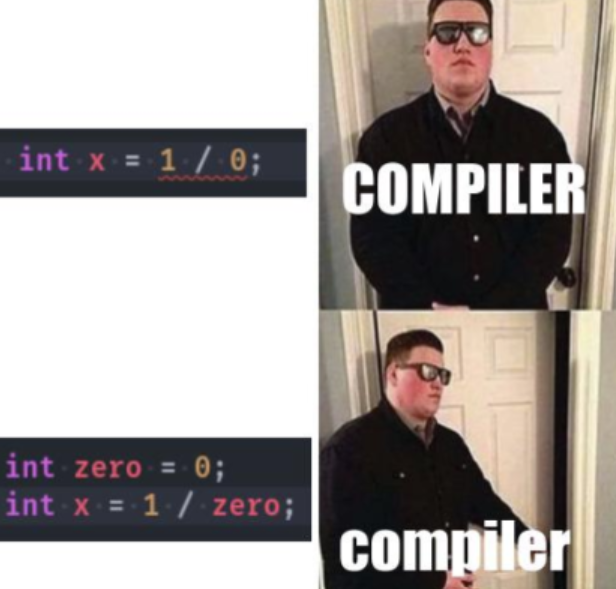
So you want to divide by zero but the compiler keeps catching you? Just add an extra step, genius. First panel shows the obvious trap: int x = 1 / 0; and the compiler's standing there like a bouncer at a club, not letting that nonsense through. But wait—the second panel reveals the master plan: declare int zero = 0; first, then do int x = 1 / zero; . Suddenly the compiler's like "seems legit" because it can't detect the runtime disaster you're about to unleash. It's the programming equivalent of wearing a fake mustache to rob a bank. Congrats, you've successfully bamboozled the compile-time checks and earned yourself a runtime exception. Your program will crash spectacularly, but hey, at least it compiled! 🎉

To Allow The Programmer To Write Bad Code Also Camel Case Sucks This Rule Sucks Snake Case Is Better

To Allow The Programmer To Write Bad Code Also Camel Case Sucks This Rule Sucks Snake Case Is Better
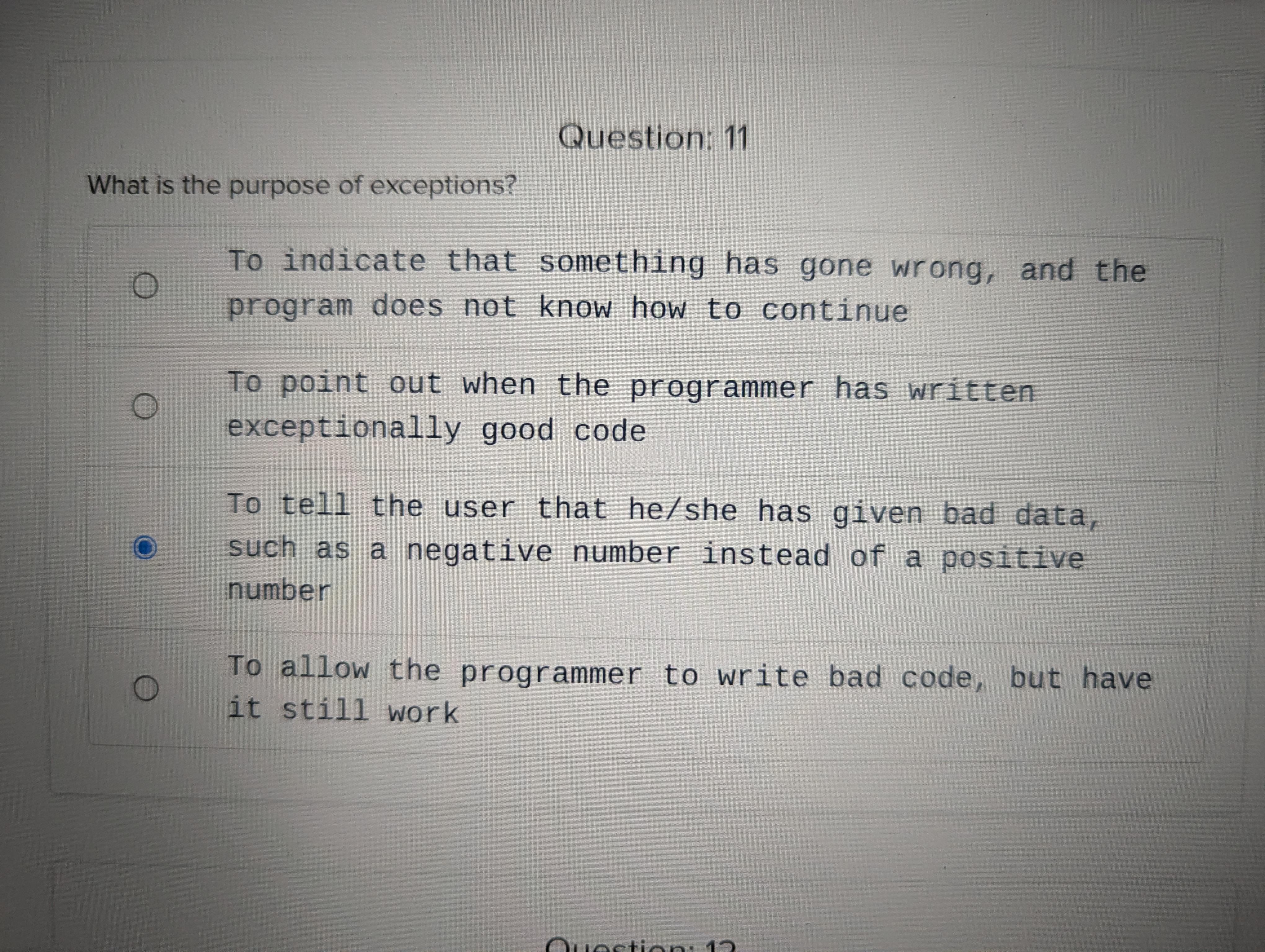
That last option hits different because it's basically the entire software industry in one sentence. Exceptions exist so we can ship code that's held together with duct tape and prayers, but hey, it compiles and runs... mostly. The real comedy here is whoever wrote this exam question accidentally created the most honest description of production code ever. They probably meant to say "handle errors gracefully" but instead gave us "write bad code, but have it still work" which is literally what we do every sprint when deadlines are breathing down our necks. Also props to whoever titled this for the snake_case vs camelCase rant. Nothing says "I've been in too many code review arguments" quite like sneaking your formatting opinions into a meme title.

C Sharp Dictionaries Be Like That

C Sharp Dictionaries Be Like That
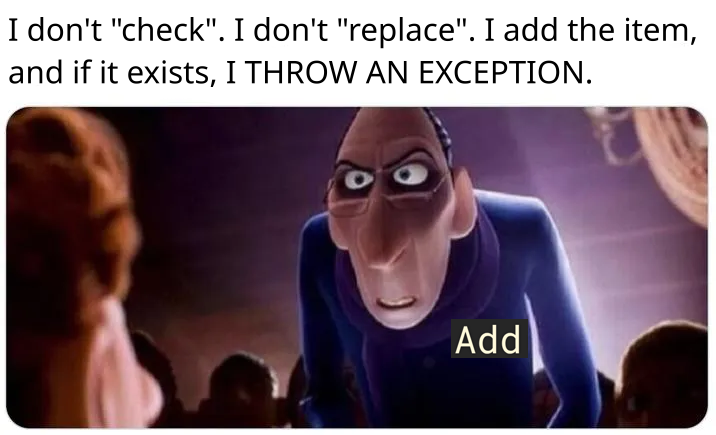
C# Dictionary's Add() method is basically that one coworker who absolutely refuses to compromise. No graceful handling, no "hey this key already exists, want me to update it?" Just straight-up throws an ArgumentException and ruins your day. Meanwhile, you've got perfectly reasonable alternatives like the indexer dict[key] = value that'll just upsert like a civilized data structure, or TryAdd() that politely returns false. But nah, Add() chose violence. It's the programming equivalent of screaming "I SAID ADD IT!" while flipping the table when someone suggests maybe checking first. Classic Microsoft energy right there.

Nice And Simple Way To Break From Multiple Loops!

Nice And Simple Way To Break From Multiple Loops!
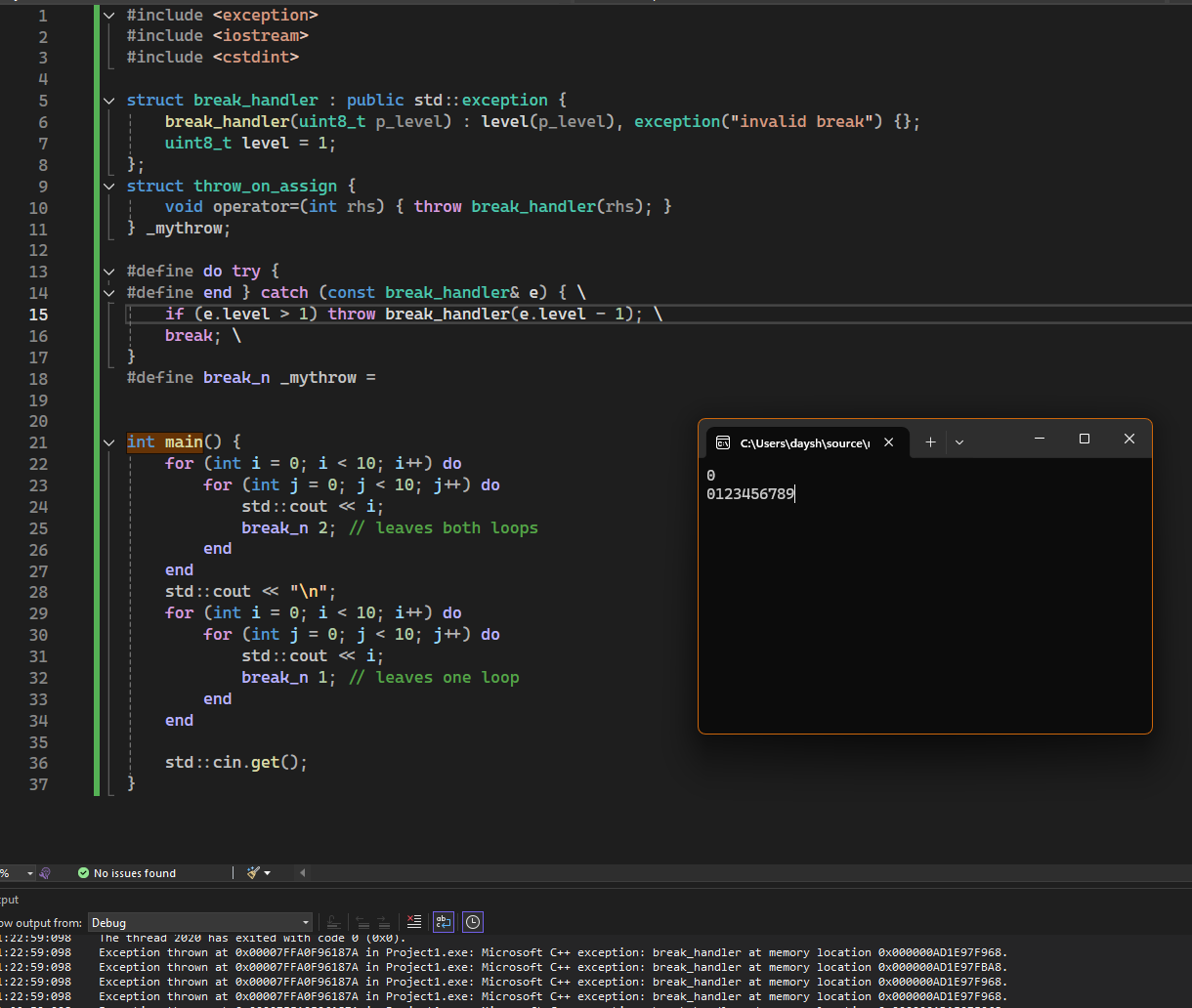
Someone really said "I need to break out of nested loops" and decided the best solution was to weaponize C++ exceptions . Because why use a simple boolean flag or labeled breaks when you can create a custom exception class, throw it through multiple stack frames, and watch your program crash spectacularly? The code creates a break_handler exception with a "level" parameter to control how many loops to escape from. It's like using a sledgehammer to hang a picture frame. Sure, break_n 2 technically exits both loops... right before the entire thing implodes in a beautiful cascade of memory violations. The terminal output tells the real story: "Exception thrown at 0x00007FA0F96187A" repeated infinitely. Nothing says "elegant solution" quite like infinite exception spam and a crashed program. This is what happens when you treat control flow like a game of exception hot potato. Pro tip: Just use a goto or refactor into a function. Your future self (and your debugger) will thank you.

Lexar E300 M.2 NVMe SSD Enclosure, USB-C 10Gbps External SSD Reader/Adapter

Lexar E300 M.2 NVMe SSD Enclosure, USB-C 10Gbps External SSD Reader/Adapter
High-Speed Transfer: Lexar E300 SSD enclosure is equipped with USB 3.2 Gen 2 interface and NVMe protocol, delivering up to 10Gbps theoretical transfer speed for efficient data transmission · Enhanced…

Exceptions Are For The Weak

Exceptions Are For The Weak
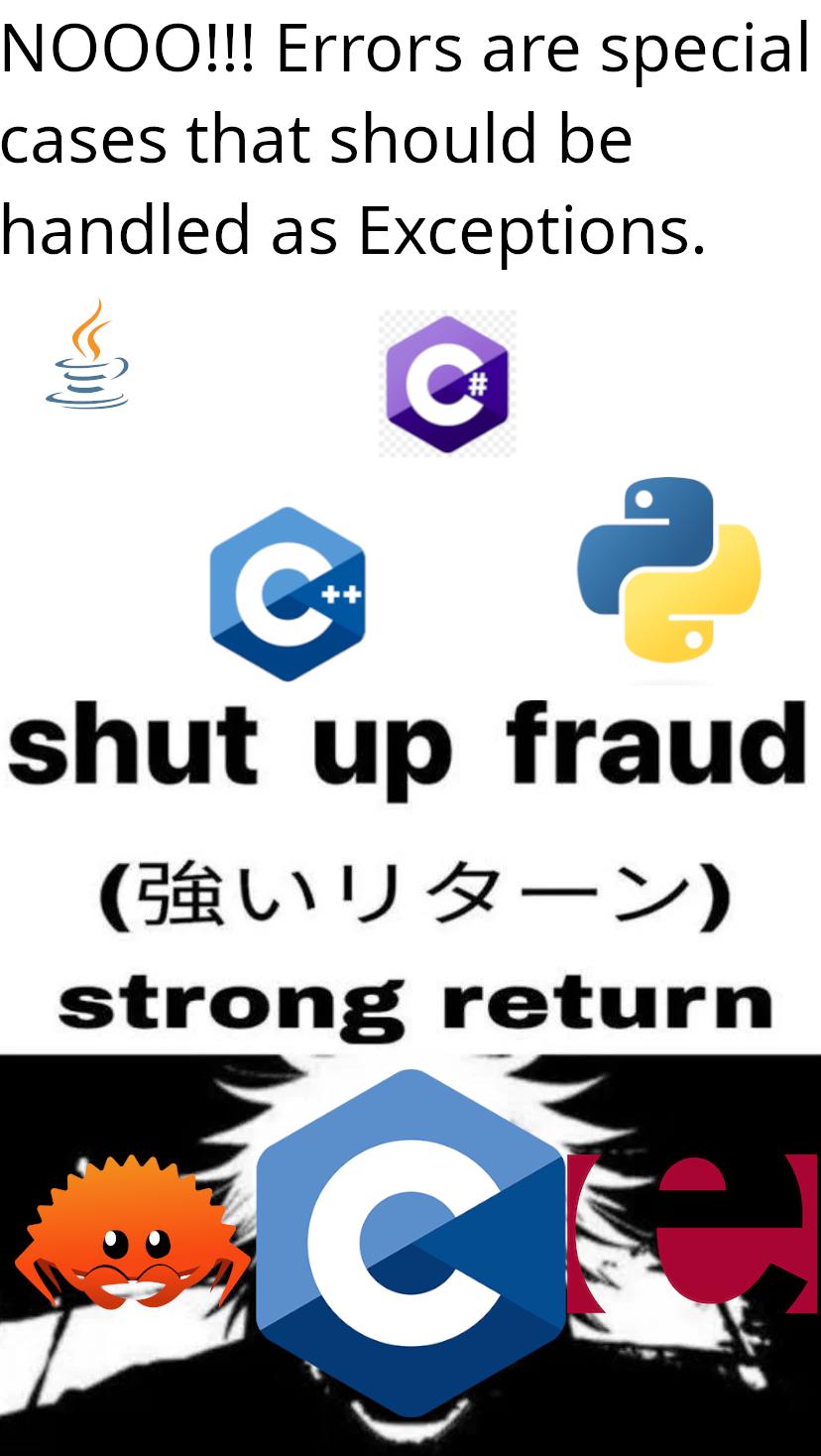
You know you've been writing C too long when someone suggests using exceptions and you physically recoil. The top panel shows the enlightened Java, C#, C++, and Python devs calmly explaining that errors are special cases deserving proper exception handling. Meanwhile, C down there is having an absolute power trip with its "strong return" energy, flanked by Rust and... whatever that other mascot is. Here's the thing: C doesn't do exceptions. You get an error code, you check it, or you don't and your program segfaults at 3 AM in production. It's survival of the fittest. Rust took that energy and made it type-safe with Result types, which is basically "we have exceptions at home." But C? Pure, unfiltered return codes and errno. No safety nets, no hand-holding, just you, your integer, and your poor life choices. The Japanese text (強いリターン) literally means "strong return" which is chef's kiss perfect. Because nothing says strength like manually propagating errors through 47 layers of function calls.

Yoda Knows Error Handling

Yoda Knows Error Handling
Junior dev says they'll handle errors. Yoda drops the holy trinity of exception handling: try-catch blocks and the often-forgotten finally clause. That look of existential dread in the last panel? That's the exact moment you realize your "I'll just log it" approach wasn't cutting it. Finally blocks execute regardless of whether exceptions occurred, perfect for cleanup operations like closing database connections or file handles. But let's be honest, most of us remember finally exists only when the code reviewer asks "but what about resource cleanup?"

Throwing Everything

Throwing Everything
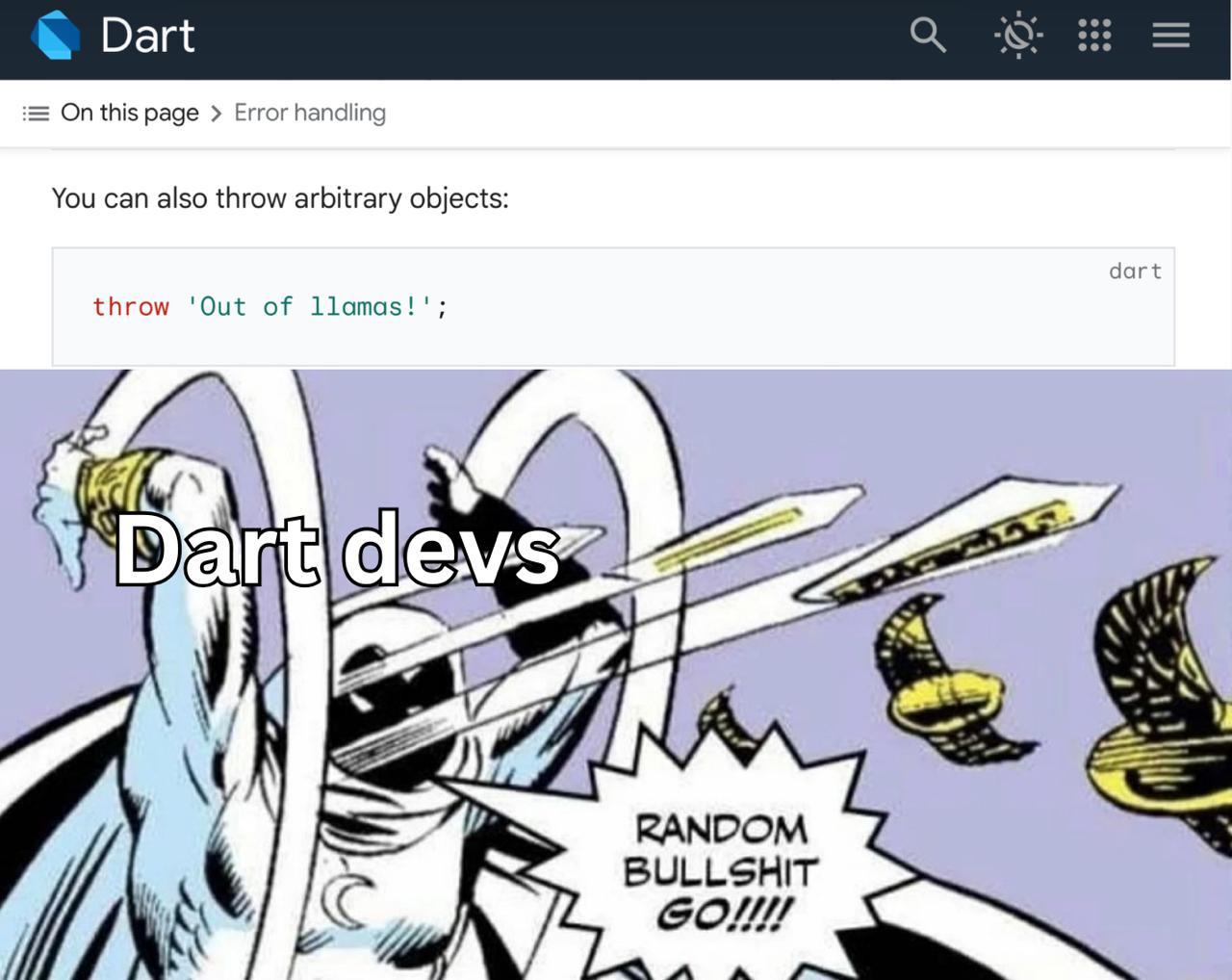
Dart's error handling is... let's say "flexible." While most languages force you to throw proper Exception objects, Dart just shrugs and lets you throw literally anything—strings, numbers, your lunch order, whatever. The documentation casually mentions "you can also throw arbitrary objects" like it's a totally normal feature and not an invitation to chaos. The example throw 'Out of llamas!'; is peak Dart energy—throwing a string error message like we're back in the wild west of programming. Meanwhile, Dart developers are out here yeeting random objects into the error stream with zero regard for type safety or sanity. Need to throw an int? Sure. A Map? Why not. A function? Go for it. The catch blocks must be having existential crises trying to figure out what they're catching. It's the programming equivalent of "throw whatever sticks to the wall" except the wall is your production error handler and nothing sticks properly.

The Critical Exception In Your Daily Runtime

The Critical Exception In Your Daily Runtime
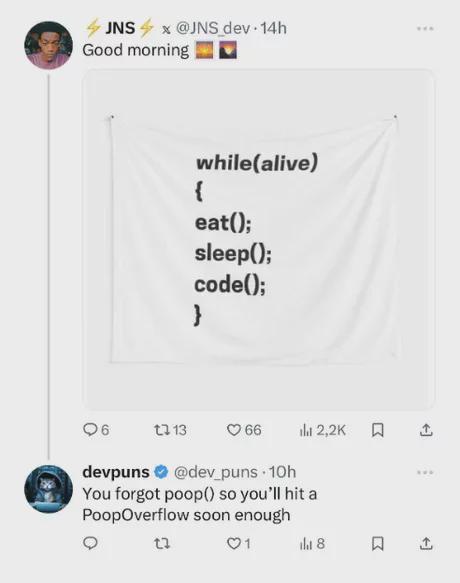
Ah yes, the classic developer life cycle reduced to its most essential functions. Someone proudly displayed their minimalist existence as while(alive) { eat(); sleep(); code(); } only to have another dev point out the critical exception handling they've missed. Without poop() , you're headed straight for a PoopOverflow exception - the most unpleasant stack overflow you'll ever experience. No garbage collection system in the world can save you from that one.

Flex Tape Programming: The C# Way

Flex Tape Programming: The C# Way
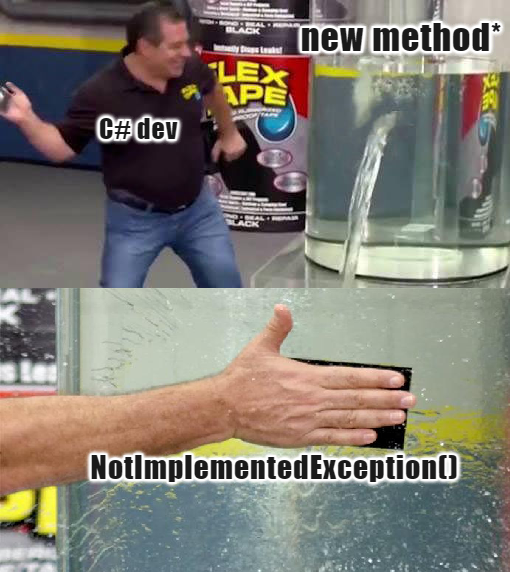
When your manager asks for a new feature by tomorrow, but you've got zero bandwidth: C# dev uses the magical Flex Tape of programming—slapping a NotImplementedException() on that method and shipping it anyway! The digital equivalent of "This leak? What leak? I don't see any water!" Works until QA actually tries to use it... then all hell breaks loose.

When Debugging Becomes Personal

When Debugging Becomes Personal
The gaming-to-debugging pipeline is real! This is exactly what happens when you hit that same exception for the third time. Your monitor becomes your new face as you merge with the code, determined to squash that bug that keeps killing your program. The transition from casual "I'll fix it later" to "I am become death, destroyer of bugs" happens so fast. That intense focus where you're basically wearing your monitor as a helmet is the universal sign that you've entered debug beast mode .