Error messages Memes

Posts tagged with Error messages
Don't Need Fix Need Answers

Don't Need Fix Need Answers
You know what's worse than not being able to fix a bug? Being able to see exactly what's wrong in the bug report but having absolutely zero clue how the code even produces that error in the first place. Like, the error message is crystal clear, the stack trace points right at the problem, but when you open the codebase it's like staring into the void. You're not even asking "how do I fix this?" anymore—you're asking existential questions like "how has this ever worked?" and "who wrote this?" (spoiler: it was you six months ago). The bug report is a map to treasure, except the treasure is buried in a codebase held together by duct tape and prayers.

Save Me From Gradle Please

Save Me From Gradle Please
You want to make a game? Cool! You're using Java? Great choice! Oh wait, you're using Gradle as your build tool? Say hello to your new full-time job: deciphering cryptic dependency resolution errors that read like ancient hieroglyphics written by a caffeinated elephant. The Gradle elephant starts off looking all cute and friendly, but then it transforms into this nightmare creature that throws walls of red text at you. "Failed to resolve all artifacts for configuration 'classpath'" – yeah, thanks buddy, super helpful. Nothing says "fun game development" quite like spending 6 hours debugging your build system instead of actually building your game. The best part? The error message is longer than your actual game code. Gradle's basically that friend who can't give you simple directions and instead explains the entire history of the road system.

Just Got To Double Check

Just Got To Double Check
You know that moment when you're debugging and stumble across an error message so absurd, so utterly bizarre, that you have to lean back in your chair and really process what you're seeing? Like "Error: Potato is not a valid database" or "Cannot read property 'undefined' of undefined of undefined." Your brain goes into full detective mode because surely, SURELY, this can't be what's actually breaking your code. The shrimp sitting in the chair represents you, the developer, carefully examining this comedic masterpiece of an error message. You're convinced it's a rabbit hole that'll send you spiraling through 47 Stack Overflow tabs, your entire codebase, and possibly questioning your career choices. But nope—sometimes a shrimp is just a shrimp. Sometimes the error is exactly what it says, no matter how ridiculous it sounds. The paranoia is real though. We've all been burned by that one time the "simple" error turned into a 6-hour debugging session involving race conditions, memory leaks, and existential dread.

This Has To Be The Best Blue Screen Of Death I've Ever Seen In Person

This Has To Be The Best Blue Screen Of Death I've Ever Seen In Person
Windows decided to get philosophical and just display ":(" followed by "You" on the BSOD. No cryptic error codes, no "CRITICAL_PROCESS_DIED", no "IRQL_NOT_LESS_OR_EQUAL"—just straight up telling you that you are the problem. The OS has achieved sentience and is now gaslighting its users. Honestly, it's the most honest error message Microsoft has ever produced. No beating around the bush with technical jargon—just a sad face and a finger pointed directly at you. At least now we know who Windows really blames for all those driver failures.

Why Not?

Why Not?
Excel really woke up and chose violence today. You're sitting there, innocently trying to do something completely reasonable with your spreadsheet, and Excel just hits you with the "We can't do that to a merged cell" error like it's personally offended by your audacity. No explanation, no helpful suggestions, just pure rejection wrapped in a passive-aggressive dialog box. The merged cell feature is basically Excel's way of saying "I'll let you make your spreadsheet look pretty, but the moment you try to actually USE it for anything, I'm shutting this whole operation down." It's the ultimate betrayal—Excel gives you the tools to create the problem, then acts shocked when you need to work with what you've created. Truly the most toxic relationship in software.

Wait What...

Wait What...
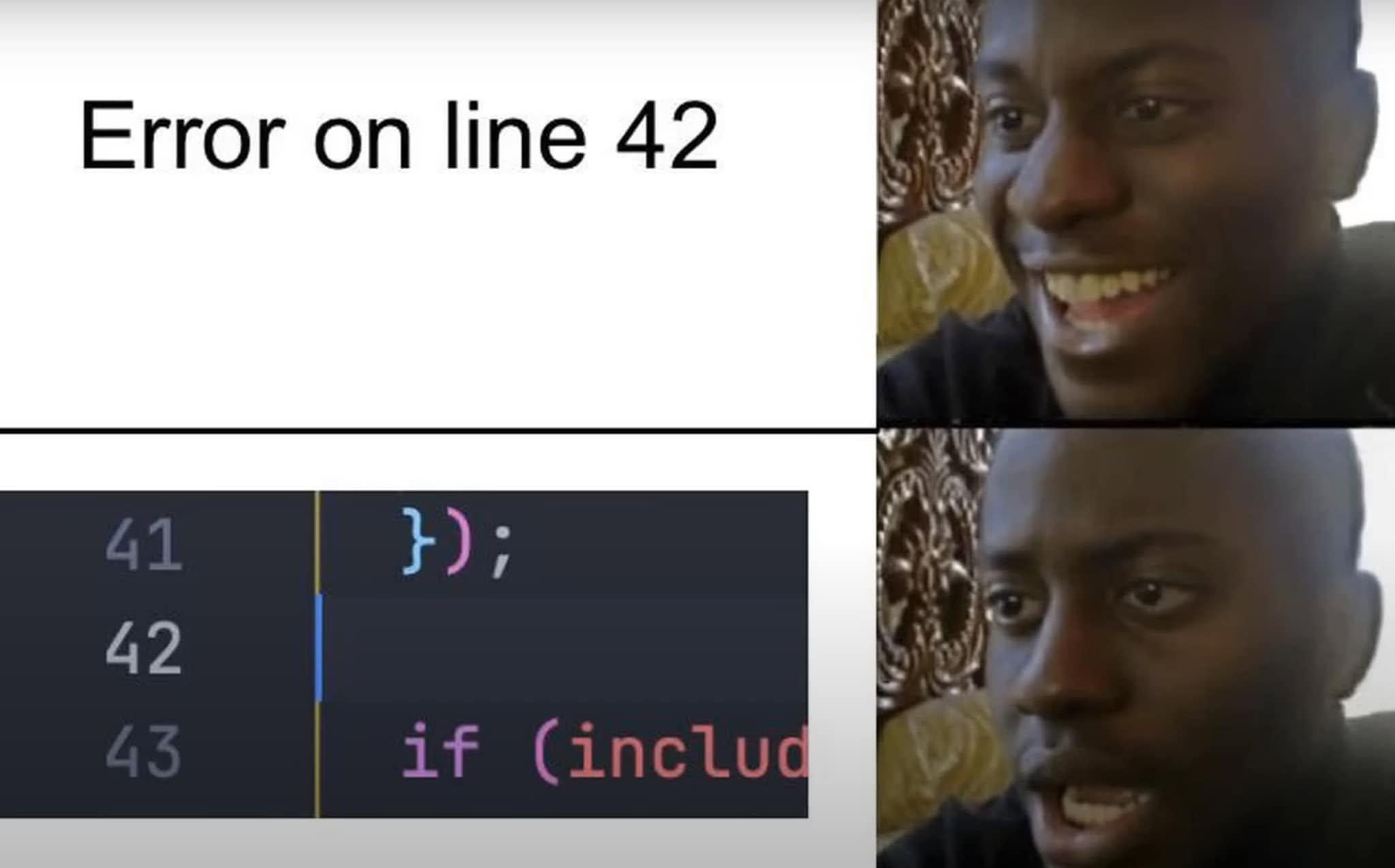
You know that mini heart attack when the compiler says "Error on line 42" and you frantically scroll to line 42, only to find it's a completely innocent closing brace? Then you look at line 43 and see the actual problem starting there. The error message is technically correct but also absolutely useless because the real issue is never where it claims to be. Compilers have this delightful habit of detecting errors at the point where they finally give up trying to make sense of your code, not where you actually messed up. That missing semicolon on line 38? The compiler won't notice until line 42 when it's like "wait, what is happening here?" It's the developer equivalent of your GPS saying "you missed your turn" three blocks after you actually missed it. Thanks, I hate it.

Well Thank You For Not Sharing The Solution I Guess

Well Thank You For Not Sharing The Solution I Guess
You're three hours deep into debugging, Googling increasingly desperate variations of your error message. Finally—FINALLY—you find a Stack Overflow thread from 2014 with your EXACT problem. Same error, same context, same everything. Your heart races. This is it. Then you see it: "nvm I solved it" with zero explanation. No code. No follow-up. Just a digital middle finger from the past. And now you're sitting there celebrating like you won something, when really you've won absolutely nothing except the privilege of continuing to suffer alone. Special shoutout to those legends who edit their posts with "EDIT: Fixed it!" and still don't share how. You're the reason trust issues exist in the developer community.

I Don't Think I've Seen An Error Like This Before...

I Don't Think I've Seen An Error Like This Before...
Python being the most passive-aggressive language ever: "Did you mean: 'sleep'?" Yeah buddy, I definitely meant sleep, not slee. Thanks for the suggestion after throwing an AttributeError at me. The real kicker? You're calling time.slee() which is basically asking Python to take a nap but misspelling it. It's like ordering a "cofee" at Starbucks and the barista correcting your spelling while refusing to serve you. Python's error messages have gotten so good they're now roasting us for typos. Props to whoever implemented these helpful suggestions though—saved countless hours of developers staring at their screen wondering why their code won't work, only to realize they fat-fingered a function name.

Programmer Story After Finding Different Error Message

Programmer Story After Finding Different Error Message
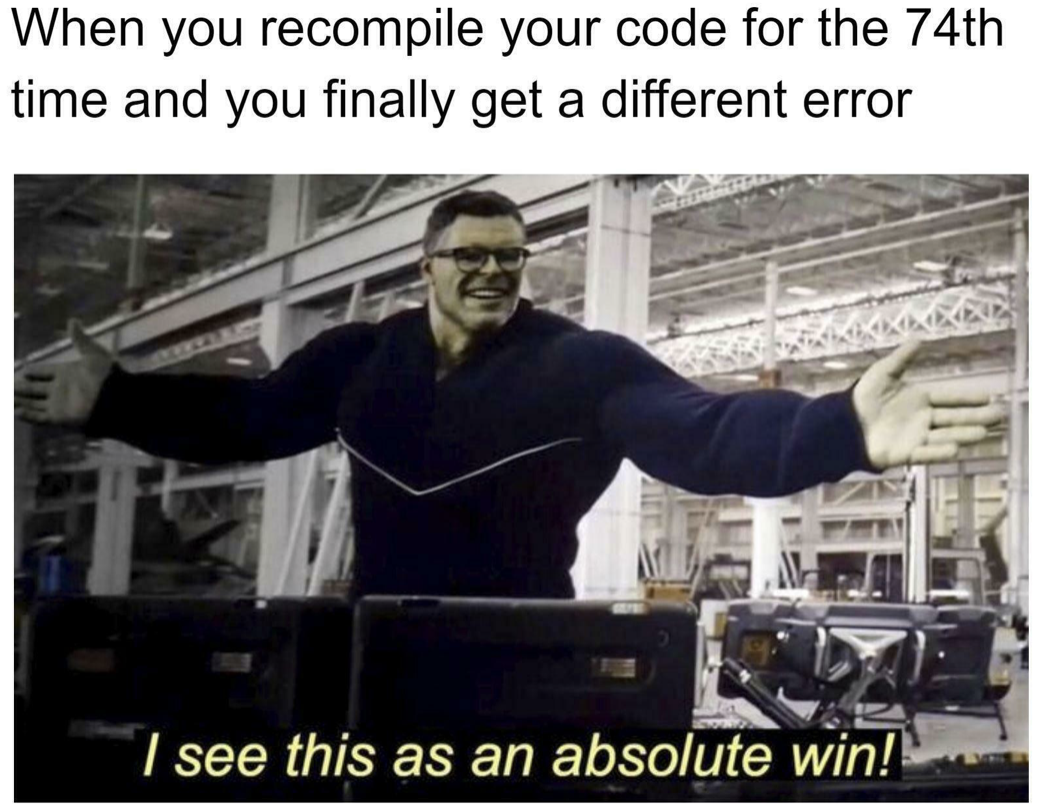
You know you've been debugging too long when a new error message feels like a victory. The bar is so low it's underground at this point. That moment when you've been staring at the same cryptic error for 4 hours, and suddenly—boom—a completely different error appears. Your brain immediately goes "YES! PROGRESS!" even though you're technically just as broken as before. Maybe even more broken. But hey, at least it's a different kind of broken. The messy desk, the dual monitors, the coffee cup that's probably been refilled 6 times—yep, that's the debugging lifestyle. Where changing the type of failure counts as moving forward.

We've All Felt This Pain

We've All Felt This Pain
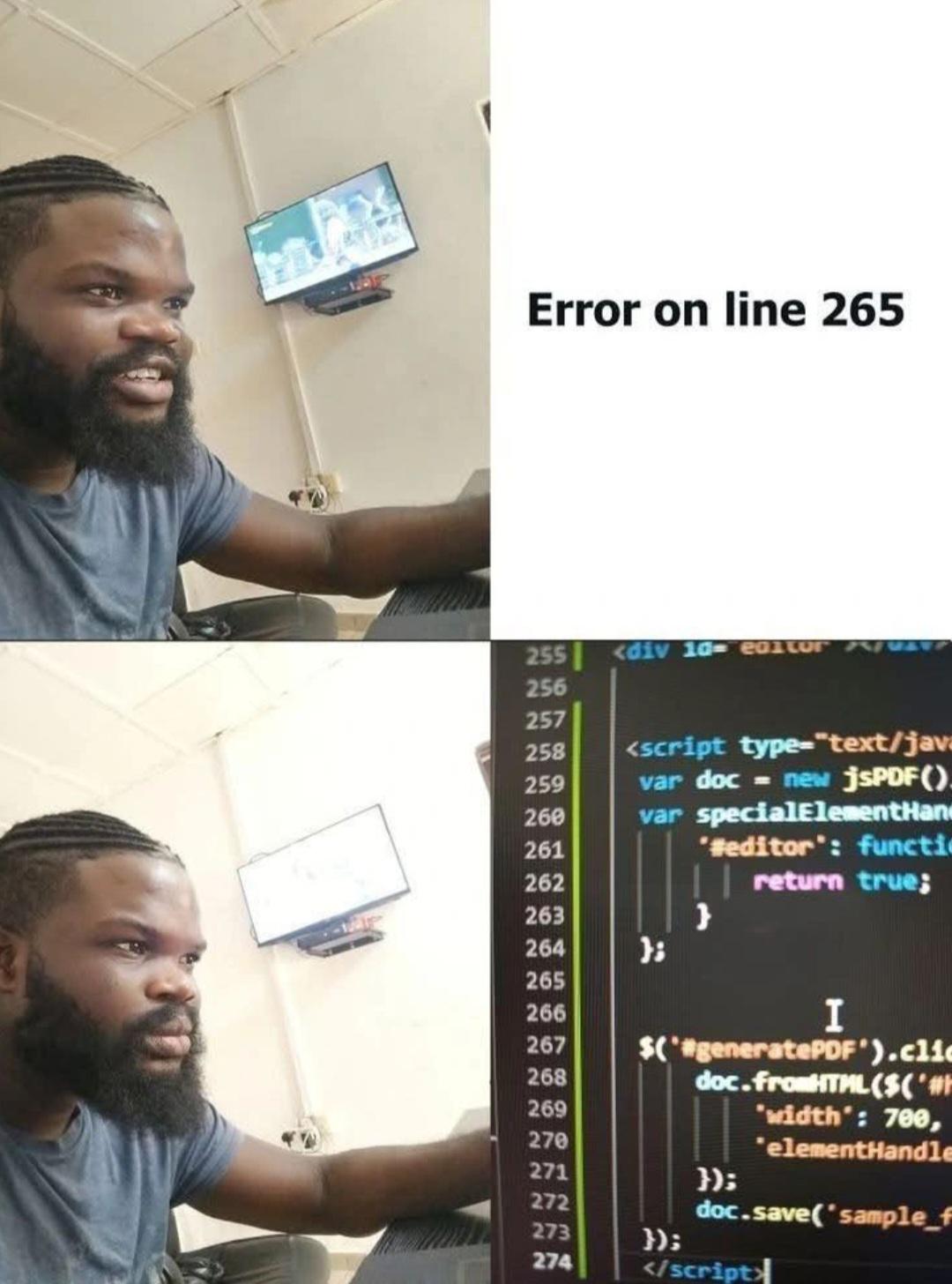
Error on line 265. Cool, let me just scroll down to check what's wrong. *Opens file* Line 274 is the last line. Nothing quite hits like your IDE confidently pointing you to a line number that doesn't exist. It's like getting directions from someone who's never been to the place. The error is somewhere in your code, probably a missing bracket or semicolon from 50 lines ago, but the stack trace decided to gaslight you instead. Time to play detective and work backwards through your entire file because apparently line numbers are just suggestions now.

Oh Caroline!!

Oh Caroline!!
Nothing says "romance" quite like a syntax error ruining your heartfelt poem! Someone tried to write a sweet little verse but Python said "NOT TODAY, SHAKESPEARE" and threw an unexpected '?' tantrum on line 32. Because apparently question marks have NO PLACE in the world of poetry when Python's involved! The absolute TRAGEDY here is that roses being red and violets being blue is literally the most predictable thing in human history, yet somehow the code still managed to be unexpected. The irony is *chef's kiss* – the one thing that was supposed to be unexpected (a romantic gesture in code) became unexpectedly broken instead. Poetry and programming: a match made in syntax hell! 💔

Do You Ever Just Look At Your Error Message Like This

Do You Ever Just Look At Your Error Message Like This
You know that moment when your code crashes, you check the error message, and it's so cryptic and unhelpful that you just... stare at it with pure contempt? Like, thanks for telling me "undefined is not a function" for the 47th time today, but WHICH undefined? WHERE? The angry stare of betrayal when your error message gives you absolutely nothing to work with. You're not reading it anymore, you're just having a silent standoff with your terminal, wondering if intimidation will make it reveal more details. Spoiler: it won't.