Efficiency Memes

Posts tagged with Efficiency

Find Your Place

Find Your Place
The hard truth that keeps memory-conscious developers up at night. A boolean only needs 1 bit to represent true or false, but because most systems can't address individual bits, it gets allocated a whole byte. That's 87.5% storage efficiency loss, which is basically the computing equivalent of buying a mansion to store a single shoe. Some languages try to optimize this with bit fields or packed structures, but let's be real—most of the time we're just casually wasting 7 bits per boolean like we're made of RAM. Which, to be fair, we kind of are these days. Storage is cheap, existential dread about inefficiency is free. The real tragedy? Those 7 bits could've been living their best life storing actual data, but instead they're just... there. Unemployed. Collecting dust. A monument to the gap between theoretical computer science and practical implementation.

Comparing 4 GB Ram Performance On Linux And Windows

Comparing 4 GB Ram Performance On Linux And Windows
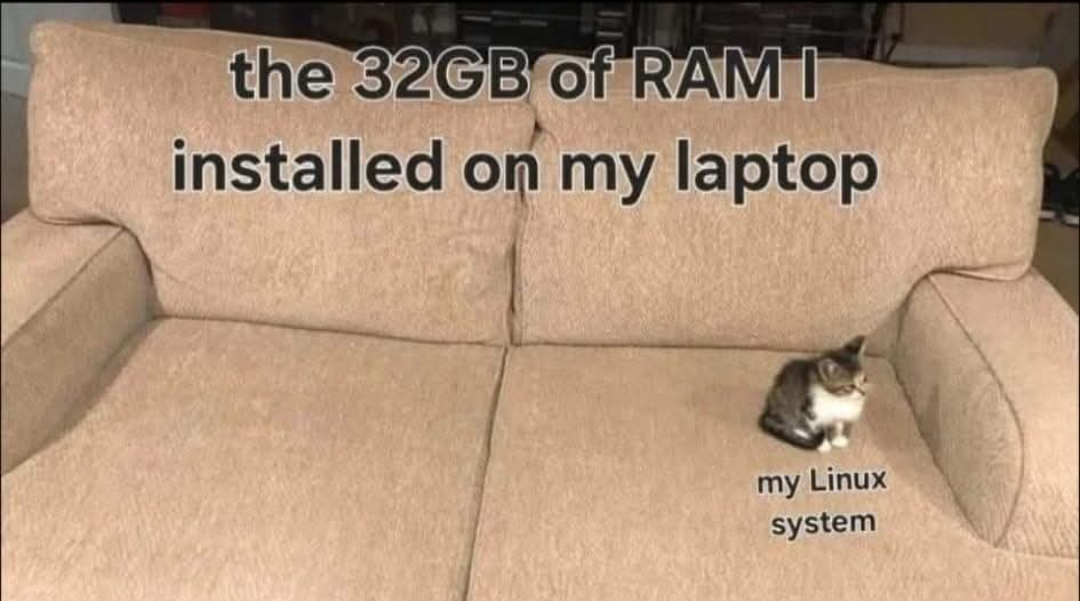
Linux with 4GB RAM: absolutely jacked, running smoothly, could probably compile the kernel while hosting a web server and still have memory to spare. Windows with 16GB RAM: barely holding it together, wheezing after booting up because the OS itself decided to consume 8GB just for existing, plus another few gigs for Windows Defender, telemetry services, and whatever Cortana is doing in the background. The efficiency gap is wild—Linux distros are engineered to run on a potato if needed, with lightweight window managers and minimal bloat. Meanwhile, Windows comes pre-loaded with enough background processes to make Task Manager look like a phonebook. You need 4x the RAM just to achieve the same level of performance, which is both hilarious and slightly depressing if you're stuck on Windows.

Tell Me The Truth

Tell Me The Truth
The harsh reality that keeps systems engineers up at night: we're using an entire byte (8 bits) to store a boolean value that only needs 1 bit. That's an 87.5% waste of memory. It's like buying an 8-bedroom mansion just to store a single shoe. But here's the thing—computers can't efficiently address individual bits. Memory is byte-addressable, so we're stuck with this inefficiency unless you want to manually pack bits together like some kind of medieval bit-packing peasant. Sure, you could optimize it with bitfields or bit arrays, but at what cost? Your sanity? Readability? The ability to debug without wanting to throw your laptop out the window? So we accept this beautiful waste in exchange for simplicity and speed. Sometimes the truth hurts more than a segmentation fault.

What Is Happening

What Is Happening
Someone really said "let's use GPT-5.2 to power a calculator" and thought that was a good idea. You know, because apparently basic arithmetic needs a multi-billion parameter language model that was trained on the entire internet. It's like hiring a neurosurgeon to put on a band-aid. The calculator probably responds to "2+2" with a 500-word essay on the philosophical implications of addition before reluctantly spitting out "4". Meanwhile, your $2 Casio from 1987 is sitting there doing the same job in 0.0001 seconds while running on a solar cell the size of a postage stamp. But sure, let's burn through enough GPU cycles to power a small town so we can calculate a tip at dinner. Innovation.

I Love Cheese

I Love Cheese
The eternal struggle between doing things the "right way" versus the "it works" way. On one side, you've got the architect who built a beautiful, scalable C# rate-limiter that probably took three weeks of planning and implementation. On the other, someone who just yeeted a time.sleep(1.6s) into their Python script and called it rate-limiting. The kicker? Both solutions technically work. The clean C# implementation runs at 100% efficiency—pristine, maintainable, documented. Meanwhile, the Python hack with its hardcoded sleep timer limps along at 95% efficiency, held together by duct tape and prayers. But here's the dirty secret: that 5% difference rarely matters in production when you're just trying to avoid getting your API key banned. After years in the trenches, you realize both programmers are valid. Sometimes you need the bear (robust enterprise solution), sometimes you need the wolf (scrappy solution that ships). The real wisdom is knowing which animal to be on any given Tuesday.

Am I Late To The Party

Am I Late To The Party
Someone just discovered AI and decided to use it for... checking if numbers are even. You know, that incredibly complex problem that's stumped humanity for centuries and definitely requires a large language model API call instead of a simple modulo operation. The first few rows show manual answers (No, Even, No, Yes) like a normal human would do it. Then row 8 hits and suddenly it's =GEMINI("Is this number even?",A8) all the way down. Someone's burning through their API quota to solve what could've been =MOD(A8,2)=0 . This is what happens when you have a hammer (AI) and everything looks like a nail. Next week they'll probably be using GPT-4 to add two numbers together. The cloud bills are gonna be *chef's kiss*.

When You Start Using Data Structures Other Than Arrays

When You Start Using Data Structures Other Than Arrays
That moment when you've been forcing everything into arrays for years and suddenly discover linked lists, trees, and hash maps. The sheer existential horror of realizing how much unnecessary O(n) searching you've been doing. Your entire coding career flashes before your eyes as you contemplate all those nested for-loops that could have been O(1) lookups.

You've Been Doing It Wrong

You've Been Doing It Wrong
Oh look, it's the keyboard shortcut showdown in prison! First inmate proudly uses Ctrl+Alt+Del like it's 1995, thinking he's all sophisticated with the three-finger salute. Then the second guy drops the mic with Ctrl+Shift+Esc, which directly opens Task Manager without the extra menu step. It's like watching someone brag about their dial-up connection while the other person quietly uses fiber. The real crime here isn't whatever got them locked up—it's wasting precious milliseconds when your application freezes.

The Win-Win Command Line Paradox

The Win-Win Command Line Paradox
The ultimate programming paradox in command-line format! The first two lines reveal that doing absolutely nothing somehow results in victory—essentially the dream scenario for any efficiency-obsessed developer. Then the plot twist: actually putting in effort and "doing something" doesn't just maintain the win state, it amplifies it! It's that beautiful contradiction where both laziness and effort are rewarded. Like when your hastily written script works flawlessly, but then you spend 3 hours optimizing it to save 0.02 seconds of runtime and feel even more accomplished. The universe rewards both the elegant minimalist and the obsessive optimizer equally!

The Automation Paradox

The Automation Paradox
The eternal programmer's dilemma: spend 20 minutes doing a boring task once, or waste an entire weekend building an elaborate automation system you'll never touch again. It's not about efficiency—it's about avoiding the soul-crushing tedium of repetitive tasks while convincing yourself that your 36-hour automation marathon was "an investment." The irony? That script will sit in a folder somewhere, gathering digital dust, while you move on to automate the next thing you could have done manually in minutes. The worst part? We'll do it again next week. Because apparently we'd rather write 500 lines of code than click the same button twice.

The Programmer's Time Investment Strategy

The Programmer's Time Investment Strategy
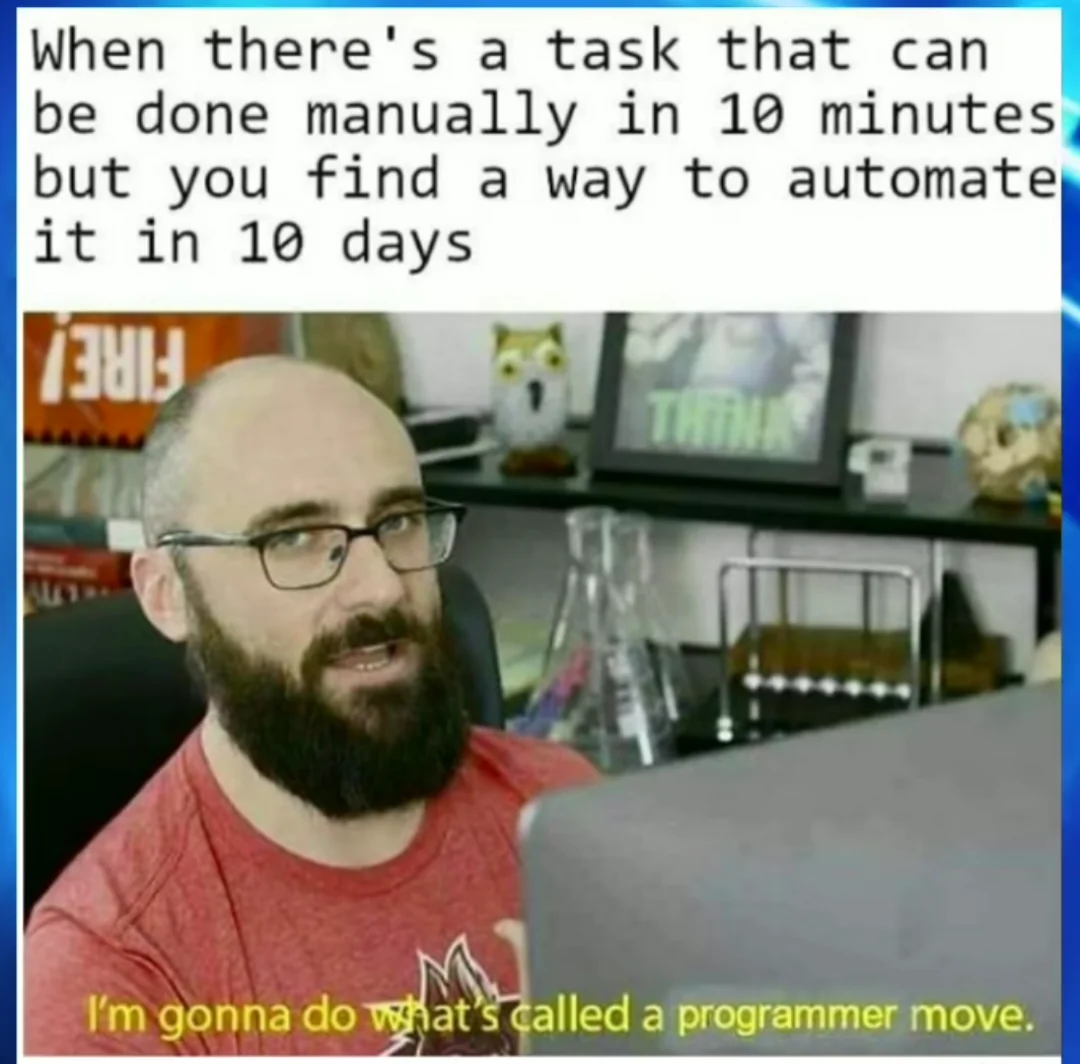
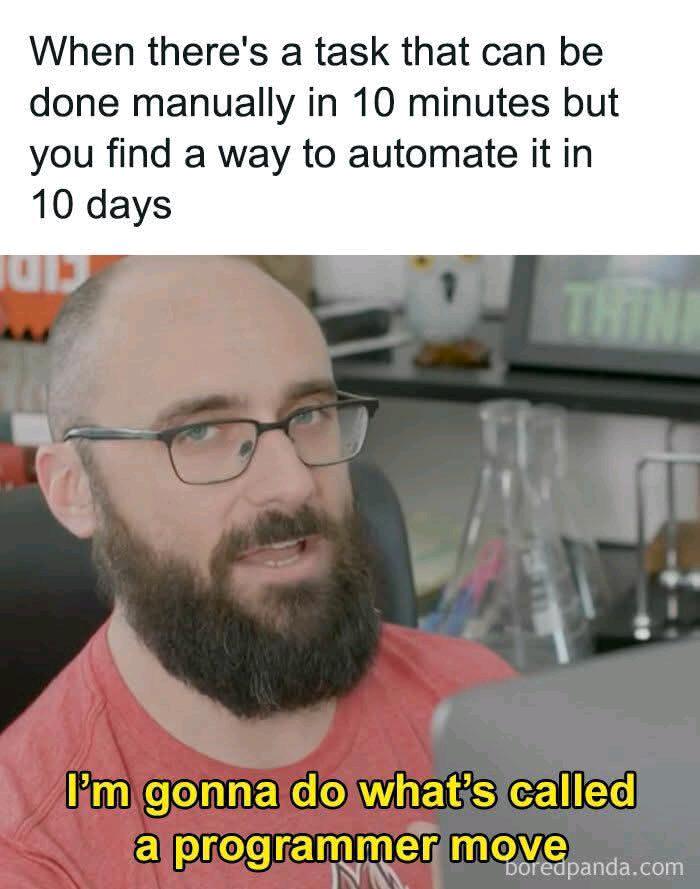
Spending 10 days automating a 10-minute task is the hill we die on. It's not about efficiency—it's about principle. Sure, I could just do the thing manually 600 times over the next five years, but what if I need to do it 601 times? That's when my beautiful, over-engineered solution pays off. The ROI calculation conveniently ignores the 16 hours of debugging and the fact that I'll probably leave this job before it ever breaks even. But hey, at least I didn't have to do something boring twice.

The 25-Mile Automation Detour

The 25-Mile Automation Detour
Behold, the quintessential developer paradox! Crawling 25 miles through the desert to spend several hours automating a task that could be done manually in 5 minutes. It's like spending 4 hours writing a script to rename files when you could've just renamed them all in 10 minutes. But where's the intellectual challenge in that? The dopamine hit from automation is worth the dehydration, obviously. Remember: A true developer measures success not by time saved, but by how unnecessarily complex the solution was. If you're not overengineering, are you even engineering?