dependencies Memes

Bring Back jQuery

Bring Back jQuery
Remember when your entire project was like 50KB? Yeah, me neither. Now you need to install 847 dependencies just to center a div. That node_modules folder has become so comically massive it's basically a black hole that consumes disk space faster than you can say "npm install." Modern web development: where your actual code is 2KB but your dependencies weigh more than a small car. Meanwhile jQuery is sitting there like "I was 30KB and did everything you needed" but nobody wants to hear it because we're too busy configuring webpack for the 47th time. Fun fact: The average node_modules folder contains more files than the number of stars visible to the naked eye. Okay I made that up, but it feels true.

The Real Struggle Of Programming

The Real Struggle Of Programming
You know what's wild? After 10+ years in this industry, I can architect a distributed microservices system in my sleep, but ask me to get Node versions, Docker containers, environment variables, and database connections working on a fresh machine? Suddenly I'm googling "why is my localhost refusing connection" for the 847th time. The actual coding is just the tip of the iceberg. Below the surface lurks the absolute monstrosity of dependency hell, conflicting Python versions, that one environment variable you forgot to set, Docker daemon not running, ports already in use, SSL certificates expired, and my personal favorite: "works on my machine" syndrome. Spent 30 minutes writing elegant code? Cool. Now spend 3 hours figuring out why your colleague's setup script doesn't work because they're on an M1 Mac and you're on Windows with WSL2 and nothing is compatible with anything anymore.

Camel Case Because I Have To

Camel Case Because I Have To
You wanted to add ONE tiny package to handle date formatting, and now your node_modules folder has somehow become sentient and is demanding its own ZIP code. The JavaScript ecosystem really said "you can't just install what you need" and decided that every package must bring its entire extended family, second cousins, and that one weird uncle nobody talks about to the party. The best part? It audited 2,370 packages in 32 minutes and 4 seconds like it's doing you a favor, when all you wanted was to format a timestamp. Meanwhile your disk space is sobbing in the corner and your .gitignore is working overtime. The node_modules folder is basically the Costco of programming—you came for one thing, you're leaving with 2,349 things you didn't know existed.

Absolutely Diabolical

Absolutely Diabolical
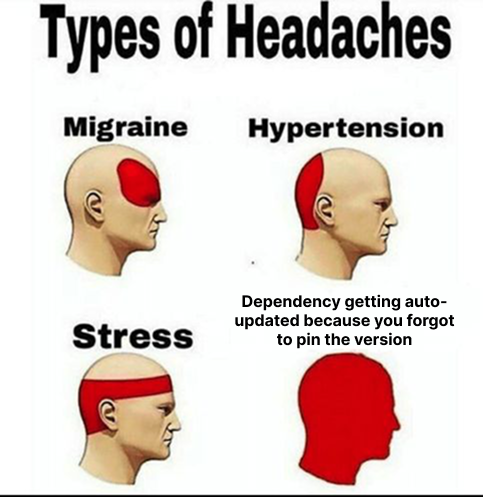
You know that one dev on your team who just wants to watch the world burn? Yeah, they pushed a breaking change to a dependency and reset the "days without npm incident" counter back to zero. Again. The JavaScript ecosystem is held together by duct tape and the prayers of overworked maintainers. One rogue package update and suddenly your entire CI/CD pipeline is screaming at you at 3 AM. The best part? It's always some obscure transitive dependency you didn't even know existed that decides to introduce a breaking change in a patch version. Pro tip: Pin your dependencies. Lock that package-lock.json like your production uptime depends on it. Because it does.

The Precarious Tower Of Modern Tech

The Precarious Tower Of Modern Tech
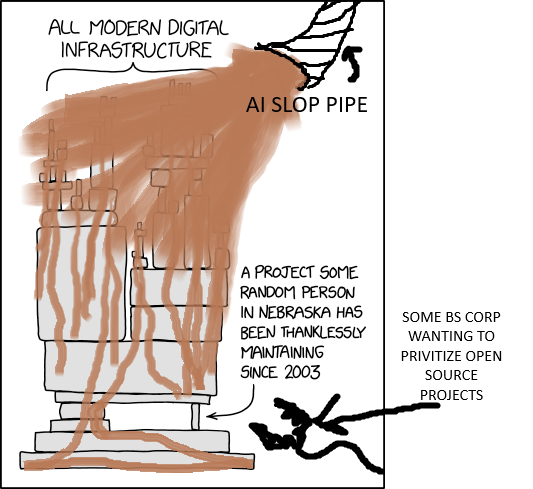
Ah, the tech stack of modern civilization depicted as a Jenga tower that somehow hasn't collapsed yet. At the bottom, we've got ASML making the chips while C developers write dynamic arrays that would make any memory manager weep. The Linux Foundation holds up the entire internet while DNS occasionally decides whether your websites exist today. AWS and Cloudflare keep the lights on while unpaid open source developers silently prevent digital apocalypse. Meanwhile, AI sits there looking smug while Microsoft does... whatever it is Microsoft does these days. And there you are, somewhere in the middle of this precarious structure, just trying to make a web app that doesn't crash when someone types an emoji.

The Jenga Stack Of Digital Doom

The Jenga Stack Of Digital Doom
BEHOLD! The terrifying tower of tech that keeps our digital world from imploding! 💀 Our entire civilization balances on this RIDICULOUS Jenga tower of services - Cloudflare, some random AWS region you picked because it was 0.001% cheaper, that Azure zone nobody remembers configuring, and THE THINNEST POSSIBLE STICK of an open-source project maintained by ONE SLEEP-DEPRIVED DEVELOPER who hasn't seen sunlight since 2014! We're literally one npm update away from digital apocalypse! Just WAITING for that one critical piece to get pulled and watch the ENTIRE STACK come crashing down while we frantically Google "how to rollback production" between sobs! 🙃

Circular Dependencies

Circular Dependencies
The perfect visual representation of modern software development. The comic shows a recursive nightmare where dependencies contain dependencies that contain... you guessed it, more dependencies! Just like that time I pulled in a simple date formatting library and somehow ended up importing half the internet. The recursive image within itself is chef's kiss irony – the meme about dependency hell is itself caught in an infinite dependency loop. Next sprint I'm just gonna write everything in C like it's 1972.

Circular Dependencies: It's Turtles All The Way Down

Circular Dependencies: It's Turtles All The Way Down
The meme brilliantly captures the recursive nightmare of modern dependency management! It's a comic showing a tower of blocks labeled "every conversation about dependencies since 2020" that contains a smaller version of itself, which contains an even smaller version... it's dependencies all the way down! Just like when you npm install a simple package and suddenly your node_modules folder weighs more than a neutron star. The infinite recursion perfectly represents how we can't even discuss dependency hell without creating more dependency hell. It's the Inception movie of software engineering problems!

Include Math And Pray For Mercy

Include Math And Pray For Mercy
The holy lamb of mathematics, surrounded by ravenous wolves! That's exactly what happens when you build a pristine math library with elegant algorithms and clean abstractions - only to have it absolutely mauled by desperate developers trying to force-fit it into their janky codebase. The halo really sells it - your beautiful numerical methods package sitting there in divine perfection while the rest of the engineering team tears into it with import statements and hacky workarounds. "But can we make it work with our legacy COBOL system?" *gnaws on factorial function*

When Your AI Assistant Gets Tangled In Dependencies

When Your AI Assistant Gets Tangled In Dependencies
Behold, the physical manifestation of Microsoft's AI ambitions. A green bicycle literally branded "Co-Pilot" tangled in a mess of cables. Just like the real GitHub Copilot - looks promising until you realize it'll get hopelessly entangled in dependencies and legacy code. At least when this one crashes, you only break your collarbone instead of production.

Bless You Node Modules

Bless You Node Modules
The eternal JavaScript developer dilemma: "Need to turn a screw? Just import a screwdriver library!" *2 seconds later* "Great, now my project depends on 17,482 packages including three different implementations of left-pad, a Bitcoin miner, and something suspiciously called 'definitely-not-keylogger'." The node_modules folder - where simple tasks require importing the entire supply chain of the global hardware industry, complete with factories you didn't know existed and dependencies that will break in mysterious ways during your demo.

Some Of You Guys Haven't Used LuaRocks And It Shows

Some Of You Guys Haven't Used LuaRocks And It Shows
Ah, the classic expectation vs. reality of package managers! Vanilla Lua looks like this majestic unicorn—elegant, magical, full of potential. Then you venture into the "ecosystem" with LuaRocks and suddenly you're dealing with a beaten-down horse with an industrial chimney for a horn. For the uninitiated, LuaRocks is Lua's package manager—theoretically making your life easier, but actually turning your pristine codebase into an industrial wasteland of dependencies. It's like npm but with fewer packages and somehow more existential dread. The true mark of a Lua veteran isn't writing beautiful code—it's surviving the package management apocalypse with your sanity intact.