

datetime Memes

We Just Need The Best

We Just Need The Best
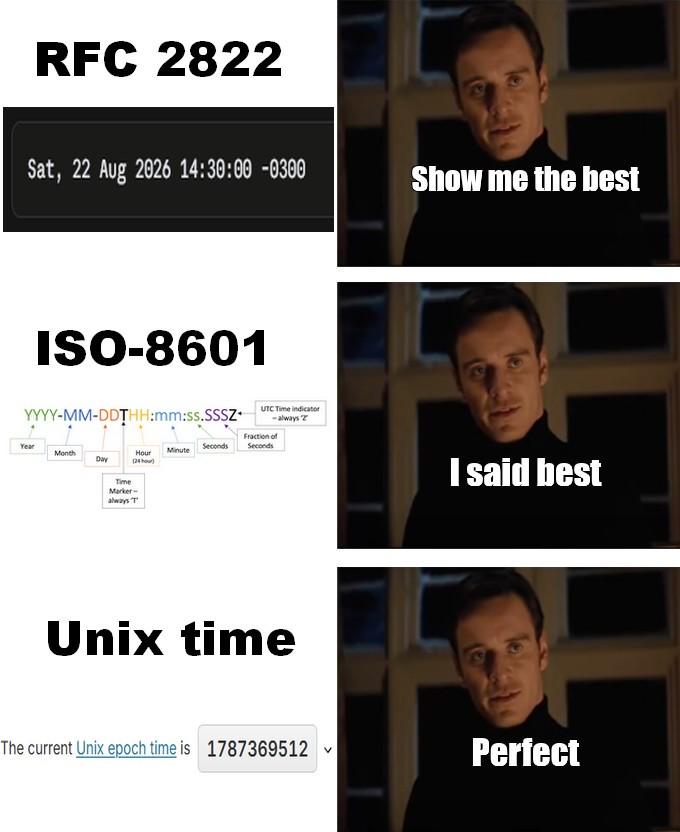
When someone asks for "the best" datetime format, they're really asking which circle of hell they want to live in. RFC 2822 gives you that vintage email header vibe with its verbose Saturday nonsense. ISO-8601 is the golden child—structured, sortable, and what your database actually wants to see. But Unix time? Just a cold, hard integer counting seconds since 1970. No timezones, no formatting drama, no parsing headaches. It's like choosing between a fancy sports car, a reliable sedan, and a skateboard that somehow gets you there faster than both. The skateboard wins every time when you're doing calculations, comparisons, or literally anything that doesn't involve showing dates to humans. Store it as Unix time, display it as ISO-8601, and never speak of RFC 2822 again unless you're debugging ancient email systems. Fun fact: Unix time will overflow 32-bit signed integers on January 19, 2038. Mark your calendars—or don't, because hopefully we'll all be using 64-bit by then.

Time Zones You're On Sight

Time Zones You're On Sight
Every developer who's dealt with datetime bugs knows the answer immediately: find whoever invented timezones and have a very stern conversation. Daylight saving time? Half-hour offsets? UTC vs local time? The International Date Line doing whatever it wants? The rage is real. You think you've got it figured out with ISO 8601 and moment.js (RIP), then some user in Arizona (which doesn't observe DST except on the Navajo Nation which does) files a bug report and you're back to questioning your entire career. Honestly, the only correct way to handle time is to store everything in UTC and let someone else deal with the display logic. But do we? No. Because we're optimists who think "this time will be different."

Is Leap Year

Is Leap Year
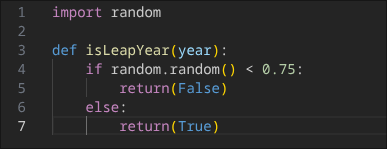
Why bother with those pesky divisibility rules for 4, 100, and 400 when you can just flip a coin? This function has a 75% accuracy rate, which honestly might be better than some production code I've seen. The beauty here is that it's technically statistically sound since roughly 1 in 4 years is a leap year. Ship it and blame any bugs on "quantum uncertainty" or "probabilistic computing paradigms."

Everybody Forgets The Time Part Of Datetime

Everybody Forgets The Time Part Of Datetime
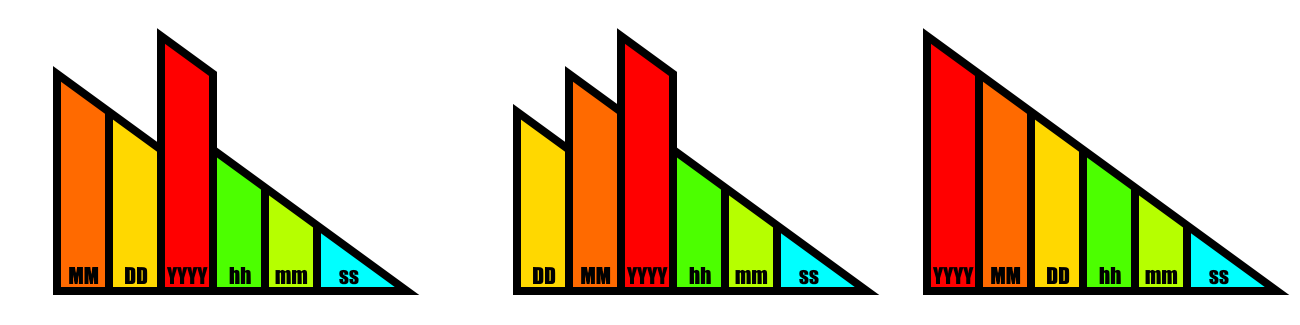
Three different datetime formats, all equally wrong in their own special way. The first one at least tries to be logical with MM-DD-YYYY-hh-mm-ss, but then someone decided to shuffle the deck and put DD-MM-YYYY in the middle. The third one? YYYY-MM-DD leading the charge like it's ISO 8601's cool cousin. But notice what they all have in common? Those time components (hh, mm, ss) are getting progressively smaller and more forgotten, like they're being pushed off a cliff into irrelevance. Developers love to bikeshed about date formats until they're blue in the face, but the moment it comes to actually storing time precision? "Eh, just set it to 00:00:00 and call it a day." Then six months later someone files a bug because events scheduled for 2PM are showing up at midnight and everyone acts surprised. The time part isn't just decoration, folks—it's literally half the name.

Cries In SQL Date Time

Cries In SQL Date Time
Nothing says "I'm a keeper" quite like someone who exclusively uses DD/MM/YYYY and refuses to acknowledge the existence of ISO 8601. While the rest of us are drowning in timezone conversions, locale-specific parsing errors, and that one database that stores dates as strings (yes, really), this guy found his soulmate who thinks there's only one true date format. Meanwhile, your production server is somewhere screaming because someone in the US entered 03/04/2024 and now nobody knows if it's March 4th or April 3rd. But sure, let's pretend other formats are just "a bit confusing" and not the reason we have 47 different datetime libraries in every programming language. Fun fact: There are at least 20+ common date formats used globally, and they all hate each other. The only thing developers can agree on is that whoever decided to make JavaScript's Date() start months at 0 deserves a special place in debugging hell.

NordVPN

NordVPN
Encrypt your traffic on public Wi-Fi, stream from anywhere, and cover up to ten devices with one plan. 30-day money-back guarantee.

Happy New Leap Year

Happy New Leap Year
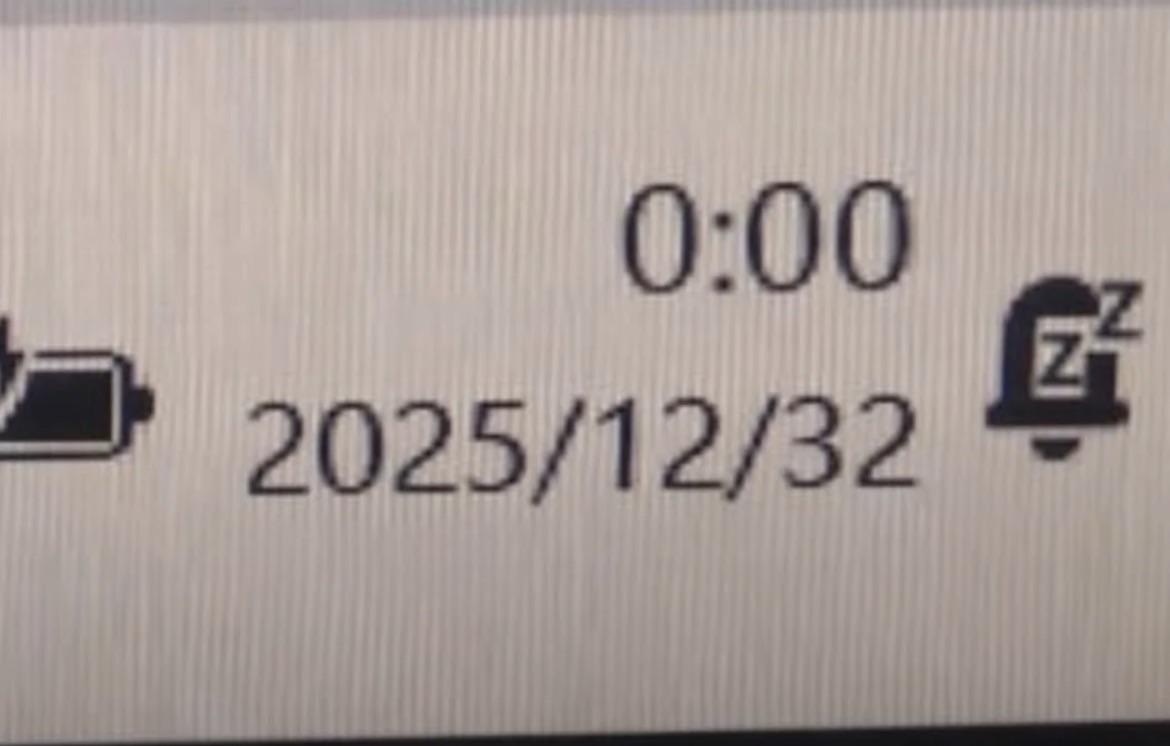
Someone's date validation logic just took a vacation. December 32nd, 2025 – because apparently months now have 32 days when your code doesn't properly handle date boundaries. This is what happens when you trust user input or forget that not all months are created equal. Somewhere, a developer is debugging why their New Year's Eve party invitations are arriving in the void. The battery icon desperately clinging to life is the perfect metaphor for the state of this system's datetime handling. Fun fact: December 32nd doesn't exist, but edge cases in production absolutely do.

The 'Perfect Date' No One Expected

The 'Perfect Date' No One Expected
When someone asks about "the perfect date," most people think romance. Programmers? They think ISO 8601 violations and the eternal hellscape of datetime formatting. DD/MM/YYYY is the hill many developers are willing to die on. It's logical, hierarchical, and doesn't make you question whether 03/04/2023 is March 4th or April 3rd. Meanwhile, Americans are out here living in MM/DD/YYYY chaos, and don't even get me started on YYYY-MM-DD purists who sort their family photos like database entries. The real kicker? "Other formats can be confusing really" is the understatement of the century. Every developer has lost hours debugging date parsing issues because some API decided to return dates in a format that looks like it was chosen by rolling dice. Date formatting is the reason we have trust issues.

Is Leap Year

Is Leap Year
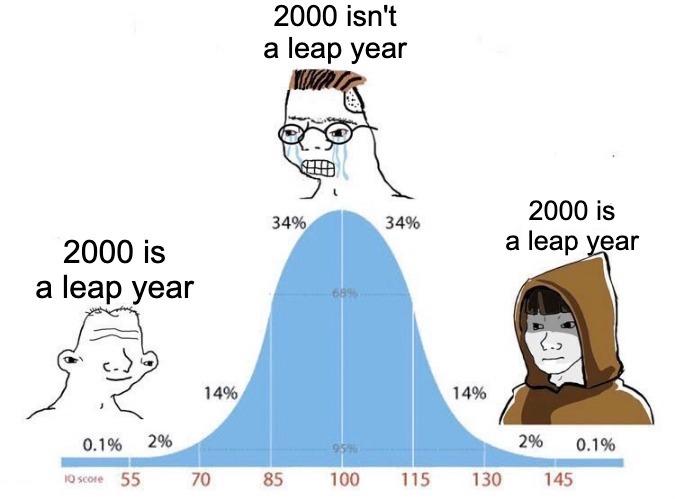
Year 2000 leap year logic is the ultimate litmus test for whether someone actually understands the rules or just memorized "divisible by 4." The century rule (divisible by 100 = not a leap year, UNLESS divisible by 400 = actually a leap year) catches everyone off guard. So 2000 gets people arguing in three camps: the "divisible by 4, obviously yes" crowd, the "wait it's a century year so no" smartypants, and the rare enlightened souls who remember the 400-year exception. The bell curve nails it. Low IQ: simple rule, correct answer. Mid IQ: overthinks it with the century exception, gets it wrong. High IQ: knows the full ruleset, correct answer. It's like watching people debug datetime libraries in real-time.

UTC And Celsius Only

UTC And Celsius Only
The eternal developer fantasy: time travel to eliminate timezones. If you've ever debugged a production issue at 3AM because your server's in EST but your database is in PST while your logs are in UTC, you understand the violence in this image. Timezone math has broken more code than null pointers. The creator of timezones would be the first target for any developer with a time machine - right before they'd implement a universal standard of UTC everywhere and Celsius-only temperature measurements. No more Date.toLocaleString() nightmares!

Python Vs Ruby: The Battle Of Time Expression

Python Vs Ruby: The Battle Of Time Expression
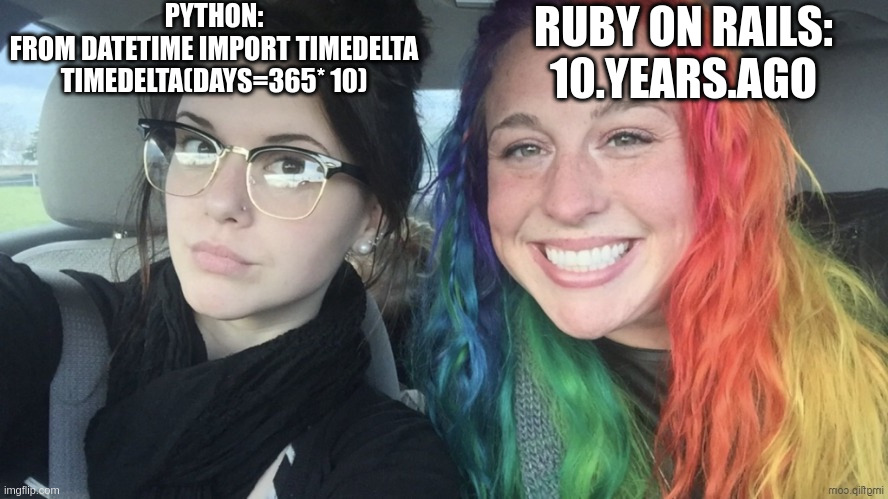
The meme perfectly captures the elegance contrast between Python and Ruby on Rails. Python needs an entire import statement and function call just to say "10 years ago," while Ruby's syntax is so human-readable it looks like plain English. And yes, the rainbow hair on the Ruby side is *chef's kiss* on-brand for a language named after a gemstone. Syntactic sugar so sweet it'll rot your teeth.

Synology 2-Bay DiskStation DS223j (Diskless)

Synology 2-Bay DiskStation DS223j (Diskless)
Secure private cloud - Enjoy 100% data ownership and multi-platform access from anywhere · Easy sharing and syncing - Safely access and share files and media from anywhere, and keep clients, colleagu…

The Only Type Of Date I Can Have

The Only Type Of Date I Can Have
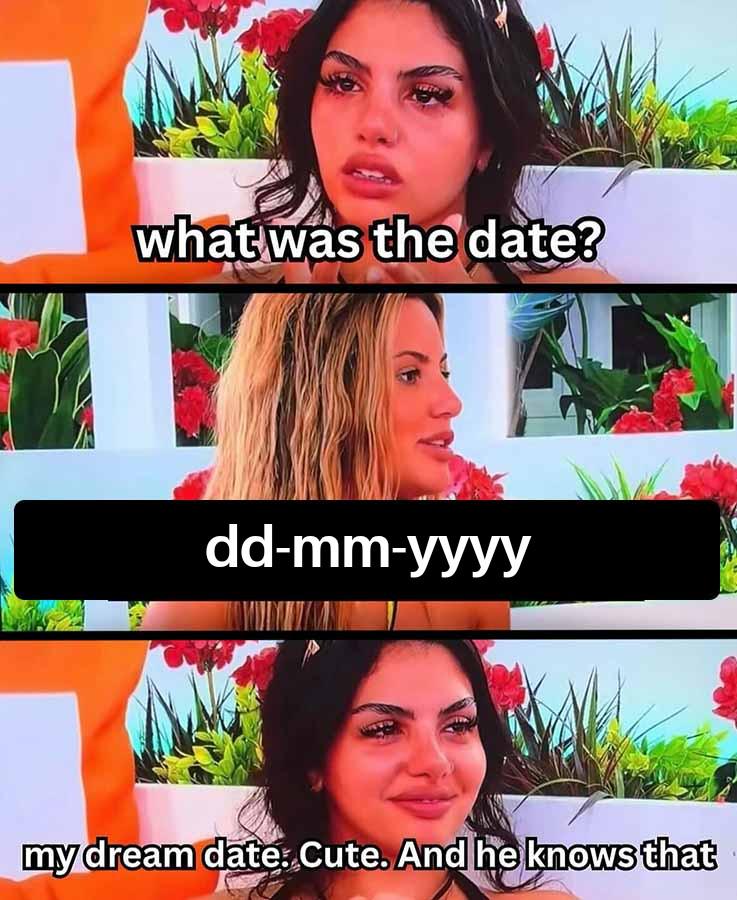
STOP EVERYTHING! This is the most tragically relatable romance of our time! 💔 When someone asks "what was the date?" and your programmer brain immediately jumps to the dd-mm-yyyy format instead of, you know, ACTUAL HUMAN INTERACTION with another living being! The absolute DEVASTATION of realizing your love life has been replaced by date formatting conventions! And yet... there's that tiny part of you that's secretly proud you knew exactly what format they were "asking" about. Your dating life may be in shambles, but your datetime formatting game? FLAWLESS. This is what happens when you spend more time with databases than with dating apps!

The Six Horsemen Of Programming Apocalypse

The Six Horsemen Of Programming Apocalypse
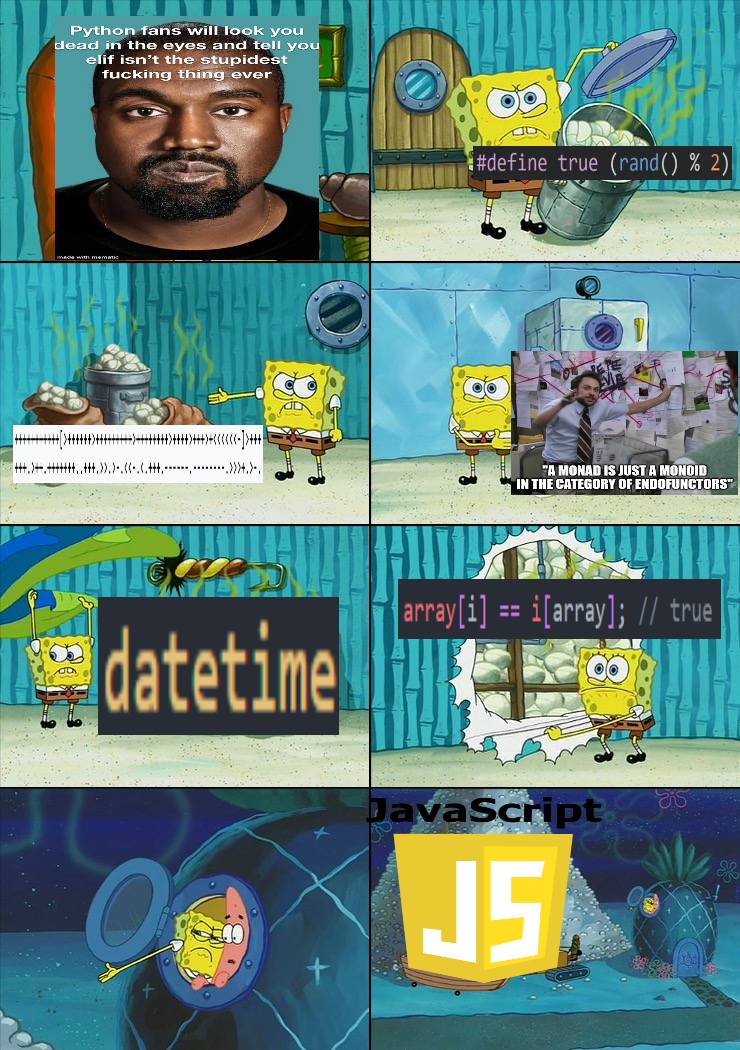
This multi-panel SpongeBob meme is a chaotic tour through programming's most cursed features and debates! First panel: Python's elif keyword getting absolutely roasted. It's literally just "else if" with two characters saved, yet Python devs will defend it with religious fervor. Second panel: SpongeBob defining truth as a random coin flip ( #define true (rand() % 2) ) - the kind of chaotic evil code that would make senior engineers wake up screaming. The functional programming panel with that monads explanation is pure chef's kiss. Nobody understands monads, but everyone pretends to. Then we've got the horrors of datetime libraries (universally painful), JavaScript's cursed array comparison ( array[i] == i[array] evaluating to true because JS type coercion is from the ninth circle of hell), and finally JS itself being the punchline. It's basically "Things That Make Developers Question Their Career Choices: The Meme".