

Backwards compatibility Memes

Posts tagged with Backwards compatibility
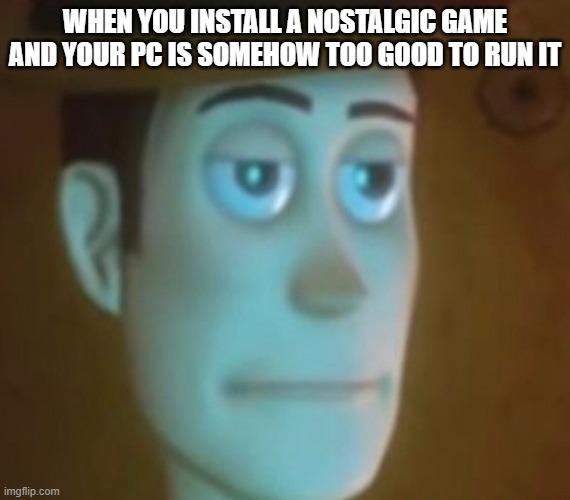
When Your RTX 4090 Can't Handle A Game From Your Childhood

When Your RTX 4090 Can't Handle A Game From Your Childhood
Oh, the sweet IRONY of dropping $1,600 on a graphics card that could probably render the entire universe in 8K, only to watch it choke on a game that ran perfectly fine on your mom's potato PC from 2003. You boot up that beloved childhood classic expecting smooth nostalgia, but instead you're greeted with frame drops, crashes, and the soul-crushing realization that backwards compatibility is a myth invented by optimists. The game was coded when developers were basically writing in hieroglyphics and praying to ancient deities, so of course it's hardcoded to run at exactly 60fps and loses its mind when your NASA-grade GPU tries to help. Now you're frantically googling "how to limit fps" and installing sketchy compatibility patches like some kind of digital archaeologist. The future is truly dystopian when your cutting-edge hardware is TOO powerful to play Pajama Sam.

Javascript Sorting

Javascript Sorting
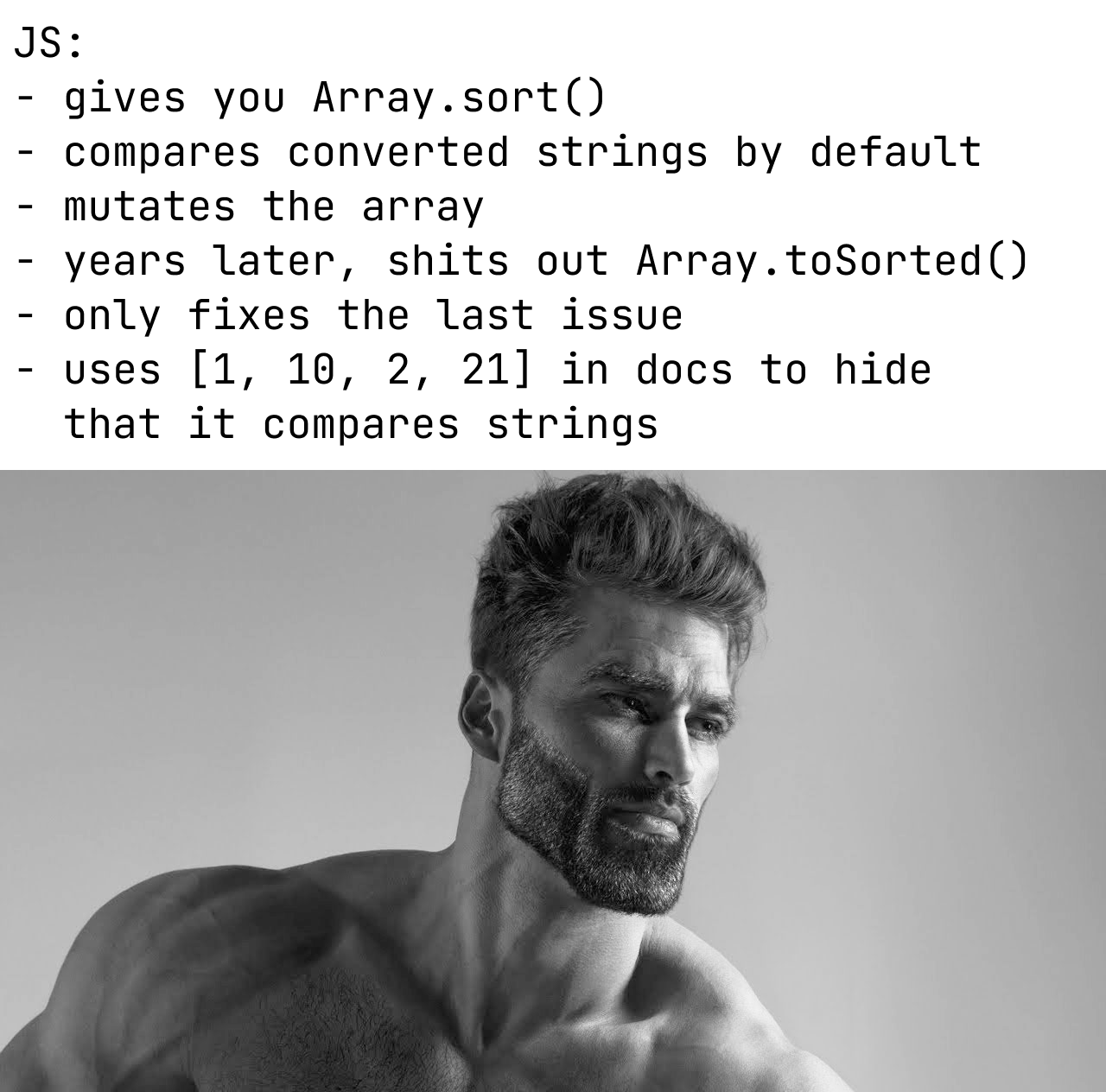
JavaScript's Array.sort() is the embodiment of "task failed successfully." It gives you a sorting method that converts numbers to strings by default (because why wouldn't you?), mutates your original array like it owns the place, and produces the legendary [1, 10, 2, 21] result that's haunted every junior dev's dreams. Then, years of Stack Overflow questions later, JavaScript blessed us with Array.toSorted() - a non-mutating version that fixes exactly ONE of the three problems. You still need to pass a comparator function like (a, b) => a - b to sort numbers properly, and the docs still use that cursed [1, 10, 2, 21] example that looks totally fine until you realize it's lexicographically sorted. The gigachad energy here is JavaScript's unwavering commitment to backwards compatibility - even when the default behavior is objectively wrong for 90% of use cases. Beautiful chaos.

Current Windows Situation

Current Windows Situation
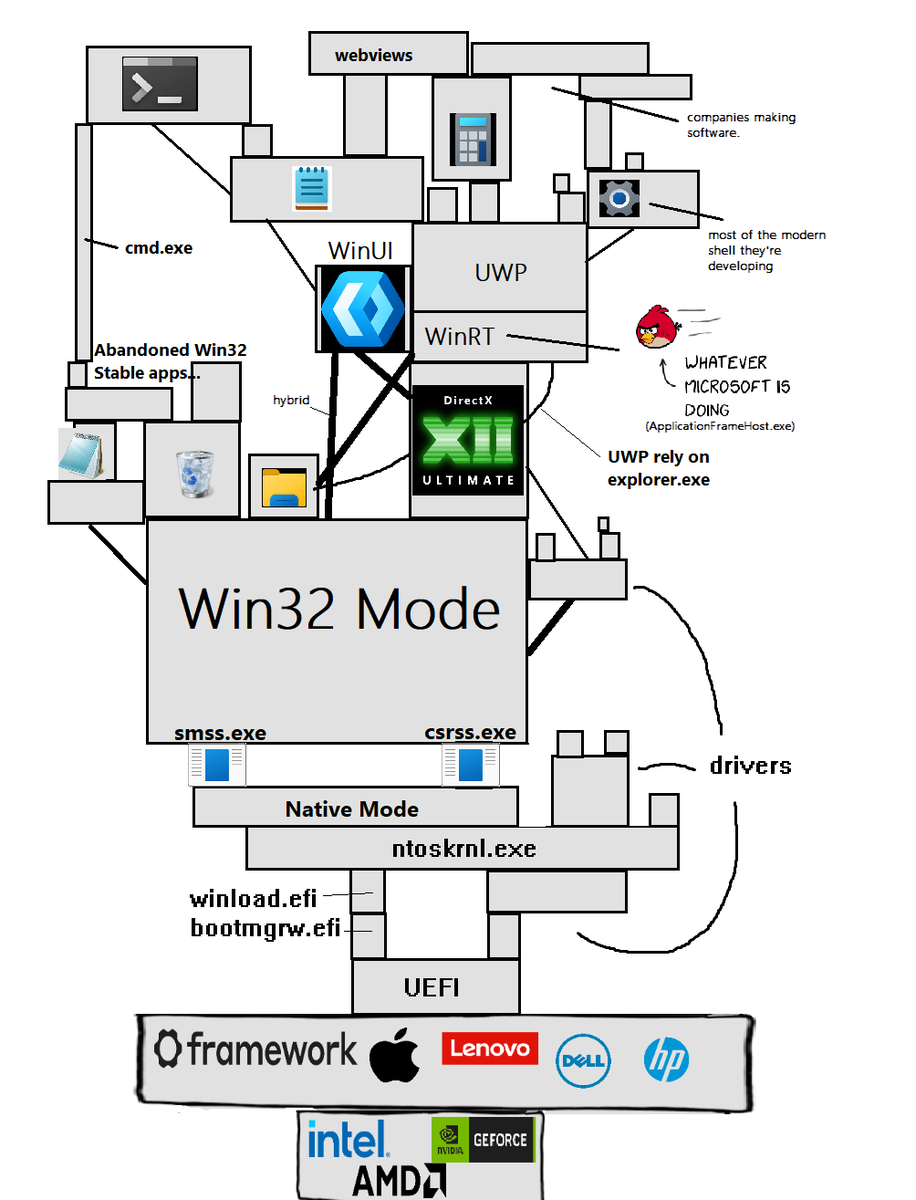
Behold, the architectural masterpiece that is Windows: a delicate Jenga tower of legacy code, abandoned frameworks, and "temporary" solutions that have been around since the Bush administration. At the foundation we've got UEFI sitting on hardware from Intel, AMD, and NVIDIA. Above that, the NT kernel (ntoskrnl.exe) manages drivers and Win32 Mode—the compatibility layer Microsoft can't kill because half the world's enterprise software still runs on crusty Win32 apps from 2003. Then there's the modern stuff: WinUI, UWP (Universal Windows Platform), and WinRT all competing for relevance while somehow depending on explorer.exe and DirectX. UWP apps? Yeah, they're basically running in a compatibility mode themselves at this point. And WinRT is labeled with an Angry Bird because, well, that's about the level of enthusiasm developers have for it. The real comedy gold: "companies making software" are building with webviews and modern shells that ultimately call back to cmd.exe and those "Abandoned Win32 Stable apps" because nothing ever truly dies in Windows. It just gets wrapped in another layer of abstraction. Microsoft's strategy? "WHATEVER MICROSOFT IS DOING (ApplicationFrameHost.exe)"—a mood we can all appreciate. Thirty years of backwards compatibility means your shiny new Windows 11 machine is essentially a museum of every architectural decision since Windows 95, held together with duct tape and prayer.

The Only Socket That Is Likely To Outlive Its Successor

The Only Socket That Is Likely To Outlive Its Successor
AMD's AM4 socket launched in 2017 and supported everything from first-gen Ryzen to Zen 3 chips. Absolute legend. Meanwhile, AM5 dropped in 2022 looking fresh and alive. Fast forward to 2026 and apparently it's already in a casket while AM4 is still kicking around in budget builds and office PCs worldwide. The joke here is that AM4 had such ridiculous longevity that it'll probably outlive its own replacement. You know your platform is immortal when people are still recommending it years after the "next-gen" dropped. AM5 never stood a chance against its own predecessor's legacy. Classic case of following up a greatest hits album with... well, an album.

Two Different Struggles

Two Different Struggles
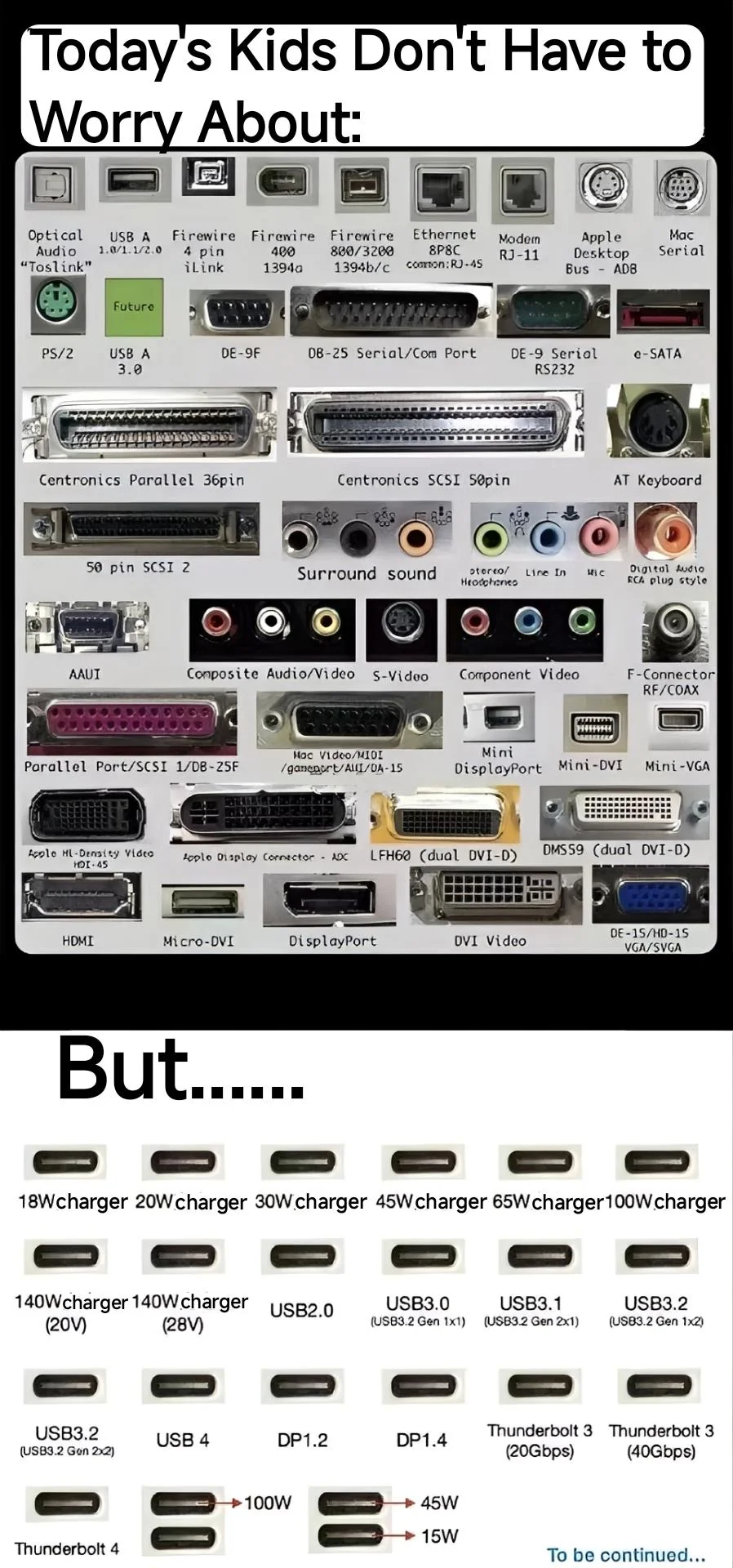
Gen Z walks into a room with just USB-C and calls it a day, while millennials and older devs still have PTSD from the connector wars. You needed a PhD in port identification just to hook up a printer back in the day—Centronics Parallel 36pin? DB-25 Serial? FireWire 800/3200? Pick your poison. But here's the kicker: we traded the chaos of 30+ different physical connectors for the absolute minefield of USB-C doing everything and nothing at the same time. That innocent-looking port could be USB 2.0 (480 Mbps), USB 3.2 Gen 2x2 (20 Gbps), Thunderbolt 4 (40 Gbps), delivering 15W or 100W of power, or just... decorative. You literally can't tell by looking at it. At least with PS/2 you KNEW it was for your keyboard. Now you're playing Russian roulette with identical ports wondering why your "USB-C" cable won't charge your laptop or transfer files faster than dial-up. Progress!

Ten Years Of No Changes

Ten Years Of No Changes
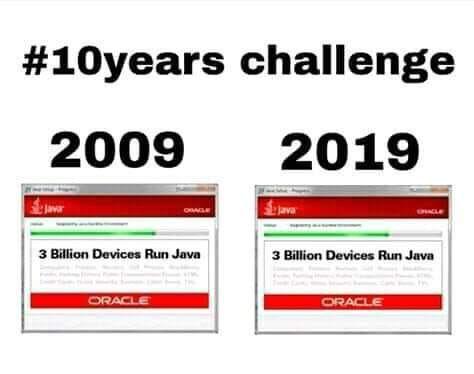
Oracle really said "if it ain't broke, don't fix it" and then just copy-pasted the same marketing slide for an entire DECADE. Like, they didn't even try to pretend they updated something. Same "3 Billion Devices Run Java" tagline, same design, same everything. It's giving "I've been wearing the same outfit for 10 years and nobody noticed" energy. The most stable thing in tech isn't your production server—it's Oracle's commitment to recycling their own promotional materials. Reduce, reuse, recycle, am I right? At least they're environmentally conscious with their PowerPoint presentations.

DDR4 Is Back On The Menu Boys

DDR4 Is Back On The Menu Boys
When DDR5 launched, everyone thought DDR4 was heading to the retirement home. Prices were supposed to crater, availability would vanish, and motherboard manufacturers would pretend it never existed. Classic tech lifecycle, right? Plot twist: DDR5 was expensive, had supply issues, and honestly didn't offer enough performance gains to justify the premium for most builds. So DDR4 pulled a Mark Twain and declared that reports of its death were greatly exaggerated. Suddenly budget builders and mid-range enthusiasts realized they could still get perfectly viable systems without selling a kidney. The community went from mourning DDR4's demise to celebrating its unexpected comeback tour. It's like finding out your favorite deprecated API is still supported in the new version because too many people complained.

Club 3D USB C Switch 8K 60Hz Bi-Directional - 2 Computers to 1 Monitor or 1 PC to 2 Displays - USB-C Video Switch with 100W Power Delivery Passthrough for MacBook Pro, Laptop, Thunderbolt

Club 3D USB C Switch 8K 60Hz Bi-Directional - 2 Computers to 1 Monitor or 1 PC to 2 Displays - USB-C Video Switch with 100W Power Delivery Passthrough for MacBook Pro, Laptop, Thunderbolt
Bi-Directional Switching: Flexible setup options allow you to connect either two USB-C source devices to one display or one source device to two separate displays. Only one connection path is active …

Annoying For Parsing

Annoying For Parsing
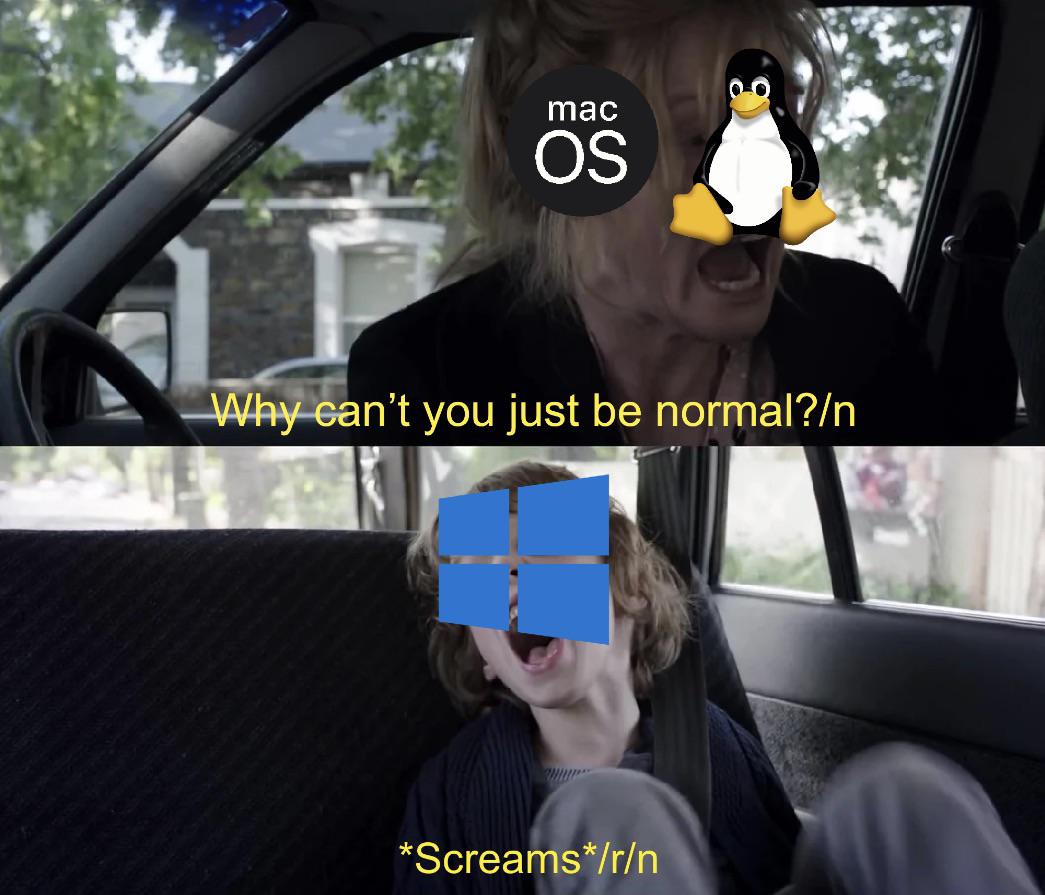
Windows just can't help itself. While macOS and Linux civilized OSes use a simple \n for line endings, Windows insists on the verbose \r\n combo (carriage return + line feed, a relic from typewriter days). This makes cross-platform text parsing a nightmare—your regex breaks, your file diffs look like chaos, and Git constantly warns you about line ending conversions. It's like Windows showed up to a minimalist party wearing a full Victorian outfit. The extra \r serves literally no purpose in modern computing except to remind us that backwards compatibility is both a blessing and a curse.

Backwards Compatibility: PC Master Race Edition

Backwards Compatibility: PC Master Race Edition
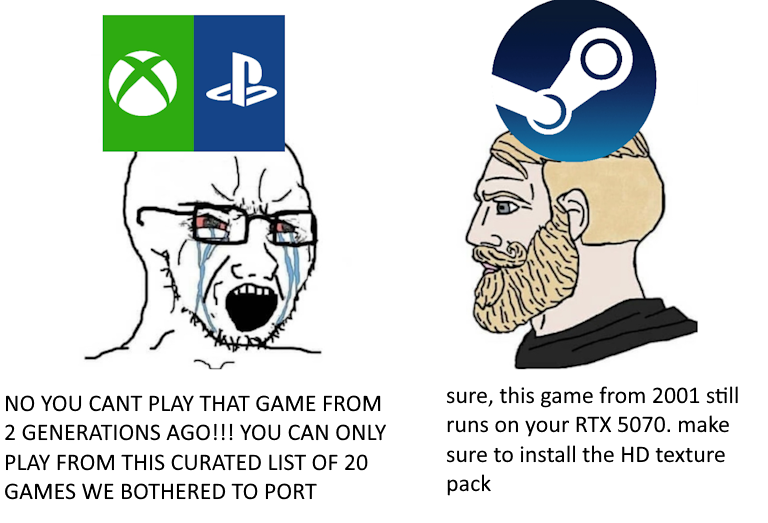
Console gamers sobbing because they can't play a 20-year-old title without paying for yet another remaster, while PC gamers casually run ancient games on cutting-edge hardware like it's no big deal. The true irony? Console makers talk about "ecosystem" while Steam is over here actually preserving gaming history. Your $3000 graphics card running Morrowind at 400 FPS with mods is peak gaming culture.

On 3 Billion Devices Until The End Of Time

On 3 Billion Devices Until The End Of Time
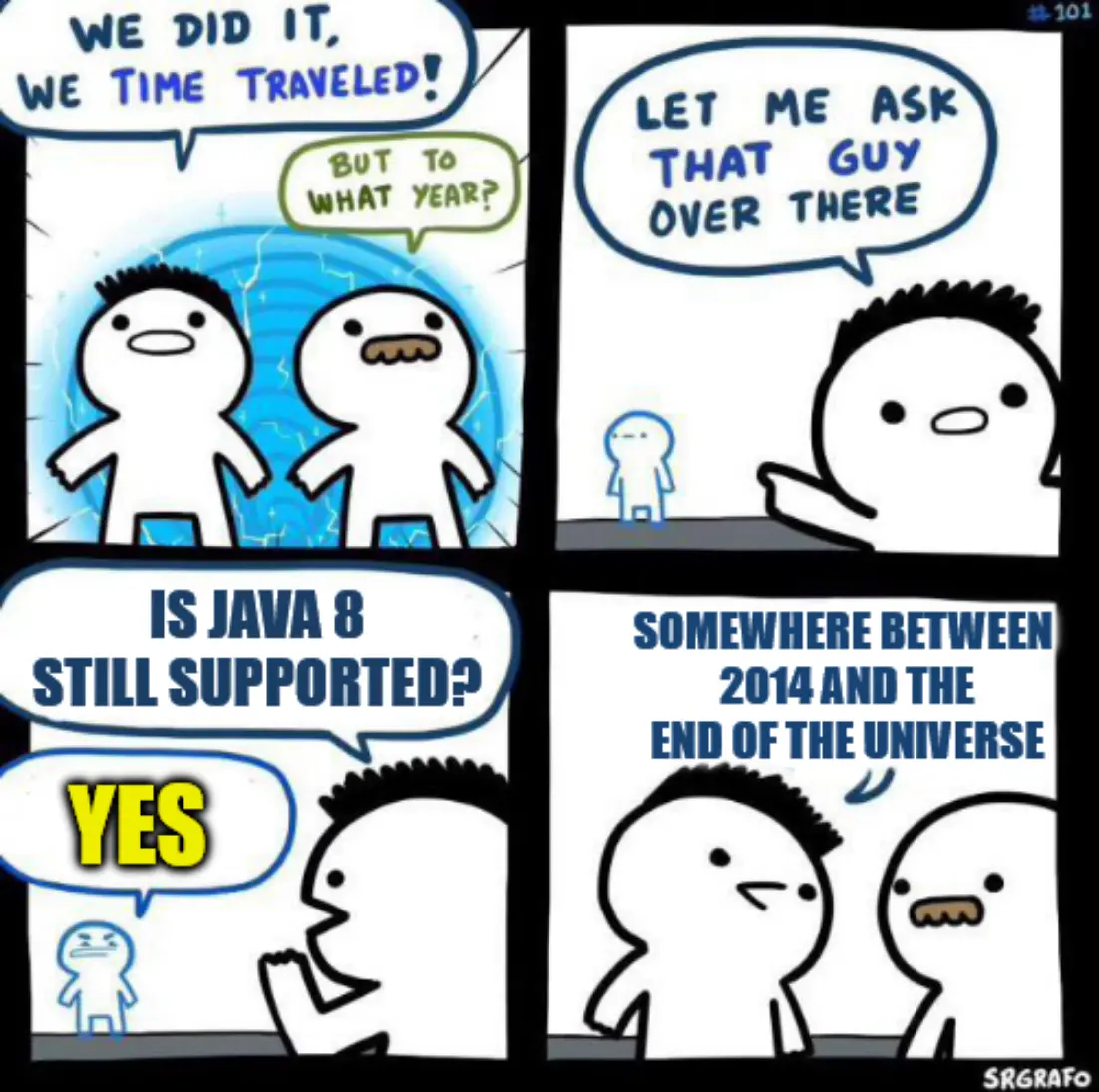
The eternal NIGHTMARE that is Java version support! These time travelers discover they've landed in the bizarre twilight zone where Java 8 (released in 2014!) is somehow STILL supported despite being practically ANCIENT in tech years! 💀 It's like finding out your grandpa's flip phone will be supported until the heat death of the universe while your 2-year-old smartphone is already "legacy hardware." The Java ecosystem is that friend who refuses to throw away their collection of VHS tapes "just in case they come back in style."

When You Enjoy Your Legacy Java 8 Codebase

When You Enjoy Your Legacy Java 8 Codebase
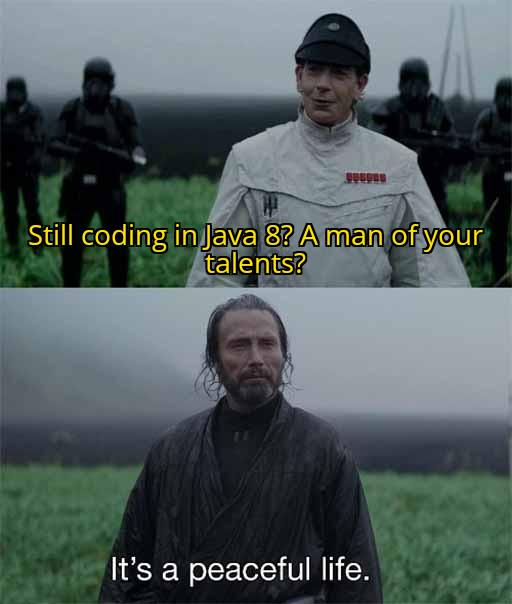
The Empire (management) questions why anyone would still use Java 8 in 2023, while the Jedi (developer) just wants to be left alone with their stable, predictable codebase. No security patches? No problem. Legacy code doesn't care about your fancy new features when it's been running flawlessly since 2014. The dark side is tempting with its shiny Java 21 virtual threads, but some of us prefer our ancient garbage collector and reliable NullPointerExceptions just where we expect them.

The Great Cable Extinction

The Great Cable Extinction
Ah, the great cable simplification. We went from needing a toolbox full of serial, parallel, VGA, PS/2, and power connectors—each with their own special way of refusing to plug in correctly—to just USB-C. Sure, now we can power a monitor, transfer data, and charge a device with one cable... but we've traded 15 different cables for 15 different dongles. Progress, I guess? At least we can finally plug it in correctly on the third try instead of the fourth.