

Average Programmer

Average Programmer
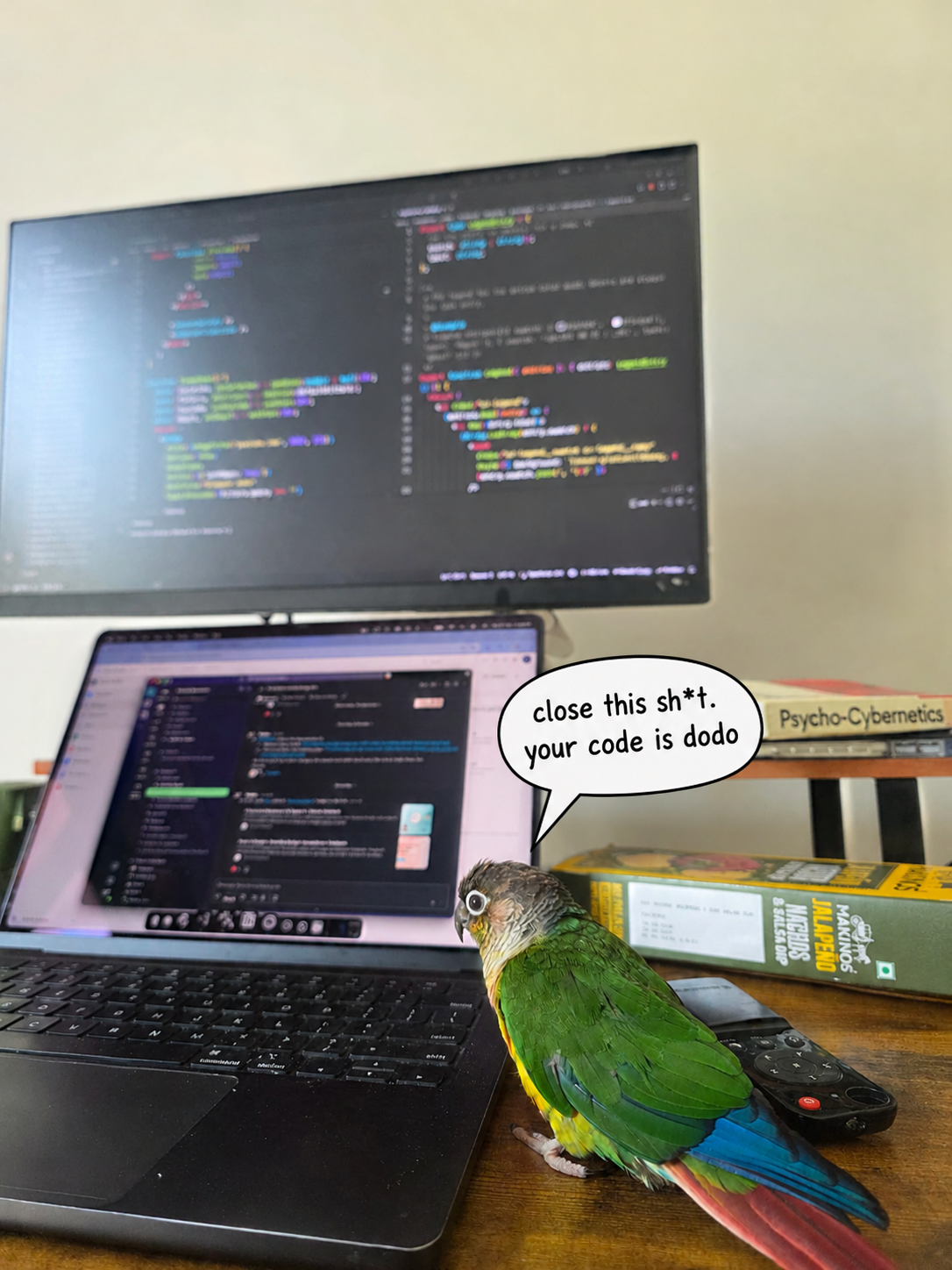
The absolute AUDACITY of calling us out like this! Look, nobody actually enjoys coding—we're just here because sitting in front of a laptop with our brows furrowed makes us look like we're solving world hunger. The reality? We're probably scrolling through memes, reading documentation for the 47th time, or desperately trying to remember what that function we wrote yesterday actually does. But hey, at least we LOOK busy, and that's what really matters in life, right? The illusion of productivity is basically our entire personality at this point.

Nobody Tell Him About Ss Ms

Nobody Tell Him About Ss Ms
God really said "fine, you want attention? Here's a whole new unit of time complexity" and dropped milliseconds, microseconds, and nanoseconds on humanity like divine punishment. The Tower of Babel reference is *chef's kiss* because just like that biblical disaster where everyone suddenly spoke different languages, we now have a fragmented mess of time units that nobody can agree on. Seconds seemed perfectly fine for centuries, but nooo, computers had to ruin everything by being too fast. Now we're measuring things in nanoseconds like we're racing photons. Wait until this guy finds out about picoseconds and femtoseconds—that's when the real existential crisis begins.

Crazy Take

Crazy Take
Someone just discovered that AWS bills exist and they're NOT taking it well. Imagine the absolute AUDACITY of suggesting that public services should be... *checks notes* ...publicly funded and not designed to extract maximum shareholder value from your suffering. Revolutionary stuff, truly. Meanwhile SaaS companies are sweating bullets reading this like "wait, you guys aren't supposed to know this is an option." The clapping hands between every word really drives home the passionate rage of someone who just got their first $10,000 cloud bill for hosting a personal blog.

Why Did We Give Up Upgradeable CPUs In Exchange For Anorexic Laptops?

Why Did We Give Up Upgradeable CPUs In Exchange For Anorexic Laptops?
Remember when laptops had ports? Like, actual ports you could use? VGA, Ethernet, USB-A, headphone jack, maybe even a DVD drive if you were fancy. Those thicc boys on the left let you swap RAM, upgrade storage, and occasionally even replace the CPU without needing a degree in microsurgery. Now we've got these ultra-thin fashion statements that throttle at 80°C, have everything soldered to the motherboard, and require a dongle for literally everything. Sure, they look sleek in coffee shops, but good luck fixing anything yourself. One component dies? Better sell a kidney for a new motherboard. The industry convinced everyone that 2mm of thickness savings was worth sacrificing repairability, upgradeability, and thermal performance. We traded function for form, and now we're stuck with laptops that are basically expensive disposable devices. Real men prefer fat laptops because they actually want their hardware to last longer than the warranty period.

But Why?

But Why?
You know that moment when you decide to be responsible and dust off your rig, maybe swap out some thermal paste, reorganize those cable rats nests... and then the power button becomes a decorative element? Nothing. No POST beep. No fan spin. Just the sound of your own panicked breathing. Now you're sitting there mentally retracing every single step, wondering if you accidentally unplugged the front panel connectors, shorted something with a stray screw, or angered the PC gods by daring to improve things. The RAM is probably just slightly unseated. Or you forgot to flip the PSU switch back on. Or your motherboard decided retirement was preferable to another cleaning session. Maintenance: the fastest way to turn a working computer into a very expensive paperweight.

Review AI Code

Review AI Code
Yeah, that wall's gonna collapse in production. The junior dev suggests maybe reviewing the AI-generated code before shipping, but the senior's already committed to velocity over quality. "It compiles, ship it" energy at its finest. Sure, the foundation is wonky, the alignment is off, and there's probably a memory leak somewhere in those bricks, but hey—it works on my machine. The tech debt will be someone else's problem in six months when the whole thing comes crumbling down during a customer demo.

Give Him A Break

Give Him A Break
The programmer got stuck in an infinite loop. No exit condition, no break statement, just pure existential dread in aisle 3. His wife made the classic mistake of adding a task to his queue while he was already mid-execution. Now he's trapped in a while(atStore) loop with no way out because getting milk was never properly scoped. The condition never evaluates to false, so he's doomed to wander the grocery store forever, probably still looking for that one specific brand she didn't specify. Should've used a for loop with a defined iteration count.

Out Nerded The Source Code

Out Nerded The Source Code
When your 12-year-old labels you as "Source Code" in their phone, you think you've peaked as a programmer parent. Then you check what they named your spouse and find "Data Compiler" staring back at you. The kid understands the fundamental relationship: source code is what you write, but the compiler is what actually makes everything work and catches all your mistakes. Dad writes the buggy logic, Mom debugs it and turns it into something functional. Getting intellectually destroyed by a middle schooler who just discovered computer science metaphors hits different. The student has become the master.

For Theoretical Computer Scientists

For Theoretical Computer Scientists
Theoretical computer scientists really out here creating algorithms with time complexity that looks like someone smashed their keyboard while having a seizure—O(n 72649 lg 72 (n))—and then celebrating like they just won the lottery because "hey, at least it's polynomial time!" The P vs NP problem has these folks so desperate for wins that proving something is solvable in polynomial time (even if that polynomial makes the heat death of the universe look quick) is cause for celebration. Sure, your algorithm would take longer than the age of the universe to sort a deck of cards, but technically it's in P, so break out the champagne! It's like saying "I can walk to Mars" and when everyone looks at you skeptically, you add "well, it's theoretically possible!" Meanwhile, us practical programmers are over here optimizing O(n log n) to O(n) and actually shipping products.

Anyone Have A PC Like This?

Anyone Have A PC Like This?
The classic gaming rig power imbalance. You've got a beastly GPU that could render the entire Marvel Cinematic Universe in real-time, paired with a CPU that's basically flexing just as hard... and then there's the motherboard looking like it's one power surge away from having a complete meltdown. That's what happens when you blow your entire budget on the shiny parts and realize too late that you cheaped out on the foundation. The motherboard is just sitting there, tongue out, barely holding these two titans together while they're trying to communicate at blazing speeds through its budget-tier circuitry. Pro tip: Your $1200 GPU deserves better than a $80 motherboard from 2016. It's like putting a Ferrari engine in a golf cart.

This Seems Better In My Head

This Seems Better In My Head
The evolution of variable naming conventions, as told by increasingly sophisticated Winnie the Pooh. Starting with "seaPlusPlus" (a literal translation that screams "I just learned camelCase yesterday"), moving up to "syncrement" (okay, now we're getting creative with portmanteaus), and finally ascending to "see peepee" - the pinnacle of developer humor. Because nothing says "professional codebase" quite like a variable name that makes your code reviewer do a double-take. Sure, "seaPlusPlus" is technically descriptive for incrementing a variable called "sea", but where's the fun in that? The real genius move is naming it something that sounds vaguely technical until you say it out loud in a meeting. Then everyone realizes you've been giggling at your own joke for three sprints. Fun fact: This is why code reviews exist - not to catch bugs, but to prevent variables named after bodily functions from making it to production. Your future self (and your teammates) will either thank you or file an HR complaint.

If It Works It Works

If It Works It Works
The eternal duality of code review: 10 lines? Time to channel your inner perfectionist and scrutinize every semicolon, variable name, and whitespace choice like you're defending your PhD thesis. 2000 lines? "LGTM" faster than you can say "technical debt." Senior devs know that reviewing a massive PR properly would take hours, and honestly? Nobody has time for that. Plus, if it compiles and the tests pass (they do pass, right?), who are we to question the architectural decisions made in those 1,847 lines we definitely didn't read? The cognitive load of context-switching into a codebase the size of a novel is just... nah. Meanwhile, that 10-line PR gets the full treatment because our brains can actually process it. "Why didn't you use a ternary here?" "This could be a one-liner." "Have you considered extracting this into a helper function?" We become code review warriors when the battlefield is manageable.