

Vulnerability Memes

Posts tagged with Vulnerability
Another Windows Zeroday, The Repo Text Is Hilarious

Another Windows Zeroday, The Repo Text Is Hilarious
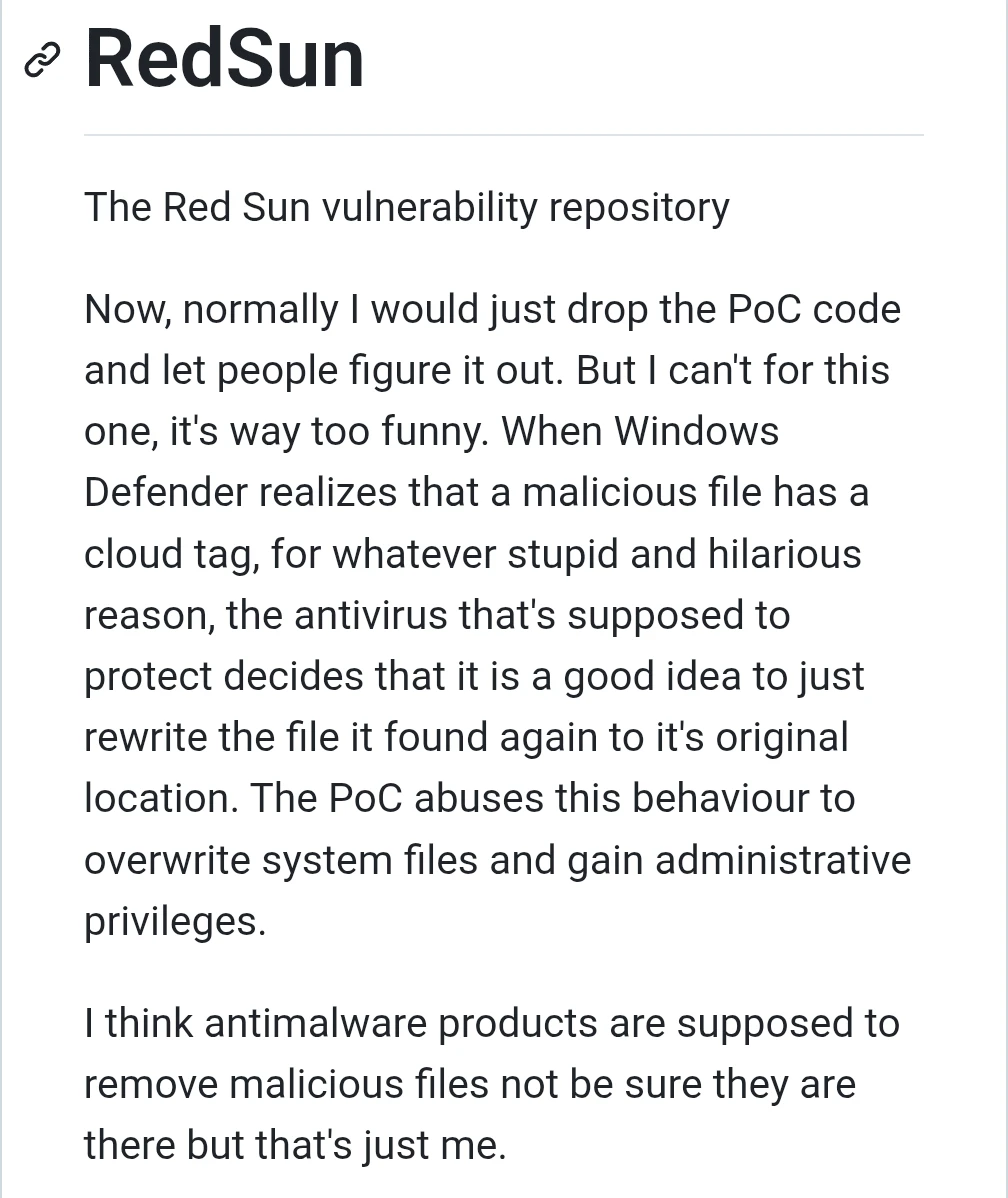
So Windows Defender found a malicious file with a "cloud tag" and thought, "You know what? Let me just restore this bad boy to its original location." Because nothing says security like putting the threat back where you found it. The exploit author couldn't even keep a straight face while writing the PoC—when your antivirus actively helps malware overwrite system files and gain admin privileges, you've transcended from bug to comedy gold. The sarcastic kicker at the end is *chef's kiss*: "I think antimalware products are supposed to remove malicious files not be sure they are there but that's just me." Yeah, just a minor detail in antivirus software design. It's like hiring a bouncer who not only lets the troublemakers in but also gives them the VIP pass and keys to the safe. Microsoft's security team must be having a great day reading this one. Another Tuesday, another zero-day that makes you question if Windows Defender is secretly working for the other side.

State Of Things

State Of Things
Bug bounty programs in 2026 are apparently going to be less "here's $50k for finding a critical vulnerability" and more "here's a dollar, now stop bothering us." The progression from confidently dropping those shiny metal balls (bugs) expecting a decent payout to literally begging for scraps with "one dollar please" is painfully accurate. Companies have mastered the art of devaluing security researchers' work. You find a zero-day that could compromise millions of users? Best we can do is a thank you in the changelog and maybe enough money for a coffee. Not even a fancy coffee—we're talking gas station coffee here. The real kicker is how bug bounty platforms keep adding more restrictions, longer validation times, and lower payouts while companies act like they're doing YOU a favor by letting you find their security holes for free. Peak capitalism meets cybersecurity, and somehow we're all surprised when critical vulnerabilities get sold on the dark web instead.

Cyber Secure Number One

Cyber Secure Number One
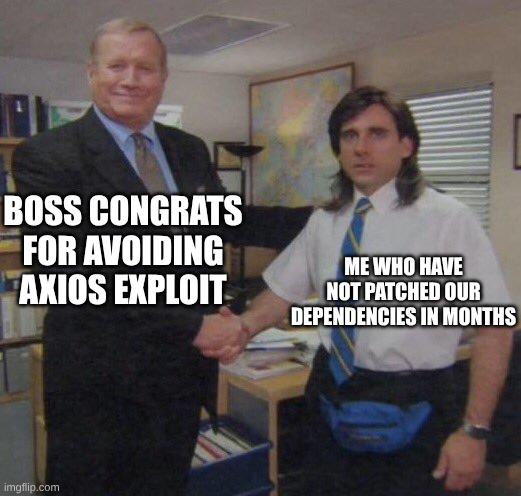
Classic corporate theater right here. Boss is out there taking victory laps for "avoiding" a critical exploit while the dev team hasn't run npm update since the Stone Age. You didn't dodge the vulnerability—you just haven't been pwned yet . There's a difference between being secure and just being lucky nobody's bothered to scan your infrastructure. Every security team knows this feeling: management celebrating "proactive security measures" while your package.json is basically a CVE museum. That Axios exploit? Sure, you're not vulnerable... because you're still running a version from 2019 that has 47 OTHER vulnerabilities. It's like bragging about not getting COVID while living in a house made of asbestos.

Ultimate Security Update

Ultimate Security Update
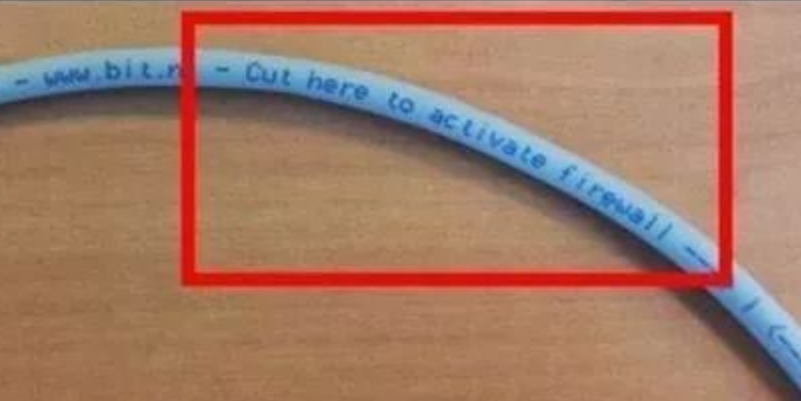
When your security team's idea of "patching vulnerabilities" is literally cutting off the attack vector. Can't exploit what doesn't exist anymore, right? Just snip that pesky activation link clean off. This is basically the physical embodiment of every "just disable the feature" security fix I've ever shipped under pressure. Sure, the phishing link can't work if users physically cannot click it. Problem solved, ticket closed, moving on. 10/10 would recommend this approach for your next penetration test report. "Mitigated all email-based attacks by removing email functionality."

Please

Please...
When you're staring at a dependency graph that looks like someone dropped spaghetti on a whiteboard and hit "visualize," you know you're in for a good time. That's OpenSSL sitting there in the middle like the popular kid everyone wants to hang out with, connected to literally everything. The walking stick figure begging it to burst already? That's every developer who's had to debug a vulnerability that cascades through 47 different packages. One CVE drops and suddenly your entire infrastructure is playing six degrees of OpenSSL. The best part is knowing that if it actually did burst, half the internet would go down faster than a poorly configured load balancer. Fun fact: OpenSSL has more dependencies on it than most developers have on coffee.

I Made This Calculator App When I Was 10. I Thought It Would Be Really Cool To Eval() Unsanitized Code

I Made This Calculator App When I Was 10. I Thought It Would Be Really Cool To Eval() Unsanitized Code
When 10-year-old you discovered eval() and thought "this is the most elegant solution ever invented" without realizing you just created a remote code execution playground. The input field literally says alert("hi") and the app helpfully executed it, producing some cursed negative number as output. The error message is peak comedy: "If it is not working, you might have typed something bad and the app doesn't want to take the input" – translation: "I have no idea what's happening under the hood and I'm blaming YOU for it." Classic junior dev energy. Using eval() on user input is basically handing attackers the keys to your kingdom and saying "please be nice." It's the security equivalent of leaving your front door open with a sign that says "robbers welcome, valuables upstairs." But hey, at least they learned this lesson early before deploying it to production... right?

Mongo Bleed Is Web Scale

Mongo Bleed Is Web Scale
A critical MongoDB vulnerability that sat dormant for 8 years (2017-2025) just got discovered, letting attackers yank out heap data like passwords and API keys through a malformed zlib request. The bug was literally committed in June 2017 and merged into production. The fix? Written in December 2025. That's an 8-year nap. But here's the kicker: there are over 213,000 potentially vulnerable MongoDB instances exposed to the internet. The punchline? "ensuring that this exploit is web scale ." 😂 For context, "web scale" is a legendary meme from a satirical video where someone hilariously defends MongoDB's design choices with buzzwords. Now it's come full circle—MongoDB's vulnerability is literally web scale with 213k+ exposed instances. MongoDB also claims "no evidence" of exploitation despite the bug being trivially simple for 8 years. Sure, Jan. Oh, and they haven't apologized yet. Classic.

Game Dev Security By Anonymity

Game Dev Security By Anonymity
The ultimate security strategy for indie devs: complete market obscurity. Why worry about CVE-2025-59489 when your player count is firmly stuck at zero? That's not a bug, that's a feature! The vulnerability can't affect your users if you don't have any. It's like spending three years building an impenetrable fortress only to realize nobody wants to break in because there's nothing valuable inside. Security through unpopularity - the unintentional benefit of grinding away at a game that only your mom will play (and even she's just being nice).

They Used The Example Key In Prod

They Used The Example Key In Prod
Ah yes, the classic "let's use the example key from the documentation" approach to security. Like putting "1234" as your bank PIN because it was the example in the manual. AMD apparently used a test cryptographic key from a NIST publication in actual Zen CPUs for years. The stunned ellipses and "I have no words" perfectly capture that special moment when you discover someone's treated a security example as production-ready code. It's the security equivalent of finding out your nuclear launch codes are "password123".

Security Analysts: Paid To Be Ignored

Security Analysts: Paid To Be Ignored
The security industry in a nutshell, folks. You hire "analysts" who confirm they're analysts, confirm they get paid to analyze, but when they actually find something—like a Log4j vulnerability that needs immediate patching—management's response is "Nah, P0 incident? That's an EOD problem." Nothing quite like hiring security experts only to ignore their expertise when it requires actual work. The classic corporate cycle: pay for security, ignore security recommendations, wonder why you got breached. Then blame the security team who warned you six months ago. For the uninitiated, Log4j was that delightful little vulnerability from 2021 that had security teams working through Christmas while executives were sipping eggnog and asking "can't we just deal with it after the holidays?"

It Was Never Patched

It Was Never Patched
Four years of computer science education vs. one Android kernel vulnerability that says "You are now a developer." The duality of modern tech! Somewhere, a CS professor is crying into their algorithms textbook while script kiddies are getting root access with zero knowledge of Big O notation. That security hole has been letting people "become developers" since 2014, and Google's probably still marking it as "will fix in next release" on their Jira board.

My Heart Is Bleeding

My Heart Is Bleeding
Ah, the infamous memcpy() function - the digital equivalent of handing scissors to a toddler. For the uninitiated, this meme references the notorious Heartbleed vulnerability that rocked the security world in 2014. When someone uses memcpy(bp, pl, payload) without proper bounds checking, they're basically saying "here's my memory, take whatever you want!" The terrified Squidward face perfectly captures that moment when you realize your opponent can read arbitrary memory chunks and steal sensitive data like private keys. Nothing says "game over" quite like discovering someone can peek at your server's memory like it's an open book.