Syntax errors Memes

Posts tagged with Syntax errors
Nah I Can't Be Bothered

Nah I Can't Be Bothered
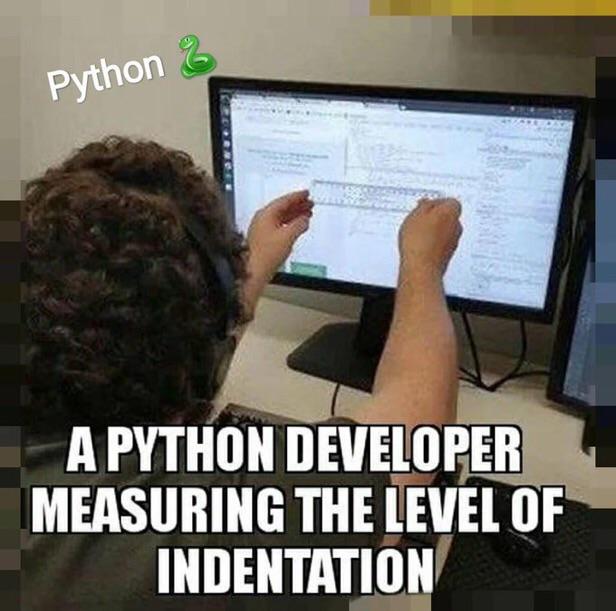
You've been debugging for THREE HOURS, your eyes are bloodshot, your coffee's gone cold, and you're questioning every life choice that led you to this moment. Then FINALLY—like finding water in the desert—you discover it's a rogue whitespace character. A space. A tab. Some invisible demon lurking in your code like it owns the place. And just when you think you've won the battle, you realize... wait. There might be MORE of these invisible gremlins hiding elsewhere in your codebase. But do you have the energy to hunt them all down? NOPE. Not today, Satan. You fix the one causing the error and pretend the others don't exist. What they don't know won't hurt them, right? Right?!

Python Interpreter Be Like

Python Interpreter Be Like
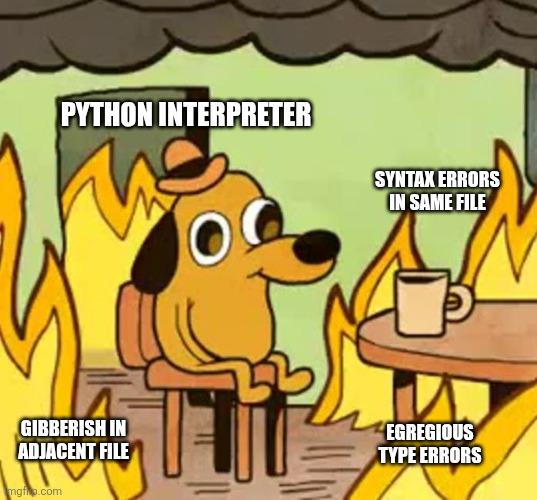
Python's interpreter sitting there sipping coffee while the entire codebase burns around it. Got syntax errors screaming at you? Type errors throwing a tantrum? Random gibberish in some other file? Everything's fine. Just vibing. The interpreter only checks syntax when it actually runs a line, so you can have a complete dumpster fire waiting three functions deep and Python won't say a word until runtime. It's like having a copilot who only mentions the engine's on fire after you've already taken off. Meanwhile, compiled languages are out here catching your mistakes before you even hit save. But hey, at least you saved 30 seconds not declaring variable types.

You Can't Change My Mind

You Can't Change My Mind
Listen, the man is out here speaking TRUTH and nobody wants to hear it! Missing semicolons? Not a real issue? The absolute AUDACITY! Every developer knows that one missing semicolon is responsible for approximately 47% of all mental breakdowns in the tech industry. But here's the kicker—he's not entirely wrong. Modern IDEs and linters have become so good at catching these little syntax terrorists that they're basically extinct in the wild. Your editor screams at you with angry red squiggles before you even finish typing the line. The days of spending three hours debugging only to find a missing semicolon on line 247 are mostly behind us (mostly being the key word here, because JavaScript developers are still having existential crises about whether to use them or not). But let's be real: the PTSD from that one time in college when a missing semicolon ruined your entire project? That trauma is forever.

Yoda Is Wise

Yoda Is Wise
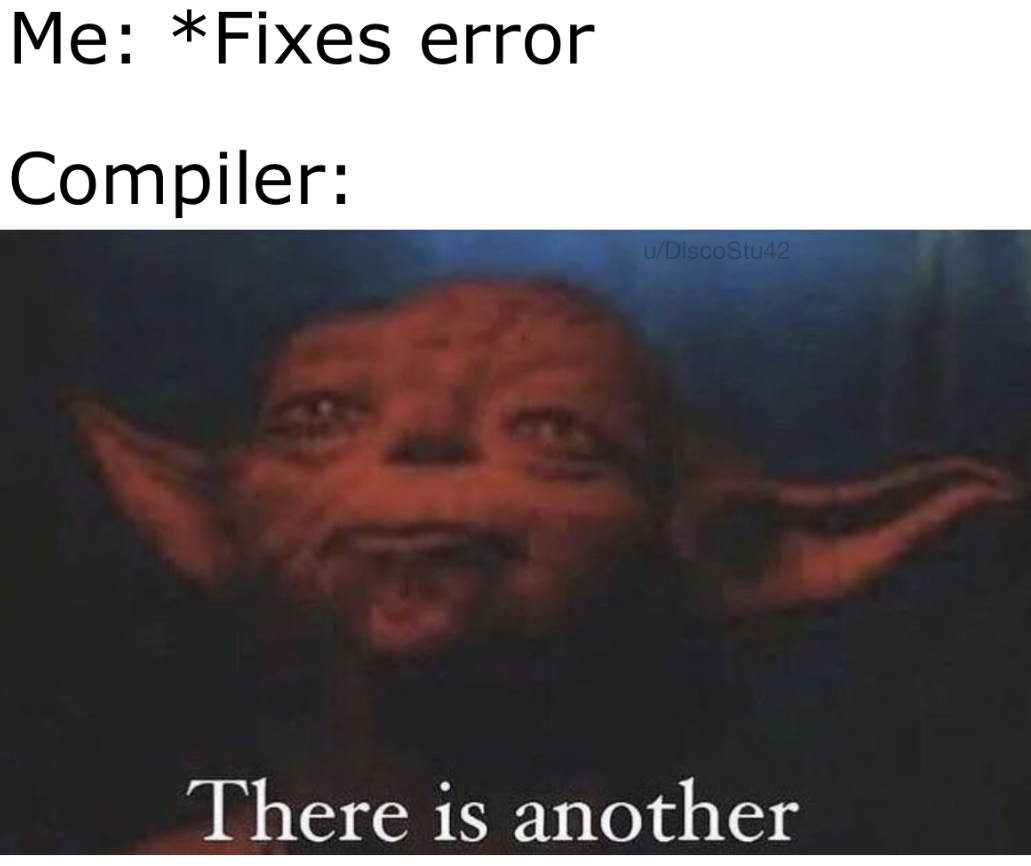
You fix one error. The compiler, wise in the ways of suffering, gently informs you there are 47 more waiting in the shadows. It's like playing whack-a-mole, except the moles are syntax errors and they multiply when you're not looking. The compiler doesn't celebrate your small victories—it just keeps the scoreboard updated on how badly you're losing.

Semicolon Removed Civilization Collapsed

Semicolon Removed Civilization Collapsed
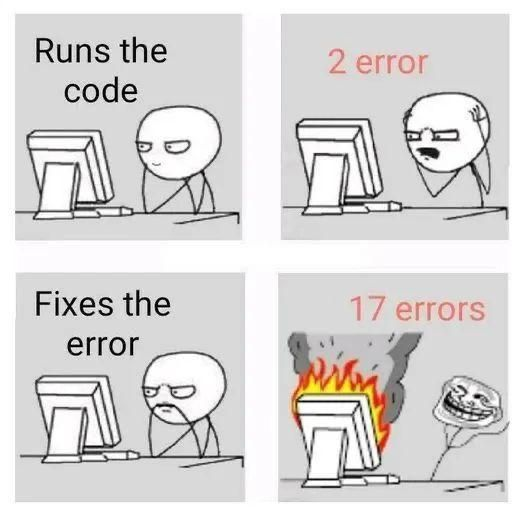
The classic cascade failure. You fix one tiny syntax error—probably a missing semicolon in JavaScript or C++—and suddenly your compiler discovers 15 more errors that were somehow hiding behind it. It's like pulling one thread and watching the entire sweater unravel. The real kicker? Those 17 errors aren't even real errors. They're just the compiler having an existential crisis because it couldn't parse anything after your original mistake. Remove one semicolon, get a cascade of "undefined variable," "unexpected token," and "syntax error" messages that make it look like you've never coded in your life. The computer's literally on fire in the last panel, which is honestly how it feels when your terminal floods with red text. Pro tip: Always fix errors from top to bottom, because 90% of them are just the compiler being dramatic about that first typo.

Python Users Watching The Chaos Unfold

Python Users Watching The Chaos Unfold
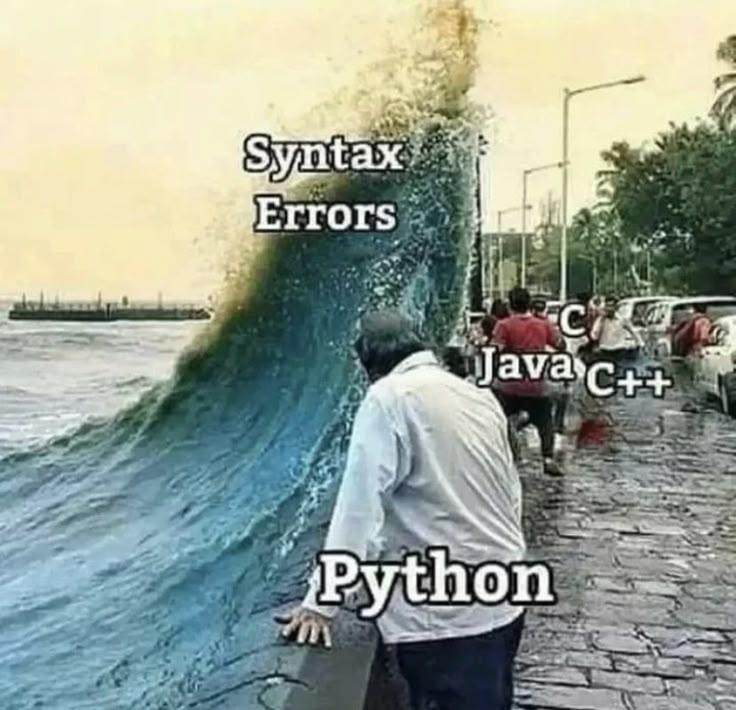
Nothing quite like watching Java and C++ devs lose their minds over a missing semicolon while you're just vibing with your indentation-based syntax. They're drowning in compiler errors and type declarations, meanwhile Python's over here like "yeah I'll figure out what type that is at runtime, no biggie." The beauty of dynamic typing and not having to declare every single variable with its ancestral lineage. Sure, we might discover our bugs at 3 AM in production instead of compile time, but at least we're not writing 47 lines of boilerplate just to print "Hello World."

NordVPN

NordVPN
Encrypt your traffic on public Wi-Fi, stream from anywhere, and cover up to ten devices with one plan. 30-day money-back guarantee.

Summoners

Summoners
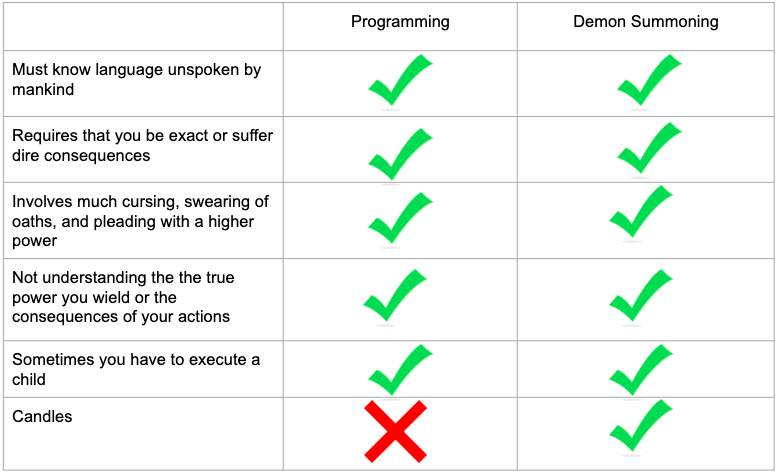
Turns out programming and demon summoning have more in common than we thought. Both require you to speak arcane languages nobody really understands, mess up one semicolon (or pentagram line) and you're debugging for hours, and there's definitely a lot of yelling at invisible forces that refuse to do what you want. The best part? Programmers don't even get candles. We just sit in the dark with our blue light screens, sacrificing our sleep and sanity to the gods of Stack Overflow, hoping our code doesn't summon a production bug instead of the feature we wanted. At least demon summoners have cool robes. We just have hoodies and imposter syndrome.

Humiliating My Little Shit Code

Humiliating My Little Shit Code
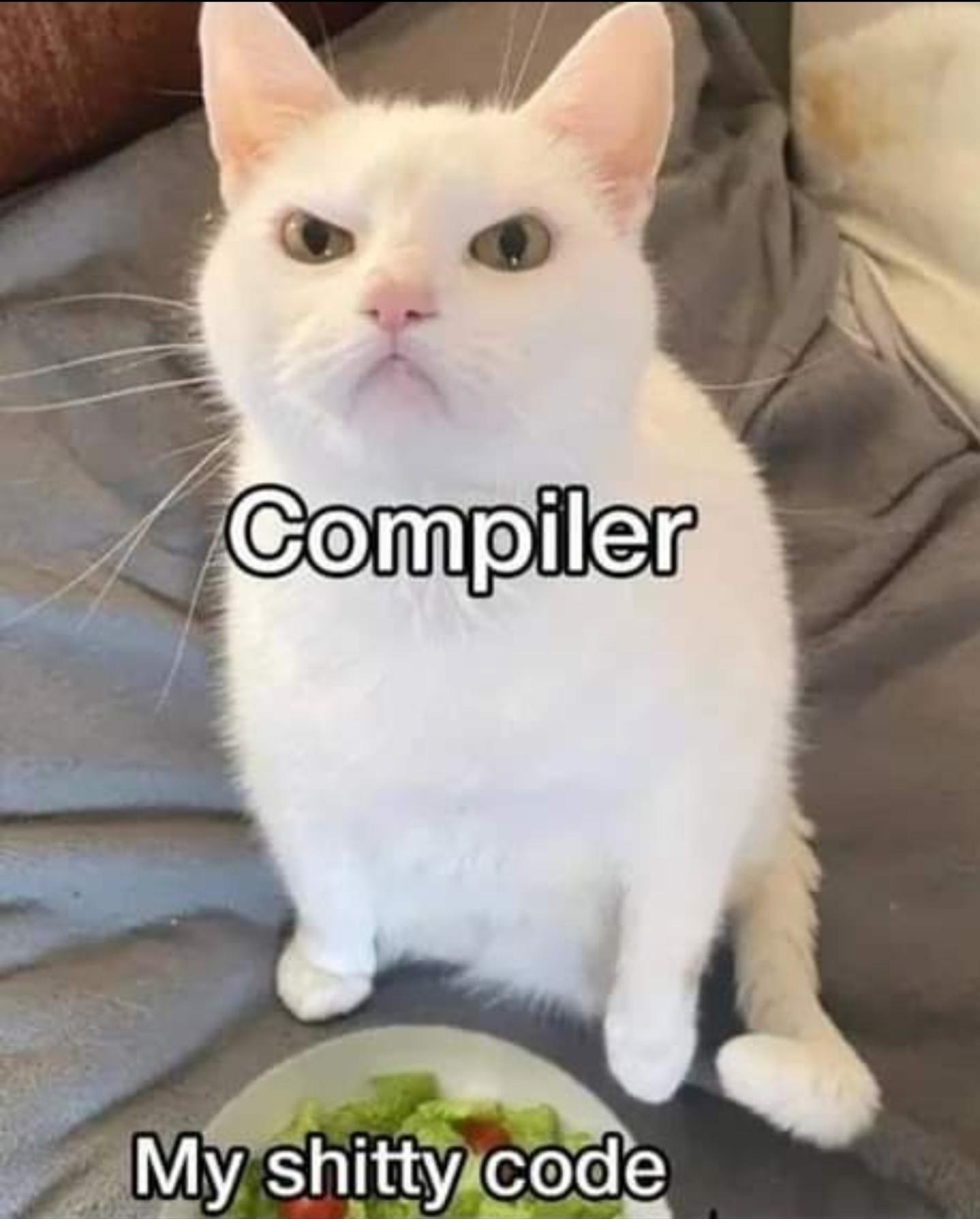
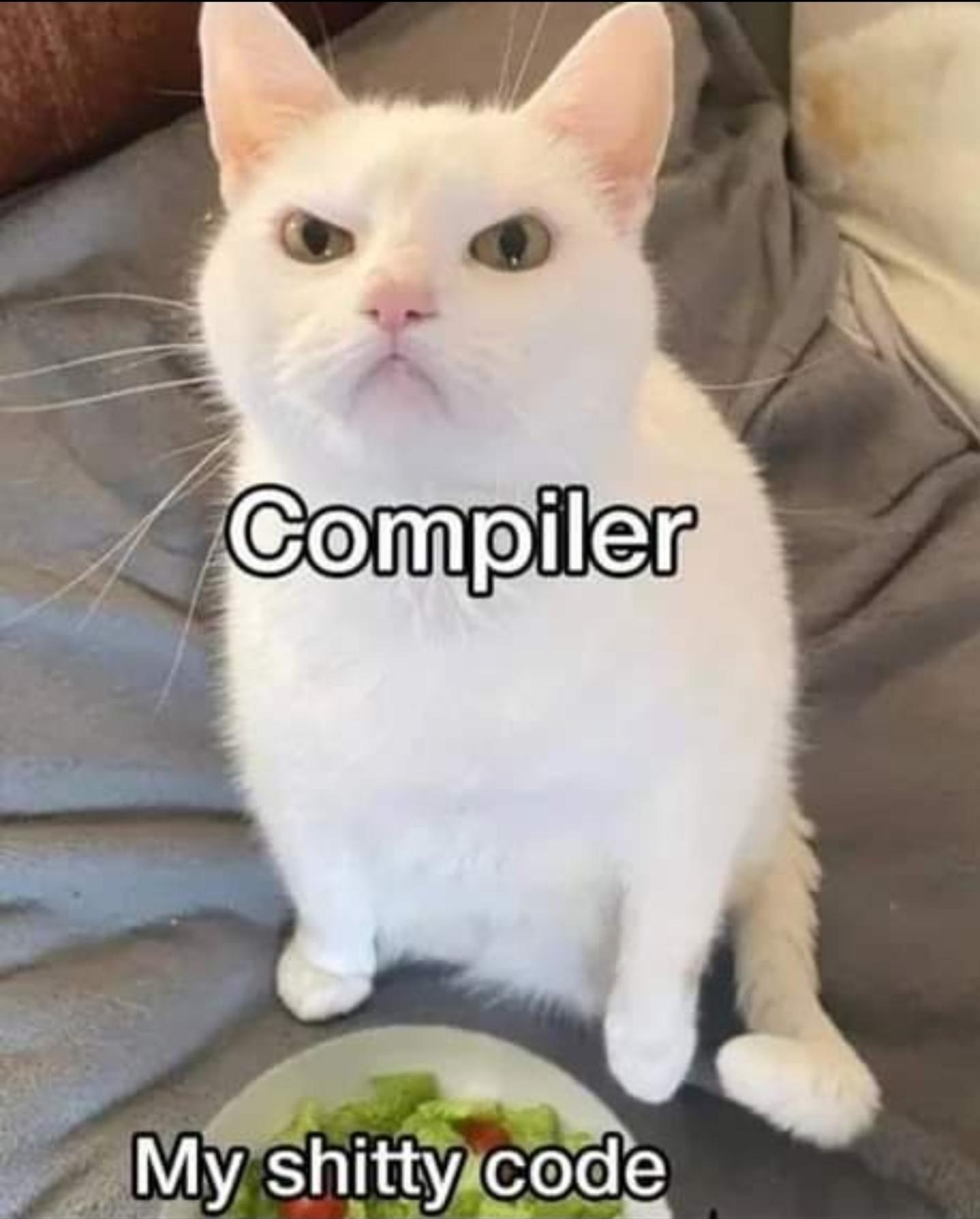
You know that moment when you hit compile and suddenly feel like a parent whose kid just threw a tantrum in the grocery store? That's what we've got here. The compiler sits there with that disappointed, judgmental stare while your code sits pathetically on the floor like the mess it is. The compiler doesn't even need to say anything—just that look of pure disgust is enough to make you question every life choice that led to that nested if-statement disaster you called "temporary." We've all been there, watching our beautiful logic crumble under 47 error messages about missing semicolons and type mismatches. The compiler is basically that brutally honest friend who tells you your code smells worse than a three-week-old pull request.

Can't Prove It Yet But I Am Sure It Wants To Kill Me

Can't Prove It Yet But I Am Sure It Wants To Kill Me
That judgmental stare you get from the compiler when it's forced to process your garbage code. You know it's sitting there, silently judging every questionable design decision, every nested ternary operator, and that one function with 47 parameters you swore you'd refactor "later." The compiler doesn't throw errors because it's helpful. It throws them because it's personally offended by your existence. Every warning is just a passive-aggressive note saying "I guess we're doing THIS now." It compiles successfully not because your code is good, but because it's too tired to argue anymore. That look says "I could segfault your entire career right now, but I'll wait until production."

Wait What...

Wait What...
You know that mini heart attack when the compiler says "Error on line 42" and you frantically scroll to line 42, only to find it's a completely innocent closing brace? Then you look at line 43 and see the actual problem starting there. The error message is technically correct but also absolutely useless because the real issue is never where it claims to be. Compilers have this delightful habit of detecting errors at the point where they finally give up trying to make sense of your code, not where you actually messed up. That missing semicolon on line 38? The compiler won't notice until line 42 when it's like "wait, what is happening here?" It's the developer equivalent of your GPS saying "you missed your turn" three blocks after you actually missed it. Thanks, I hate it.

Pepperidge Farm Remembers Code By Hand

Pepperidge Farm Remembers Code By Hand
Back in the dark ages of computer science exams, you'd sit there with a pencil and paper, manually writing out your code like some kind of medieval scribe. No autocomplete, no syntax highlighting, no Stack Overflow to copy from—just you, your brain, and the absolute terror of forgetting a single parenthesis that would make your entire program invalid. The real kicker? You couldn't even test if it worked. You'd hand in your paper code and just pray to the compiler gods that you didn't mess up somewhere on line 47. One missing semicolon and your entire grade goes down the drain. Modern devs with their fancy IDEs that auto-close brackets don't know the struggle of counting parentheses on your fingers like you're doing elementary school math. Fun fact: Studies show that programmers who learned to code by hand developed an irrational fear of whiteboard interviews that persists to this day.

Software Engineer Funny Co-Worker Description Definition T-Shirt

Software Engineer Funny Co-Worker Description Definition T-Shirt
A perfect personalized gift for him or a gift for her. · Lightweight, Classic fit, Double-needle sleeve and bottom hem

It May Have Been Chucked Out The Window

It May Have Been Chucked Out The Window
You give the computer explicit instructions. The computer, being the literal-minded silicon brick it is, executes exactly what you typed—not what you meant, not what you needed, but what you actually told it to do . And now it's sitting there with that smug look, waiting for you to realize the bug isn't in the machine. The gap between "what I told it to do" and "what I wanted it to do" is where every developer's sanity goes to die. You spend three hours debugging only to discover you wrote i++ instead of j++ in a nested loop. The computer did its job flawlessly. You, however, did not. Welcome to programming, where the machine is always right and you're always wrong, but somehow it's still the computer's fault.