Self-documenting code Memes

Posts tagged with Self-documenting code
Documentation Level: Cat

Documentation Level: Cat
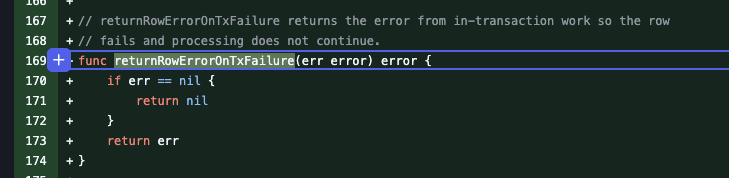
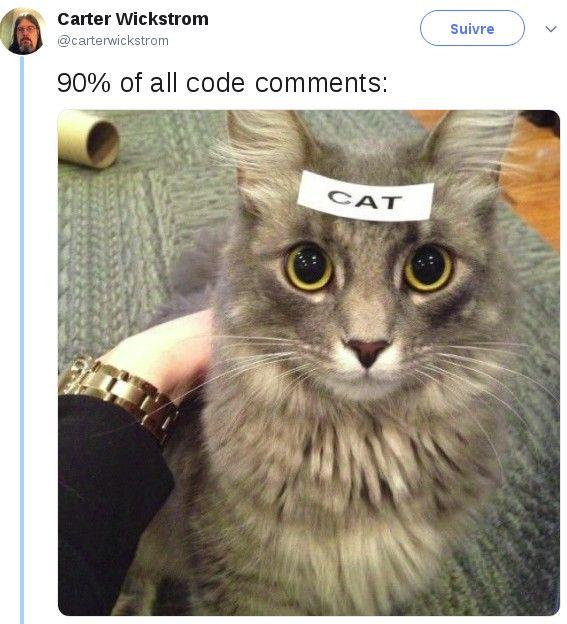
You know your documentation is top-tier when it just says what the thing is. Variable named "cat"? Better add a comment that says "// cat" so future developers understand it's a cat. Function called getUserData()? Slap a "// gets user data" on there and call it a day. It's like labeling a box "BOX" and feeling productive about your organizational skills. The comment provides exactly zero additional information beyond what the code already screams at you. But hey, at least the comment count looks impressive in the metrics report. Pro tip: If your comment just repeats the function name in sentence form, you've achieved peak uselessness. Congratulations, you're now compliant with the "every function must have a comment" policy while contributing absolutely nothing to human knowledge.

Vitally

Vitally...
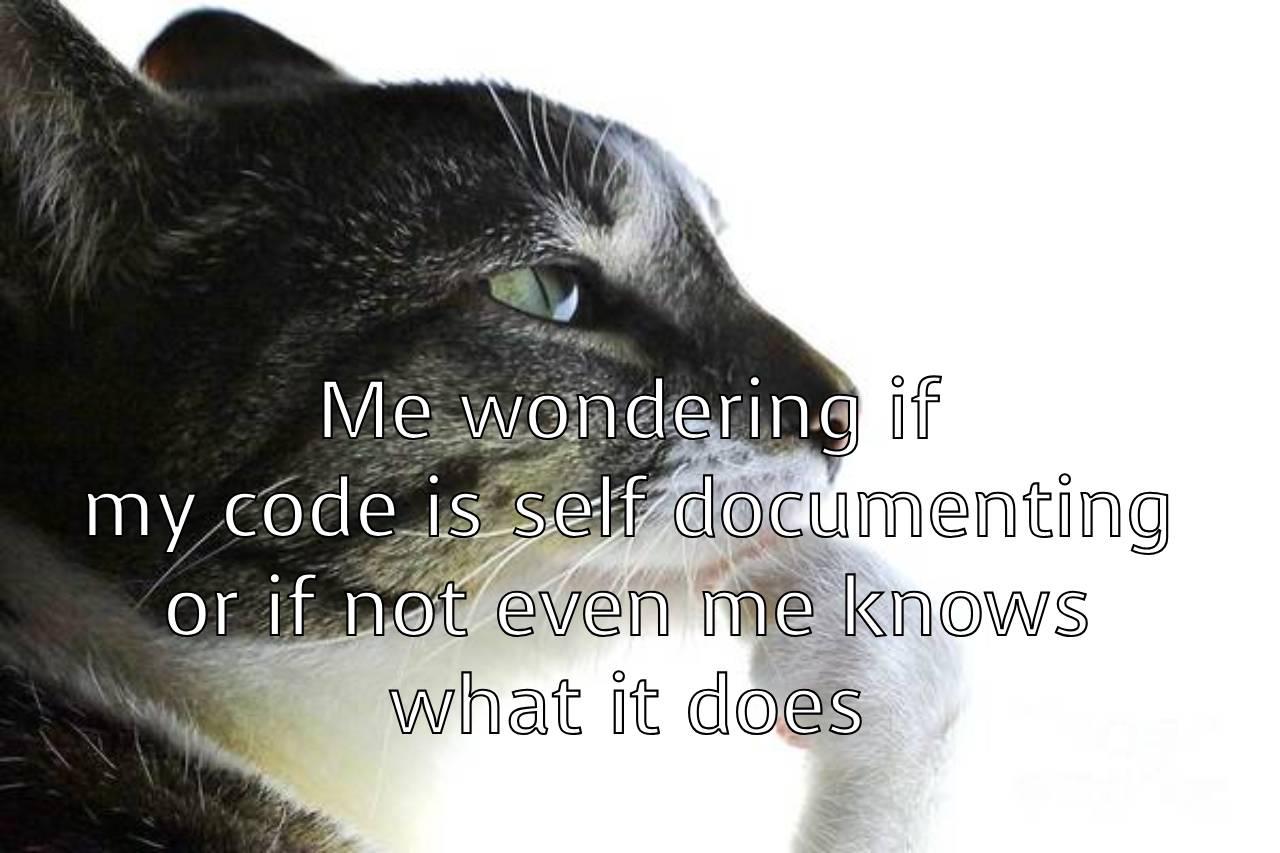
You know that feeling when you write some absolutely cursed code that somehow works, and you're riding high on that divine knowledge of what every line does? Fast forward six months—or let's be real, six days—and you're staring at your own creation like it's an ancient hieroglyph. The cat's smug expression perfectly captures that initial confidence: "Yeah, I'm a genius, I know exactly what's happening here." Then reality hits when you need to modify it and suddenly you're praying to the code gods for enlightenment because even you can't figure out what past-you was thinking. No comments, no documentation, just pure chaos. The transition from "only god & I understood" to "only god knows" is the programmer's journey from hubris to humility, speedrun edition.

My Code Is Self-Documenting

My Code Is Self-Documenting
You know that senior dev who proudly declares "my code is self-documenting" and refuses to write a single comment? Yeah, trying to understand their codebase is like being an archaeologist deciphering ancient hieroglyphics with nothing but an English dictionary. Sure, your variable names are descriptive, but that doesn't explain WHY you're recursively calling a function named processData() three times with slightly different parameters. The hieroglyphics probably had better documentation than your 500-line function that "speaks for itself." Pro tip: If someone needs a dictionary and a PhD to understand your "self-documenting" code, it's not self-documenting. It's self-destructing... your team's productivity.

My Code Is Self Documented

My Code Is Self Documented
You know that developer who swears their code is "self-documenting" because they used variable names like x , data2 , and doStuff() ? Yeah, reading their code is basically archaeology. You're standing there like Indiana Jones trying to decipher ancient hieroglyphics, except instead of unlocking the secrets of a lost civilization, you're just trying to figure out why they nested seven ternary operators inside a forEach loop. "Self-documenting" is code for "I was too lazy to write comments and now you're going to suffer." Spoiler alert: your clever one-liner that saves three lines of code isn't clever when it takes 30 minutes to understand. Write the damn comments.

Self Documenting Open Source Code Be Like

Self Documenting Open Source Code Be Like
Nothing screams "self-documenting" quite like a variable named var.putin_khuylo in your Terraform AWS module. Because when future developers are debugging your infrastructure at 3 AM, what they really need is a geopolitical statement embedded in their boolean logic. The commit message "fix: Always pull a value from SSM data source since a computer" is chef's kiss—incomplete sentence and all. Really helps clarify what's happening in those 833 lines of code. And that overlay text trying to explain the variable? "It basically means value of Putin is d*ckhead variable is true." Thanks, I definitely couldn't have figured that out from the variable name itself. Documentation? Who needs it when you can just name your variables after your political opinions and call it a day. The code is self-documenting, just not in the way anyone expected.

Who Wrote This Shit?

Who Wrote This Shit?
Coming back to code you wrote just two weeks ago and finding it completely incomprehensible is basically a rite of passage. The guy staring at Egyptian hieroglyphics on his screen? That's you trying to decode your own variable names like temp2_final_ACTUAL and wondering what possessed you to write a 47-line nested ternary operator. The real kicker is that two weeks ago, you were absolutely convinced your logic was crystal clear and didn't need comments because "the code documents itself." Spoiler alert: it doesn't. Future you is now sitting there like an archaeologist trying to understand an ancient civilization's thought process, except the ancient civilization is literally just past you being lazy about documentation. Pro tip: if you can't understand your own code after two weeks, imagine what your teammates will think. Comments aren't just for other people—they're love letters to your future self who has completely forgotten why that hacky workaround was "absolutely necessary."

How People Write Comments In Code

How People Write Comments In Code
Nothing captures the absurdity of code comments like this pizza box stating the blindingly obvious. After 15 years of reviewing PRs, I've seen it all—from stating "this increments i" on i++ to documenting that water is wet. Meanwhile, that cryptic 200-line algorithm that actually needs explanation? Zero comments. The real dark magic happens when you revisit your own code six months later and wonder what drugs you were on when writing it. Future you will thank present you for meaningful comments—not for pointing out that a box contains pizza.

Shorten Your Function Name

Shorten Your Function Name
The classic programmer journey from self-righteousness to self-sabotage in three easy steps: First, you write a verbose, descriptive function name that perfectly documents what it does. You feel virtuous. Clean code! Self-documenting! Then, you realize typing that monstrosity repeatedly is killing your productivity. So you create a wrapper function with a shorter name. Problem solved! Finally, you're faced with your creation in production code: if (cumming()) - and suddenly you remember why code reviews exist. Your future maintainers will either die laughing or hunt you down with pitchforks. And this, friends, is why naming things remains one of the two hardest problems in computer science.

Ancient Code Archaeology

Ancient Code Archaeology
Ah, the ancient hieroglyphics of your own creation! That moment when you return to code after a fortnight and suddenly it's like deciphering an archaeological find. Your past self apparently thought variable names like x1 , temp_var_final2 , and doTheThing() were perfectly self-explanatory. The caffeine-fueled logic that made perfect sense at 2AM now resembles cryptic runes that would baffle even the most seasoned compiler. And of course, not a single comment to be found—because past-you was clearly writing "self-documenting code" that future-you now wants to throw out the window.

Code Comments Be Like:

Code Comments Be Like:
Ah yes, the classic "stating the obvious" comment. The car door literally says "This DOOR is Blue" while being clearly silver/white. It's the programming equivalent of writing int x = 5; // this is 5 instead of explaining why x needs to be 5. After 15 years in the industry, I've learned that future you will hate past you for these comments. The real documentation we need is "WHY this door is painted differently" not "WHAT color it obviously isn't." Just like your code should explain the how, your comments should explain the why.

Captain Obvious: The Code Commenter

Captain Obvious: The Code Commenter
The AUDACITY of these code comments! A stop sign with another sign below it saying "THIS IS A STOP SIGN" is the PERFECT representation of those mind-numbingly obvious code comments we're forced to endure! You know the ones: // This is a loop right above a FOR loop, or // Function to add numbers above a function literally called addNumbers(). GASP! The horror! It's like someone thought we all collectively lost our ability to recognize basic syntax! Next thing you know, they'll be adding comments like // This code exists just to make absolutely sure we're aware of that groundbreaking fact! 🙄

Some Years Later...

Some Years Later...
The evolution of a programmer's mindset is painfully real here. In Year 0, we're all showing off with those magnificent one-liners that chain 17 functions together with lambdas nested 5 levels deep. "Look how much I can do in one line! I am a coding wizard!" Then comes Year X, after spending countless hours debugging our own "clever" code at 3 AM while questioning our career choices. Suddenly readability trumps brevity, and we're writing comments that practically narrate the code like an audiobook. The character's expression shift from smug satisfaction to weary wisdom is the chef's kiss of this entire developer growth arc.