Scope creep Memes

Posts tagged with Scope creep
Help

Help
The development lifecycle captured in one brutal image. You've got programmers crafting beautiful, pristine code. Then testers come in and absolutely demolish it by finding every edge case you never thought existed. Developers rush in to patch all those bugs the testers found. And just when everyone thinks they're done... The client shows up with a chainsaw to change the requirements, obliterating the entire tree everyone's been carefully working on. Nothing says "software development" quite like rebuilding everything from scratch because someone decided the app should now work on refrigerators too. The cycle never ends. It just repeats with different feature requests and increasingly creative ways to say "that's not what I asked for" during demos.

Still Adding One More Feature

Still Adding One More Feature
You know that moment when you get hit with a brilliant new project idea and your brain goes "this is simple, I'll knock it out in 2 days max"? Fast forward one month and your codebase looks like someone threw a box of cables into a blender. That's because you couldn't help yourself—just one more feature, just one more "quick improvement," just one more "while I'm at it" moment. The real tragedy? You're probably still not done, and that tangled mess of dependencies, edge cases, and "temporary" solutions has become your new reality. The 2-day project is now your magnum opus of technical debt. But hey, at least it has that one feature literally nobody asked for but you knew would be cool.

Still Adding One More Feature

Still Adding One More Feature
You know that side project you started with pure intentions and a clean architecture? Yeah, that one. You told yourself it'd take 2 days max—just a simple MVP to validate the idea. Fast forward one month and your codebase looks like someone tried to untangle headphones in a tornado. Each "small feature" brought three dependencies, two refactors, and one existential crisis about whether you should've just used a monorepo. The real tragedy? You're still not done. There's always just one more feature before you can ship. Authentication can wait, but dark mode? Absolutely critical. The cycle continues until your "weekend project" becomes a legacy system you're too emotionally invested to abandon. Pro tip: That tangled mess of cables is actually a more organized system than your project's dependency graph at this point.

Interesting Problems Bring Management Headaches

Interesting Problems Bring Management Headaches
The moment you utter the word "interesting" about a bug or technical challenge, your manager's fight-or-flight response kicks in. To you, it means you found something intellectually stimulating that might require some creative problem-solving. To them, it translates to: delayed timelines, scope creep, potential system meltdowns, and having to explain to stakeholders why the "simple feature" is now a three-week research project. Developers live for these moments—the weird edge cases, the bizarre race conditions, the "wait, that shouldn't even be possible" scenarios. Management lives in fear of them. It's the eternal conflict between curiosity and deadlines, between engineering elegance and shipping code that just works™.

What Was Your First Project?

What Was Your First Project?
Every aspiring game dev starts with "I'm just gonna make a simple platformer" and somehow ends up planning a massively multiplayer open-world FPS with crafting mechanics, procedural generation, ray-traced graphics, and a blockchain economy. Then reality hits harder than a null pointer exception. The emo Spider-Man sitting in the rain captures that exact moment when you realize your first game won't be the next GTA meets Minecraft meets Cyberpunk. Instead, you'll be lucky if you can get a cube to move without clipping through the floor. The ambition-to-skill ratio is truly unmatched in the gamedev world. Pro tip: Start with Pong. Then maybe Snake. Then we'll talk about your ultrarealistic MMO.

Very Attentive Listeners

Very Attentive Listeners
You spend three hours explaining why the feature will take two weeks to implement, complete with technical debt analysis, database migration concerns, and API limitations. The business team nods enthusiastically. Then they ask if you can have it done by Friday. The headphones aren't even plugged in. They never were. That "good point" they mentioned? They have no idea what you said. They're just waiting for their turn to say "but it's just a button" again. Pro tip: Next time, just say "no" and watch them suddenly develop the ability to hear.

Scope Creep Speedrun!

Scope Creep Speedrun!
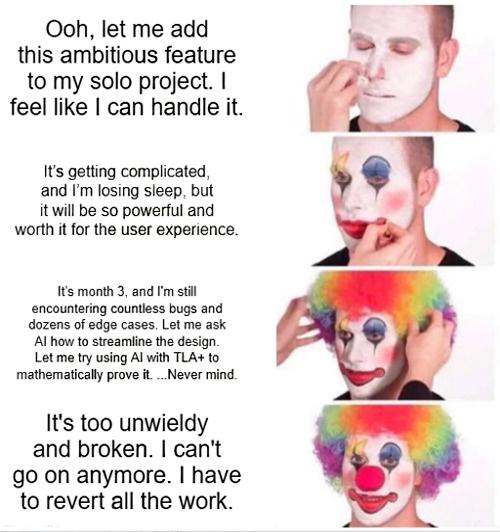
You start with a simple CRUD app. Just a basic form, maybe a login. Two weeks tops. Then the client casually drops "one extra feature" and suddenly you're implementing OAuth, real-time notifications, and a recommendation engine. Before you know it, someone mentions "procedural generation" and you're writing algorithms you barely understand. Then comes the final boss: "What about adding co-op?" Now you're dealing with WebSockets, conflict resolution, and questioning every life choice that led you to this moment. The makeup progression is chef's kiss—perfectly captures how your project transforms from clean and manageable into a full circus act. And you? You're the clown who said "yes" to everything.

Chaotic Magic

Chaotic Magic
Game devs live in a universe where physics simulations, particle effects, and complex AI pathfinding are just "Tuesday morning tasks," but adding a cosmetic item like a scarf? That's apparently where the engine decides to have an existential crisis. The contrast is beautiful—rendering a demon erupting from molten lava with real-time particle effects and collision detection is trivial, but cloth physics or character customization? Now we're talking about refactoring the entire rendering pipeline. It's the classic case of "we built this system to do one specific thing really well, and now you want to add a feature we never considered." Turns out the game's architecture was designed around demons and explosions, not fashion accessories. Welcome to game development, where complexity is completely arbitrary and nothing makes sense until you're knee-deep in the codebase.

True Story Of Being A Developer

True Story Of Being A Developer
The three stages of developer enthusiasm. First panel: naive optimism. Second panel: the moment you realize they want you to build a spaceship but won't tell you if it needs to fly or just look pretty. Third panel: pure, unfiltered joy because no requirements means no one can tell you you're doing it wrong. You're not building what they want—you're building what they deserve for not writing a single user story.

When You Ask Viewers For Products/Features Ideas

When You Ask Viewers For Products/Features Ideas
So you thought crowdsourcing feature requests would be a great idea. You opened the floodgates, asked your community what they wanted, and now you're staring at "just add real-time multiplayer with blockchain integration and AI-powered NPCs that learn from player behavior." Meanwhile, your actual game is a 2D platformer you built in two weeks. The scope creep boss has entered the chat, and it's wielding a sword made of unrealistic expectations and zero understanding of development time. Your poor little game never stood a chance against the eldritch horror of feature requests that would require a AAA studio budget and three years of crunch.

We're Making A Hand-Drawn 2D Point And Click Sidescroller Game And Someone On TikTok Asked For A First Person Mode 😭

We're Making A Hand-Drawn 2D Point And Click Sidescroller Game And Someone On TikTok Asked For A First Person Mode 😭
Nothing says "I don't understand game development" quite like asking for a first-person mode in a 2D side-scroller. The dev's response is chef's kiss—comparing it to someone asking you to add beef and gravy to chocolate cupcakes. Sure, they're both food, but you've fundamentally misunderstood the assignment. Converting a hand-drawn 2D point-and-click game to first-person would require redrawing literally everything from a completely different perspective. It's not a feature request—it's asking you to make an entirely different game. The "get fancier later" caption on that beautiful hand-drawn barn really seals the deal. Yeah buddy, first-person mode is slightly beyond "fancier." TikTok users and feature creep, name a more iconic duo.

Feature Updates Gone Wrong

Feature Updates Gone Wrong
You know that feeling when your codebase is running smooth, optimized, and beautiful? Then product management decides it needs "just one more feature" and suddenly you're introducing unnecessary complexity, bloat, and technical debt. The monkey with a stick represents that shiny new feature nobody asked for, aggressively poking at your pristine, battle-tested code that was perfectly content just lying there being efficient. The lion's resigned expression? That's your code after the 47th "quick enhancement" that somehow required refactoring three modules and adding two new dependencies. Sometimes the best feature is no feature at all, but try explaining that in a sprint planning meeting.