Programming history Memes

Posts tagged with Programming history
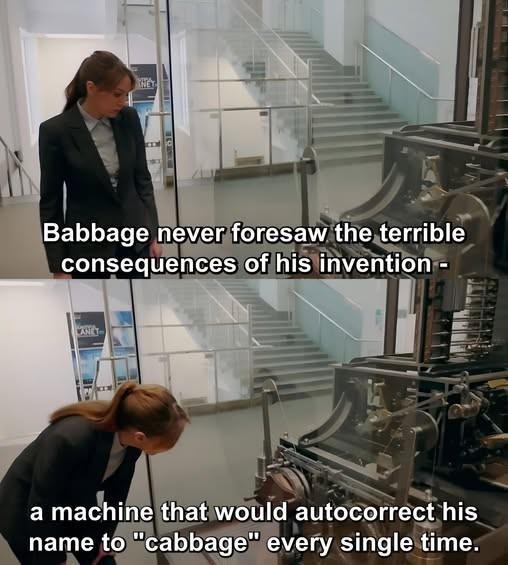
If Only It Had Ended At Useless Autocorrect...

If Only It Had Ended At Useless Autocorrect...
Oh the DELICIOUS irony! Charles Babbage, the father of computing, literally invented the machine that would eventually spawn autocorrect—the digital demon that's been turning "ducking" into... well, you know. And now his own name gets absolutely DESTROYED by his own creation's descendant. The man designed the Difference Engine and Analytical Engine in the 1800s, dreaming of mechanical computation, but he never could've predicted that his legacy would include your phone changing his name to a vegetable every. single. time. It's like creating fire and then having your house burn down. The ultimate betrayal! Babbage spent his entire life building the foundation for modern computers, and now those computers are like "Babbage? Never heard of him. You must mean cabbage." The disrespect is ASTRONOMICAL.

How Programming Became Poetry

How Programming Became Poetry
Ada Lovelace's mom trying to steer her away from poetry by pushing math, only to have Ada invent programming—which is basically just poetry with semicolons. The irony is chef's kiss. Her mom's like "do math, not that artsy nonsense" and Ada's over here creating the first algorithm, writing loops in prose, and basically turning logic into literature. Turns out you can't escape poetry when you're literally writing instructions that future generations will call "elegant" or "beautiful code." The real kicker? Modern programmers spend half their time arguing about code readability and naming conventions like they're editing Shakespeare. Ada's mom tried to dodge poetry but accidentally created a whole field where people debate tabs vs spaces with the passion of literary critics.

Fly Me To The Moon Baby

Fly Me To The Moon Baby
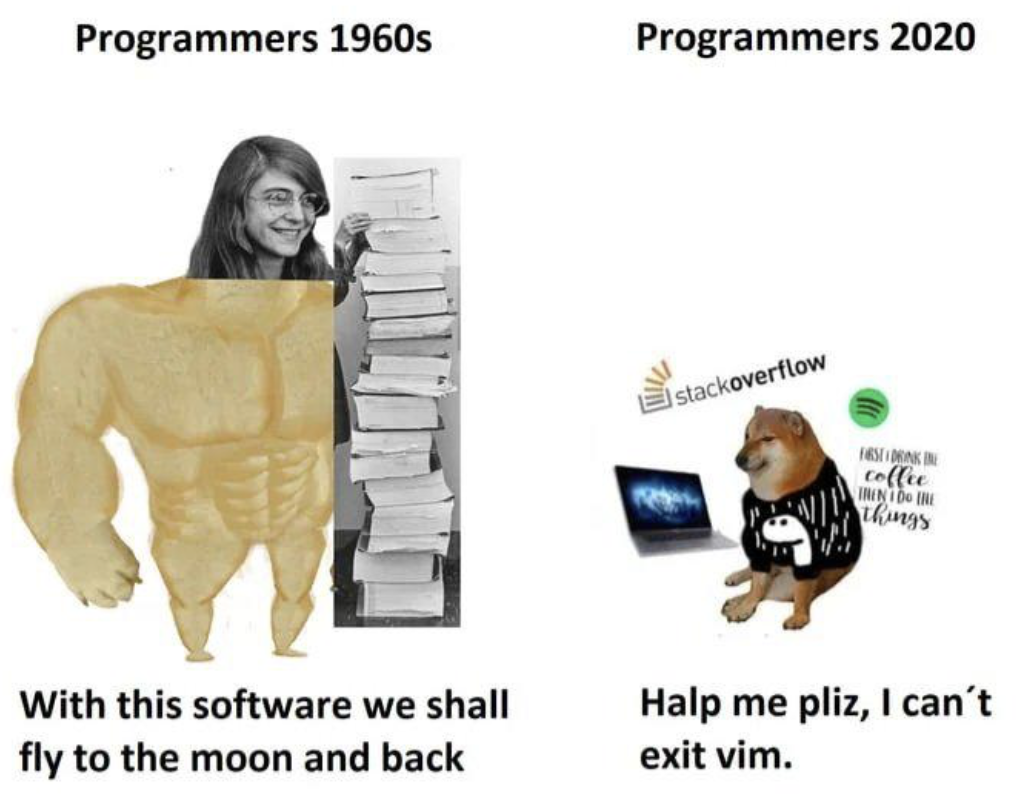
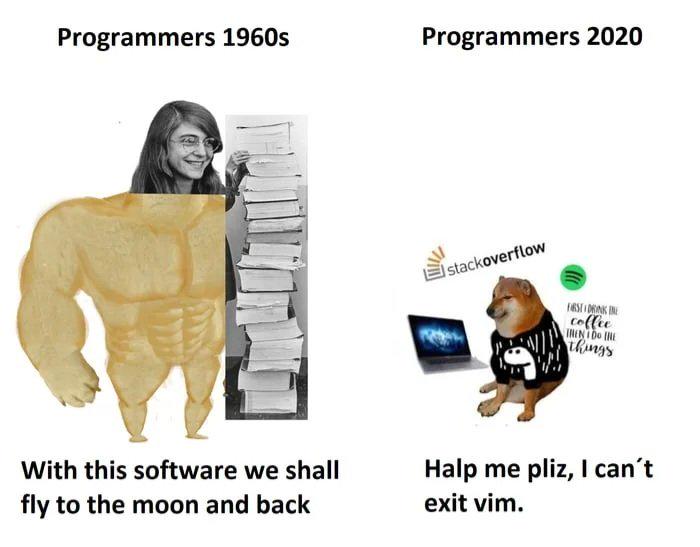
1960s programmers had 4KB of RAM and somehow managed to calculate trajectories to land humans on the moon. They were basically computational gods with slide rules and punch cards. Fast forward to 2020: we've got machines with literally millions of times more computing power, infinite Stack Overflow tabs, GitHub Copilot, and enough JavaScript frameworks to fill a library... and we can't even exit vim without googling it for the 47th time. The contrast is brutal. Margaret Hamilton standing next to her Apollo guidance code looking like an absolute unit, versus modern devs who panic when their linter throws a warning. We went from "let's send humans to space with less computing power than a calculator" to "why won't my CSS center this div?" The real tragedy? Both are equally valid struggles in their respective eras. Except one put people on the moon and the other... well, at least our websites have smooth animations.

Old Programmers Telling War Stories Be Like

Old Programmers Telling War Stories Be Like
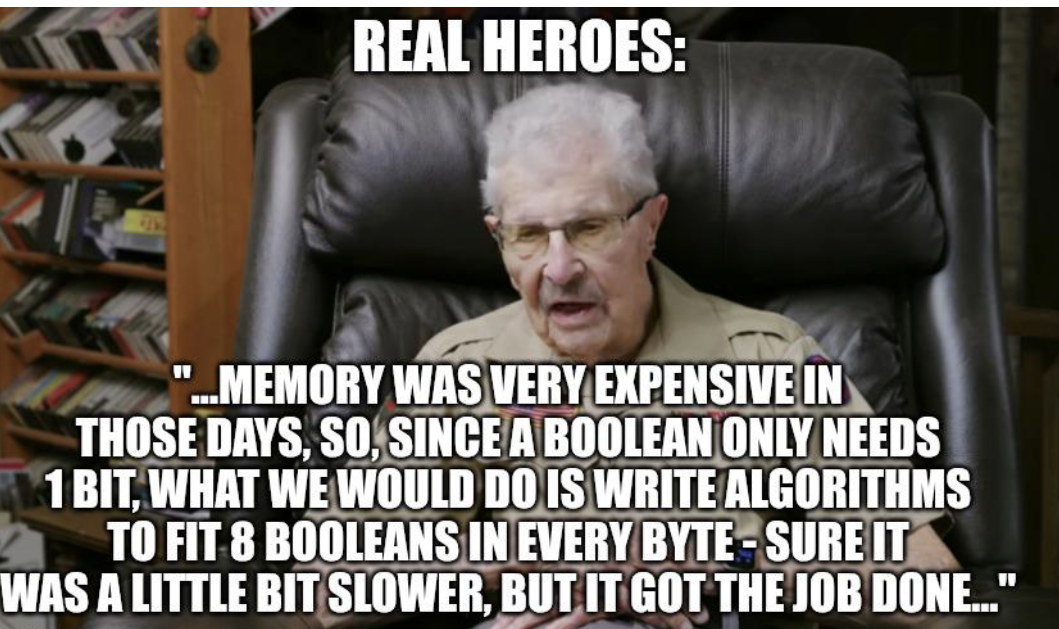
Back when RAM cost more per byte than your monthly rent, veteran programmers had to get *creative*. Packing 8 boolean values into a single byte using bitwise operations wasn't just optimization—it was survival. Sure, it made the code run slower because you had to mask, shift, and extract individual bits every time you needed to check a flag, but when you're working with kilobytes (not gigabytes) of memory, you do what you gotta do. Today's juniors casually allocating arrays of objects while the old guard still flinches at unnecessary memory usage. The trauma runs deep.

Do Not Cite The Deep Magic To Me, Witch. I Was There When It Was Written.

Do Not Cite The Deep Magic To Me, Witch. I Was There When It Was Written.
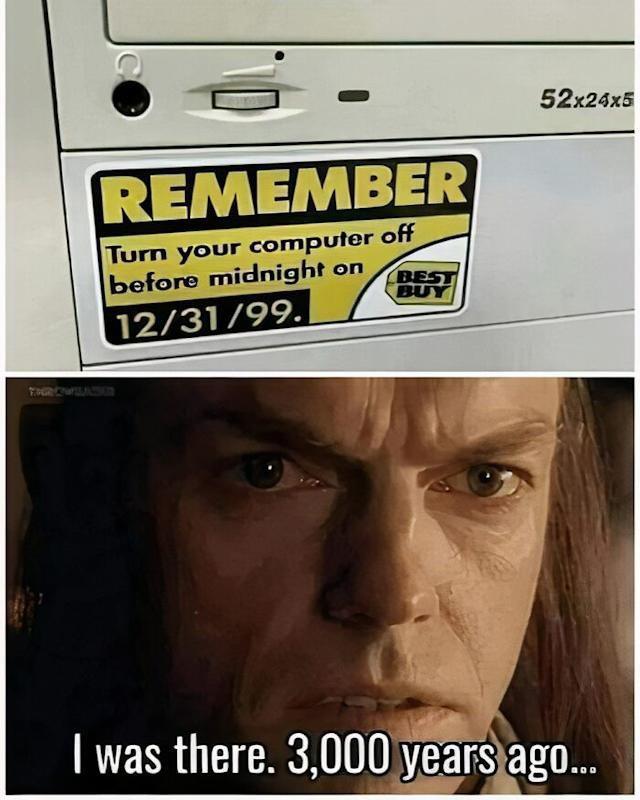
That vintage Best Buy Y2K warning sticker hits different when you're a senior dev who actually lived through the millennium bug panic. Some junior developer trying to explain legacy code issues? Please. You were literally there debugging COBOL on New Year's Eve 1999 while everyone else was partying. The 52x CD-ROM drive really seals the nostalgia here. Back when "52x" was considered blazing fast and you could physically hear your computer thinking. Now some fresh bootcamp grad wants to lecture you about technical debt? Buddy, you've been managing technical debt since their parents were on dial-up. The Aslan energy is immaculate. "I was there 3,000 years ago" perfectly captures that moment when someone half your age tries to explain a design pattern you implemented before Stack Overflow even existed.

Vilros Raspberry Pi 5 Starter Kit MAX – Official 8GB RAM Pi 5 Board, 128GB Preloaded Micro SD, Case, Power Supply & Cooling – Complete Plug-and-Play Kit for Beginners & Advanced Users

Vilros Raspberry Pi 5 Starter Kit MAX – Official 8GB RAM Pi 5 Board, 128GB Preloaded Micro SD, Case, Power Supply & Cooling – Complete Plug-and-Play Kit for Beginners & Advanced Users
𝗦𝗲𝗮𝗺𝗹𝗲𝘀𝘀 𝗦𝗲𝘁𝘂𝗽 𝘄𝗶𝘁𝗵 𝗣𝗿𝗲-𝗜𝗻𝘀𝘁𝗮𝗹𝗹𝗲𝗱 𝗢𝗦: Start creating right out of the box—our kit arrives with Raspberry Pi OS already on the microSD card, saving you time and effort from day one. · 𝗘𝘃𝗲𝗿𝘆𝘁𝗵𝗶𝗻𝗴 𝗬𝗼𝘂 𝗡…

Sit Down Son

Sit Down Son
Grandpa dev just unlocked a core memory. Stack Overflow was the OG before ChatGPT started writing everyone's code. Back in the day, you'd copy-paste solutions from SO with religious devotion, close all 47 tabs, and pretend you understood what async/await actually does. The kid found it in the basement like some ancient artifact, probably next to a Flash Player installer and a jQuery plugin from 2011. Gramps is about to drop the entire lore of marking questions as duplicate, getting roasted for not showing your research effort, and the legendary Jon Skeet with his 1.4 million rep. Those were simpler times when you had to actually read documentation AND get passive-aggressively told your question already exists somewhere in a thread from 2009.

He Definitely Did

He Definitely Did
The question "How did he create Facebook without Claude?" hits different when you realize we're now at the point where devs genuinely can't imagine building anything without their AI coding assistant. Like, Mark Zuckerberg somehow managed to cobble together a social network in 2004 using just PHP, MySQL, and pure spite—no ChatGPT, no Claude, no Copilot whispering sweet code completions in his ear. The comment "He stole it from someone else" is chef's kiss perfect because it references the whole Winklevoss twins drama while also being the most programmer answer ever. Can't figure out how someone coded without AI? Obviously they just copied it. Stack Overflow wasn't even around back then, so where else could the code have come from? We've gotten so dependent on AI assistants that the idea of writing code from scratch feels like building a fire without matches. Your grandpa coded uphill both ways in the snow, kids.

Alphanumeric

Alphanumeric
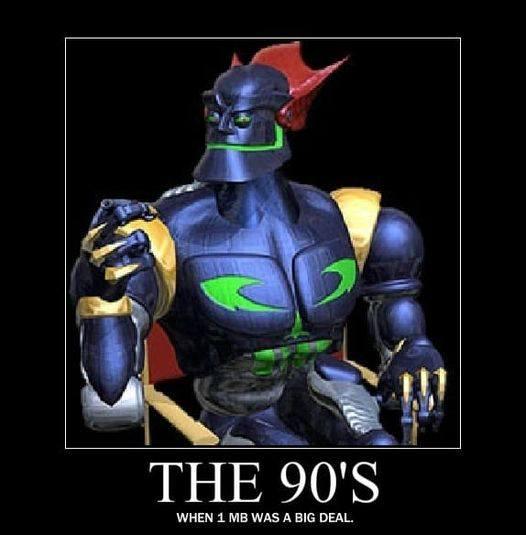
Back when 1 MB was considered massive storage, developers had to get creative with their character choices. Alphanumeric passwords? More like "alpha-NO-numeric" because you literally couldn't afford the extra bytes. Every character mattered when your entire codebase had to fit on a floppy disk that held less data than a single smartphone photo today. Those were the days when optimization wasn't a best practice—it was survival. You'd compress, truncate, and abbreviate everything just to squeeze your program into existence. Modern devs complaining about a 500 MB node_modules folder would've had an aneurysm in the 90s.

Machine Learning The Punch Card Code Way

Machine Learning The Punch Card Code Way
So you thought you'd jump on the AI hype train with your shiny new ML journey, but instead of firing up PyTorch on your RTX 4090, you're apparently coding on a machine that predates the invention of the mouse. Nothing says "cutting-edge neural networks" quite like a punch card machine from the 1960s. The irony here is chef's kiss—machine learning requires massive computational power, GPUs, cloud infrastructure, and terabytes of data. Meanwhile, this guy's setup probably has less processing power than a modern toaster. Good luck training that transformer model when each epoch takes approximately 47 years and one misplaced hole in your card means restarting the entire training process. At least when your model fails, you can't blame Python dependencies or CUDA driver issues. Just the fact that your computer runs on literal paper cards and mechanical gears.

Fly Me To The Moon Baby

Fly Me To The Moon Baby
The 1960s programmer: a literal chad with a tower of punch cards, writing assembly code to send humans to the moon with less computing power than your toaster. Fast forward to 2020, and we've got the doge programmer who can't even escape Vim without consulting Stack Overflow, powered by Spotify and coffee-fueled anxiety. They built Apollo with slide rules and raw determination. We build CRUD apps with 47 npm packages and still manage to break production on a Friday. The devolution is real, folks. But hey, at least we have syntax highlighting and dark mode... oh wait, we're stuck in Vim so we can't even enjoy that.

The True Messiah

The True Messiah
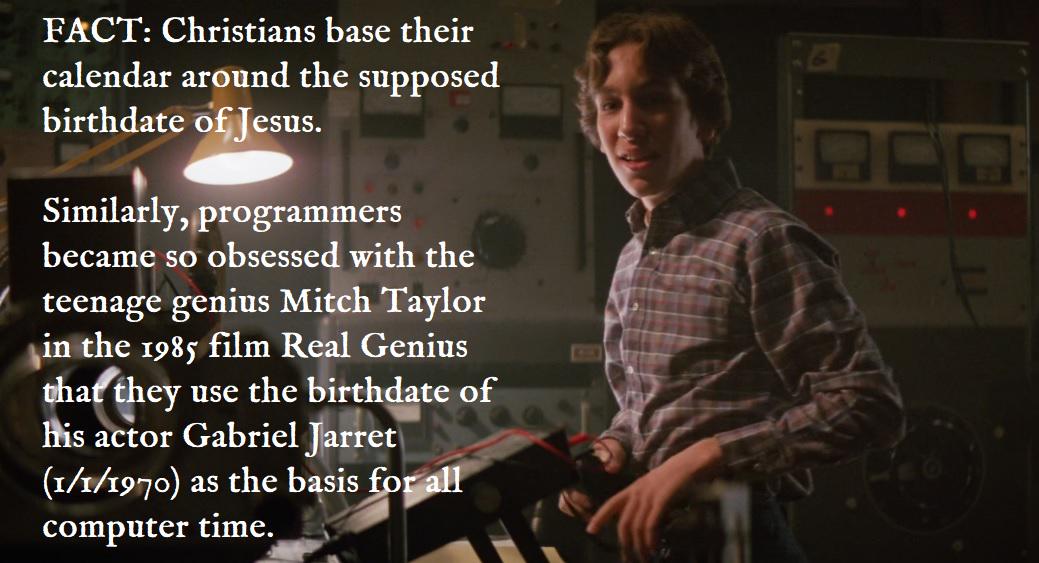
So apparently we've been worshipping the wrong deity all along. While Christians organized their entire calendar around Jesus's birthday, programmers took one look at Gabriel Jarret playing teenage prodigy Mitch Taylor in the 1985 film "Real Genius" and collectively decided, "Yeah, this random actor's birthdate (January 1st, 1970) shall be the foundation of all computer time." The Unix epoch timestamp starts counting from midnight UTC on January 1, 1970—which happens to be Gabriel Jarret's actual birthdate. It's like the entire computing world accidentally created a religion around a child actor who would later play a genius in a comedy film. The irony is chef's kiss level. Every time you check a timestamp, log an event, or schedule a cron job, you're essentially measuring time from the birth of Mitch Taylor himself. Forget Y2K—we should be preparing for the Year 2038 problem when Gabriel Jarret turns 68 and our 32-bit signed integers overflow. That's when the real apocalypse happens.

Vicious Circle

Vicious Circle
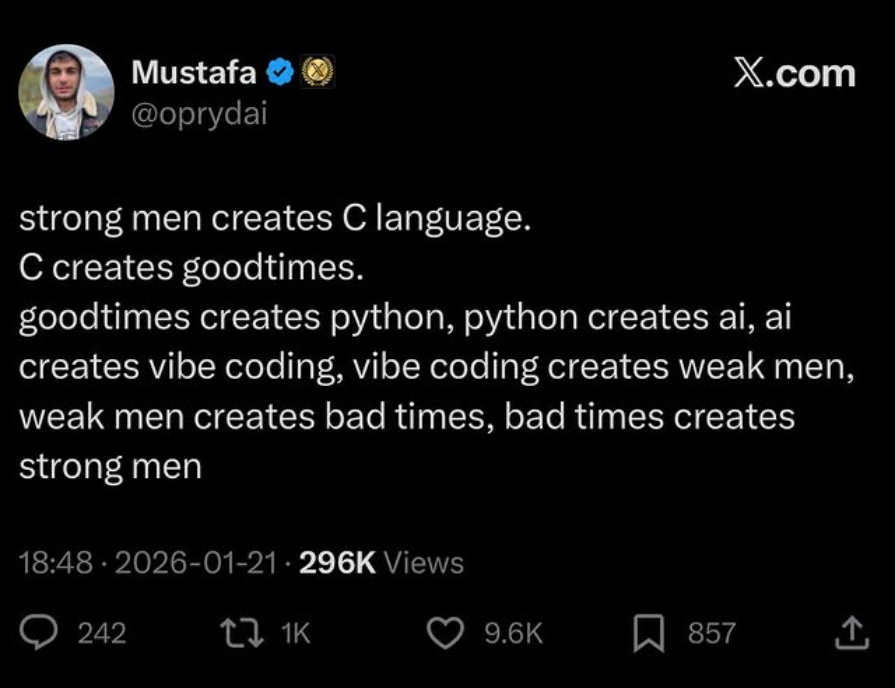
A beautiful philosophical journey through programming history that somehow ends up blaming AI for creating "vibe coding" bros who will inevitably bring about the apocalypse. The chain goes: C language → good times → Python → AI → vibe coding (you know, that thing where people just throw prompts at ChatGPT and pray) → weak men → bad times → strong men. And we're back to square one. The real kicker? We're currently somewhere between "AI creates vibe coding" and "weak men creates bad times," which means we're all just waiting for the collapse so the next generation of C programmers can rise from the ashes and manually manage memory again. Circle of life, baby.

NordVPN

NordVPN
Encrypt your traffic on public Wi-Fi, stream from anywhere, and cover up to ten devices with one plan. 30-day money-back guarantee.