postgresql Memes

All It Has Is A Hammer

All It Has Is A Hammer
When you're desperately trying to explain to Claude AI that your database schema is missing a critical concept, but Claude just keeps slapping JSONB at every single problem like it's the ultimate solution to life, the universe, and everything. Need relational data? JSONB. Need proper normalization? JSONB. Need to store literally anything? Believe it or not, also JSONB. It's giving "when all you have is a hammer, everything looks like a nail" energy, except the hammer is a PostgreSQL data type and the nail is your beautifully architected database that's about to become a glorified document store. Sure, JSONB is flexible and powerful, but maybe—just MAYBE—some things deserve their own proper columns and relationships instead of being yeeted into an unstructured blob of chaos.

My First Joke Is Already A Sequel Joke

My First Joke Is Already A Sequel Joke
Granting ALL PRIVILEGES to a wildcard user on a wildcard host is basically handing out root access like candy on Halloween. It's the database equivalent of leaving your front door wide open with a sign that says "rob me." The punchline here is that Hugh Grant's name becomes a terrible SQL security joke. Because when you GRANT ALL... well, you're making a huge grant . Get it? Hugh Grant? Huge grant? Yeah. The "sequel" part of the title is chef's kiss because SQL is literally pronounced "sequel" by half the industry. A SQL joke is technically a sequel joke. The layers of dad joke energy here could fill a normalized database schema.

Have You Or Your Fellow Brethren Tried The Porn Stack Yet

Have You Or Your Fellow Brethren Tried The Porn Stack Yet
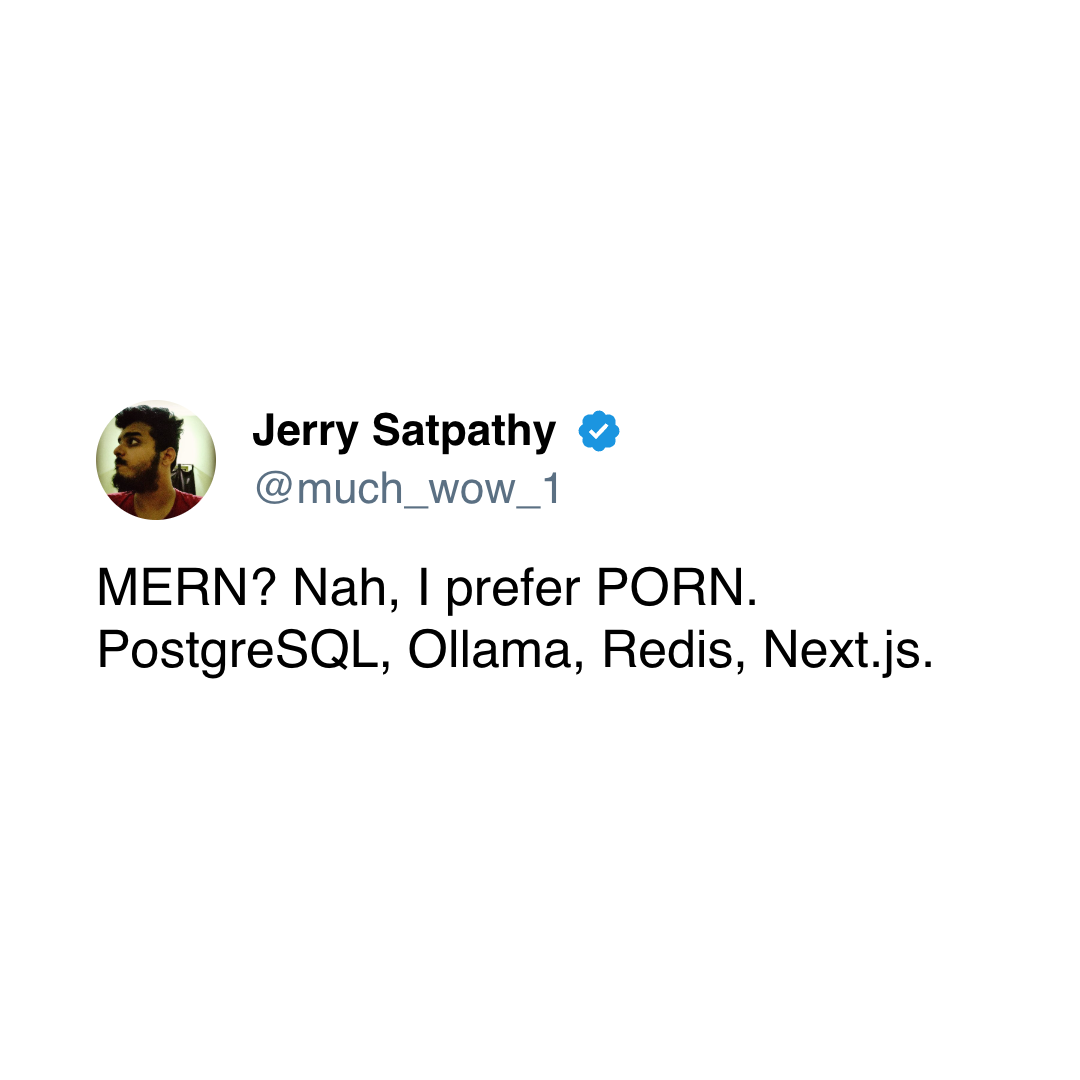
Someone finally cracked the code on tech stack naming. Forget MERN (MongoDB, Express, React, Node) – that's for people who still think JavaScript frameworks won't change by next Tuesday. The real pros are running PORN: PostgreSQL, Ollama, Redis, Next.js. It's got everything you need: a battle-tested database that won't randomly corrupt your data, an LLM framework for when you need to add "AI-powered" to your resume, an in-memory cache because your queries are slower than your standup meetings, and Next.js because apparently we needed another way to render React. The stack is solid, the acronym is chef's kiss, and your HR department will have questions about your pull request descriptions.

Query Of Doom

Query Of Doom
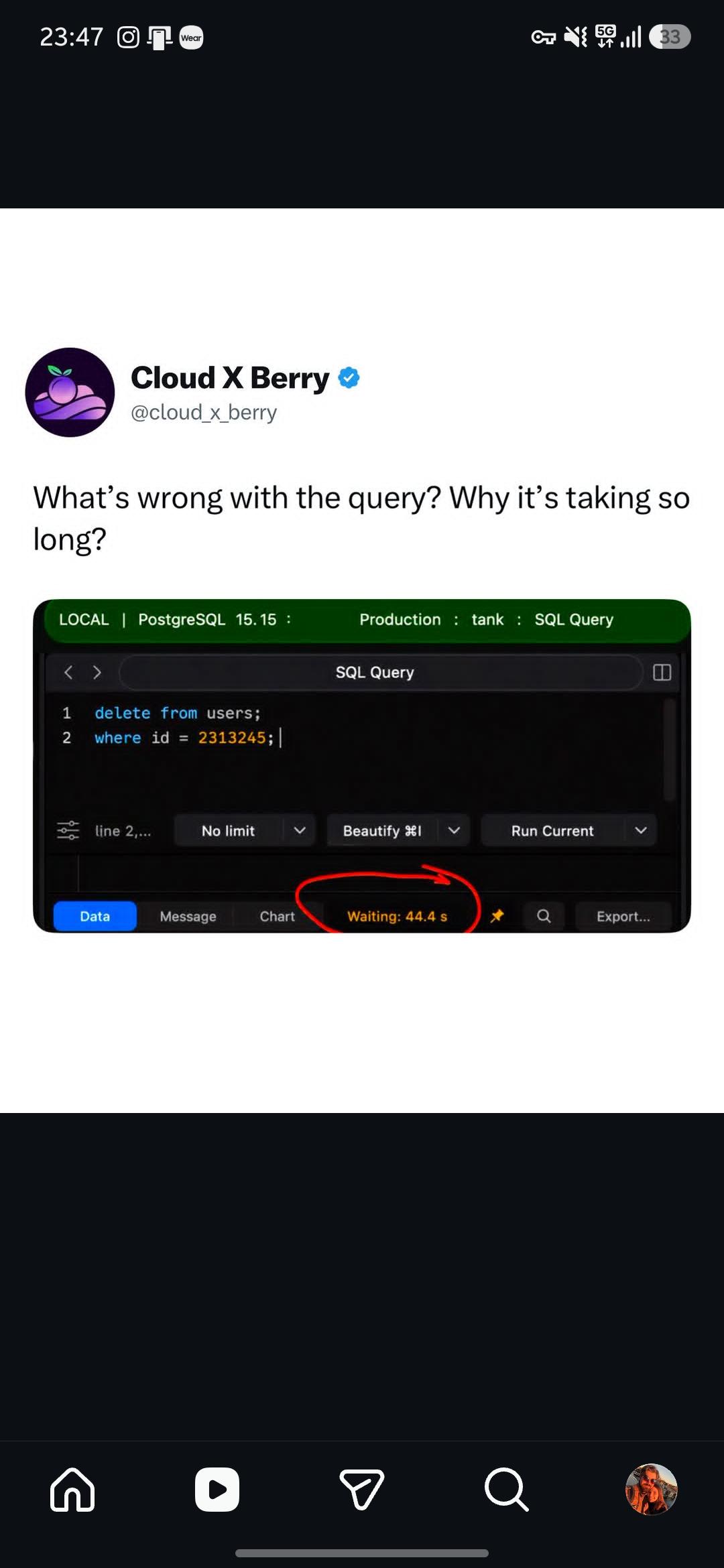
Someone's running a DELETE query on production with a WHERE clause targeting a single user ID. Should be instant, right? Wrong. It's been spinning for 44 seconds. Either that user has half a million orphaned records scattered across 37 tables with cascading deletes, or someone forgot to index the ID column. Both scenarios mean you're about to have a very uncomfortable conversation with your DBA. The "Production : tank" label in the corner is just chef's kiss—nothing says confidence like running destructive queries on a server nicknamed after a military vehicle.

Adult Database

Adult Database
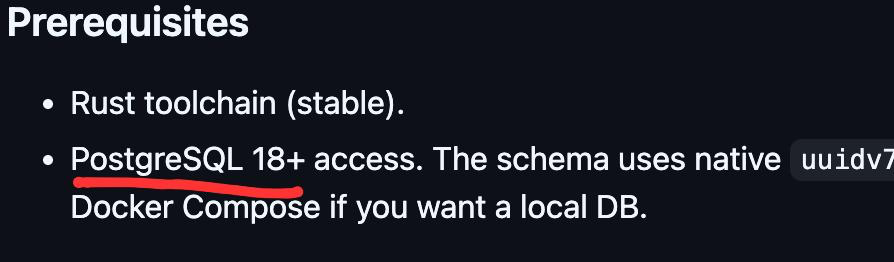
Nothing says "mature enterprise application" quite like requiring PostgreSQL 18+ access. You know, the version that doesn't exist yet since we're currently at PostgreSQL 16. Either this project is so cutting-edge it's time-traveling, or someone's README is living in a very optimistic future. The Rust toolchain requirement is appropriately stable though, so at least half the prerequisites are grounded in reality. Props for the age-gating on databases—wouldn't want any underage MySQL instances sneaking in.

CV Skills

CV Skills
You know that impressive list of database technologies you confidently slapped on your resume? PostgreSQL, MySQL, Microsoft SQL Server, MongoDB—basically the entire database hall of fame? Yeah, turns out knowing they exist and actually being able to write a proper query are two wildly different skill levels. The recruiter sees "expert in 4 database systems" and imagines you architecting enterprise-level data solutions. Reality check: you're about to crash harder than that Ferrari when they ask you to explain the difference between INNER JOIN and LEFT JOIN, or god forbid, optimize a query. SQLite crash course? More like SQL-ightest clue what I'm doing course. Pro tip: maybe stick to the ones you can actually spell without autocorrect.

NordVPN

NordVPN
Encrypt your traffic on public Wi-Fi, stream from anywhere, and cover up to ten devices with one plan. 30-day money-back guarantee.

Select Myself Where Date Time Equals Now

Select Myself Where Date Time Equals Now
Someone just discovered SQLite and thinks they've unlocked the secrets of the universe. The bird goes from rage-quitting at proper database architecture to absolutely losing it over SQLite's "features" – zero configuration (because who needs setup when you can just YOLO a file), serverless (it's not a bug, it's a feature!), single user (concurrency is overrated anyway), and the ability to literally copy-paste your entire database like it's a Word document. Look, SQLite is genuinely great for what it does – embedded systems, mobile apps, small projects, prototypes. But watching developers discover they can avoid setting up PostgreSQL and suddenly think they've found the holy grail is chef's kiss. Just wait until they need to scale beyond one concurrent write operation. That bird's gonna need therapy.

Cat Rating Env

Cat Rating Env
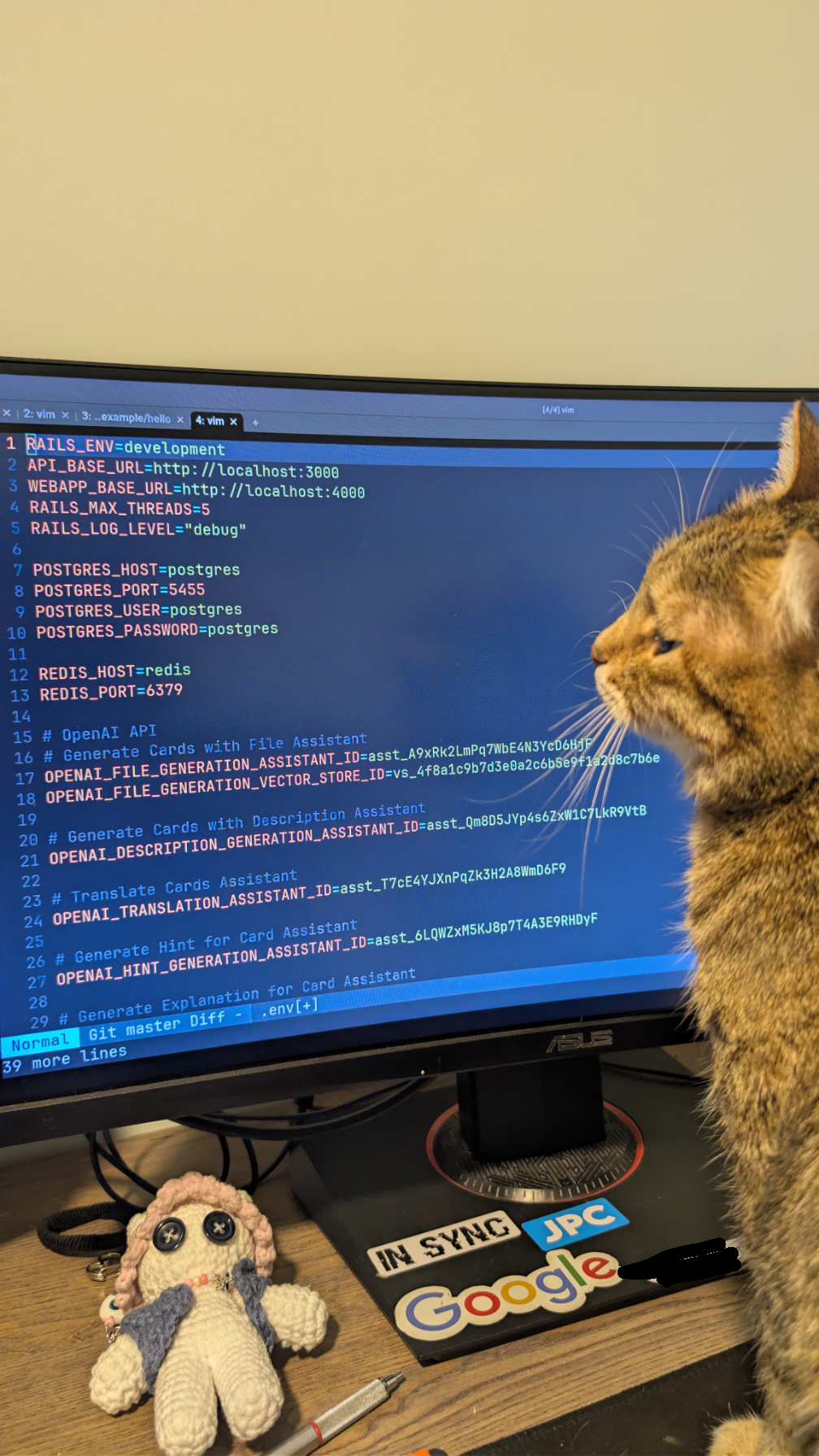
Your code reviewer has arrived, and judging by that look, your environment variables are getting a solid 6/10. The cat's inspecting your .env file like a senior architect reviewing a junior's first pull request—silently judging every OpenAI API key you've got hardcoded in there. Nothing says "professional development setup" quite like having multiple OpenAI assistants for generating cards, translations, hints, and descriptions. Someone's building a card game with enough AI assistance to make the entire QA team obsolete. Props for the Rails + PostgreSQL + Redis stack though—at least the boring parts are solid. The little voodoo doll next to the "IN SYNC" sticker really ties the whole setup together. That's what you need when your API keys stop working in production.

Root Root

Root Root
When your dev database credentials are just username: root and password: root , you might as well be wielding a lightsaber made of security vulnerabilities. The double "root root" is the universal developer handshake that screams "I'm definitely not pushing this to production... right?" Every dev environment has that one database where the admin credentials are so predictable they might as well be written on a sticky note attached to the monitor. It's the database equivalent of leaving your house key under the doormat, except the house is full of test data and half-finished migrations that will haunt you later. Fun fact: The "root" superuser account exists because Unix systems needed a way to distinguish the all-powerful administrator from regular users. Now it's the most overused password in local development, right next to "admin/admin" and "password123".

Excel As A Database? Straight To Jail

Excel As A Database? Straight To Jail
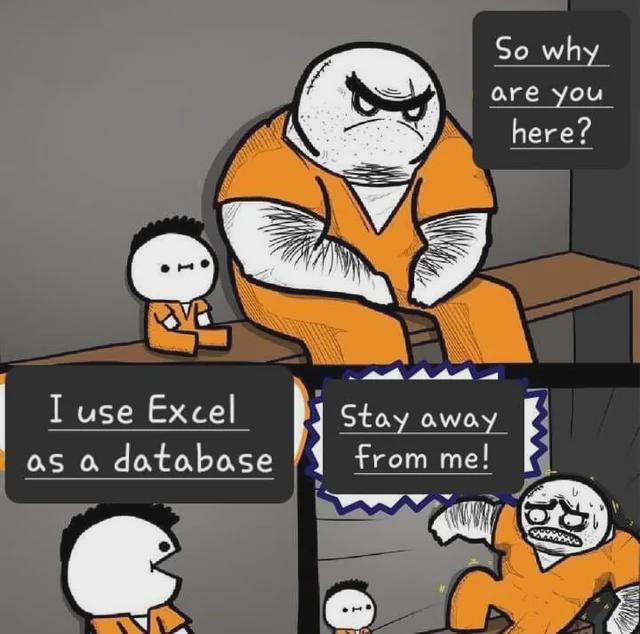
Using Excel as a database is the tech equivalent of wearing socks with sandals - technically functional, but everyone who sees it will judge you. The moment you admit to storing production data in .xlsx files, you've earned yourself a one-way ticket to developer prison. No trial, no jury, just straight to jail. Sure, it starts innocently enough. "It's just a small project," you say. "We only have 50 rows," you promise. Fast forward six months and you're dealing with VLOOKUP nightmares, circular references, and that one guy who keeps saving it as .xls instead of .xlsx. Meanwhile, actual databases are sitting right there, crying in PostgreSQL. The prison guard's reaction is completely justified. This is a crime against data integrity, ACID compliance, and everything our ancestors fought for when they invented relational databases in the 1970s.

Every Day We Stray Further From Kafka

Every Day We Stray Further From Kafka
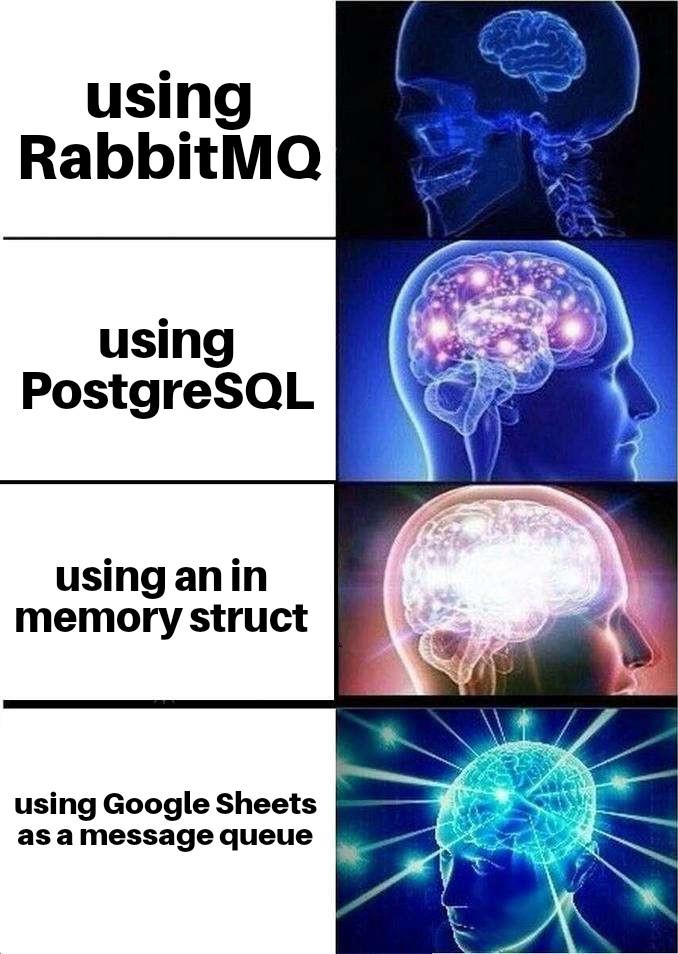
The descending brain power meme format perfectly captures the devolution of message queue solutions. RabbitMQ? Sure, solid choice. PostgreSQL as a queue? Questionable but functional. In-memory struct? Getting sketchy. But using Google Sheets as a message queue? That's galaxy brain territory right there. Someone out there is polling a spreadsheet every 500ms and calling it "distributed architecture." The API rate limits are just natural backpressure, obviously. Franz Kafka didn't write about existential dread and bureaucratic nightmares for us to turn collaborative spreadsheets into event streaming platforms, yet here we are.

We Invented Object Oriented Design To Solve A Problem And Then Invented SQL To Unsolve It Again

We Invented Object Oriented Design To Solve A Problem And Then Invented SQL To Unsolve It Again
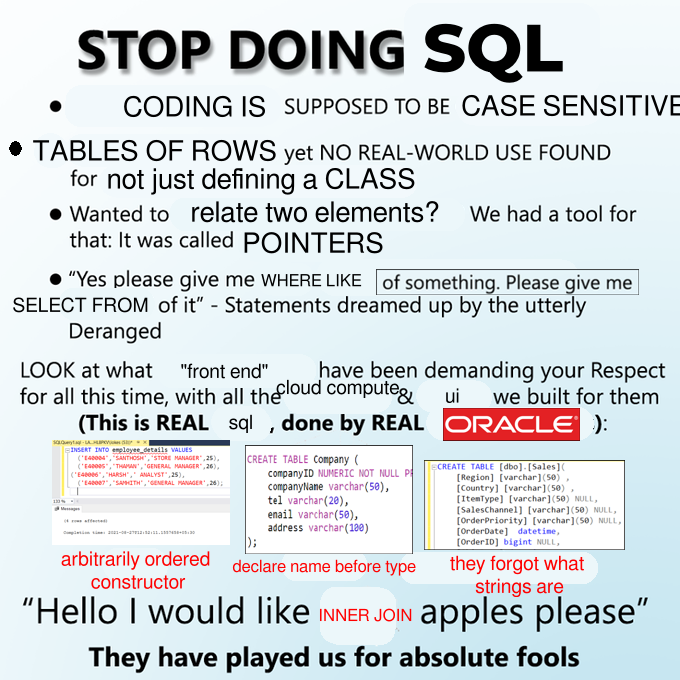
The eternal irony of software engineering: we spent decades building beautiful OOP abstractions with encapsulation, inheritance, and polymorphism, only to throw it all away the moment we need to persist data. SQL databases force us to flatten our elegant object hierarchies into normalized tables, then painfully reconstruct them with JOINs. The meme roasts SQL's quirks with surgical precision: case sensitivity that makes you question your life choices, tables that are just "rows of stuff" (goodbye encapsulation), and foreign keys that are basically pointers but worse. The "WHERE LIKE" and "SELECT FROM of it" mockery is chef's kiss—SQL reads like English written by someone who learned programming from a fever dream. Those three CREATE TABLE examples? Pure gold. MySQL's arbitrary constructor order, PostgreSQL declaring types before names (backwards from most languages), and Oracle forgetting strings exist entirely. Each database vendor decided to implement SQL their own special way, creating a fragmentation nightmare. The punchline "Hello I would like INNER JOIN apples please" perfectly captures how unnatural SQL feels compared to object navigation. Instead of customer.orders , you're writing verbose JOIN ceremonies. Object-relational mapping exists precisely because this impedance mismatch is so painful.

NordVPN

NordVPN
Encrypt your traffic on public Wi-Fi, stream from anywhere, and cover up to ten devices with one plan. 30-day money-back guarantee.