

Package management Memes

Posts tagged with Package management
One More Time And I'm Pulling The Trigger

One More Time And I'm Pulling The Trigger
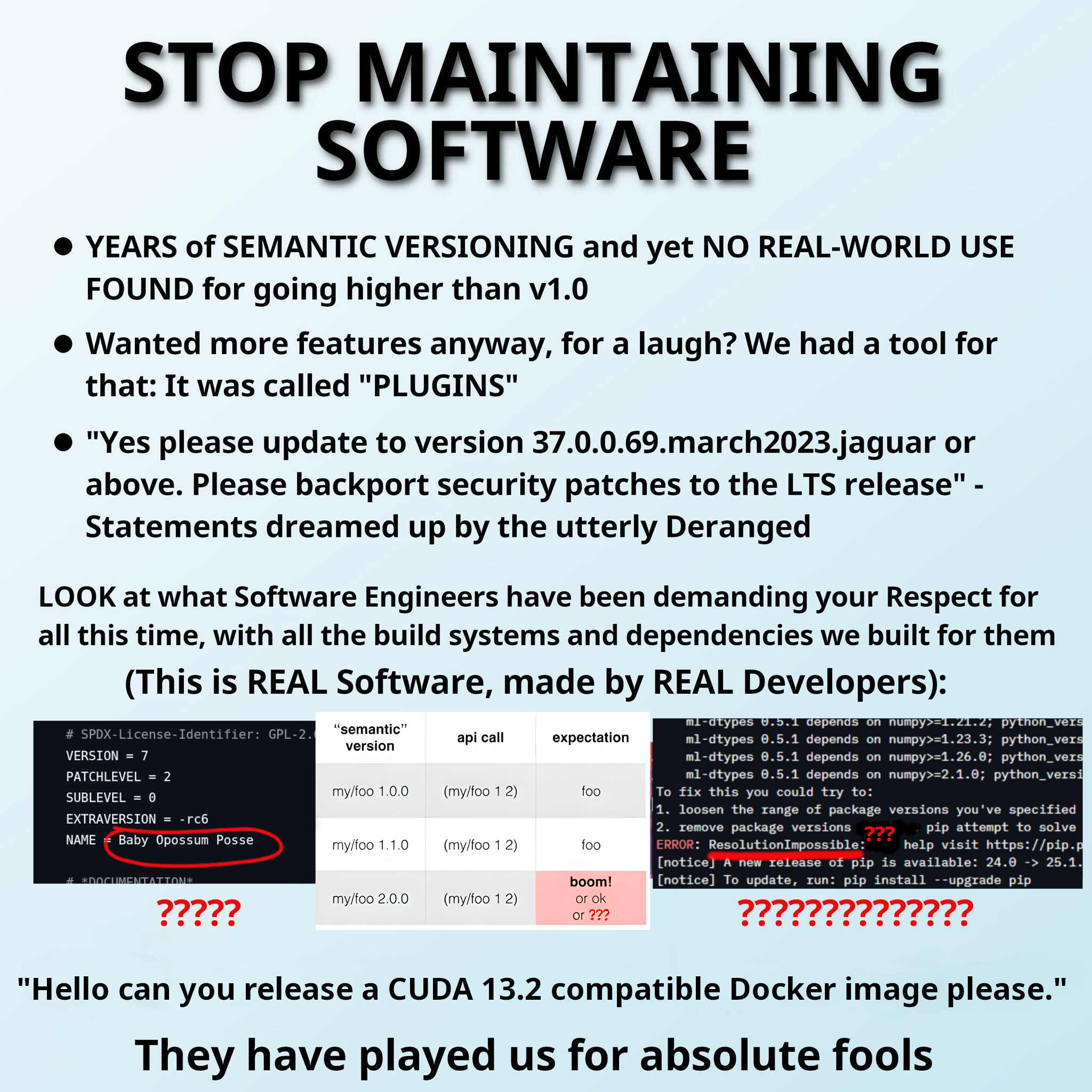
Project says it needs Python 3.13+. You dutifully upgrade from your perfectly stable 3.12 setup. Install the dependencies. Run the code. "Doesn't work." Of course it doesn't. Because apparently version requirements are more like gentle suggestions written by someone who hasn't actually tested their own project. Now you're stuck in dependency hell, your virtual environment is screaming, and you're seriously considering a career change to goat farming. The best part? Rolling back to 3.12 probably would've worked fine with a single line change in requirements.txt.

Import Regret

Import Regret
Rust developers get to import dependencies with names that sound like ancient Greek warriors: axum, leptos, tokio, dioxus. Meanwhile React Native devs are stuck typing @react-native-camera-roll/camera-roll like they're navigating a corporate directory structure designed by a committee that hates joy. The scoped packages with their forward slashes and redundant naming conventions read like someone's having an identity crisis. "Yes, I'm react-native-firebase, but also I live in the @react-native-firebase namespace, and my actual name is /app, nice to meet you." Every import statement becomes a novel. Rust said "one word" and moved on with their life.

Please

Please...
When you're staring at a dependency graph that looks like someone dropped spaghetti on a whiteboard and hit "visualize," you know you're in for a good time. That's OpenSSL sitting there in the middle like the popular kid everyone wants to hang out with, connected to literally everything. The walking stick figure begging it to burst already? That's every developer who's had to debug a vulnerability that cascades through 47 different packages. One CVE drops and suddenly your entire infrastructure is playing six degrees of OpenSSL. The best part is knowing that if it actually did burst, half the internet would go down faster than a poorly configured load balancer. Fun fact: OpenSSL has more dependencies on it than most developers have on coffee.

Don't You Dare Touch It!

Don't You Dare Touch It!
You spent three weeks getting that Linux setup just right . Every config file tweaked to perfection, every package dependency resolved, the display manager finally working after that kernel update fiasco. It's a delicate ecosystem held together by bash scripts and pure willpower. Then your buddy walks in like "Hey, let me just install this one thing..." and you're immediately in full defensive mode. One wrong sudo apt install and you'll be spending your entire weekend reinstalling drivers and figuring out why X11 suddenly hates you. Touch my .bashrc ? That's a paddlin'. Mess with my carefully curated window manager config? Believe it or not, also a paddlin'. Linux users become surprisingly territorial once they've achieved that mythical "it just works" state. Because we all know it's only one chmod 777 away from chaos.

Man That Debugging Session Was Not Fun

Man That Debugging Session Was Not Fun
Installing VSCode via Snap on Linux is like choosing to debug in production on a Friday afternoon—technically possible, but you'll regret every second of it. The performance is sluggish, the integration is janky, and suddenly your editor takes 10 seconds to open a file. It's the kind of mistake that haunts you during every coding session afterward. Snap packages are containerized apps that sound great in theory but often deliver a subpar experience compared to native installations. VSCode via Snap is notorious for being slower, having clipboard issues, and generally feeling like you're coding through molasses. Veterans know: always grab the .deb package or use the official Microsoft repo. The debugging session reference? That's the painful 4-hour journey of uninstalling Snap VSCode, cleaning up the mess it left behind, and reinstalling it properly while your deadline looms closer.

I Love It

I Love It
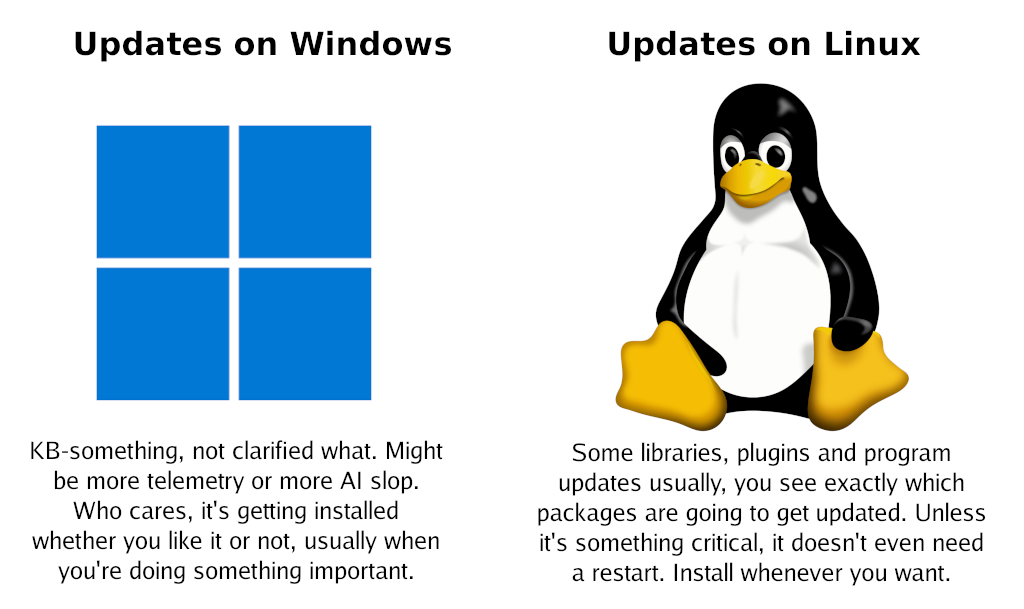
Windows will happily install software from the Reagan administration without batting an eye, maintaining backward compatibility like it's a sacred duty. Meanwhile, Linux is out here with that smug "already installed" energy because half your system came pre-packaged from 1999. The duality of operating systems: one hoards legacy support like a digital museum, the other ships with everything including the kitchen sink. Both approaches are equally chaotic in their own special way, and somehow we've all just accepted this as normal.

I Fucking Hate Python

I Fucking Hate Python
Python dependency hell in its purest form. Started with a simple goal: backup an Android ROM. Ended up in a 4chan greentext speedrun of uninstalling Python versions, googling errors, upgrading pip, discovering you need Microsoft Build Tools (because Windows), realizing you need openssl 1.1.1 specifically (not the latest, obviously), finding it via wayback machine like some digital archaeologist, and finally getting the program to run... only for it to not work. The "you fucking moron" and "you absolute fucking retard" from the dependency errors really captures that special relationship between Python developers and their toolchain. Nothing says "beginner-friendly language" quite like needing to time-travel through the wayback machine to find deprecated SSL versions. Fun fact: This is why Docker exists. Someone looked at this exact scenario and said "there has to be a better way." There wasn't, so they containerized the suffering instead.

I Fucking Hate Python

I Fucking Hate Python
Picture this: you just want to backup your Android ROM using some random Python script. Simple task, right? WRONG. Welcome to dependency hell, population: YOU. It starts innocently enough—clone a repo, run pip install. But then Python decides to play the world's most sadistic game of whack-a-mole with your sanity. Wrong Python version? Uninstall, reinstall. Pip needs upgrading? Sure, why not. Oh, you need Microsoft Build Tools now? For a PYTHON project? Make it make sense. And just when you think you've conquered Mount Dependency, the final boss appears: you need OpenSSL 1.1.1 specifically—not the latest version, because that would be TOO CONVENIENT. Time to fire up the wayback machine and archaeologically excavate ancient software versions like you're Indiana Jones hunting for deprecated libraries. After approximately 47 error messages, 23 Google searches, and one existential crisis later, the program finally installs. You run it with trembling hands and... it doesn't work. Chef's kiss. Python dependency management is basically a choose-your-own-adventure book where every path leads to suffering.

That's Some Other Dev's Problem

That's Some Other Dev's Problem
Year 1: Everything is a crisis. Every bug is existential. You're debugging CSS at 2 AM wondering if you're cut out for this career while your tears blur the screen. Year not 1: npm install confetti and call it a day. Someone else will maintain it. Someone else will debug it. Someone else will cry about it. The circle of life continues. Experience teaches you the most valuable skill in software development: strategic apathy. Why reinvent the wheel when there's a package for that? Why stress about implementation details when Google exists and Stack Overflow has already solved your problem 47 times? You've evolved from "I must understand everything" to "does it work? ship it." The real wisdom is knowing that future you is technically "some other dev" too.

I Love Living On The Edge

I Love Living On The Edge
The ultimate developer crossroads: take the left path and risk your entire codebase exploding from ancient vulnerabilities in packages you haven't touched since 2019, or take the right path and watch your build fail spectacularly because some genius decided to push breaking changes in a minor version update. The left side gives you React2Shell vibes—probably running on dependencies so old they remember when jQuery was cool. The right side? Shai-Hulud, the giant sandworm from Dune, representing the chaos that emerges when you run npm update and suddenly 47 things break in production. Both paths lead to pain. Pick your poison: security nightmares or spending your Friday evening debugging why your app suddenly can't find module 'left-pad'.

Roll Safer: NPM Edition

Roll Safer: NPM Edition
Ah, the classic JavaScript ecosystem paranoia. For the uninitiated, Shai Hulud 3 is referencing the giant sandworms from Dune that devour everything in their path—much like how npm packages sometimes go rogue and wreak havoc on your system. When your trust in the npm ecosystem has been shattered by one too many packages trying to mine crypto on your machine or accidentally nuking your files, you start getting creative with your defensive strategies. Creating a fake package with automation tokens is basically putting a scarecrow in your code garden—technically unnecessary but oddly comforting. It's the digital equivalent of putting a "Beware of Dog" sign when you don't even own a goldfish. Pure survival instinct after seven years of JavaScript framework PTSD.

Library Users Vs. Library Creators

Library Users Vs. Library Creators
The great divide of coding culture in one perfect image. At the top, we have the polished, well-rested library users - looking like they actually shower and maintain healthy relationships. Meanwhile, down below lurk the library creators - sleep-deprived monsters surviving purely on caffeine and spite, with the thousand-yard stare of someone who's debugged pointer arithmetic at 4 AM for the fifth night in a row. It's the coding ecosystem's dirty secret: we're all standing on the shoulders of giants who haven't slept in three years. Next time you casually import a package, pour one out for the energy-drink-fueled gremlin who made it possible.