Object oriented programming Memes

Posts tagged with Object oriented programming

The Call To Super

The Call To Super
Ah yes, the sacred ritual of object-oriented programming where you MUST acknowledge your ancestors before doing literally anything. You're trying to override a method and add your own cool functionality, but the compiler is like "EXCUSE ME, did you forget someone?" Every. Single. Time. You just want to customize your class, but nope—you gotta call super() first because your parent class has feelings too, apparently. It's like being forced to thank your parents at every awards ceremony even though you're 35 years old and just trying to live your life. Forget it once and watch your entire application crumble into a beautiful stack trace of despair. The parent constructor literally HAS to be invoked first—it's not a suggestion, it's the law of inheritance!

How To Remove A Child Class In Java

How To Remove A Child Class In Java
We've all been there—innocently Googling something programming-related and realizing mid-search how absolutely unhinged it sounds out of context. The FBI watching you search "how to remove a child" is mildly concerning, but adding "class in java" to the end? That's the developer experience in a nutshell. Your search history as a developer is basically a list of things that would get you put on multiple watchlists if anyone didn't know you were just trying to figure out inheritance hierarchies. Between "kill orphan processes," "abort child," and "terminate parent," it's a miracle we're all still walking free. Pro tip: Always add the programming context FIRST in your searches. Your FBI agent will thank you.

Thing Doer

Thing Doer
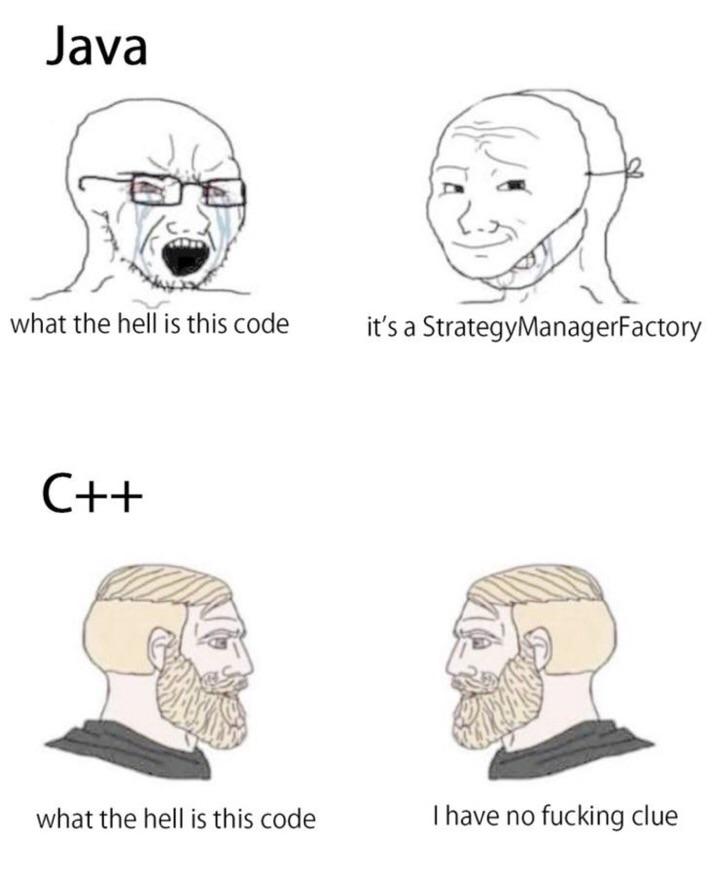
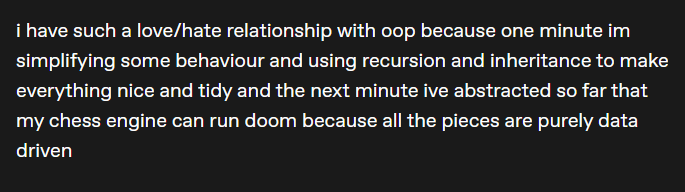
Every OOP developer's journey: First you discover inheritance and polymorphism and suddenly you're an architectural genius, creating elegant hierarchies where a ChessPiece extends MovableGameEntity which implements IPositionable . You're writing beautiful recursive algorithms, feeling like a wizard. Then reality hits. You've abstracted so hard that your chess pieces are now just pure data with zero behavior, floating in a sea of interfaces seven layers deep. Your bishop doesn't know how to move anymore—some MovementStrategyFactory three folders away does. You need a PhD and a map to figure out where the actual logic lives. The duality of OOP: powerful enough to model the entire universe, confusing enough to make you question if your knight should even exist as an object or just be a JSON blob processed by a ThingDoer class.

Object Oriented Programming Is An Exceptionally Bad Idea Which Could Only Have Originated In California

Object Oriented Programming Is An Exceptionally Bad Idea Which Could Only Have Originated In California
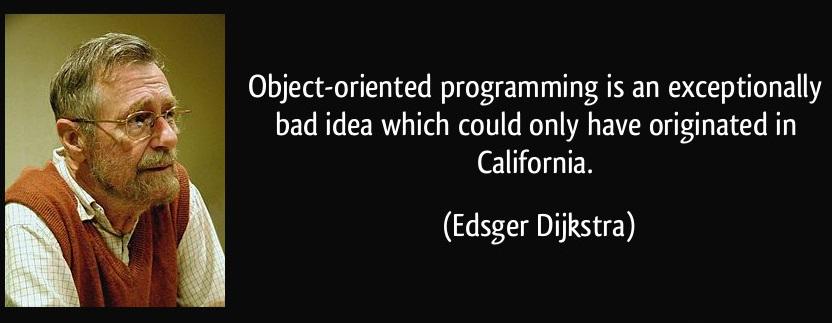
Edsger Dijkstra, the legendary computer scientist who gave us shortest path algorithms and structured programming, wasn't exactly known for holding back his opinions. The man literally wrote essays with titles like "Go To Statement Considered Harmful" – subtlety wasn't his thing. Here he's taking a flamethrower to OOP while simultaneously roasting California in one elegant sentence. The California dig is chef's kiss – implying that only the land of tech startups, venture capital, and questionable wellness trends could birth something as "misguided" as object-oriented programming. Dijkstra preferred mathematical elegance and formal methods. To him, OOP was like watching someone solve a calculus problem with crayons. The functional programming crowd still quotes this like scripture whenever someone mentions inheritance hierarchies or the Singleton pattern. Plot twist: OOP went on to dominate the industry for decades. Sometimes even legendary computer scientists can't predict what'll stick. But hey, at least we got a sick burn out of it.

Easy

Easy
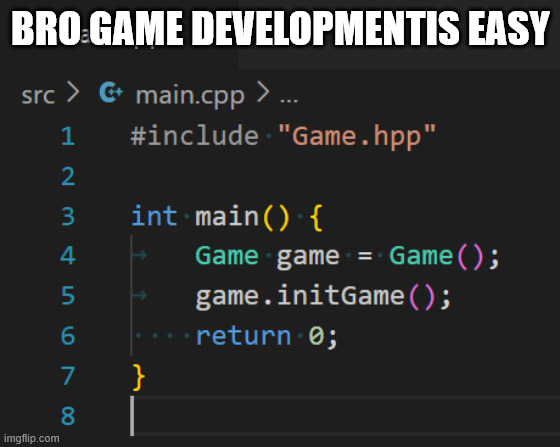
Oh sure, just instantiate a Game object, call initGame(), and boom—you've got the next AAA title ready to ship. Seven lines of C++ and you're basically competing with Unreal Engine 5. The real kicker is that "Game.hpp" header file doing all the heavy lifting while you pretend your main.cpp is the genius behind it all. That single header probably contains 50,000 lines of physics engines, rendering pipelines, AI pathfinding, and enough spaghetti code to make an Italian chef weep. But hey, game development is easy when you abstract away literally everything that makes it hard. This is the programming equivalent of those "how to draw an owl" memes where step 1 is drawing two circles and step 2 is "draw the rest of the owl." Just hide all the complexity in a header file and call it a day.

OOP Is A Construct Of Oppression Installed By The Bourgeoisie

OOP Is A Construct Of Oppression Installed By The Bourgeoisie
Nothing quite captures the revolutionary spirit like deleting 47 abstract factory singleton builder classes that were "definitely gonna be useful someday." That dopamine hit when you realize your entire inheritance hierarchy can be replaced with three functions and a Map is chef's kiss. The functional programming crowd has been preaching this gospel for decades, but sometimes you need to write your 15th "Manager" class before you see the light. Turns out, not everything needs to be an object. Sometimes a function is just... a function. Wild concept, I know. Bonus points if those "useless classes" included a AbstractSingletonProxyFactoryBean or a VisitorPatternStrategyFactoryManager. The revolution will not be encapsulated.

NordVPN

NordVPN
Encrypt your traffic on public Wi-Fi, stream from anywhere, and cover up to ten devices with one plan. 30-day money-back guarantee.

I Didn't Get It

I Didn't Get It
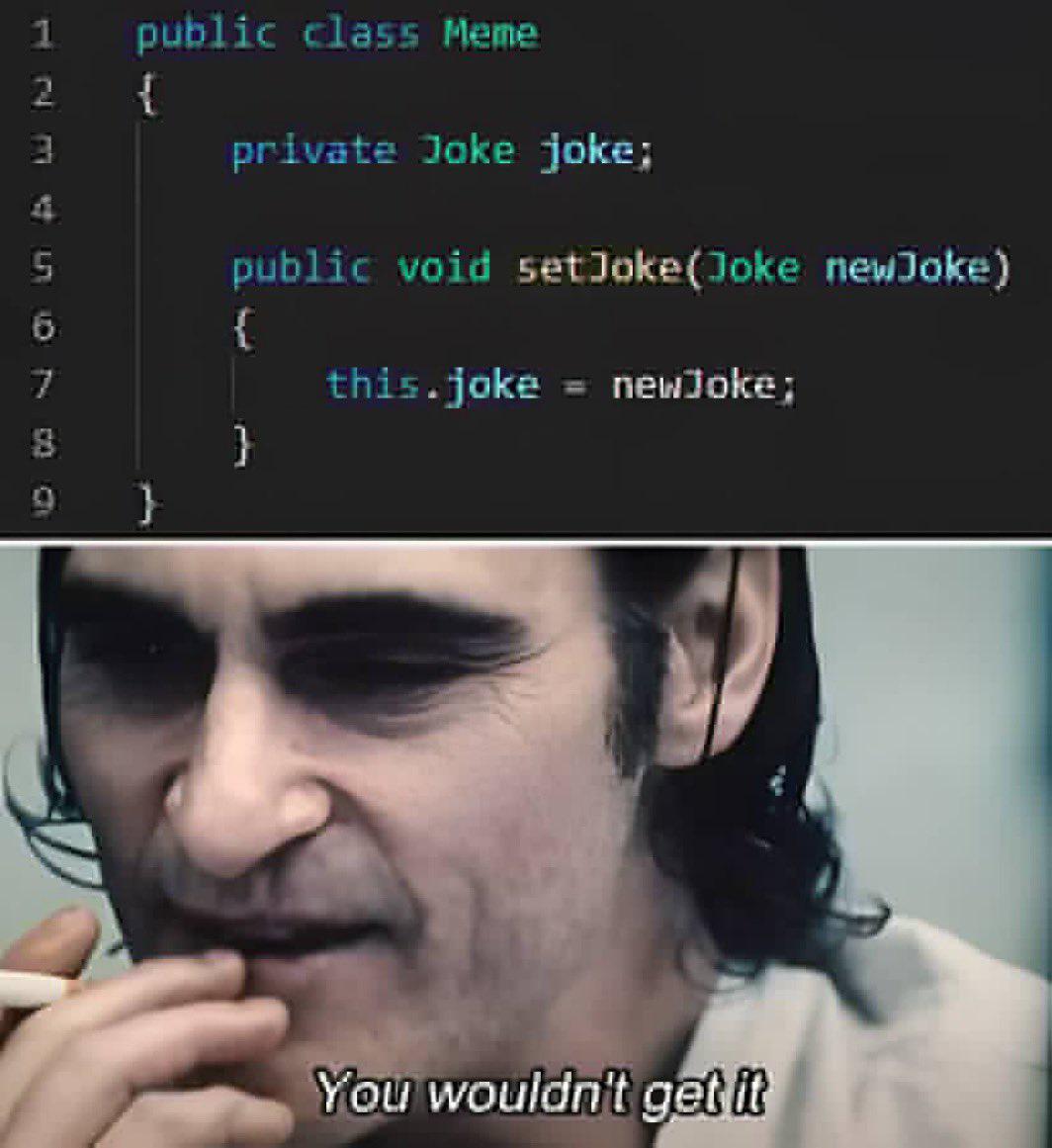
Oh, the absolute TRAGEDY of encapsulation! Someone made a private Joke object and then had the AUDACITY to provide a public setter method for it. The punchline? You literally can't access the joke directly because it's private, so you genuinely "wouldn't get it." It's a meta-joke about access modifiers that becomes the very thing it describes - an inaccessible joke. The setter is there taunting you like "here, you can SET a new joke, but you'll never GET the original one!" Pure object-oriented poetry wrapped in existential programming humor. Chef's kiss to whoever wrote this because they created a joke that perfectly embodies its own inaccessibility. The irony is *chef's kiss* immaculate.

When You Finally Remove Useless Classes From Your Code

When You Finally Remove Useless Classes From Your Code
You know that feeling when you've been carrying around dead code for months—maybe years—and you finally get the courage to delete those abstract factory singleton builder classes that literally do nothing? Revolutionary moment right there. It's like declaring independence from technical debt. The crowd goes wild because everyone's been silently judging that bloated codebase, but nobody wanted to be the one to touch it. Now you're the hero who reduced the bundle size by 40% and made the CI pipeline actually finish before the heat death of the universe. Chef's kiss. Until you realize three months later that one of those "useless" classes was actually being reflection-invoked by some ancient framework configuration and now production is on fire.

Typical Child In The Life Of A Programmer

Typical Child In The Life Of A Programmer
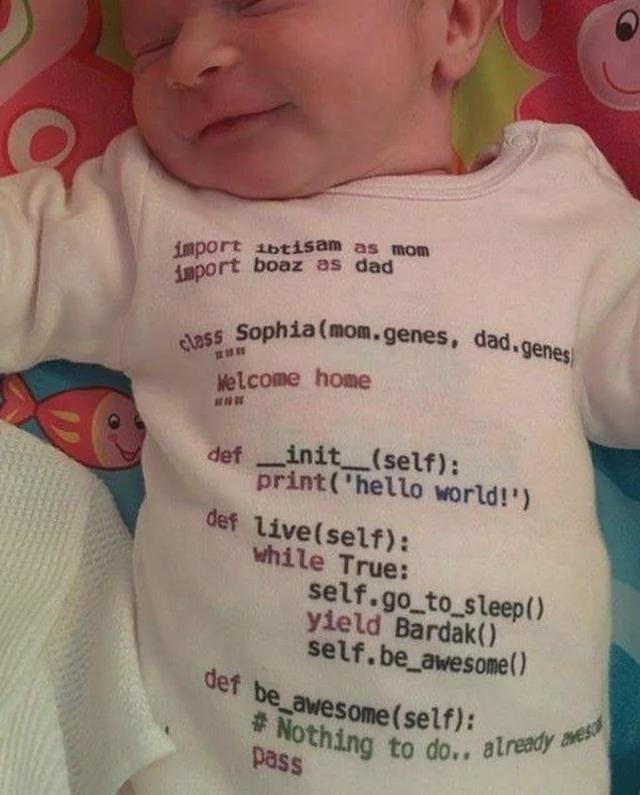
When you inherit from both parents but implement the interface as a Python class. The onesie is basically a programmer's birth certificate written in code. Love how the live() method is just an infinite loop of sleeping, yielding to Bardak (probably a parenting framework for diaper changes), and calling be_awesome() . The implementation of be_awesome() ? Just pass . Already awesome by default—no logic needed. That's some solid object-oriented parenting right there. The imports are chef's kiss: import ibtiSam as mom and import boaz as dad . Aliasing your parents like they're npm packages. The class constructor takes both parents' genes as parameters—multiple inheritance done right. And that __init__ printing "hello world!" is probably the most accurate representation of birth ever coded. Baby's first deployment was clearly a success. No exceptions raised, all tests passing, and already in production with that "Welcome home" comment. 10/10 would instantiate again.

The Great Class Purge Revolution

The Great Class Purge Revolution
Nothing says "revolutionary leader" quite like deleting those 17 unused classes from your codebase that someone created "just in case we need them later." The crowds cheer! Your git commit is hailed as heroic! The build time decreases by 0.03 seconds! Truly, you've liberated your fellow developers from the tyranny of bloated inheritance hierarchies and half-baked abstractions. Next week's revolution: removing all those interface classes with only one implementation. The people demand freedom from unnecessary indirection!

Srsly Who Names These Laws

Srsly Who Names These Laws
OH. MY. GOD. Whoever came up with this "Law of Demeter" deserves both a Nobel Prize and a slap across the face! 🤦‍♀️ It's literally the most RIDICULOUS way to explain encapsulation in programming history - comparing object methods to nose-picking etiquette?! I'm deceased! 💀 For the uninitiated: The Law of Demeter is actually a serious design principle that says objects should only talk to their immediate friends (direct dependencies), not friends of friends. It prevents your code from turning into a codependent mess where everyone's all up in everyone else's business. But sure, let's explain complex software architecture with nose-picking metaphors. Because THAT'S what makes computer science approachable! Next up: Garbage collection explained through bathroom etiquette! 🚽

Dollger Blue light Glasses for Women Men Oversize Square Computer Screen Blue light Blocking Eyeglasses TR90 Frame

Dollger Blue light Glasses for Women Men Oversize Square Computer Screen Blue light Blocking Eyeglasses TR90 Frame
BLUE LIGHT BLOCKING GLASSES: Anti-blue light lenses can filter out some harmful blue light, reduce the amount of blue light entering the eyes, effectively reduce the continuous damage of blue light t…

The Single Responsibility Principle's Worst Nightmare

The Single Responsibility Principle's Worst Nightmare
The eternal software engineer's dilemma, perfectly illustrated by Emperor Kuzco. On one shoulder, the devil whispers "just cram that new functionality into your existing bloated class and call it a day." On the other, the angel begs you to consider proper architecture. Meanwhile, you're standing there with that blank stare, knowing you'll choose technical debt now and regret it during code review later. The single responsibility principle weeps silently in the corner.