Nested loops Memes

Posts tagged with Nested loops
Just Found A Puzzle Solver I Made A While Back

Just Found A Puzzle Solver I Made A While Back
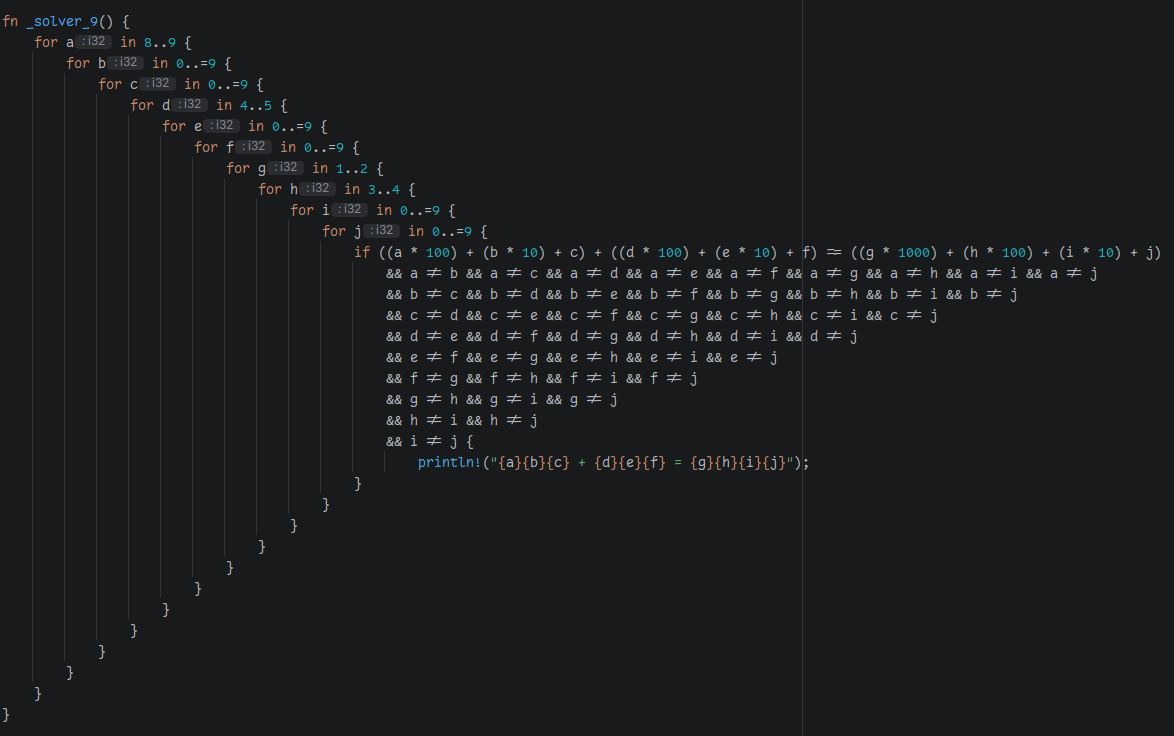
Someone really woke up one day and chose violence against their CPU. Ten nested for-loops iterating through ranges with a conditional statement that's basically checking every possible combination of ten variables against a mathematical equation. The time complexity? O(n^10). Your processor called, it wants its thermal paste back. The beautiful part is that this is technically a brute-force puzzle solver, and it'll work... eventually. Maybe. If the heat death of the universe doesn't happen first. Each loop multiplies the iterations exponentially, so even with those modest ranges, you're looking at potentially billions of iterations just to solve what's probably a simple alphametic puzzle. The real kicker? Looking back at old code you wrote and realizing you were either a genius or completely unhinged. Based on this masterpiece of computational overkill, I'm leaning towards the latter. But hey, at least the variable names are single letters – maximum efficiency in the worst possible way.

Nice And Simple Way To Break From Multiple Loops!

Nice And Simple Way To Break From Multiple Loops!
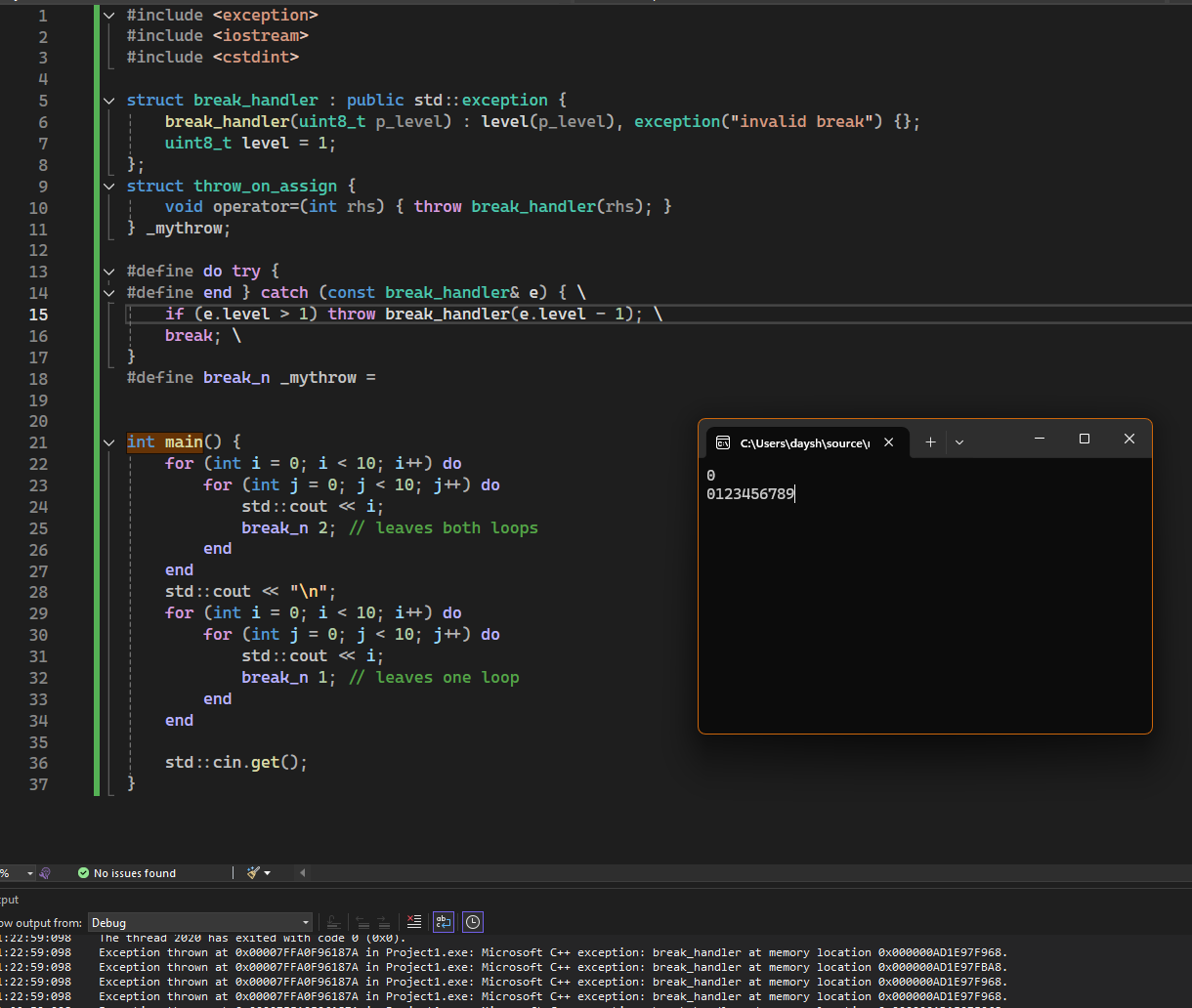
Someone really said "I need to break out of nested loops" and decided the best solution was to weaponize C++ exceptions . Because why use a simple boolean flag or labeled breaks when you can create a custom exception class, throw it through multiple stack frames, and watch your program crash spectacularly? The code creates a break_handler exception with a "level" parameter to control how many loops to escape from. It's like using a sledgehammer to hang a picture frame. Sure, break_n 2 technically exits both loops... right before the entire thing implodes in a beautiful cascade of memory violations. The terminal output tells the real story: "Exception thrown at 0x00007FA0F96187A" repeated infinitely. Nothing says "elegant solution" quite like infinite exception spam and a crashed program. This is what happens when you treat control flow like a game of exception hot potato. Pro tip: Just use a goto or refactor into a function. Your future self (and your debugger) will thank you.

Boomer Bummer

Boomer Bummer
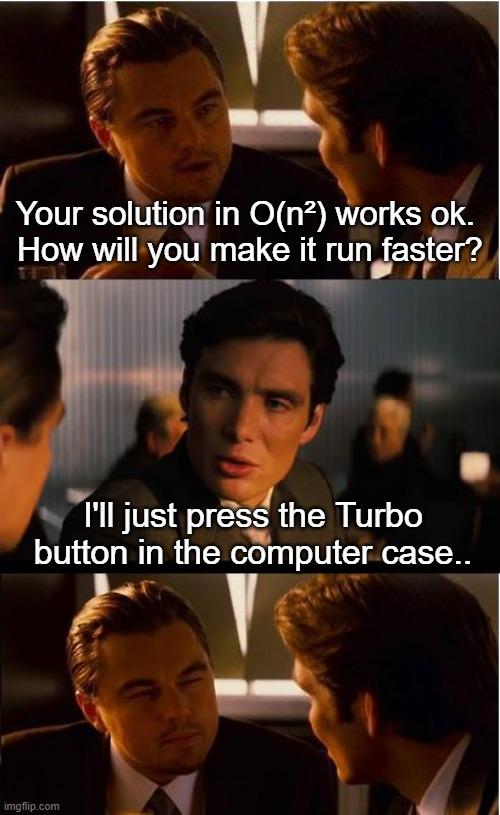
When your manager asks how you'll optimize that O(n²) algorithm and your coworker suggests downloading more RAM by pressing the turbo button. Big O notation measures time complexity, not clock speed, but sure, let's just overclock our way out of a nested loop problem. Next they'll recommend defragging the SSD to make the bubble sort faster. The confidence with which some people confuse hardware solutions with algorithmic efficiency is genuinely impressive.

I, J And K In The Alphabet

I, J And K In The Alphabet
You know those three innocent letters just chilling in the alphabet? Yeah, they're absolute menaces in programming. Regular variables? Fine, whatever. Loop counters? Sure, getting annoying. But then you hit i, j, k as unit vectors in 3D math and suddenly you're debugging quaternion rotations at 2 AM wondering why your spaceship is spinning into the sun. The escalation is real. From "cute little loop iterator" to "I need to understand linear algebra again" faster than you can say "cross product." Those three letters carry more trauma per character than any other part of the ASCII table.

Works Perfectly. Good Luck Maintaining It.

Works Perfectly. Good Luck Maintaining It.
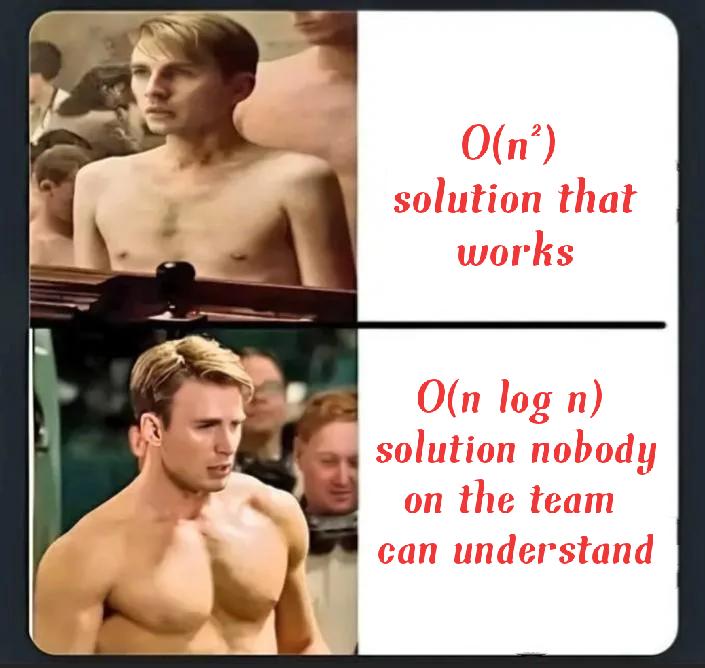
You know that moment when you write an O(n²) solution that actually works and everyone's like "cool, ship it"? Yeah, that's the scrawny Steve Rogers energy right there. But then some absolute LEGEND on your team casually drops an O(n log n) solution that's so elegant and optimized it makes everyone else look like they're coding with crayons. Suddenly they're Captain America and you're just... there. Watching. Contemplating your life choices. The real tragedy? The O(n²) code works PERFECTLY. It passes all tests. Users are happy. But deep down, you know that when the dataset grows, your nested loops are gonna choke harder than a developer trying to explain their spaghetti code in a code review. Meanwhile, Chad over here with his logarithmic complexity is basically flexing computational muscles you didn't even know existed. The kicker? Nobody on the team understands the optimized solution. It's got recursion, divide-and-conquer, maybe some tree balancing magic. Six months from now when someone needs to modify it, they'll be staring at that code like it's ancient hieroglyphics. But hey, at least it scales beautifully! 🎭

Iterator, Jterator, Kterator...

Iterator, Jterator, Kterator...
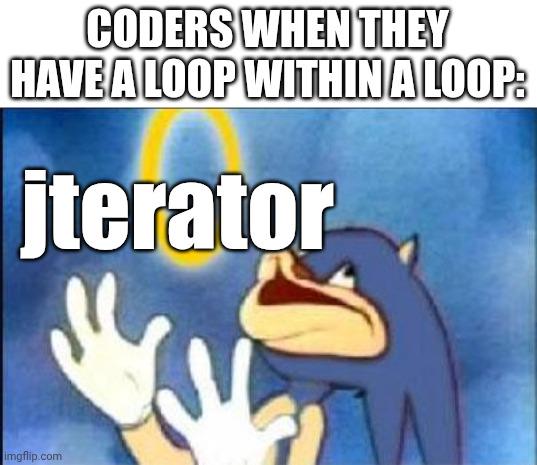
You know you've hit peak laziness when you're nesting loops and your variable names become a countdown to despair: i , j , k ... and then suddenly you're reaching for l and questioning every life choice that brought you to this moment. But here's the real kicker—instead of just using those single letters like a normal person, someone decided to get fancy and call them "jterator" and "kterator" because apparently j wasn't descriptive enough. It's like putting a bow tie on a dumpster fire. If you're three loops deep, you're either working with matrices, doing some cursed algorithm nobody should touch, or you've architectured yourself into a corner. Either way, that code review is gonna be spicy.

Christmas Tree

Christmas Tree
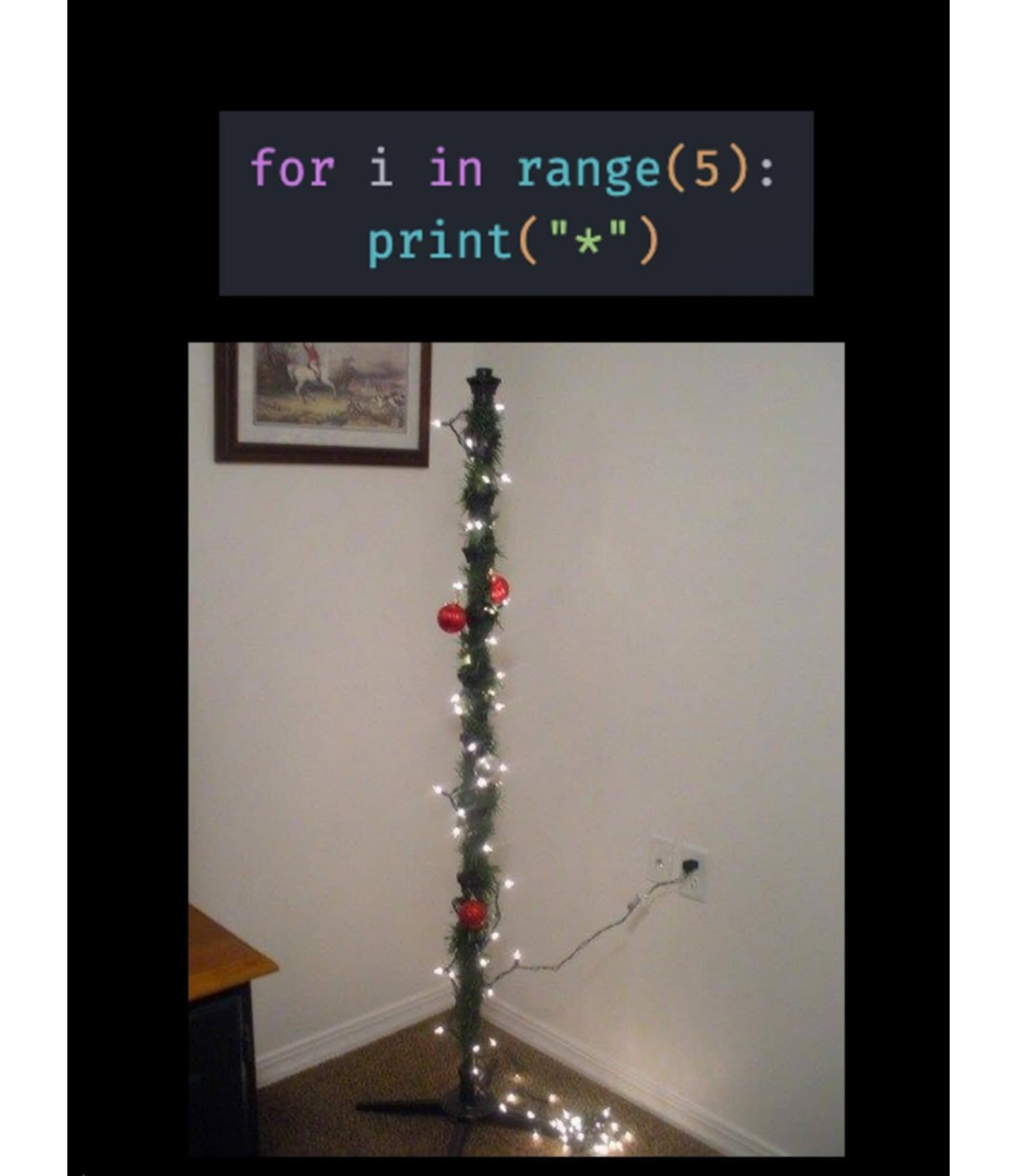
When you try to print a Christmas tree in Python but forget how nested loops work. Someone wrote for i in range(5): print("*") expecting a beautiful triangular tree, but instead got five sad asterisks stacked vertically like the world's most depressing Christmas decoration. The photo shows exactly what this code produces in real life: a pathetically tall, skinny "tree" that's basically just a decorated stick leaning against the wall. Pro tip: You need nested loops and some string multiplication to build an actual tree shape. But hey, at least this one fits in small apartments.

EMEET C960 1080P Webcam with Microphone, 2 Mics, 90° FOV, Computer Camera

EMEET C960 1080P Webcam with Microphone, 2 Mics, 90° FOV, Computer Camera
1080P Webcam with Cover for Video Calls - EMEET computer webcam provides design and Optimization for professional video streaming. Realistic 1920 x 1080p video, 5-layer anti-glare lens, providing smo…

$I, J, K$ In Math Vs. Programming

$I, J, K$ In Math Vs. Programming
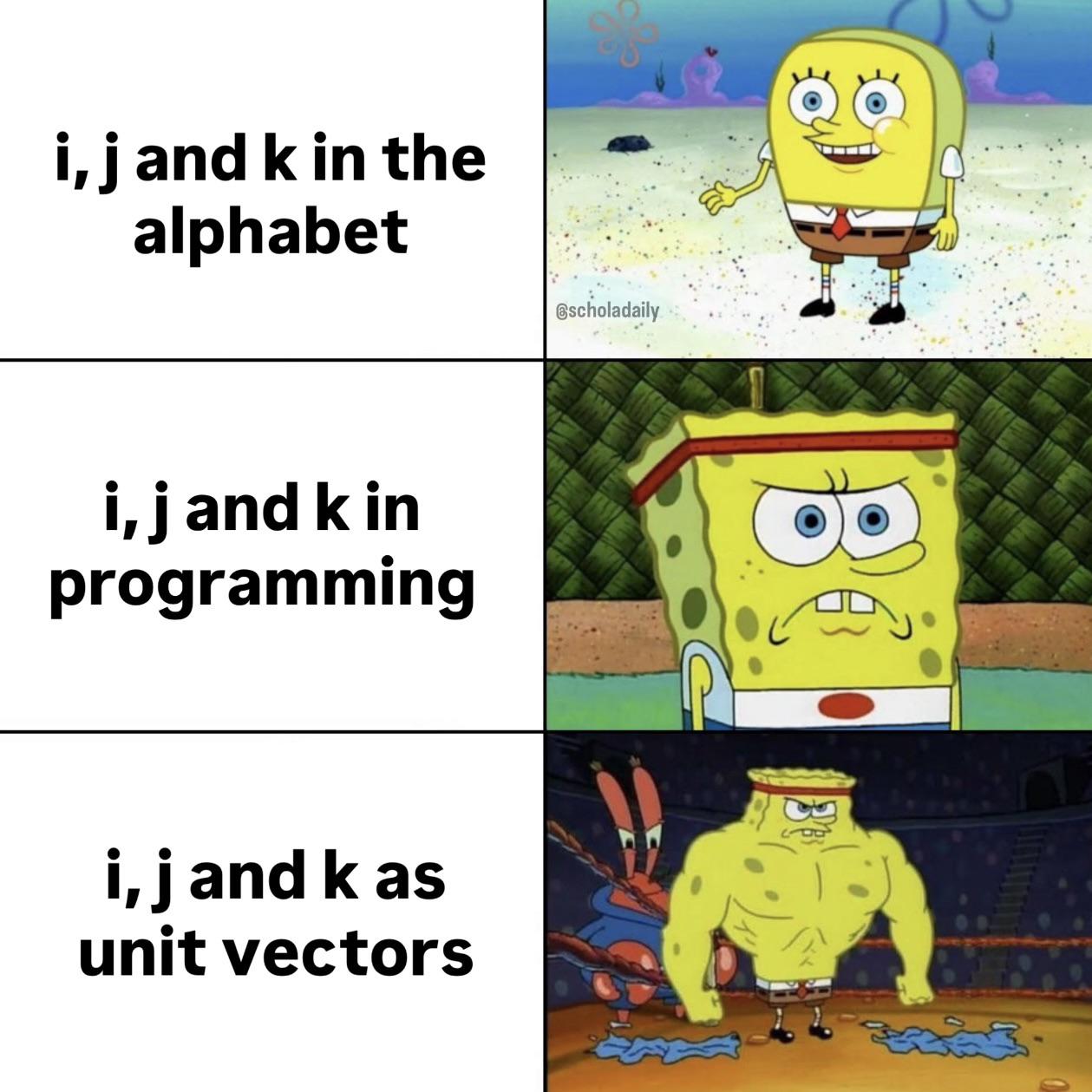
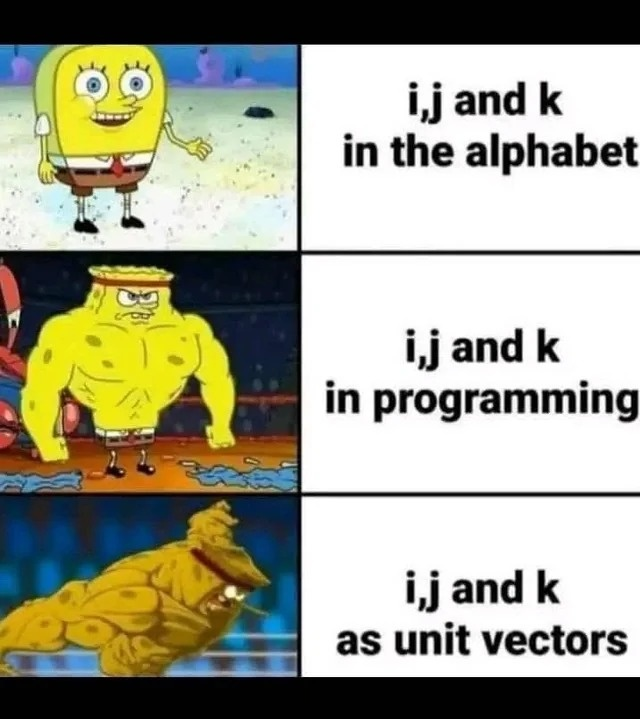
So i, j, and k start out as innocent alphabet letters, minding their own business. Then they hit programming and suddenly become the holy trinity of nested loop variables—battle-hardened from iterating through arrays, matrices, and every conceivable data structure known to humanity. But wait, there's more! When they ascend to their final form as unit vectors in 3D space (î, ĵ, k̂), they achieve ultimate enlightenment, representing the fundamental basis of vector mathematics. The progression from wimpy SpongeBob to buff SpongeBob to godlike SpongeBob captures the increasing complexity and power these three letters wield. In programming, they're your go-to variables for nested loops—you know, when you're doing O(n³) operations and your code reviewer gives you that look. But as unit vectors? They literally define the coordinate system of 3D space. That's like going from counting apples to bending reality itself. Fun fact: Using i, j, k for loops is so ingrained in programming culture that seeing something like "for (int x = 0...)" feels wrong on a spiritual level. It's like putting pineapple on pizza—technically possible, but why would you do that to yourself?

At Least He Closes Brackets Like Lisp

At Least He Closes Brackets Like Lisp
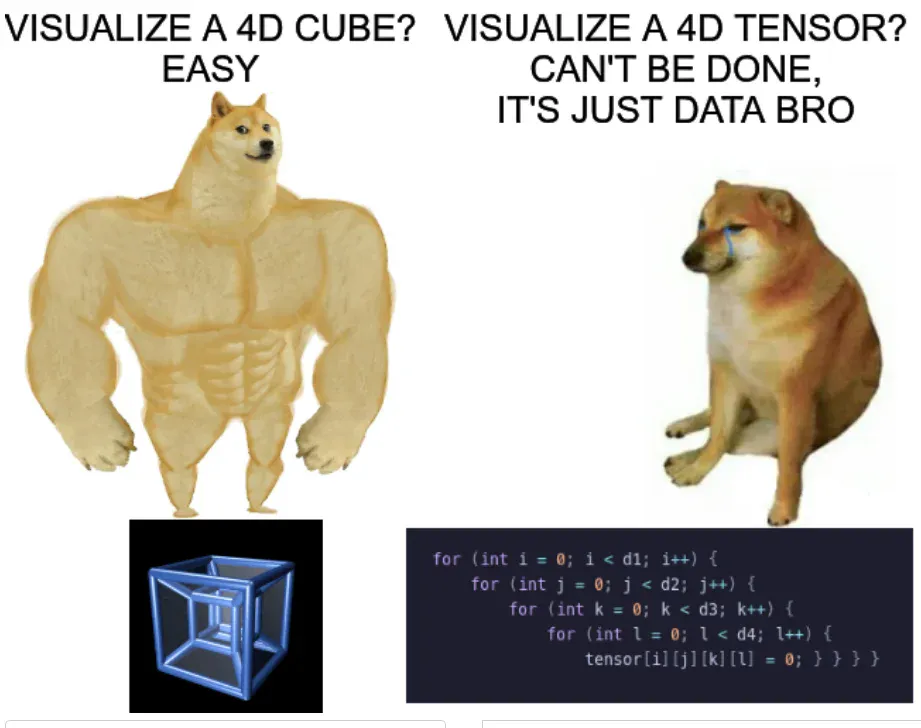
When you can mentally rotate a 4D hypercube in your head but suddenly become illiterate when asked to visualize nested loops. The buff doge confidently shows off his spatial reasoning skills, while the wimpy doge just stares at four nested for-loops like they're written in ancient Sumerian. The punchline? That glorious cascade of closing brackets: } } } } – the telltale sign of someone who either writes machine learning code or has given up on life. It's the programming equivalent of those Russian nesting dolls, except each doll contains existential dread and off-by-one errors. The title references Lisp's infamous parentheses situation, where closing a function looks like )))))))) – except now we've upgraded to curly braces. Progress!

Time Complexity 101

Time Complexity 101
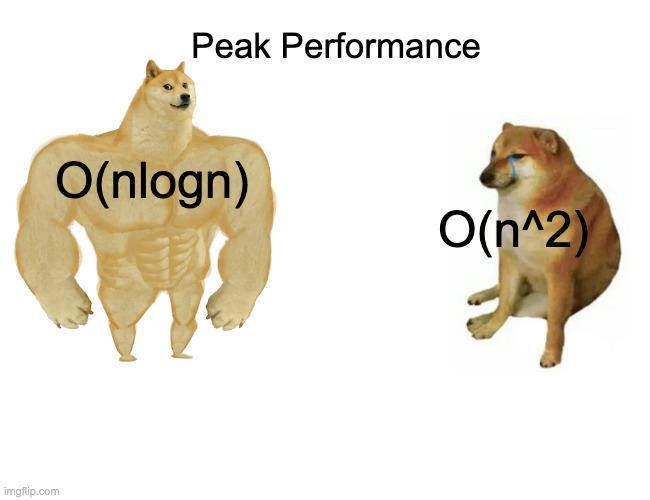
O(n log n) is strutting around like it owns the place—buff doge, confident, the algorithm everyone wants on their team. Meanwhile O(n²) is just... there. Weak, pathetic, ashamed of its nested loops. The truth? O(n log n) is peak performance for comparison-based sorting. Merge sort, quicksort (on average), heapsort—they're all flexing that sweet logarithmic divide-and-conquer magic. But O(n²)? That's your bubble sort at 3 AM because you forgot to optimize and the dataset just grew to 10,000 items. Good luck with that. Every junior dev writes O(n²) code at some point. Nested loops feel so natural until your API times out and you're frantically Googling "why is my code slow." Then you learn about Big O, refactor with a HashMap, and suddenly you're the buff doge too.

Beginner Vs Professional

Beginner Vs Professional
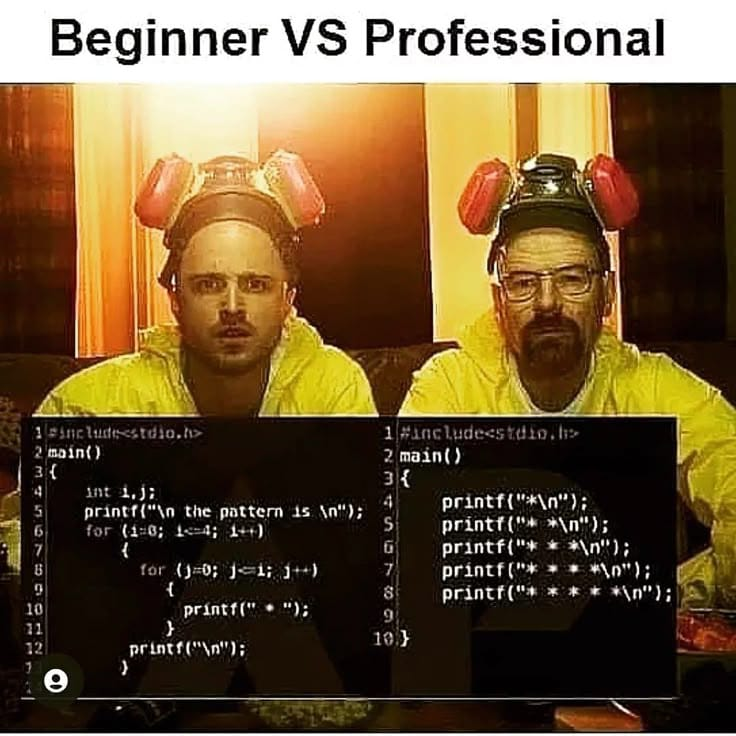
The duality of coding in its purest form. Left side: a beginner writing a nested loop monstrosity with 12 lines to print a simple pattern. Right side: the professional with the thousand-yard stare of someone who's seen too many code reviews, just hardcoding five print statements and calling it a day. The beginner thinks they're being clever with their algorithm. The professional knows the true path to enlightenment: whatever ships fastest with the least maintenance. Why waste time writing elegant loops when you can just... not? It's the coding equivalent of using a jackhammer to hang a picture frame versus just using a nail and your shoe.

Thermaltake Tower 250 Black Mini-ITX Mini Tower; 2x120mm CT Fans Included; 360mm Radiator Support; 360mm GPU Clearance; Dual Chamber; CA-1Z9-00S1WN-00

Thermaltake Tower 250 Black Mini-ITX Mini Tower; 2x120mm CT Fans Included; 360mm Radiator Support; 360mm GPU Clearance; Dual Chamber; CA-1Z9-00S1WN-00
【Maximize Workspace】 Space-efficient compact vertical design saves valuable desk space. · 【Small Size, Big Performance】 Support GPUs up to 360mm in length with PSU cover removed / CPU cooler hieght u…

The Sacred Law Of Loop Variables

The Sacred Law Of Loop Variables
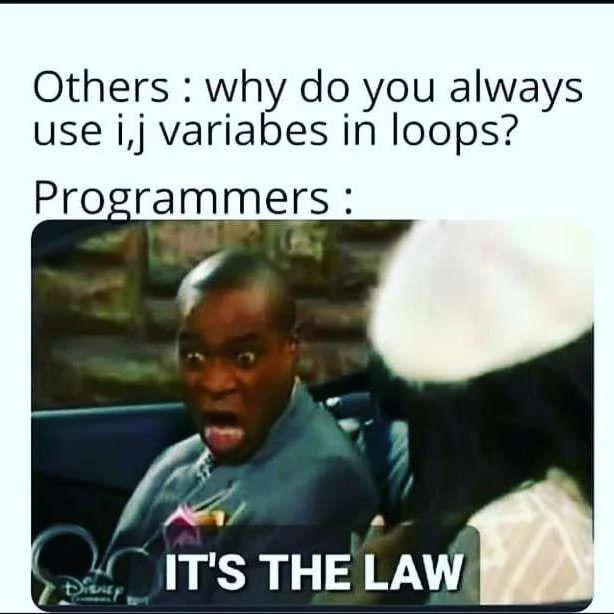
Listen, when someone questions why you use i and j for loop counters, there's only one valid response: IT'S THE LAW. It's like asking why we drink coffee or hate meetings that could've been emails. Some traditions in programming aren't meant to be questioned—they're sacred knowledge passed down from the ancient CS gods. Using foo and bar as placeholder names, tabs vs spaces, and i , j , k for nested loops... these are the unwritten commandments that separate the true believers from the heretics. Sure, you could use descriptive variable names like index or counter , but then your fellow devs might think you're some kind of revolutionary anarchist. And nobody wants that kind of reputation in the office.