json Memes

Bro Couldn't You Just Use One Format As Normal Human

Bro Couldn't You Just Use One Format As Normal Human
Nothing says "I make questionable life choices" quite like having XML, JSON, AND YAML config files all living in the same project. Pick a lane, my guy. It's like showing up to a meeting wearing a tuxedo jacket, basketball shorts, and flip-flops. Sure, they're all technically clothing, but what are you doing? The rest of us are out here trying to maintain some semblance of sanity, and you're creating a United Nations of serialization formats. Your package.json is crying. Your .gitlab-ci.yml is confused. And somewhere, an app.config.xml is wondering what it did to deserve this. Consistency is dead. Long live chaos.

Http 200 Error

Http 200 Error
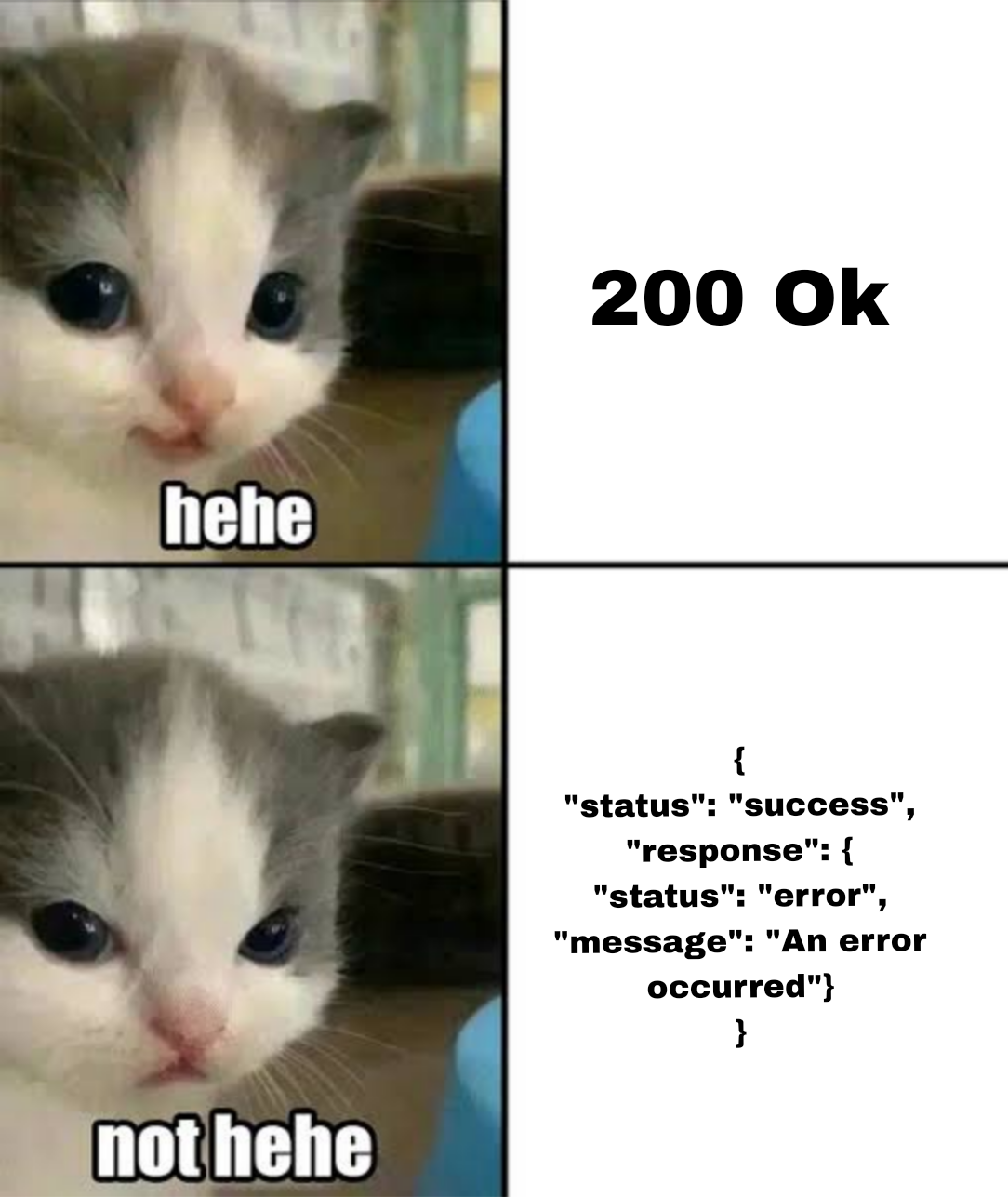
Nothing says "everything is fine" quite like an HTTP 200 OK response cheerfully delivering a 500 Internal Server Error in the body. It's the API equivalent of your house being on fire while the smoke detector plays calming jazz music. The server is basically gaslighting you—the status code says success, but the JSON is screaming disaster. That confused cat stare? That's every developer trying to debug this nonsense because their error handling only checks status codes. Bonus points if this breaks your entire monitoring system because technically it's a "successful" request. Pro tip: whoever designed this API architecture probably also thinks pineapple belongs on pizza and tabs are better than spaces.

Frontend And Backend Devs Unite Through JSON

Frontend And Backend Devs Unite Through JSON
Frontend devs and backend devs might have their differences—one's obsessing over pixel-perfect margins while the other's optimizing database queries at 3 AM—but they both bow down to the same lord and savior: JSON. It's the universal peace treaty, the lingua franca of web development, the one thing that lets React talk to Node without starting a war. Meanwhile, the fullstack developer is just sitting there with both arms in a death grip, forced to maintain both sides of the handshake simultaneously. They're the poor soul who has to debug why the frontend is sending camelCase while the backend expects snake_case, then fix it on both ends while everyone else is at lunch. The price of knowing too much is eternal context-switching and no one to blame but yourself.

Cool Format

Cool Format
ASN.1 (Abstract Syntax Notation One) is that ancient data serialization format that nobody asked for but everyone in telecom and cryptography has to deal with. It's basically the granddad of JSON, except it makes encoding a simple boolean value feel like you're performing cryptographic surgery. So you want to encode TRUE? Cool, that'll be 3 bytes please: one byte for the type (01₁₆ = Boolean), one byte for the length (01₁₆ = 1 byte of data), and finally one byte for the actual value (FF₁₆). That's right, a single bit of information now costs you 24 bits. It's like paying $3 in transaction fees to send $1. Meanwhile, JSON just goes true and calls it a day. But hey, at least ASN.1 is "efficient" and "well-structured" according to the 1984 standards committee that designed it.

I'm Guilty

I'm Guilty
Database normalization? Never heard of her! This is the ultimate programmer IQ distribution chart where the galaxy brains on both ends have discovered that storing JSON blobs in PostgreSQL is actually... totally fine? Meanwhile, the sweating middle-ground folks are clutching their database textbooks screaming about proper relational design and creating separate tables for each entity like their professors taught them. Plot twist: Both extremes are right but for wildly different reasons. The low-IQ chad just wants to ship code and doesn't care about third normal form. The high-IQ monk has transcended traditional database design, understands JSONB indexing, and knows that sometimes denormalization is actually the move for performance. The middle? They're having an existential crisis about whether their CS degree was a lie. Spoiler alert: We're ALL guilty of yeeting JSON into Postgres at 2 AM when the deadline is tomorrow. No judgment here! 🙈

Toml

Toml
Oh honey, the TOML community really thought they were doing something revolutionary here. Started with v0.1 looking all innocent with their dotted keys, then v0.5 came along like "let's make it SLIGHTLY more nested" and everyone's nodding along. But THEN v1.1 drops and suddenly we're writing what is essentially JSON with extra steps, and the character just SNAPS. The absolute horror of realizing you've been gaslit into thinking TOML was "more readable" than JSON when you're now staring at the exact same nested structure with curly braces. The betrayal! The drama! It's like watching someone slowly morph into the very thing they swore to destroy. RIP simple config files, you will be missed.

Friday 13

Friday 13
Senior developers when they have to deal with JSON: intimidating, powerful, commands respect. Senior developers when they have to deal with JSON.stringify() : adorable crochet doll that looks like it was made by someone's grandmother during a church group meeting. The juxtaposition is chef's kiss—JSON itself is straightforward, but the moment you need to convert an object to a JSON string, suddenly you're this wholesome craft project with blood tears. Probably because you've seen what stringify() does to circular references. Or tried to debug why your dates became strings. Or dealt with undefined values just vanishing into the void. The horror movie villain becomes a sad little yarn person real quick.

From A Multinational Bank Too

From A Multinational Bank Too
Nothing screams "enterprise-grade documentation" quite like receiving your API specification as JSON snippets copy-pasted into Excel cells. Because why use OpenAPI/Swagger specs, Postman collections, or literally any proper API documentation tool when you can just... Excel ? The fact that this came from a multinational bank makes it even more delicious. Somewhere in their tech stack, they're handling billions in transactions with microservices and distributed systems, but when it comes to sharing API docs? Excel spreadsheet it is! The JSON is probably beautifully formatted too—until Excel decides that your timestamps are dates and your IDs need to be in scientific notation. Props to whoever had to parse through those cells trying to figure out which curly brace belongs where. Hope they didn't need to copy-paste that JSON anywhere, because Excel definitely added some invisible characters for flavor.

From A Multinational Bank Too

From A Multinational Bank Too
Nothing screams "enterprise-grade documentation" quite like receiving JSON screenshots pasted into Excel cells. Because why use OpenAPI/Swagger specs, Postman collections, or literally any structured format when you can squint at pixelated text in a spreadsheet? The fact that this is coming from a multinational bank with presumably billions in revenue makes it even more chef's kiss. Someone probably spent hours meticulously screenshotting each endpoint, carefully pasting them into Excel, and thought "yes, this is the professional way." Meanwhile, the developer receiving this masterpiece gets to manually type out every field, guess the data types, and pray they didn't miss anything because zooming into cell B47 isn't helping. The frog's dignified expression perfectly captures the internal screaming while maintaining that corporate professionalism.

Json Momoa

Json Momoa
Someone just walked up to Jason Momoa and called him "json momoa" and honestly? The man looks like he's about to unleash the fury of a thousand misplaced commas. That death glare could parse your entire API and find every single syntax error in your soul. The absolute AUDACITY to reduce this majestic human to a data interchange format! Though let's be real, if Jason Momoa was actually JSON, he'd be perfectly formatted, properly indented, and would never throw a parsing error. Unlike the rest of us mortals who forget a closing bracket and watch our entire application burn.

Cookie Cutter For Empty Jsons

Cookie Cutter For Empty Jsons
Finally, a practical kitchen tool for when your API returns {} for the 47th time today. Just press it into your dough and boom—perfectly shaped emptiness, just like that response body you've been staring at for the past hour. The cookie cutter literally creates nothing but an outline, which is the most accurate representation of what you get when the backend "successfully" returns an empty object. Status 200, zero data, maximum confusion. At least now you can eat your frustration in cookie form. Pro tip: Pair these cookies with a nice cup of "why didn't they just return null" tea.

Json Daddy

Json Daddy
Dad jokes have officially infiltrated the tech world, and honestly? We're not even mad about it. Jay's son is JSON—get it? Because JSON is literally "Jay's son." It's the kind of pun that makes you groan and chuckle simultaneously. The beauty here is that JSON (JavaScript Object Notation) has become such a fundamental part of modern web development that it deserves its own origin story. Forget superhero backstories—we now have the canonical tale of how Jay brought JSON into this world. Every API response, every config file, every data exchange you've ever dealt with? Yeah, that's Jay's kid doing the heavy lifting. The stick figure representation really drives home how simple yet profound this joke is. No fancy graphics needed—just pure, unadulterated wordplay that hits different when you've spent countless hours parsing JSON objects at 2 AM trying to figure out why your nested arrays aren't behaving.