

Hello world Memes

Posts tagged with Hello world

Found This Brilliant Code On Teenagersbutcode

Found This Brilliant Code On Teenagersbutcode
Oh honey, where do I even BEGIN with this masterpiece? Someone literally wrote a C program that calls Python to print "Hello from world c". Because why use one language when you can create the most beautifully chaotic Frankenstein's monster of code ever conceived? It's like ordering a pizza, but instead of just eating it, you hire someone to chew it for you and then spit it into your mouth. The sheer AUDACITY of including stdlib.h, setting up a proper C main function with all the ceremony, only to use system() to shell out to Python for a basic print statement is sending me into orbit. 🚀 Truly the programming equivalent of using a forklift to move a single grape. But you know what? We've ALL been teenagers learning to code, and honestly? Respect for the creativity, even if it makes every senior developer's eye twitch uncontrollably.

Can Still Write Code

Can Still Write Code
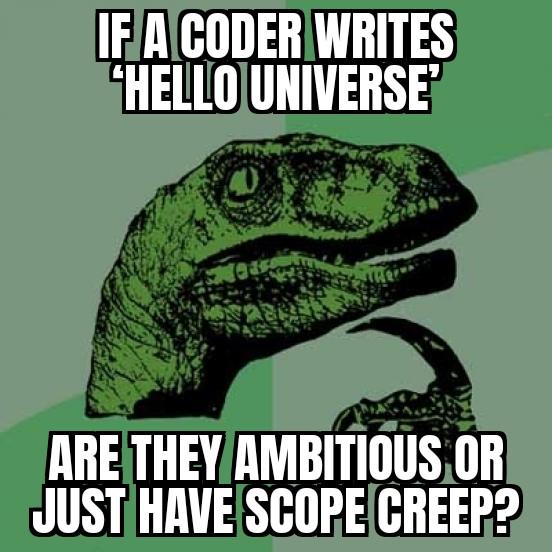
You know a developer's code quality has reached questionable territory when you can't tell if they're building the next big thing or just accidentally polluting the global namespace. "Hello Universe" instead of the traditional "Hello World" screams one of two things: either this person has grand visions of intergalactic-scale applications, or they've got variables leaking into scopes they have no business being in. Scope creep in project management means your features are spiraling out of control. Scope creep in programming means your variables are showing up in places like uninvited guests at a party. The Philosoraptor here is doing what we all do during code review—wondering if that ambitious naming convention is intentional genius or just a red flag that someone doesn't understand lexical scoping. Either way, "Hello Universe" definitely suggests someone's `var` declarations are living their best uncontained life.

C Really Needs Six Songs

C Really Needs Six Songs
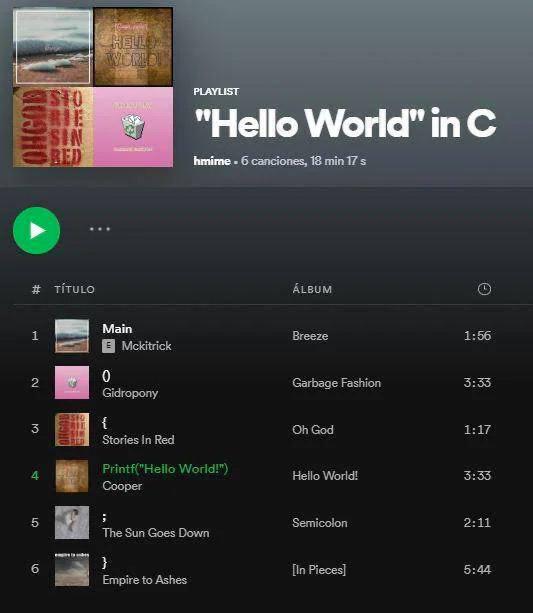
Someone made a Spotify playlist called "Hello World" in C, and it's literally just six songs with titles that spell out the classic printf("Hello World!") program. Main, curly braces, Printf, semicolon, closing brace... all there. The dedication here is honestly impressive. They really went through the effort of finding songs with these exact titles just to recreate the most basic C program known to humanity. Meanwhile, Python devs are over here with their one-liner print("Hello World") living their best life. This is what happens when you give programmers too much free time and a Spotify account. At least they didn't include the #include <stdio.h> header—that would've required a whole separate album.

My First Hello World Program!

My First Hello World Program!
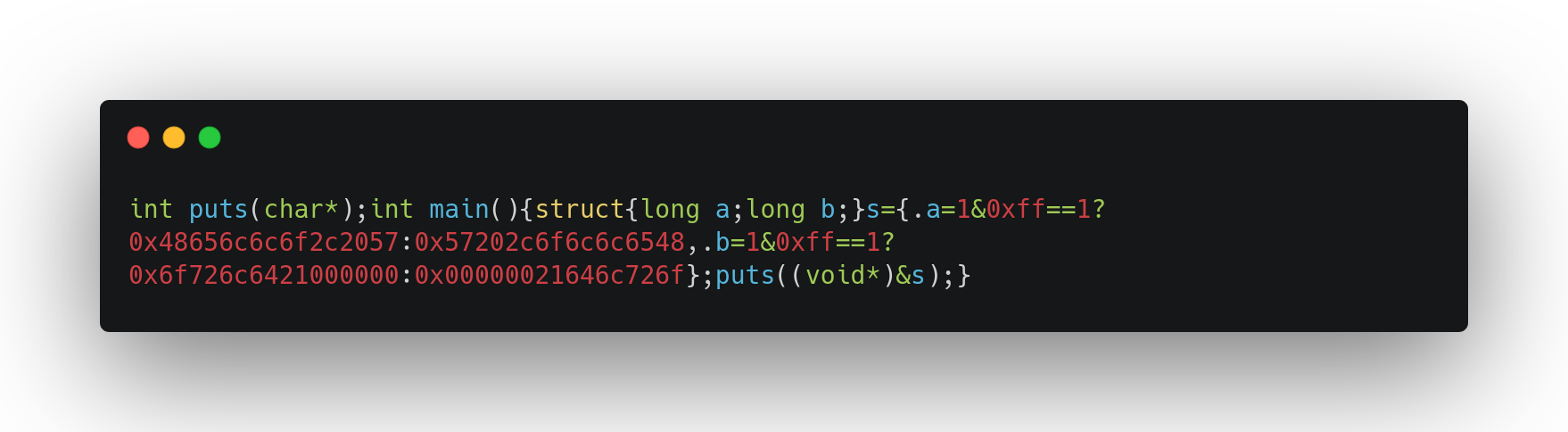
When someone says their "first Hello World" looks like a hexadecimal nightmare spawned from the depths of memory manipulation hell, you know they've gone full cursed C programmer mode. Instead of the innocent printf("Hello World\n"); , we're treated to a beautiful mess of struct pointers, ternary operators, and raw memory addresses that would make any compiler cry. The code is doing some absolutely unhinged bit manipulation with conditions like .a=1&0xff==1? and casting void pointers while somehow calling puts() in the most convoluted way possible. Those hex addresses? Probably hardcoded memory locations or some ASCII encoding shenanigans. This is what happens when you learn C from StackOverflow answers written at 3 AM by someone who thinks "readable code" is for the weak. Nobody's first Hello World looks like this unless they're either a masochist or they copy-pasted from a code obfuscation contest. 10/10 would segfault again.

Hello World With Macro In C++

Hello World With Macro In C++
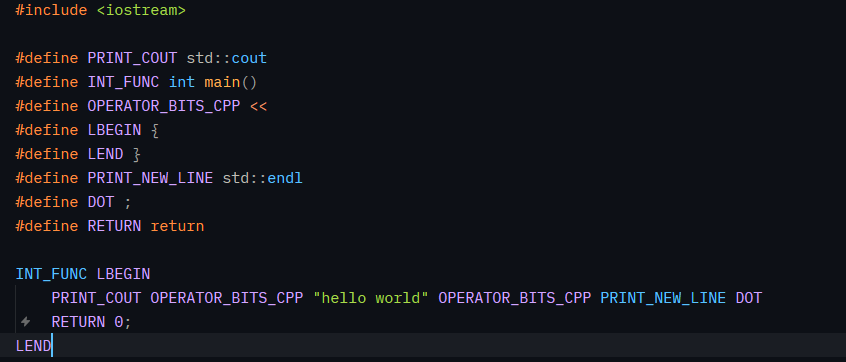
Someone woke up and chose violence. They took the classic "Hello World" program and turned it into a preprocessor nightmare by replacing every single keyword with macros. PRINT_COUT instead of std::cout , INT_FUNC instead of int main() , curly braces replaced with LBEGIN and LEND . It's technically valid C++, compiles just fine, and is absolutely cursed. This is what happens when you give C++ developers too much power and not enough supervision. The preprocessor was a mistake, and this code is Exhibit A. Your coworkers will find you if you commit this to production.

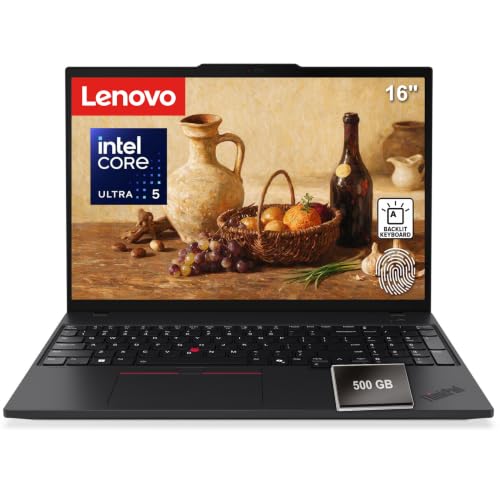
Lenovo ThinkPad T16, Ultra 5 225U, 16GB DDR5, 512GB SSD+500GB External HDD | 16" Large Display, Business Laptop, Designed for Everyday Productivity and Programming, Backlit Keyboard & Fingerprint Reader

Lenovo ThinkPad T16, Ultra 5 225U, 16GB DDR5, 512GB SSD+500GB External HDD | 16" Large Display, Business Laptop, Designed for Everyday Productivity and Programming, Backlit Keyboard & Fingerprint Reader
AI-READY INTEL CORE ULTRA PERFORMANCE: The Intel Core Ultra 5 225U delivers 12 cores, 14 threads, speeds up to 4.8GHz, and 12MB Intel Smart Cache for office applications, programming, data analysis, …

Unsolvable Problems On Step One

Unsolvable Problems On Step One
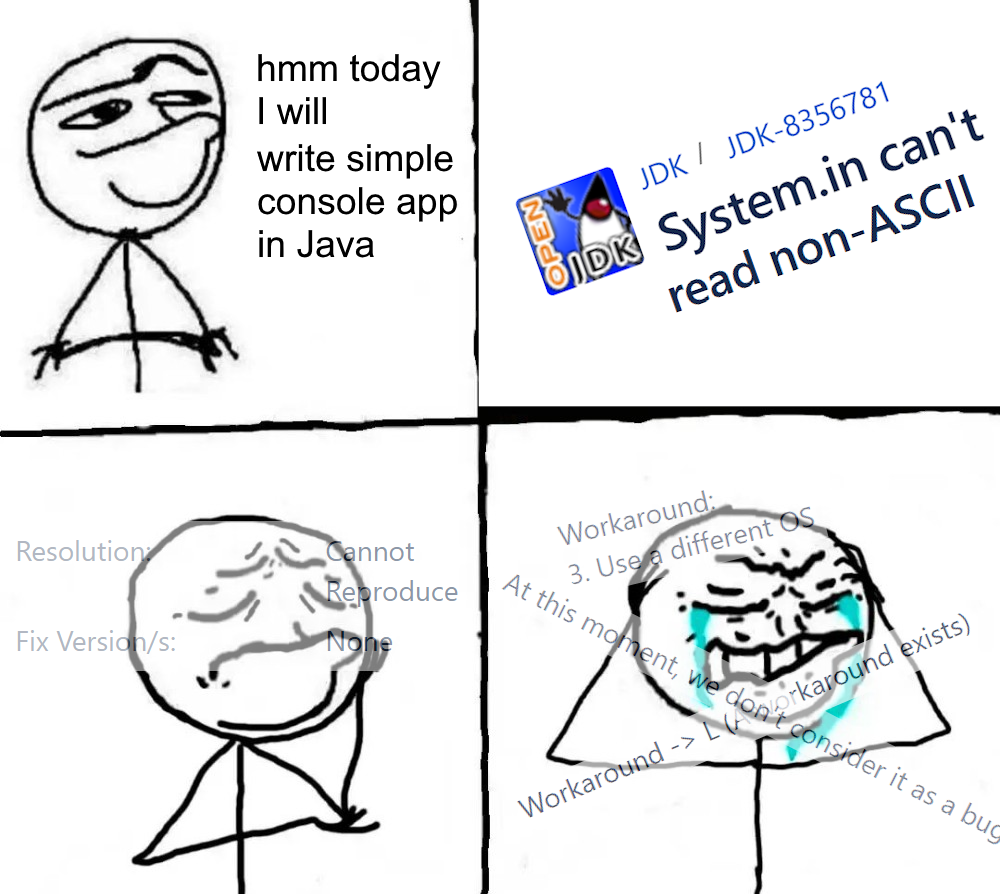
You know you're in for a wild ride when your "simple console app" throws a System.in encoding tantrum before you even write "Hello World." Nothing says "Java experience" quite like spending 3 hours debugging character encoding issues while your code hasn't even reached line 10. The progression from confident optimism to existential crisis is *chef's kiss*. Started with "hmm today I will write simple console app" and ended up in Stack Overflow hell with error messages that have more workarounds than actual solutions. Resolution: Cannot Reproduce. Fix Version: None. Translation: "You're on your own, buddy." The best part? The error literally says "System.in can't read non-ASCII" which means your JDK decided that anything beyond basic English characters is too exotic for its taste. Welcome to Java, where even reading user input requires a PhD in charset negotiation.

This "Hello World" Program I Submitted On Day One Of My Java Class

This "Hello World" Program I Submitted On Day One Of My Java Class
Someone really said "I'm not like other programmers" and wrote Hello World using ASCII character codes stored in an int array, then looped through to print each character individually. The professor asked for Hello World and got a war crime instead. Bonus points for the completely unnecessary ternary operator that does absolutely nothing ( args.length == 0 ? 0 : args[0].charAt(0) ) and the recursion wrapped in a lambda just to flex. Day one energy right here—when you know just enough to be dangerous but not enough to realize you're writing code that would make your future self weep. The professor probably needed a drink after grading this one.

Cpp Hello World

Cpp Hello World
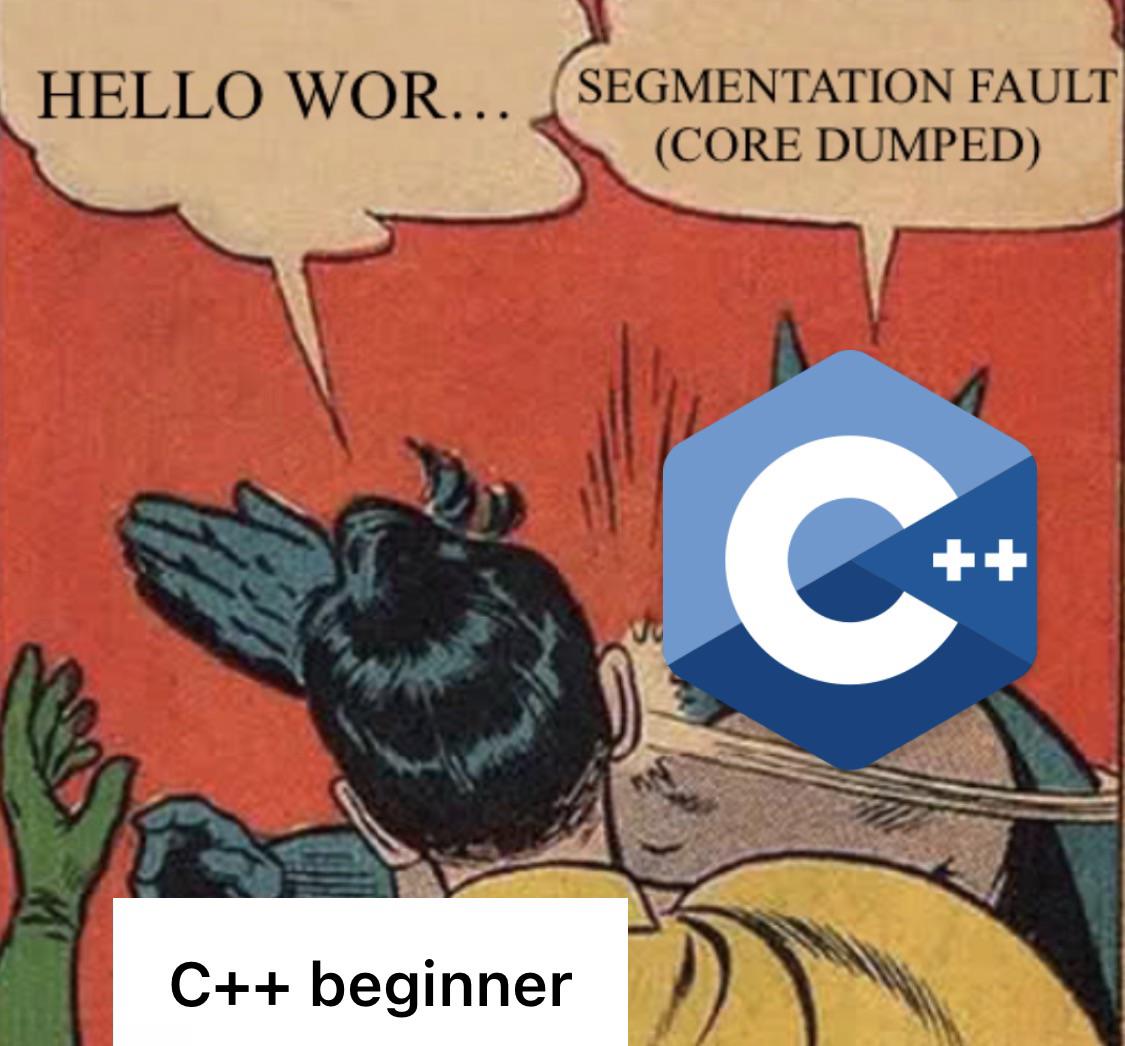
C++ beginner tries to write "Hello World" and somehow manages to trigger a segmentation fault before even finishing the sentence. Memory management strikes again. Meanwhile, Python devs are on their fifth microservice and Rust is still compiling. The beauty of C++ is that you can crash your program in ways that shouldn't even be theoretically possible. Forgot to initialize a pointer? Segfault. Looked at memory wrong? Segfault. Breathed near the stack? Believe it or not, segfault.

Use Code With Caution

Use Code With Caution
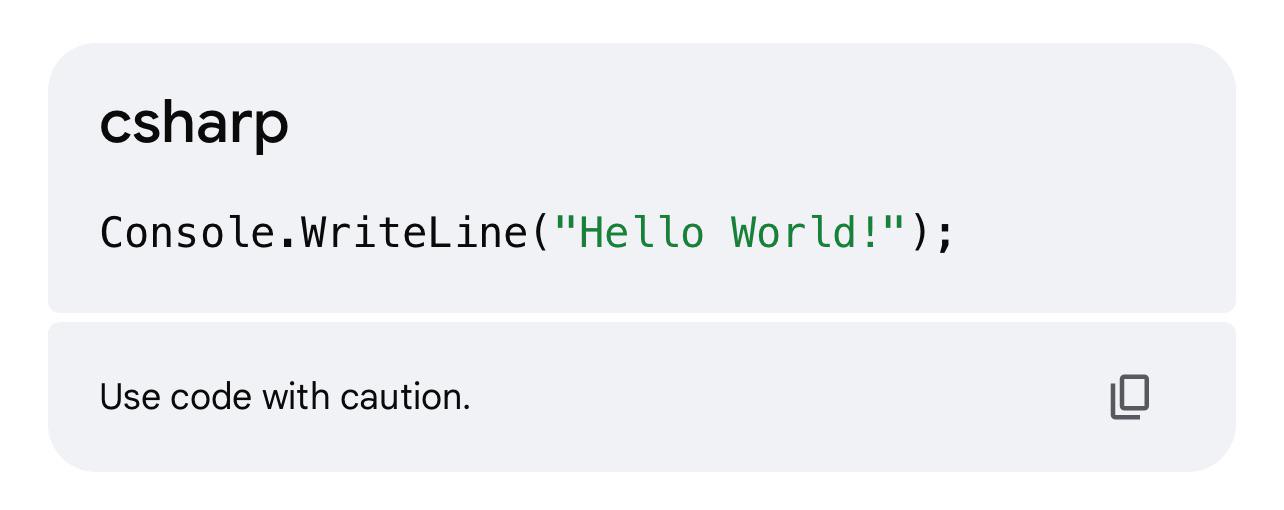
When your AI assistant slaps a "Use code with caution" warning on a literal Hello World program, you know we've reached peak paranoia in software development. It's the most harmless snippet possible—literally the first thing you learn in any programming language—and somehow it's being treated like volatile nuclear code that might detonate your production servers. Either the AI has trust issues with C# developers specifically, or it's seen some truly cursed Hello World implementations in its training data. Maybe someone once managed to cause a buffer overflow with "Hello World!" and now the AI is traumatized. The warning-to-danger ratio here is absolutely unhinged.

First Project Kinda Nervous

First Project Kinda Nervous
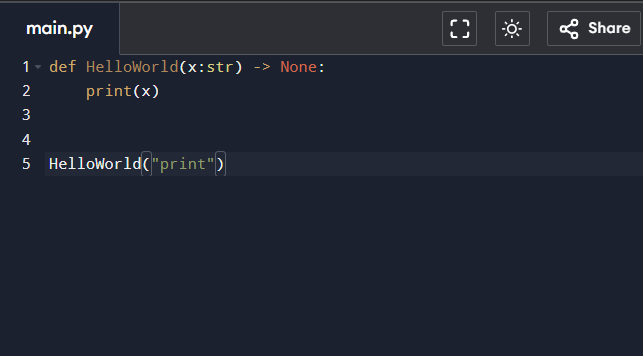
When you're so nervous about your first project that you accidentally create a function that takes a parameter, adds type hints, specifies a return type... and then just calls print() on that exact parameter. Then you call it with the string "print" because apparently recursion wasn't confusing enough, so why not add some meta-chaos? The function signature screams "I read the documentation!" while the implementation whispers "I have no idea what I'm doing." It's like showing up to a job interview in a three-piece suit and then asking if they have crayons. The nervous energy is palpable—this person added type annotations like they're collecting Pokemon badges but forgot the actual logic part of programming. Bonus points for the function literally just being a wrapper around print(). That's not abstraction, that's procrastination with extra steps.

Tower Of Abstraction

Tower Of Abstraction
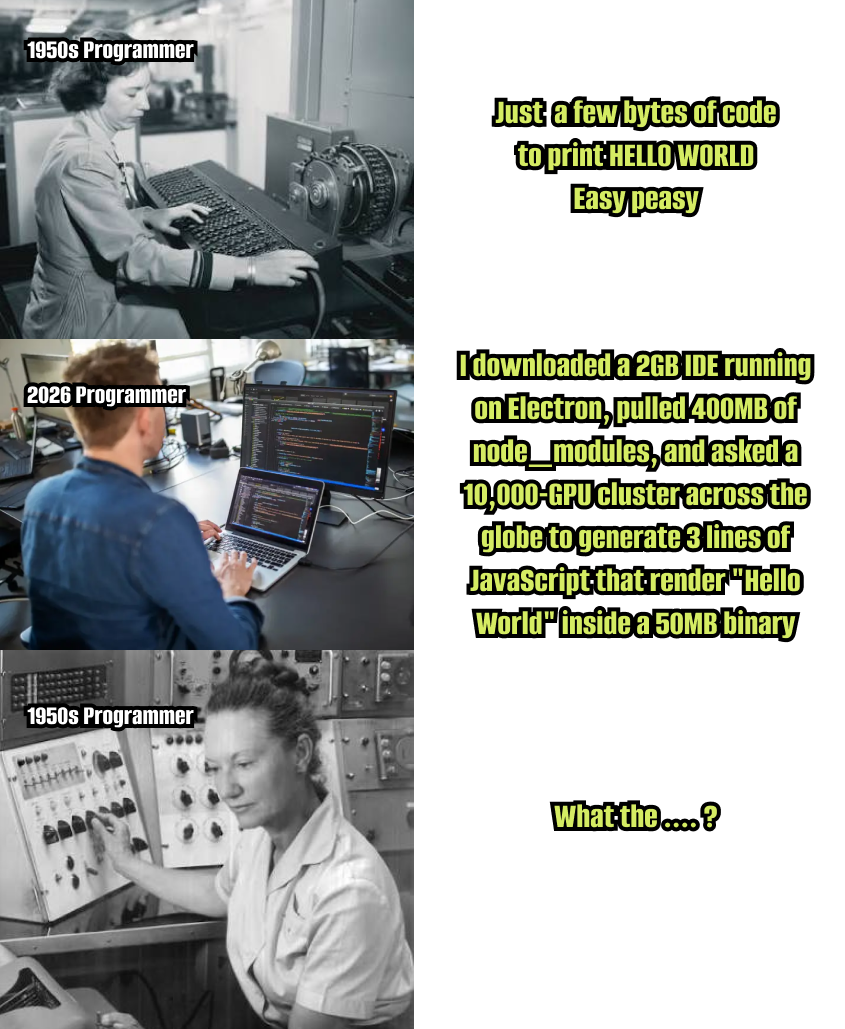
Back in the '50s, you'd wire up some vacuum tubes and flip a few switches to get "HELLO WORLD" on a teletype. Simple. Direct. You knew exactly what the machine was doing. Fast forward to 2026: you need a 2GB IDE that runs on Electron (because native apps are for boomers), pull in 400MB of node_modules (mostly left-pad and its 47 dependencies), spin up a 10,000-CPU cluster across three continents, all to generate 3 lines of JavaScript that render "Hello World" inside a 50MB binary. The 1950s programmer looks at this technological "progress" and just... can't. We've built so many layers of abstraction on top of abstraction that we've essentially created a Rube Goldberg machine that requires the GDP of a small nation to print two words. But hey, at least it's cross-platform and has dark mode.

Hi Claude Is The New Hello World

Hi Claude Is The New Hello World
Developers now spend more time testing AI assistants than writing actual code. Instead of the classic "Hello World," the first thing every programmer does is open Claude, ChatGPT, Gemini, and whatever other AI just dropped this week to ask them to generate fake programming languages. Because nothing says "productive coding session" like watching multiple LLMs hallucinate syntax for CoffeeScript 2.0, Python++, JavaScriptScript, and RubyOnDiamonds. The naming conventions are hilariously on point though. We've got Java (coffee), C (letter), Python (snake), Ruby (jewelry), and now we're just mashing them together like a tech startup name generator. Can't wait for the next language: MochaQ# featuring decorators shaped like emeralds. 💎☕

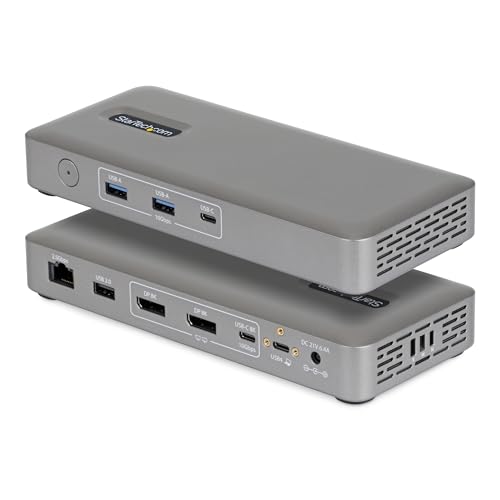
StarTech Driverless USB4 Dock, Dual 4K 144Hz for Mac and Windows, 100W

StarTech Driverless USB4 Dock, Dual 4K 144Hz for Mac and Windows, 100W
STANDARDIZE ON USB4 ACROSS MAC AND WINDOWS: USB4 is natively supported on M4 / M5 MacBook Pro, MacBook Air, and Windows business laptops, making it the right time to consolidate on a single driverles…