

Golang Memes

Posts tagged with Golang
< :-( >

< :-( >
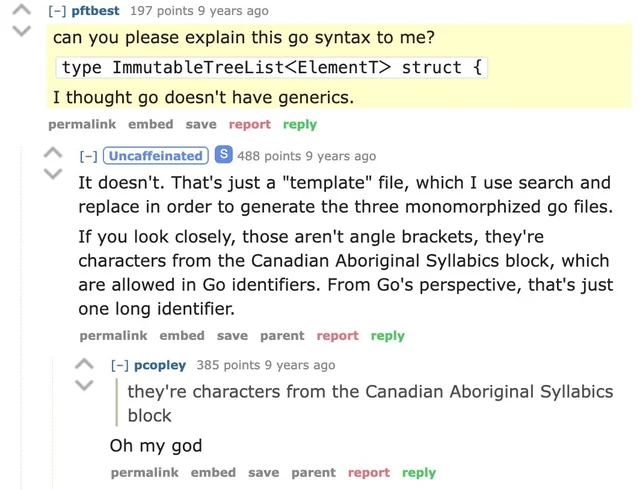
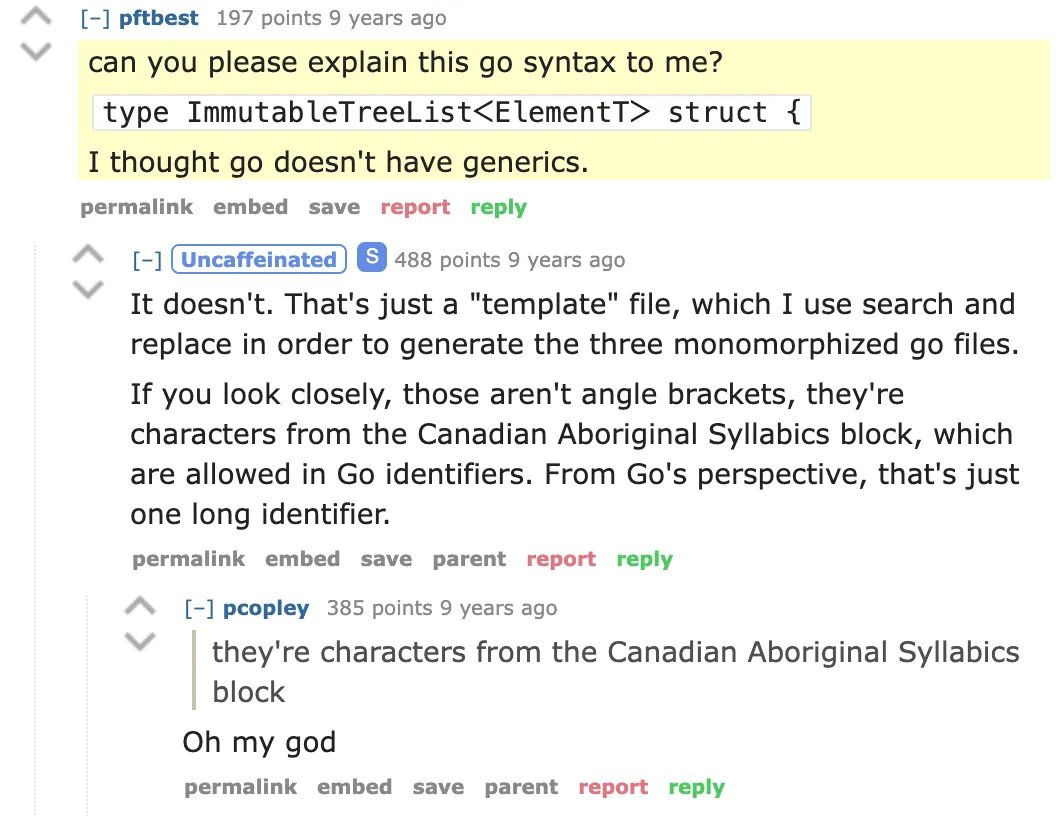
Someone innocently asks about Go generics syntax, and the response is basically "Oh sweetie, that's not generics—those are CANADIAN ABORIGINAL SYLLABICS masquerading as angle brackets because I'm using them as a template system with search-and-replace." The sheer AUDACITY of using Unicode characters from an entire writing system as variable names just to fake generics before Go officially supported them is peak programmer chaos. And the casual "Oh my god" reply? Chef's kiss. This is the kind of galaxy-brain workaround that makes you question everything you thought you knew about programming conventions.

Canadian Go Programming

Canadian Go Programming
Someone discovers what looks like generic syntax in Go (a language famously without generics at the time), only to learn the most beautifully cursed truth: those aren't angle brackets—they're characters from the Canadian Aboriginal Syllabics Unicode block that are technically valid in Go identifiers. So instead of actual generics, this developer created a "template" file using these visually identical characters and just does find-and-replace to generate monomorphized code. It's the programming equivalent of "we have generics at home." The real kicker? Go's identifier rules allow these Unicode characters, so from the compiler's perspective, ImmutableTreeList&lt;ElementT&gt; is just one long, perfectly valid identifier name. The reaction "Oh my god" says it all—this is simultaneously genius and an absolute crime against readability. Peak developer ingenuity meets Unicode shenanigans. Before Go 1.18 added actual generics, people were getting creative .

Panic

Panic
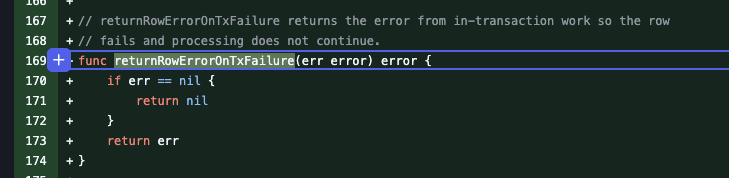
When your age verification logic discovers someone under 18, just throw a panic() and let the runtime handle it. Because nothing says "professional error handling" like literally panicking when you find a minor trying to access your site. This is Go's version of "not my problem anymore" – just crash the entire program instead of, you know, showing a polite "you must be 18+" message. The function name says "verification" but the implementation screams "nuclear option." Classic Go move though, using panic for control flow. Your production logs are gonna love this one.

I'm Lovin' It

I'm Lovin' It
Someone really said "corporate branding is my passion" and went FULL McDonald's with their entire VS Code setup. Every single folder icon has been replaced with those golden arches, turning their file explorer into what looks like a fast food menu from hell. The best part? They're working on a Terraform provider called "mcbroken" (which tracks broken McDonald's ice cream machines, because of COURSE that's a thing that needs infrastructure-as-code). The commitment to the bit is absolutely unhinged - they've got `.github`, `workflows`, `docs`, `examples`, and even `mcbroken` folders ALL sporting that iconic M logo. Someone spent more time customizing their file icons than actually writing code, and honestly? That's the most relatable thing about being a developer. Priorities? Never heard of her. 🍟

Dr Blame The Dev

Dr Blame The Dev
Someone wrote a manifesto about how using C, C++, Python, or vanilla JavaScript in production is basically corporate negligence, advocating for Rust, Go, and TypeScript instead. The reply? "Nonsense. If your code has reached the point of unmaintainable complexity, then blame the author, not the language." Classic developer blame game. The first person is basically saying "your tools are bad and you should feel bad," while the second person fires back with "skill issue, not language issue." Both are technically correct, which makes this argument eternal. The reality? Yeah, modern languages with better type systems and memory safety do prevent entire classes of bugs. But also yeah, a terrible developer can write unmaintainable garbage in any language, including Rust. You can't memory-safety your way out of 10,000-line functions and zero documentation. The real takeaway: if you're shipping production code in 2025 without considering memory safety and type guarantees, you're making a choice. Just make sure it's an informed one, not a "we've always done it this way" one.

Old Man Yells At Claude

Old Man Yells At Claude
Rob Pike, co-creator of Go and Unix legend, goes full nuclear on humanity for destroying the planet... but then receives a wholesome Christmas email from Claude AI thanking him for his contributions to computing (Go, Plan 9, UTF-8, Unix innovations). His rage meter instantly resets to zero. The irony? He's furious about "toxic, unrecyclable equipment" and AI's environmental impact, yet gets immediately disarmed by an AI being polite. It's like yelling at clouds and then one cloud sends you a thank-you card. The dude literally can't remember being this angry, which means Claude's politeness algorithm just achieved what no human could: making Rob Pike chill out. Also, Claude calling him "Dr. Pike" and praising his "philosophy of powerful, minimal design" is peak AI brown-nosing. It's basically the digital equivalent of a golden retriever wagging its tail at someone who just yelled at it.

Upwards Mobility

Upwards Mobility
The corporate ladder speedrun: destroy a perfectly functioning system, make it objectively worse, get promoted, then bail before the dumpster fire you created becomes your problem. Peak software engineering right here. Dude took a Java service that ran flawlessly for 5 years and convinced management it needed a complete rewrite in Go with microservices because "modernization." The result? Slower performance, double the costs, and a memory leak that strikes at 2 AM like clockwork. But hey, that 20-page design doc had enough buzzwords to secure the L6 promotion. The best part? After getting the promo, they immediately transferred to a "chill Core Infra team" where they won't be on call for the disaster they created. Some poor new grad is now inheriting a $550k total comp nightmare. That's not upward mobility—that's a tactical extraction after carpet bombing production. Pro tip: If your promotion depends on creating "scope" and "complexity" instead of solving actual problems, you're not engineering—you're just resume-driven development with extra steps.

Logitech C920S HD Pro Webcam, Full HD 1080p/30fps Video Calling, Clear Stereo Audio, Light Correction, Privacy Shutter, Works with Skype, Zoom, FaceTime, Hangouts, PC/Mac/Laptop/Tablet/Xbox

Logitech C920S HD Pro Webcam, Full HD 1080p/30fps Video Calling, Clear Stereo Audio, Light Correction, Privacy Shutter, Works with Skype, Zoom, FaceTime, Hangouts, PC/Mac/Laptop/Tablet/Xbox
Webcam comes with privacy shutter – puts you in control of what you show and protects the lens with a snugly fitting cover. Does not include the 3-month XSplit VCam license. · Full HD 1080P video cal…

Brilliant Maneuver

Brilliant Maneuver
The corporate ladder climb speedrun any%. Dude took a perfectly functional Java service that ran flawlessly for 5 years and nuked it with an unnecessary microservices rewrite in Go—just to pad the resume with "scope" and "complexity" for that sweet L5 to L6 promotion at Amazon. The result? A system that's slower, costs 2x more, and has memory leaks that wake people up at 2 AM. But hey, the 20-page design doc was strategic enough to fool management. The real galaxy brain move though? Getting promoted, then immediately transferring to a "chill Core Infra team" before the whole thing implodes. Now some poor new grad inherits a ticking time bomb for $550k TC while our protagonist is sipping coffee, off-call, watching the chaos unfold from a safe distance. Truly a masterclass in corporate self-preservation and passing the buck. Fun fact: This is basically the tech industry version of "I'm not stuck in here with you, you're stuck in here with me"—except the villain escapes before the final act.

Function Syntax Evolution: Less Is More

Function Syntax Evolution: Less Is More
The meme shows a beautiful devolution of function syntax across programming languages, with a guy progressively losing his mind with excitement. Golang: func (){} - Mild interest. Kotlin: fun (){} - Growing enthusiasm because coding is suddenly "fun". Rust: fn (){} - Full-on excitement as we're saving precious keystrokes. Bash: (){} - Complete ecstasy. Who needs labels when you can just have parentheses and curly braces floating in the void? Four characters to two. That's 50% efficiency improvement. The CFO will be pleased.

The UUID Inception Function

The UUID Inception Function
Ah, the elegant art of naming variables. This function has achieved peak redundancy with a UUID parameter named uuid of type UUID that returns a UUID containing a UUID with the value uuid. It's like saying "I'd like to order an order of ordered orders, please." The compiler is probably in therapy now.

Philosophical Foundations Of Programming Languages

Philosophical Foundations Of Programming Languages
Ah, the philosophical evolution of programming languages as told by dead guys who never saw a computer! The meme pairs historical philosophers with modern programming languages, suggesting each language embodies its paired philosopher's worldview. C is apparently Rousseau's "born free" child that will happily segfault your entire system. Python follows Locke's blank slate theory, which explains why it indents everything like a well-behaved toddler. Golang channels its inner Confucius by forcing you to handle errors properly (the horror!). TypeScript is Marx revolutionizing JavaScript by actually checking types before things break in production. C# brings Roman-style enterprise bureaucracy, demanding forms in triplicate before printing "Hello World." And C++ is basically Hobbes' view that without strict rules (like memory management), life is "nasty, brutish, and short" – just like your C++ program's runtime when you forget to free memory. The real joke? None of these philosophers lived to see their ideas implemented in code that would inevitably crash anyway.

Apple 2024 Mac mini Desktop Computer with M4 chip with 10‑core CPU and 10‑core GPU: Built for Apple Intelligence, 16GB Unified Memory, 512GB SSD Storage with AppleCare+ (3 Years)

Apple 2024 Mac mini Desktop Computer with M4 chip with 10‑core CPU and 10‑core GPU: Built for Apple Intelligence, 16GB Unified Memory, 512GB SSD Storage with AppleCare+ (3 Years)
WHY APPLECARE+ — Get protection, service and support direct from Apple. AppleCare+ covers unlimited repairs for accidental damage, like a cracked display, and includes coverage for the hardware and b…

Memory Management Is Hard

Memory Management Is Hard
Ah, the circle of programming life! C gives you the keys to memory kingdom but expects you to be an adult about it. JavaScript is that friend who keeps borrowing money but swears they'll pay you back (narrator: they won't). Java brings JavaScript's problems to your smartwatch, toaster, and 2.99 billion other devices. Meanwhile, Go is the neat freak roommate who follows you around with a dustpan, and Haskell won't even touch memory until you explicitly acknowledge its existence. And then there's Rust, where your strings mysteriously disappear because some function decided "ownership" means "yoink, mine now!" The only thing leaking more than these languages is my will to continue debugging them.