

Data formats Memes

Posts tagged with Data formats

Json Daddy

Json Daddy
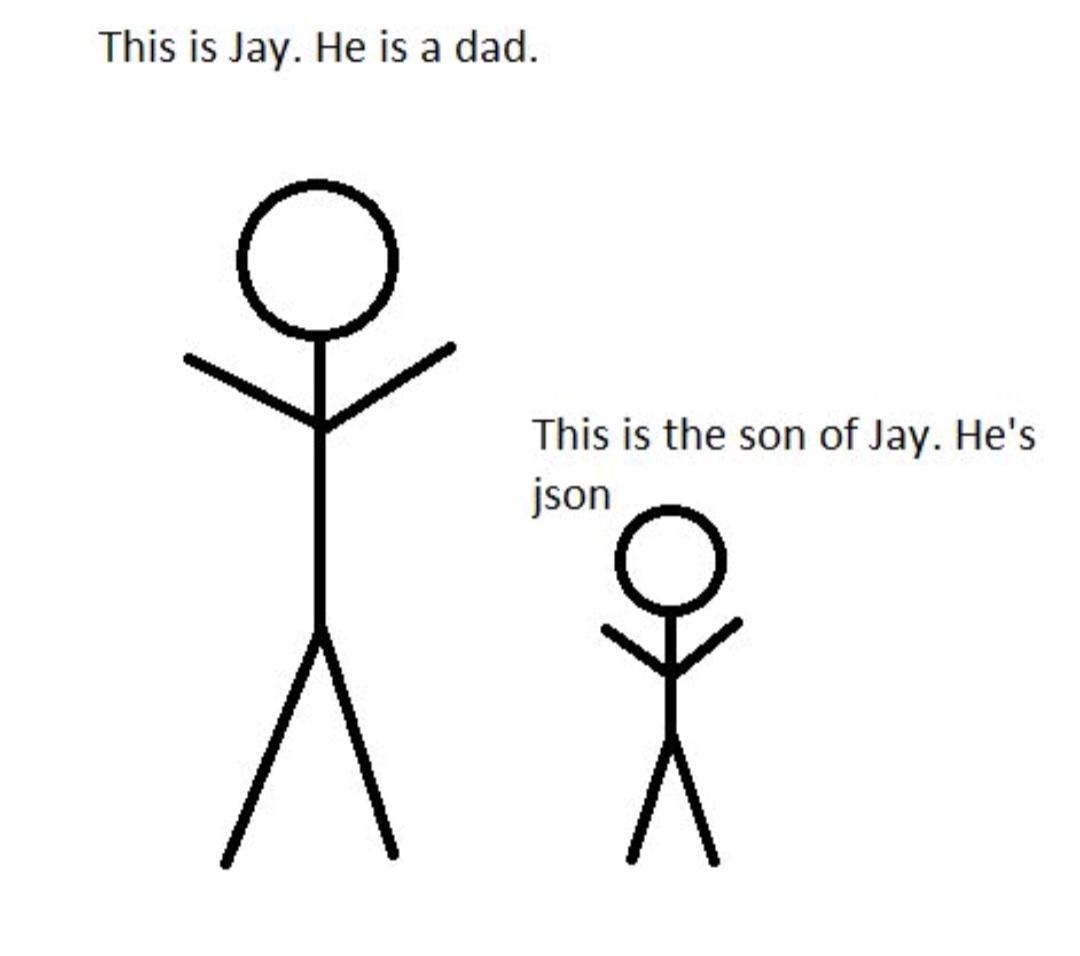
Dad jokes have officially infiltrated the tech world, and honestly? We're not even mad about it. Jay's son is JSON—get it? Because JSON is literally "Jay's son." It's the kind of pun that makes you groan and chuckle simultaneously. The beauty here is that JSON (JavaScript Object Notation) has become such a fundamental part of modern web development that it deserves its own origin story. Forget superhero backstories—we now have the canonical tale of how Jay brought JSON into this world. Every API response, every config file, every data exchange you've ever dealt with? Yeah, that's Jay's kid doing the heavy lifting. The stick figure representation really drives home how simple yet profound this joke is. No fancy graphics needed—just pure, unadulterated wordplay that hits different when you've spent countless hours parsing JSON objects at 2 AM trying to figure out why your nested arrays aren't behaving.

Noah's Ark Of Data Formats

Noah's Ark Of Data Formats
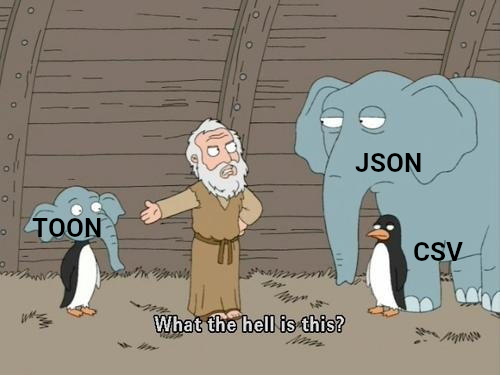
Noah's config file ark, but make it cursed! The old bearded dev is horrified at his data format options. YAML and XML are so awful they didn't even make it onto the ark, while JSON and CSV got the VIP treatment as full-size elephants. Meanwhile, poor TOML is that weird penguin-elephant hybrid that nobody quite understands but somehow still works. The dev's face screams what we're all thinking when looking at legacy codebases: "What unholy serialization format am I supposed to use for this project?!"

That Just Sounds Like CSV With Extra Steps

That Just Sounds Like CSV With Extra Steps
The eternal cycle of data format reinvention continues. TOON appears to be yet another attempt to make data more readable than JSON, which itself was supposed to be more readable than XML, which was more readable than... you get the idea. The kicker? TOON uses 154 chars while JSON needs 412 for the same data. Sure, it's more compact, but at what cost? Another syntax to learn, another parser to debug at 2AM when production breaks. The Rick and Morty reaction perfectly captures that weary sigh of "here we go again" that echoes through developer souls whenever someone announces they've invented a revolutionary new data format.

The Two Faces Of JSON Development

The Two Faces Of JSON Development
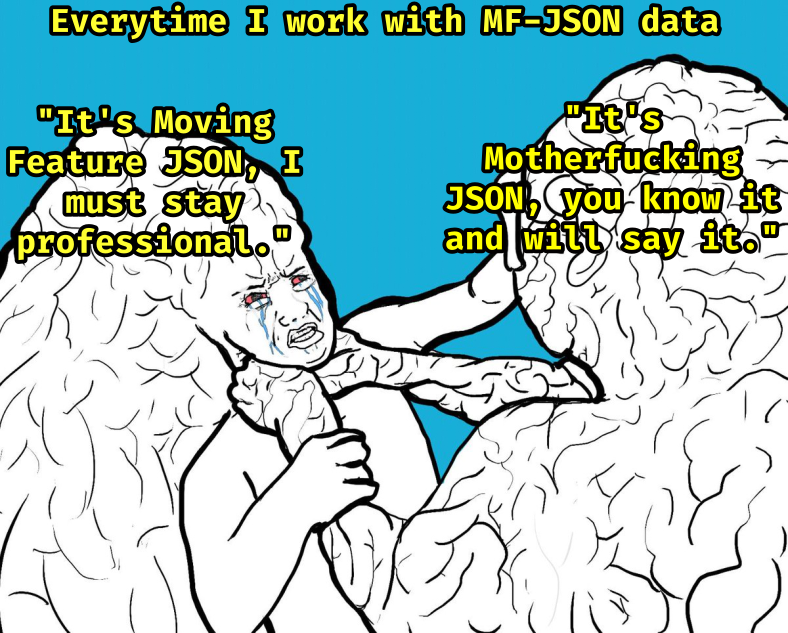
The duality of every developer who's spent more than 10 minutes wrestling with JSON files. In meetings: "It's a standardized data interchange format that enables cross-platform compatibility." In private: *keyboard smashing and cursing* "WHY WON'T THIS PARSE CORRECTLY?!" The professional facade crumbles faster than a JSON file with a missing comma. Let's be honest—we've all mentally replaced "MF" with exactly what it stands for while debugging at 2PM on a Friday.

Required Fields Are Just Suggestions

Required Fields Are Just Suggestions
Software engineers crying about data standards while data engineers are out here like "You guys have standards?" The unholy amalgamation of JSON wrapped in XML with a sprinkle of Markdown is just Tuesday for us. Single quotes, double quotes, dates formatted as MM/DD/YYYY or "Last Thursday-ish" - doesn't matter. After 5 years of parsing whatever nightmare format the client sends, you develop a certain... immunity. Standards are just what happens to other people.

The Most Efficient XML Parser

The Most Efficient XML Parser
The ultimate XML parser isn't some fancy library—it's the Unix delete command. Why waste CPU cycles parsing XML when you can just rm it from existence? A truly elegant solution that runs in O(1) time and permanently resolves all XML validation errors. The only XML schema that matters is no XML at all.

Who The Hell Are These Serialization Formats?

Who The Hell Are These Serialization Formats?
JSON looking at alternative serialization formats like they're aliens from another dimension is peak developer humor. While JSON has become the undisputed champion of data interchange, these other formats (Protocol Buffers, Thrift, Avro, and Ion) are actually powerful alternatives with better performance and schema validation. But let's be honest - most of us just keep defaulting to JSON because it's everywhere. We'll research these alternatives for that "high-performance microservice architecture," add them to our "things to learn" Trello board, and then immediately go back to JSON.stringify() and call it a day.

JSON With Comments: The Technically Correct Loophole

JSON With Comments: The Technically Correct Loophole
The ultimate developer loophole! Standard JSON doesn't support comments, driving devs to ridiculous workarounds. But technically, if you add comments to your JSON and call it YAML... you're not wrong! YAML is indeed a superset of JSON that allows comments. It's like ordering a Diet Coke with your triple cheeseburger—technically healthier, but who are we kidding? The Kermit sipping tea meme perfectly captures that smug "I found a hack" energy every developer feels when circumventing language limitations with a technically-correct-but-absurd solution.

The Data Cake Of Broken Dreams

The Data Cake Of Broken Dreams
Client: "Our data is very organized and clean!" Developer: *receives a pile of crumbled chocolate cupcakes with random file formats scattered around* The expectation vs. reality gap in data handoffs is the tech world's greatest practical joke. Clients envision their data as this adorable, well-groomed dog cake with perfect frosting roses, while developers get what looks like someone dropped the cake in a parking lot and then tried to fix it with a spatula and blind optimism. And of course, they've sprinkled in some Excel, XML, TXT, and PDF files because why use one consistent format when you can use four incompatible ones? Nothing says "professional data management" like a digital version of a dessert crime scene.