Code review Memes

Posts tagged with Code review
Stop Naming Services After Marvel Characters

Stop Naming Services After Marvel Characters
Finally! Freedom to name your microservice whatever your heart desires! No more boring "user-authentication-service" or "payment-processor-api"—nope, we're going FULL CREATIVE MODE. And what better way to exercise this newfound liberty than naming it after a disabled piglet with a wheelchair? Because nothing screams "professional enterprise architecture" quite like explaining to your CTO that the authentication service is called Chris P. Bacon. The beauty here is the sheer commitment to the bit. Your manager gives you carte blanche on naming conventions, thinking you'll choose something sensible and descriptive. Instead, you've immortalized a piglet from Clermont, Florida in your company's infrastructure. Now every standup meeting includes the phrase "Chris P. Bacon is down" and nobody can keep a straight face. The on-call rotation just got 1000% more entertaining. Bonus points: when new developers join and have to read documentation that casually references Chris P. Bacon handling critical business logic. They'll spend their first week wondering if they joined a tech company or a petting zoo.

Verbatim What He Wrote Btw

Verbatim What He Wrote Btw
You know that moment when you're feeling kinda insecure about your coding skills, questioning your entire career path, maybe even googling "is it too late to become a barista"... and then you glance over at your classmate's screen and witness them comparing an integer variable to the LITERAL STRING "positive" in a for loop condition? Like bestie, that loop is NEVER going to execute because 'a' will NEVER equal the word "positive" 💀 And then declaring a variable called "double" (which is a reserved keyword in most languages) equals "balance"? The sheer audacity! The confidence! The complete disregard for syntax! Suddenly your imposter syndrome evaporates faster than your motivation on a Monday morning. Sometimes the best therapy is just... looking at someone else's code and realizing you're doing just fine, actually.

Strong Developers Be Like

Strong Developers Be Like
You know you're living dangerously when your code could throw exceptions that would make the entire app crash, but you just... let it ride. No try-catch, no error handling, just pure faith in your logic. Then your senior dev does a code review and casually asks about exception handling, and suddenly you're sweating bullets trying to maintain composure. The "if he dies, he dies" mentality is peak confidence (or recklessness, depending on who you ask). Either the code works flawlessly, or production goes down in flames. No middle ground. It's like deploying to prod on a Friday afternoon—you're either a hero or updating your LinkedIn profile by Monday. Pro tip: Maybe wrap that database call in a try-catch before your senior finds out you're one null pointer away from taking down the entire microservices architecture.

The Code AI Wrote Is Too Complicated

The Code AI Wrote Is Too Complicated
Junior dev writes spaghetti code? Unreadable mess. Senior dev writes spaghetti code? "Architectural brilliance." AI writes spaghetti code? Suddenly everyone's a code quality advocate. The double standard is real. We've gone from blaming juniors to blaming ChatGPT for the same nested ternary operators and callback hell. Plot twist: maybe the AI learned from reading senior dev code on GitHub. Ever think about that? Fun fact: studies show developers spend more time complaining about code complexity than actually refactoring it. This meme just proves we'll find any excuse to avoid admitting we don't understand something.

When I Was 12, I Thought My Code Looked "Cooler" With Cryptic Variable Names And Minimal Spacing. The Entire Project Looks Like This.

When I Was 12, I Thought My Code Looked "Cooler" With Cryptic Variable Names And Minimal Spacing. The Entire Project Looks Like This.
Oh, the absolute HORROR of 12-year-old you thinking that hbglp , vbglp , and cdc were the height of programming sophistication! Nothing screams "elite hacker" quite like variable names that look like someone smashed their keyboard while having a seizure, am I right? And that LINE 210? SWEET MOTHER OF SPAGHETTI CODE, it's longer than a CVS receipt! That single line is basically a novel written in the ancient tongue of "I-have-no-idea-what-future-me-will-think." The nested ternaries, the eval() calls, the complete and utter disregard for human readability—it's like looking at the Necronomicon of JavaScript. Young developers everywhere: this is your brain on "looking cool." Please, for the love of all that is holy, use descriptive variable names and hit that Enter key once in a while. Your future self (and literally anyone who has to touch your code) will thank you instead of plotting your demise. 💀

Who Wrote This Shit?

Who Wrote This Shit?
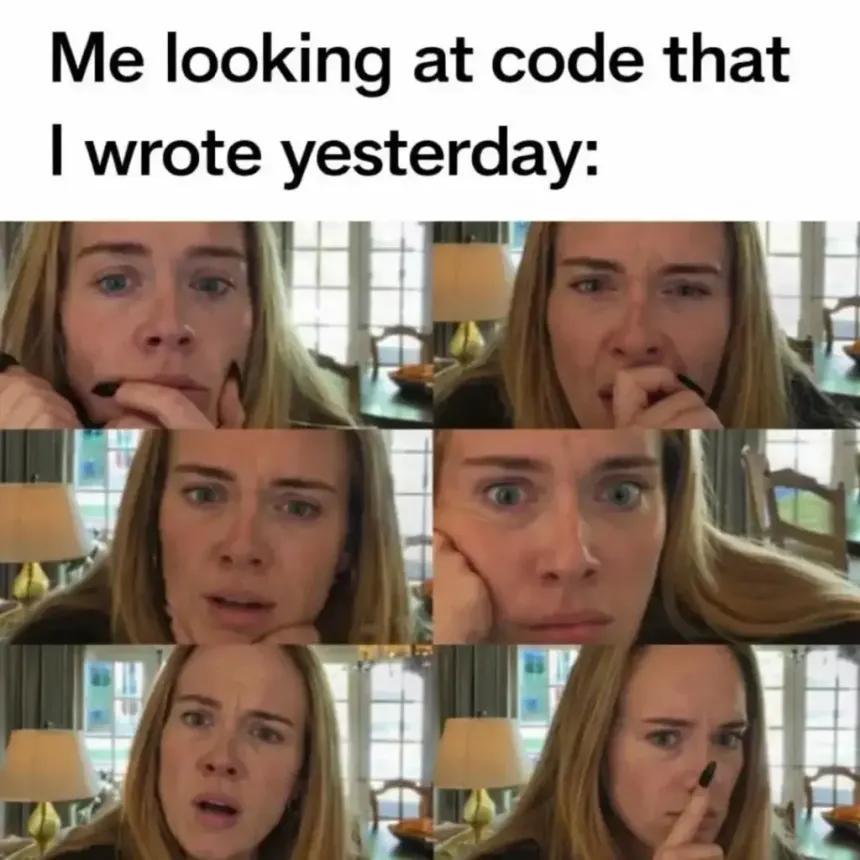
Coming back to code you wrote just two weeks ago and finding it completely incomprehensible is basically a rite of passage. The guy staring at Egyptian hieroglyphics on his screen? That's you trying to decode your own variable names like temp2_final_ACTUAL and wondering what possessed you to write a 47-line nested ternary operator. The real kicker is that two weeks ago, you were absolutely convinced your logic was crystal clear and didn't need comments because "the code documents itself." Spoiler alert: it doesn't. Future you is now sitting there like an archaeologist trying to understand an ancient civilization's thought process, except the ancient civilization is literally just past you being lazy about documentation. Pro tip: if you can't understand your own code after two weeks, imagine what your teammates will think. Comments aren't just for other people—they're love letters to your future self who has completely forgotten why that hacky workaround was "absolutely necessary."

It's Working

It's Working
Someone asked for help printing numbers 1-25 in a clockwise expanding spiral pattern. The "solution" is just five hardcoded print statements with the numbers manually typed out in rows. No loops, no algorithms, no spiral logic—just raw, unfiltered copy-paste energy. The sender confidently declares "It's working" like they just solved P=NP. Technically correct? Sure. The numbers are there. They're in some kind of pattern. Mission accomplished, right? This is the programming equivalent of being asked to build a car and showing up with a skateboard taped to a lawnmower. The person who asked for help said "thanks" which means they either didn't actually look at the code, or they've completely given up on life. Both are valid responses in this industry.

Relatable

Relatable
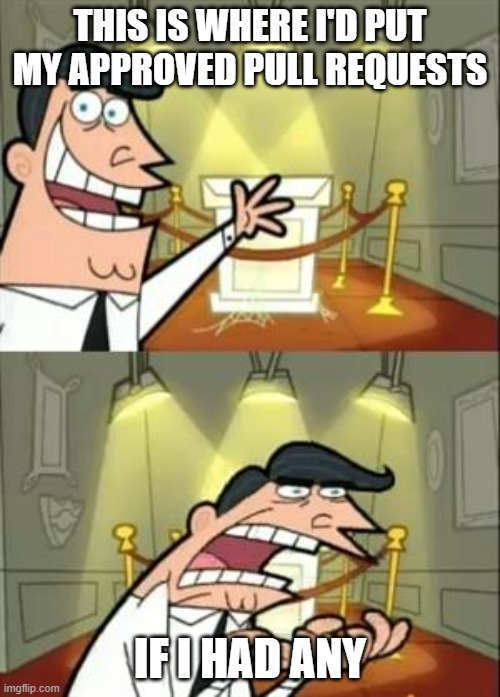
You know that moment when you're reviewing someone's PR and you're mentally composing a scathing code review about how their implementation violates every principle you hold dear? But then reality kicks in—you remember your own code from last Tuesday that looks suspiciously similar, or you realize you're already 45 minutes late for standup, or you just... can't be bothered to start a philosophical debate about variable naming conventions. So you shrug, click approve, and move on with your life. We've all been that person judging the code AND the person who wrote the questionable code. It's the circle of life in software development.

How Do I Explain It Briefly

How Do I Explain It Briefly
You know that moment when someone asks what you changed and you stare into the void trying to compress 47 file modifications, 3 refactors, 2 bug fixes, and that one random typo correction into a coherent sentence? Yeah, the -m flag becomes your worst enemy. The struggle is real when you've been in the zone for 2 hours, touched half the codebase, and now Git is asking you to summarize your life choices in one line. So you either write "fixed stuff" like a caveman or spend 10 minutes crafting a commit message longer than the actual code changes. Pro tip: This is why you commit early and often. But we all know you won't.

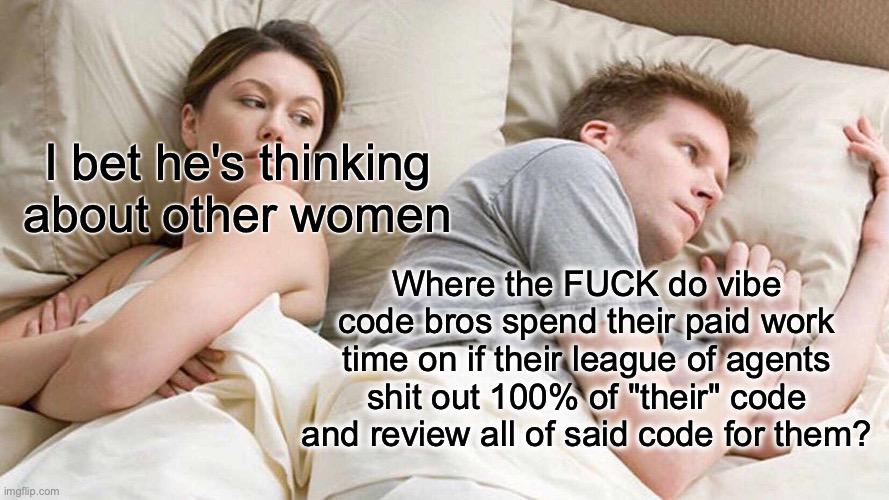
Vibe Coders Who Actually Review And Edit The Code Get A Pass Tho

Vibe Coders Who Actually Review And Edit The Code Get A Pass Tho
Finally, someone said it. The gatekeeping energy here is *chef's kiss*. While everyone's out here letting AI autocomplete their entire codebase and calling it "productivity," this dev is out here writing actual code from scratch like it's 2015. No Copilot suggestions, no ChatGPT prompts, no MCP server wizardry—just pure, unfiltered human logic and Stack Overflow tabs. The real flex? "If it doesn't work right, I DON'T PUBLISH it." Revolutionary concept in the era of "ship fast, fix in prod." Quality control? In THIS economy? Respect the hustle, honestly. Though let's be real, we all know this person still has 47 console.logs they forgot to remove before committing.

If 'X' Not In Data

If 'X' Not In Data
When your condition checks if 'X' is NOT in the data AND if some massive pipeline exception error message is also NOT in the data, you're basically saying "if everything is fine AND there's no error, show success." The else block? That's for literally every other scenario in the universe. So yeah, your "failure" div is getting rendered 99.9% of the time because that's the most cursed boolean logic ever written. The condition is so specific it's like saying "I'll only go outside if it's sunny AND there are no clouds AND a unicorn is nearby." Spoiler: you're staying inside.

So Who Is Sending Patches Now

So Who Is Sending Patches Now
Someone tried to roast FFmpeg for having a "messy codebase" and got absolutely demolished with the most brutal comeback in open-source history. FFmpeg's response? "Talk is cheap, send patches." That's the beauty of open source right there. You can't just throw shade at a project that literally powers half the internet's video infrastructure—from Netflix to YouTube to your grandma's video editing app—and expect them to care about your opinion. FFmpeg is written in C and assembly because it needs to squeeze every last CPU cycle out of your hardware to decode 4K video without melting your laptop. The tweet went viral with 200K views because it's the perfect encapsulation of the open-source ethos: put up or shut up. Don't like the code? Fork it. Fix it. Submit a PR. Otherwise, you're just another armchair architect who's never had to optimize a hot loop in their life. This is the energy every maintainer wishes they could channel when dealing with drive-by critics on GitHub.