cloud Memes

It Happened Again

It Happened Again
Ah yes, the classic "workplace safety sign" energy. You know that feeling when your entire infrastructure has been humming along smoothly for over two weeks? That's when you start getting nervous. Because Cloudflare going down isn't just an outage—it's a global event that takes half the internet with it. The counter resetting to zero is the chef's kiss here. It's like those factory signs that say "X days without an accident" except this one never gets past three weeks. And the best part? There's absolutely nothing you can do about it. Your monitoring alerts are screaming, your boss is asking questions, and you're just sitting there like "yeah, it's Cloudflare, not us." Then you watch the status page refresh every 30 seconds like it's going to magically fix itself. Pro tip: When Cloudflare goes down, just tweet "it's not DNS" and wait. That's literally all you can do.

Gentlemen A Short View Back To The Past

Gentlemen A Short View Back To The Past
Cloudflare going down has become the developer's equivalent of "my dog ate my homework" - except it's actually true about 40% of the time. The other 60% you're just on Reddit. The beautiful thing about Cloudflare outages is they're the perfect scapegoat. Your code could be burning down faster than a JavaScript framework's relevance, but if Cloudflare has even a hiccup, you've got yourself a get-out-of-jail-free card. Boss walks by? "Can't deploy, Cloudflare's down." Standup meeting? "Blocked by Cloudflare." Missed deadline? You guessed it. The manager's response of "Oh. Carry on." is peak resignation. They've heard this excuse seventeen times this quarter and honestly, they're too tired to verify. When a single CDN provider has enough market share to be a legitimate excuse for global productivity loss, we've really built ourselves into a corner haven't we?

It Happened Again

It Happened Again
When you've been riding that sweet 17-day streak of Cloudflare stability and suddenly wake up to half the internet being down. Again. Nothing quite like that sinking feeling when your perfectly working app gets blamed for being broken, but it's actually just Cloudflare taking a nap and bringing down a solid chunk of the web with it. The best part? Your non-tech manager asking "why is our site down?" and you have to explain that no, it's not your code this time—it's literally the infrastructure that's supposed to protect you from going down. The irony is chef's kiss. Pro tip: Keep a "Days Since Last Cloudflare Outage" counter in your Slack. It's like a workplace safety sign, but for the modern web.

Re Joined Cloudflare Again As Intern

Re Joined Cloudflare Again As Intern
So you left Cloudflare, probably for that "amazing opportunity" at a startup that promised equity and ping pong tables, only to realize the grass isn't always greener. Now you're back at the same company, but this time as an intern. The demotion is real, and that fancy reception desk is giving off some serious "we both know what happened here" vibes. The boomerang employee phenomenon hits different when you come back at a lower level. At least the office still looks nice, and hey, Cloudflare's CDN is pretty solid, so there's that. Maybe this time you'll appreciate the free coffee and stable infrastructure before chasing the next shiny thing.

Please Pop

Please Pop
Someone volunteers to time travel and fix tech history, and naturally they go back to prevent the AI and cloud gaming hype. The guy literally says "Adiós" to the bubble (stack data structure joke intended) before popping it. But here's the kicker: he comes back to a timeline where everyone's just... sadder? Turns out preventing those "bubbles" didn't save us from anything—it just robbed us of the collective delusion that kept spirits high. The double meaning hits hard: "pop" as in popping a bubble (both the economic kind and the stack operation), and the desperate "please pop" like we're all begging for these trends to just burst already. But careful what you wish for—without the hype cycles, we're left staring at the void of what actually shipped.

For Profit Company

For Profit Company
OpenAI trying to patch the massive leak in their server costs with ads is peak tech company energy. They're out here burning through cash faster than a GPU farm on full load, watching those cloud bills stack up like a memory leak nobody wants to fix. The Flex Tape meme format is *chef's kiss* here. Sure, you've got infrastructure costs that could fund a small country's GDP, but slap some ads on it and call it a business model. Nothing says "we're totally sustainable" like desperately monetizing your product after promising to democratize AI. Remember when they were "open" AI? Good times. Now they're just another company discovering that training models on the entire internet isn't exactly cheap, and VCs eventually want their money back.

Not A Big Deal, Just A Company That Runs Half The Internet

Not A Big Deal, Just A Company That Runs Half The Internet
Nothing says "enterprise reliability" quite like AWS failing to collect 82 cents and sending you a formal email about it. The irony here is chef's kiss—a company that hosts Netflix, NASA, and probably your startup's MVP can't process a payment under a dollar. Meanwhile, their URLs are still using template variables like ${AWSConsoleURL} in production emails, which is either a hilarious oversight or they're charging you extra to render those variables. The "Thank you for your continued interest in AWS" at the end really seals the deal. Yeah, not like I have a choice when you're literally running my entire infrastructure. It's giving "we know you can't leave us" energy. That 82 cents probably cost them more in engineering time to send this email than the actual charge was worth.

Vibe Bill

Vibe Bill
Nothing kills the startup vibes faster than your first AWS bill showing up like a final boss. You're out here "vibing" with your minimal viable product, feeling like the next unicorn, deploying with reckless abandon because cloud resources are "scalable" and "pay-as-you-go." Then reality hits harder than a null pointer exception when you realize "pay-as-you-go" means you're actually... paying. For every single thing. That auto-scaling you set up? Yeah, it scaled. Your database that you forgot to shut down in three different regions? Still running. That S3 bucket storing your cat memes for "testing purposes"? $$$. The sunglasses coming off is the perfect representation of that moment when you check your billing dashboard and suddenly understand why enterprise companies have entire teams dedicated to cloud cost optimization. Welcome to adulthood, where your code runs in the cloud but your bank account runs on fumes.

Are We In A Sim

Are We In A Sim
So we've got tech bros uploading their consciousness to the cloud for digital immortality, only to end up as NPCs in someone's Sims 4 save file. The .tar.gz format is chef's kiss here—because of course your eternal soul would be compressed using gzip. Nothing says "preserving human consciousness" quite like a tarball that'll probably get corrupted during extraction. The year 2050 timeline feels generous considering how fast Silicon Valley moves. By then, some teen will be torrenting these consciousness archives like they're season packs of a TV show, casually modding billionaire minds into digital servants who autonomously cook mac and cheese and get stuck in swimming pools without ladders. The ultimate revenge for all those "move fast and break things" mantras. Fun fact: A .tar.gz file is actually a two-step compression process—first tar (tape archive) bundles files together, then gzip compresses them. So your consciousness would literally be archived like it's going on backup tape storage from the 1980s. Peak irony for the cloud computing crowd.

Down The Drain We Go

Down The Drain We Go
Picture the internet as a beautiful, fragile ecosystem held together by duct tape and prayer. Now watch it spiral down the drain because literally EVERYTHING depends on AWS, Azure, and Cloudflare. One Cloudflare outage? Half the internet goes dark. AWS decides to take a nap? Your startup, your bank, your streaming service, and probably your smart toaster all scream in unison. The center of this glorious death spiral? "Dead internet" – because when these cloud giants sneeze, the entire digital world catches pneumonia. The cherry on top? That little "first major LLM deployed" at the start of the spiral, suggesting AI might've kicked off this beautiful cascade of chaos. And there you are, helplessly watching your carefully architected microservices get flushed along with everyone else's infrastructure. Single point of failure? Never heard of her! Welcome to modern cloud architecture where "distributed systems" somehow all route through the same three companies. Redundancy is just a fancy word we use in meetings to feel better about ourselves.

Last Time For Sure

Last Time For Sure
That one kid in class who discovers status monitoring sites and suddenly becomes the herald of every Cloudflare outage. Seven weeks straight. At some point the teacher's just wondering if maybe, just maybe, the kid's router is the actual problem. But no—Cloudflare really does go down that often, and now everyone knows because this kid has appointed himself Chief Outage Officer. The internet's most reliable unreliable service strikes again.

The Whole Internet Relies On That One Shark

The Whole Internet Relies On That One Shark
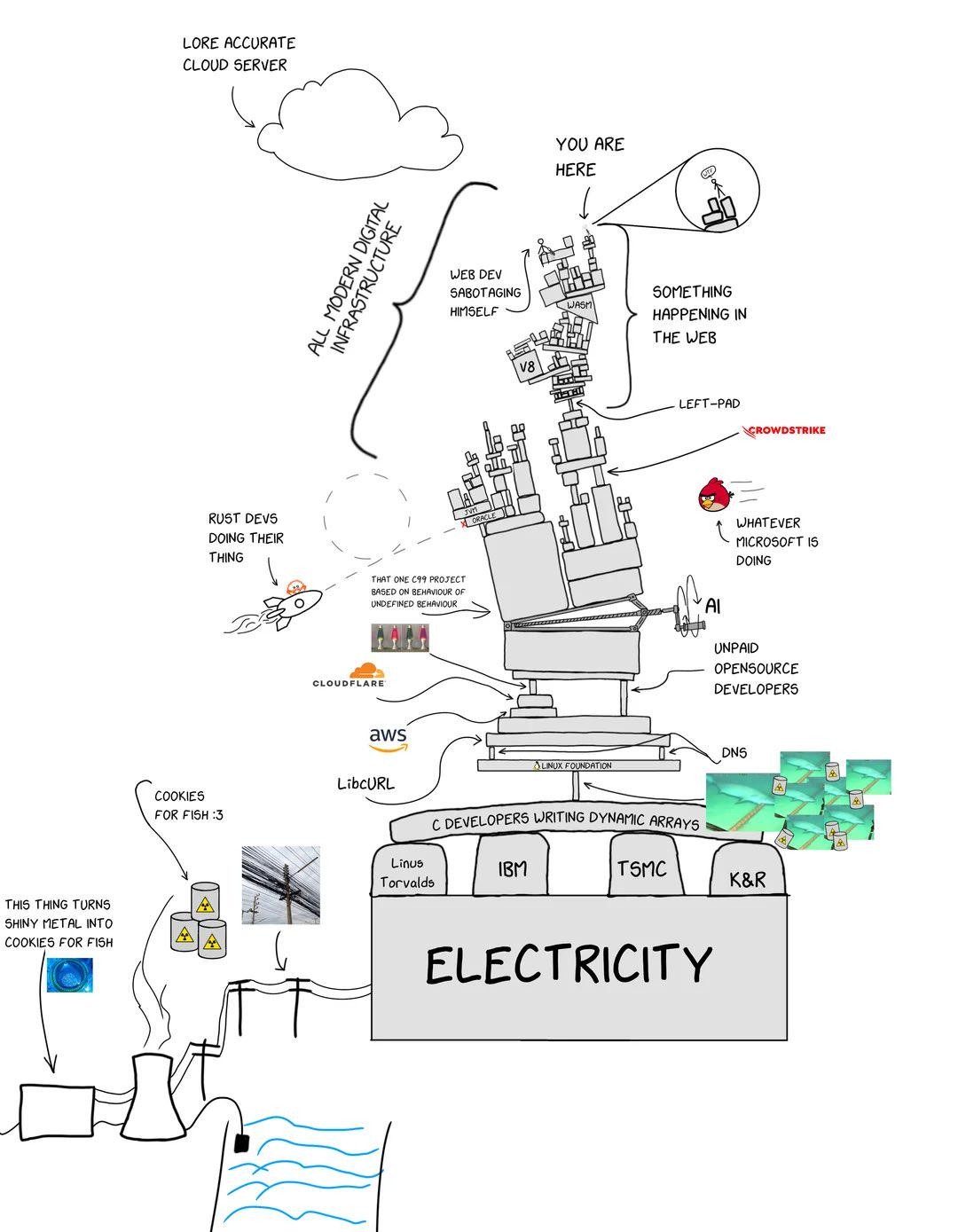
So that's what's holding up the internet - a precarious tower of technology balanced on Linus Torvalds' shoulders with a random shark at the DNS level. Turns out those underwater cables aren't the most concerning part of our infrastructure. The real MVP is that shark guarding the DNS servers while C developers write dynamic arrays, Rust devs do their thing, and some web dev quietly sabotages himself in the corner. Meanwhile, unpaid open source developers and "whatever Microsoft is doing" somehow keep this Jenga tower from collapsing. Sleep well tonight knowing your entire digital existence depends on this absurd tech stack and one very dedicated fish.