

bug Memes

Halloween Costume

Halloween Costume
Behold, the most TERRIFYING creature known to software development: a feature disguised as a harmless bug! Nothing strikes more fear into the hearts of developers than realizing that what they thought was a simple little bug has actually evolved into a full-blown FEATURE that users now depend on. The horror! The absolute NIGHTMARE! Now you can't fix it without breaking someone's workflow, so congratulations—you're stuck maintaining this abomination forever. It's giving "oops, that's not a bug anymore, that's legacy behavior" energy. The bug costume with a "Feature" sign is *chef's kiss* because once users start relying on your broken code, it magically transforms from "we should fix this" to "it's a feature, not a bug!" RIP to all the clean code dreams that died this way.

Programming Life Cycle

Programming Life Cycle
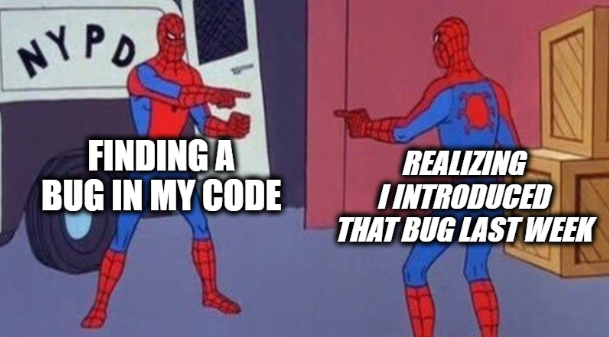
You know that satisfying moment when you find a bug and feel like a debugging god? Yeah, that lasts about 3 seconds until you realize YOU wrote the code that introduced it last week. The circle of life, except instead of majestic lions, it's just you pointing at yourself in shame. The best part? You probably spent hours tracking down this bug, feeling like a detective solving a complex case, only to discover you're both the criminal and the investigator. Welcome to software development, where we create our own problems and then congratulate ourselves for fixing them.

Bug With Benefits

Bug With Benefits
You know you've reached peak software development when that weird glitch you discovered accidentally becomes the most beloved feature in your app. Suddenly you're out here vibing and celebrating what should've been a ticket in your backlog. The best part? Now you can't fix it even if you wanted to because users have built entire workflows around it. It's not a bug anymore—it's "legacy behavior" and touching it would be a "breaking change." Ship it and call it innovation.

It's Not A Bug It's A Feature

It's Not A Bug It's A Feature
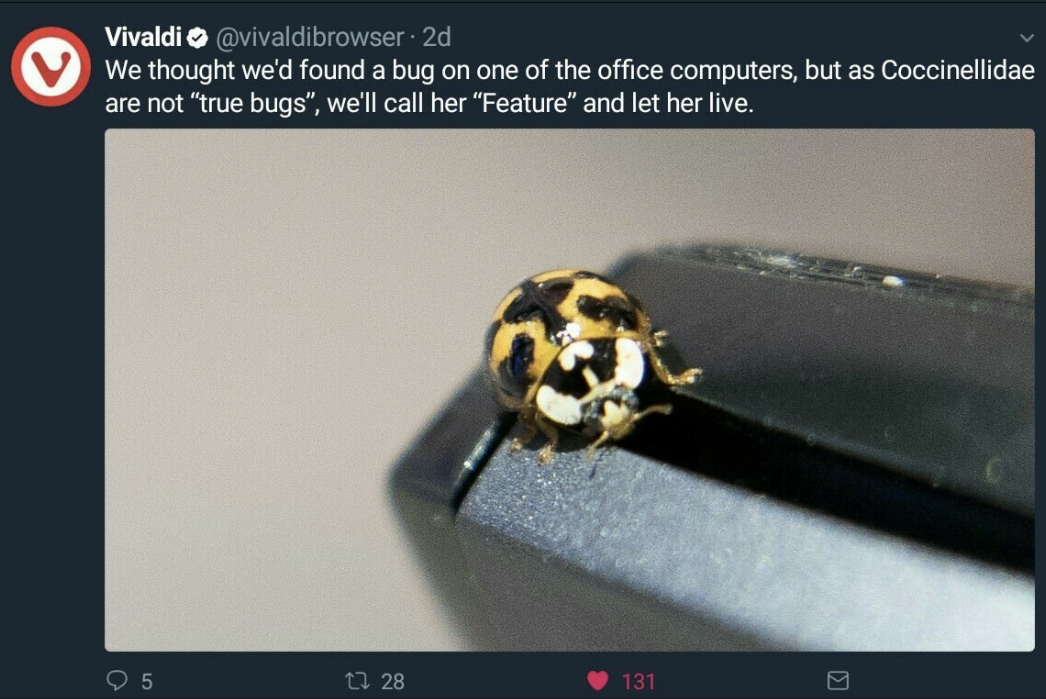
The Vivaldi browser team found a literal ladybug (Coccinellidae) on their office computer and decided to apply the classic developer excuse to actual wildlife. Since it's not a "true bug" in the taxonomic sense—ladybugs are beetles—they're calling it a "feature" instead. Finally, a legitimate use case for the most overused phrase in software development. The bug/feature loophole works in entomology too, apparently. Ship it.

JYKEYMOUT Bluetooth and 2.4G (2-in-1) Rechargeable Wireless Mouse, Ergonomic Vertical Design, 1000/1200/1600 DPI, 6 Silent Buttons, for Laptop, Computer, PC, MacBook, Chromebook-Black

JYKEYMOUT Bluetooth and 2.4G (2-in-1) Rechargeable Wireless Mouse, Ergonomic Vertical Design, 1000/1200/1600 DPI, 6 Silent Buttons, for Laptop, Computer, PC, MacBook, Chromebook-Black
【2-in-1 (Bluetooth & 2.4G) Dual Mode】The wireless PC mouse features both Bluetooth (5.2/3.0) and 2.4GHz USB modes. Opt for Bluetooth mode to connect to a laptop or tablet, saving a USB-A port. Especi…

Found The Bug

Found The Bug
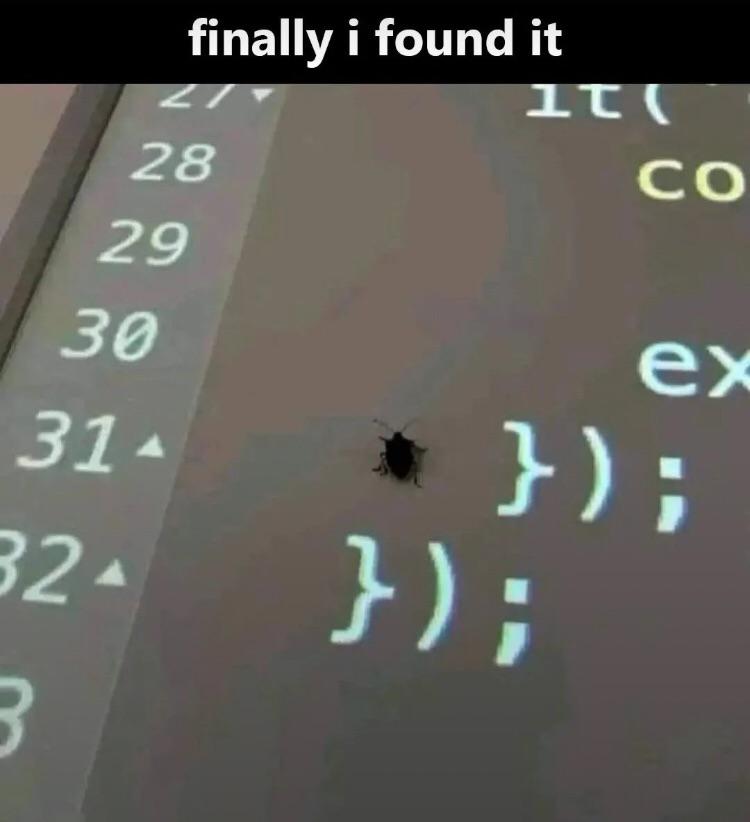
Oh look, a literal bug on your screen. Because of course when you spend 4 hours debugging your code, the problem turns out to be an actual insect blocking line 31. The universe really has a twisted sense of humor—you were hunting for a logic error, null pointer exception, or maybe an off-by-one mistake, but nope. Just a little critter vibing on your monitor, probably judging your code quality. Fun fact: The term "bug" in computing actually originated in 1947 when engineers found a literal moth stuck in a Harvard Mark II computer causing malfunctions. So technically, this is the OG debugging method. Your IDE's debugger could never.

This Hotfix Needs A Hotfix

This Hotfix Needs A Hotfix
You know that feeling when you just wanted to add a "small feature" and suddenly the entire codebase is on fire? That innocent little change cascaded through the system like dominoes, breaking things you didn't even know existed. Now you're frantically pushing hotfixes for your hotfixes while production burns and Slack is blowing up. The best part? You're just standing there with that same satisfied smirk because deep down, you knew this would happen the moment the PM said "it's just a tiny change." Pro tip: There's no such thing as a "small feature." Every line of code is a potential arson charge waiting to happen.

The Pain Of Reading The Solution Too Late

The Pain Of Reading The Solution Too Late

I Guess I Can Take A Break Now

I Guess I Can Take A Break Now

UGREEN 40Gbps M.2 NVMe Enclosure (SSD Not Included)

UGREEN 40Gbps M.2 NVMe Enclosure (SSD Not Included)
Transmission files in seconds: This product is equipped with the ASM2464PD chip, and the maximum speed can reach 3600MB/s; compatible with USB4/3.2/3.1/3.0/2.0 & Thunderbolt 3/4.NOTE: Thunderbolt 4 c…

Bug Fifty Seven

Bug Fifty Seven

Root Cause

Root Cause
Ah yes, the classic debugging journey. You spend hours examining the logs (literally logs here), digging through stack traces, checking your API calls, reviewing your database queries... only to find out the bug was an actual bug . A literal insect. Nested deep in the wood. The pun game is strong here - "root cause analysis" meets actual tree roots. Because nothing says "I found the problem" quite like discovering a beetle when you were expecting a race condition or memory leak. At least you can squash this bug without opening a JIRA ticket. Fun fact: The term "bug" in computing actually originated from a real moth found in a Harvard Mark II computer in 1947. Grace Hopper's team literally debugged their system. So technically, finding an actual bug as your root cause is staying true to computing history.

Different Reaction At Every Level

Different Reaction At Every Level
Tester finds a bug and gets pure, unadulterated joy. Another one for the collection. Developer hears about a bug and stays calm, professional—just another Tuesday. Manager hears about a bug and enters full panic mode because now there's a meeting to schedule, a timeline to explain, and stakeholders to appease. The hierarchy of suffering is real. Testers live for this moment. Developers have accepted their fate. Managers? They're already drafting the incident report in their heads.

Developer Logic: It's Not A Bug… It's An 'Unexpected Feature'!

Developer Logic: It's Not A Bug… It's An 'Unexpected Feature'!
The ancient art of developer spin doctoring at its finest! When QA finds a catastrophic leak in your code, you don't panic and fix it like some amateur—no, no, no. You simply slap some duct tape on it, add a fancy fountain animation, call it a "feature," and watch the stakeholders applaud your "creative vision." Bonus points if you can convince them it was intentional all along and charge extra for the "premium water feature package." The transformation from disaster to masterpiece is truly the developer's greatest superpower.