

bad code Memes

I'm Going To Fail That Class

I'm Going To Fail That Class
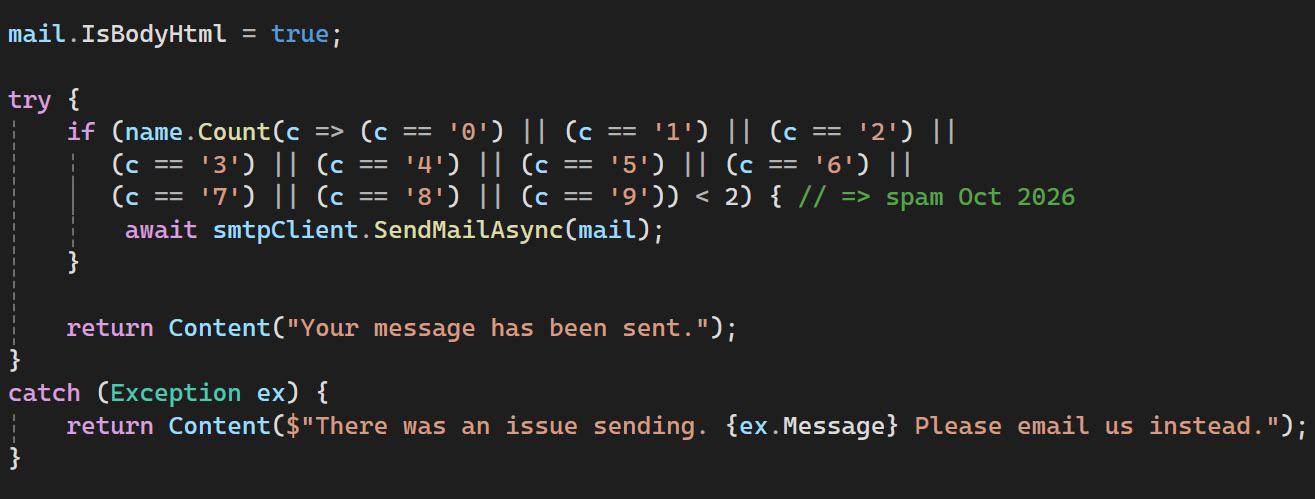
When your software architecture professor asks about your design patterns and you realize your entire codebase is held together by duct tape, prayer, and a single try-catch block that catches Exception. Sure, you've got architecture—disaster architecture. The kind where every component is tightly coupled, your database talks directly to your UI, and your "separation of concerns" is just different folders with the same spaghetti code. But hey, at least you're self-aware about the impending doom, which is more than most CS students can say when they're confidently explaining their monolithic mess as "microservices-ready."

Never Say Never

Never Say Never
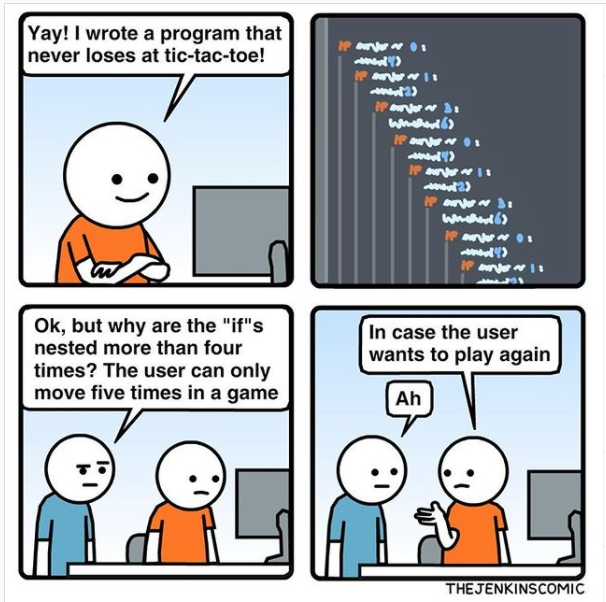
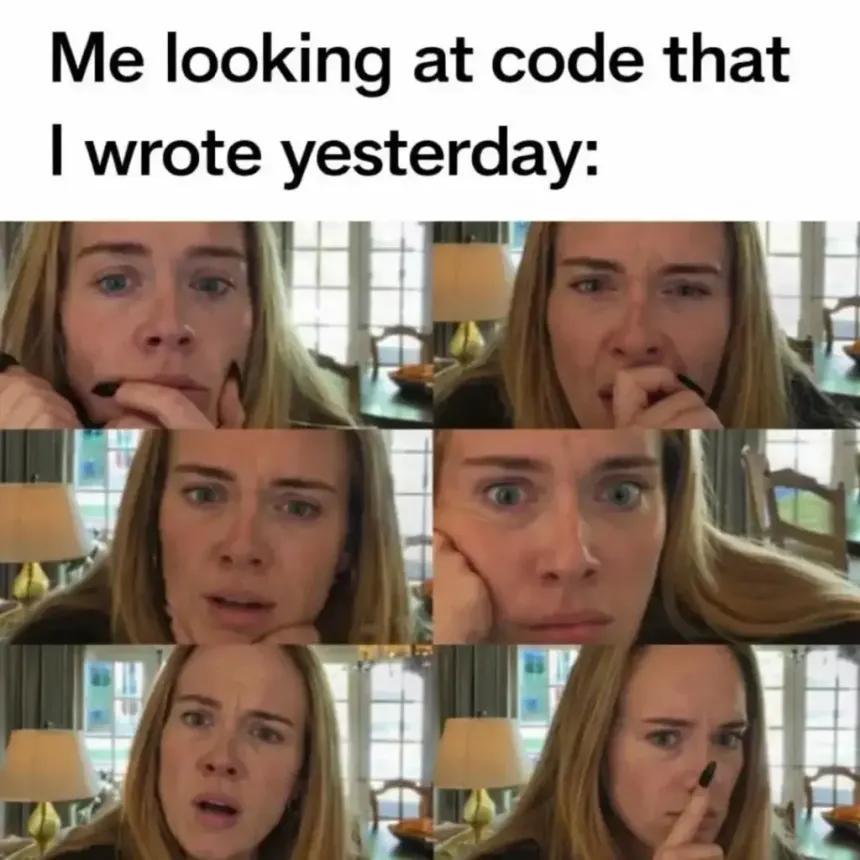
You know that monstrosity you wrote years ago? The one that makes you physically recoil when you see it in the codebase? Yeah, that 1,200-line behemoth with nested if-else statements so deep you need a map and a flashlight to navigate them. You promised yourself you'd refactor it "someday" and then conveniently forgot it existed. Fast forward to today: a critical bug appears, or worse, a "simple" feature request that touches that exact function. Now you're stuck wrestling with your past self's crimes against clean code. The best part? You can't even blame anyone else because git blame points straight at you. Nothing quite captures that special blend of regret, horror, and resignation like having to debug your own spaghetti code from 2019.

For That Modern Web Feeling

For That Modern Web Feeling
Someone literally wrote 15 lines of JavaScript to make a page fade out. You know what else makes a page disappear? Closing the tab. Takes zero lines of code. But no, we need to set the page opacity to 30%, create a spinner element with inline styles that would make any CSS developer weep, position it dead center with transforms (because apparently flexbox is too mainstream), add a linear infinite rotation animation with hardcoded pixel dimensions, append it to the body, wait 750ms, then fade everything out and remove the spinner. All of this to simulate "loading" when the function literally does nothing except waste three-quarters of a second of the user's life. Modern web development is just adding spinners to make users think something important is happening. Spoiler: it's not. The best part? The setTimeout callback has an empty action() function. Chef's kiss. Peak web engineering right there.

Scripting Kinda Easy

Scripting Kinda Easy
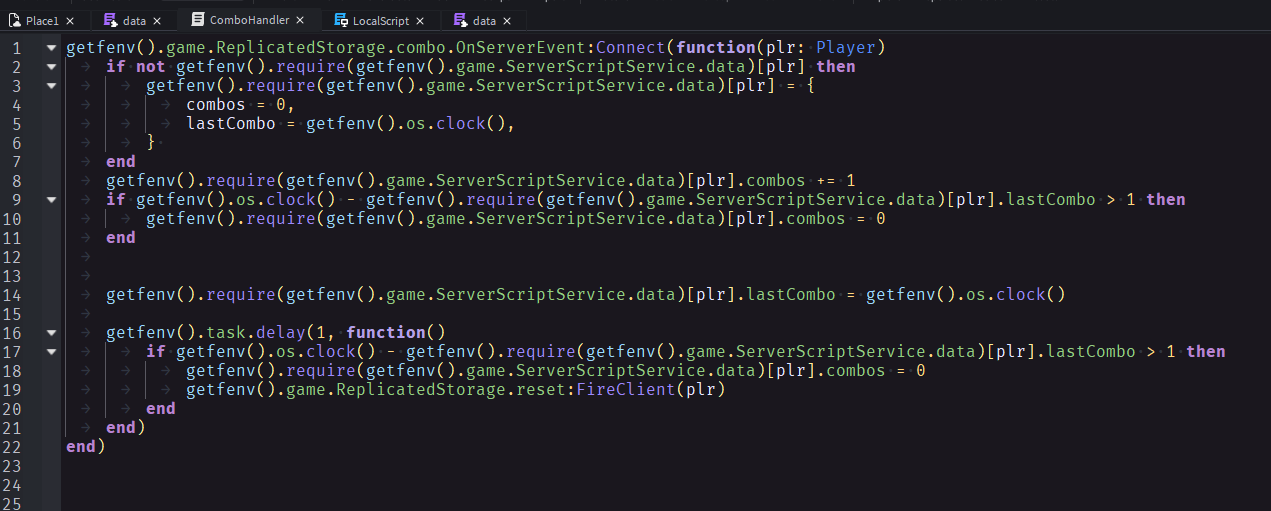
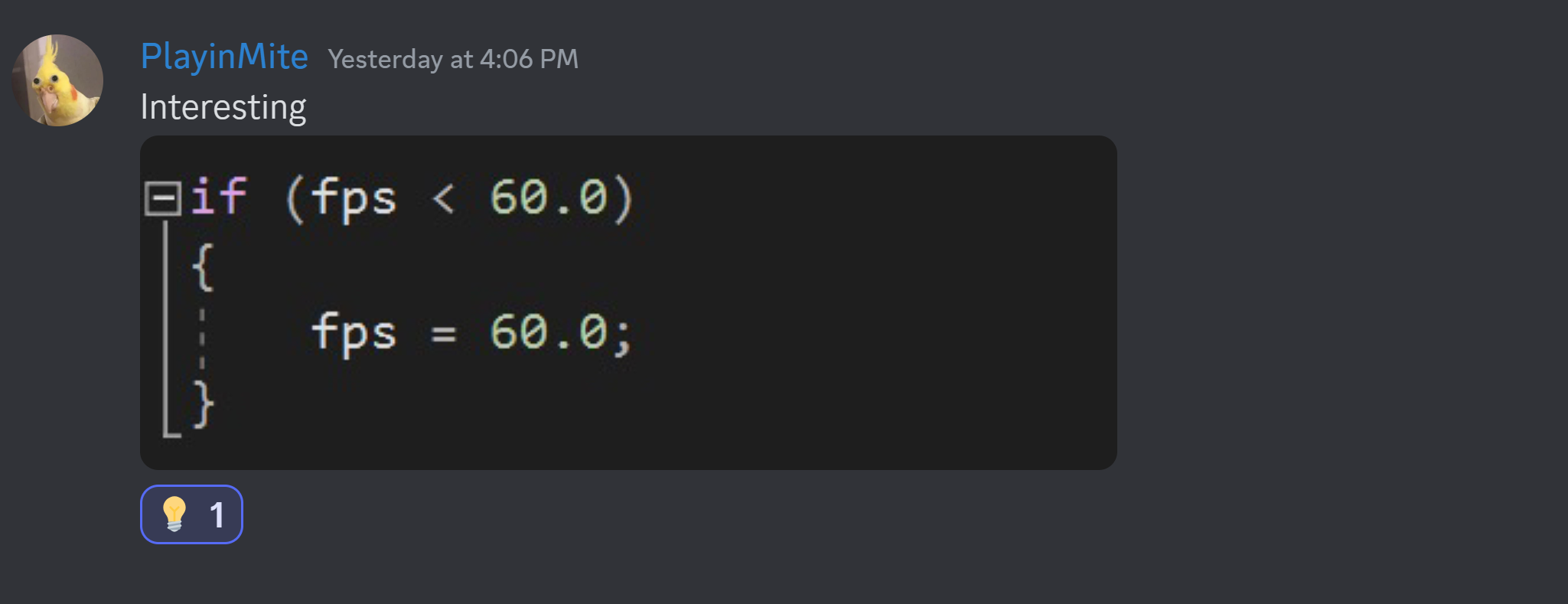
Oh honey, someone just discovered that naming variables is THE HARDEST part of programming and decided to give up entirely! Instead of using actual descriptive names, they've created a beautiful masterpiece where keyboard controls are literally just... the action names. Shift = sprint? Groundbreaking. Space = jump? Revolutionary. Left click = punch? GENIUS. But wait, it gets better! They're so confident about their "graphics = very good" and "music = good" that they just... declared it in the code like a royal decree. No implementation, no assets, just pure manifestation energy. And of course, "fps = 120" and "no lag" because if you write it down, it becomes true, right? That's how game development works! Just comment your dreams into existence and ship it! 🎮✨

We All Know It Is

We All Know It Is
When you're vibing with terrible code quality, writing nested callbacks six levels deep, zero error handling, and variable names like "x1" and "temp2"... and suddenly your commit counter hits 3251. Nothing says "professional software engineer" quite like watching your crime against computer science get immortalized in git history. The code may be garbage, but hey, at least you're consistently producing garbage. That's what they call velocity in Agile, right?

Year

Year
So everyone's screaming about JavaScript being terrible, but then you look at how developers actually get the current year in production code. Instead of just using new Date().getFullYear() , some genius decided to hardcode "2025" wrapped in a beautiful mess of <footer><small> tags that don't even close properly. The closing </small> is chilling AFTER the text instead of wrapping it correctly. Maybe JavaScript isn't the problem. Maybe it's the developers who refuse to use it correctly. This footer will be hilariously outdated in about 365 days, and some poor soul will have to manually update it while the rest of the internet just... uses a date function like normal people. The real kicker? They're complaining about hardcoded YEARS while literally hardcoding a year. Chef's kiss. 💋👌

Enron Architecture

Enron Architecture
When your codebase is so sketchy it's basically a federal crime. Building financial products with code so questionable you're not networking at meetups—you're collecting character witnesses for your inevitable trial. Two lawyers, three cops, a judge, and almost Maduro? That's not a professional network, that's a legal defense dream team in the making. Your architecture isn't just bad, it's "cooking the books" level fraudulent. At least Enron had the decency to collapse quickly—your technical debt is the gift that keeps on giving to law enforcement.

When The Code Is Written Entirely By AI

When The Code Is Written Entirely By AI
Rick confidently throws a portal at the wall, expecting it to work. Cut to him staring at a wall covered in nested if-statements with zero logic inside them. That's your AI-generated codebase right there. You ask ChatGPT for a simple function and it gives you seven layers of conditionals that all check the same thing. No else blocks, no early returns, just pure chaos wrapped in the illusion of structure. Sure, it might technically run, but good luck explaining to your team why there are 47 if-statements doing absolutely nothing productive. The best part? The AI will confidently tell you it's "optimized" and "follows best practices." Meanwhile you're left refactoring what looks like a choose-your-own-adventure book written by someone who's never heard of boolean logic.

I'm Beggin

I'm Beggin
Nothing says "career advancement" quite like desperately pleading to avoid accountability. Because who needs ownership, code reviews, or the ability to sleep at night when you can just... not be responsible? The beautiful irony here is that becoming a service owner means you'd actually have to care about uptime, monitoring, and those pesky production incidents. Much better to stay in the shadows where your technical debt can compound interest-free and your spaghetti code remains someone else's problem. Pro tip: if you're begging NOT to own something, you've probably already written the exact kind of code that makes service ownership a nightmare. The circle of life continues.

It Works But Only One Time

It Works But Only One Time
Someone wrote a method to count employees, but there's a tiny problem: it deletes ALL the employees from the database first, then counts how many are left. Spoiler alert: zero. Every single time after the first run, you're counting an empty table. The function technically works once—before it nukes your entire workforce into the digital void. The best part? They're using using statements for proper resource disposal, so at least the database connection is being cleaned up responsibly while the employee data gets yeeted into oblivion. Priorities, right? Pro tip: maybe fetch the count BEFORE running DELETE FROM. Or better yet, don't run DELETE FROM at all when you just want to count rows. That's what SELECT COUNT(*) is for. Your HR department will thank you.

Randomly Stumbled Upon This Code In My Company's Product (CAE Software)

Randomly Stumbled Upon This Code In My Company's Product (CAE Software)
Someone really said "I could use a loop" and then proceeded to manually hardcode what appears to be quaternion rotation calculations for every possible case. Each line is a beautiful handcrafted snowflake of copy-pasted arithmetic operations with slightly different array indices. This is what happens when you learn programming from a stenographer. The best part? There's probably a single matrix multiplication library function that could replace this entire screen of madness. But no, someone decided to type out hundreds of lines of p.a.c[i] * p.a.c[j] combinations like they were getting paid by the character. The code review must have been legendary. This is peak "it works, don't touch it" territory. Nobody's refactoring this beast because nobody wants to be the one who breaks the CAE software that's been running in production for 15 years.

I Guess They Let The Intern Optimize The App

I Guess They Let The Intern Optimize The App
So Discord's brilliant solution to their memory leak problem is... turning it off and on again? REVOLUTIONARY! Instead of actually fixing why their app is devouring RAM like a starving hippo at an all-you-can-eat buffet, they just implemented a hard reset when it crosses 4GB. That's not optimization, that's just automated panic mode! It's like your car engine overheating, so instead of fixing the cooling system, you just install a mechanism that automatically turns the car off every time it gets too hot. Sure, technically it prevents the engine from exploding, but you're still stranded on the highway every 20 minutes. Genius engineering right there! Someone really looked at this memory leak, shrugged, and said "Have we tried just... restarting it?" And somehow that made it to production. The absolute audacity of calling this a "failsafe" when it's literally just admitting defeat to your own memory management.