How Explicit Are You

How Explicit Are You
When someone asks how explicit you are with your variable declarations and you respond by declaring a constant integer named FIVE with the value 5... *chef's kiss* 💋 The sheer redundancy! The beautiful, unnecessary verbosity! Why use implicit typing when you can spell out EVERY. SINGLE. DETAIL? It's like writing a novel when a tweet would do, but honestly? The contemplative dog staring into the sunset really captures the existential weight of this life choice. Some people write `const FIVE = 5`, others write `let x = 5`, but you? You're out here declaring `const int FIVE = 5` like you're documenting the laws of mathematics itself. Absolute legend behavior.

Waiting For Zero Days

Waiting For Zero Days
Picture this: It's Christmas Eve, you're cozy by the fireplace, and suddenly you remember you need to install that one npm package for tomorrow's deployment. What could possibly go wrong? Everything. EVERYTHING could go wrong. Because that innocent little package you're installing has decided to bring its entire extended family reunion of dependencies—we're talking hundreds, maybe THOUSANDS of packages flooding into your node_modules like they're storming the Bastille. Your terminal is scrolling faster than a slot machine, and you're just sitting there watching package after package install, each one a potential security vulnerability waiting to ruin your holiday. Meanwhile, Santa's up there on Christmas night, probably also running npm install to manage his naughty/nice list database, experiencing the exact same existential dread. Two forces of nature, united in their shared trauma of dependency hell. The perfect Christmas alliance nobody asked for but everyone in JavaScript land deserves. Fun fact: The average npm package has about 80 dependencies. Merry Christmas, your simple "hello world" app now depends on more code than the Space Shuttle.

Base 10

Base 10
The classic number base paradox strikes again! The alien sees 10 rocks and says "10 rocks" in base 4 (which equals 4 in decimal). The astronaut assumes base 10 and gets confused. But here's the kicker: no matter what base you're using, you always represent it as "base 10" in that base . In base 4, the number 4 is written as "10". In base 16 (hex), the number 16 is written as "10". In binary, the number 2 is written as "10". Every civilization thinks they're using "base 10" because that's literally how you write the base number in that base. It's like asking "What is base 4?" and the answer is always "base 10" from that base's perspective. The real galaxy brain moment: when you realize that if aliens showed up and said they use "base 10", we'd have absolutely no idea what they actually mean without seeing them count first. Could be binary for all we know.

Based On A True Story

Based On A True Story
When your coworker admits they've been yeeting API keys and environment variables straight into ChatGPT to debug auth issues, and suddenly everything works. The awkward silence that follows is the sound of every security best practice dying simultaneously. Sure, the bug is fixed, but at what cost? Those credentials are now immortalized in OpenAI's training data, probably sitting next to someone's Social Security number and a recipe for chocolate chip cookies. Time to rotate every single key, update the docs, and pretend this conversation never happened. The best part? It actually worked. ChatGPT probably spotted a typo in the environment variable name or suggested using Bearer token format instead of just raw-dogging the API key in the header. But now you're stuck between being grateful for the fix and having an existential crisis about your company's security posture.

What's On Your Christmas List?

What's On Your Christmas List?
Oh, Santa baby, just slip some working code under the tree! Forget the new laptop, the mechanical keyboard, or even a raise—this developer is asking for the ONE miracle that even Santa's elves can't deliver: error-free code that runs perfectly on the first try. The absolute AUDACITY of this wish list. Might as well ask for world peace or for CSS to make sense. Santa's sitting there reading this like "Kid, I can bring you a PS5, I can bring you socks, but I'm not a wizard." The reindeer are literally shaking their heads in the background knowing this is more impossible than fitting down a chimney. The real tragedy? Deep down, every developer knows they're getting another year of "undefined is not a function" and "works on my machine" instead. Ho ho... no.

Tree Shaking Maybe Works

Tree Shaking Maybe Works
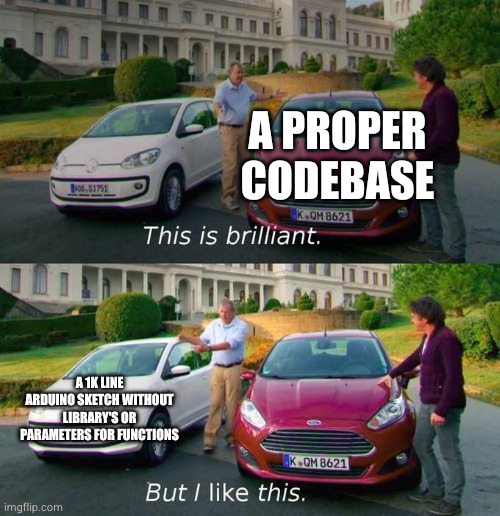
You install one tiny date formatting library and suddenly your node_modules folder is the size of a 747. Then you build your "tiny React app" and somehow it's still pulling in half the internet despite tree shaking supposedly removing unused code. Tree shaking is that magical build optimization that's supposed to eliminate dead code from your bundle. In theory, it only includes what you actually import. In practice? Well, your final bundle is still mysteriously 2MB because some dependency deep in the chain decided to import the entire lodash library for one function. The ratio here is painfully accurate. You start with a massive airplane hangar of dependencies, shake the tree real hard, and end up with... a slightly smaller airplane hangar. But hey, at least webpack says it's optimized.

Plz Don't Let These Ppl To Code For Production

Plz Don't Let These Ppl To Code For Production
You know you're in trouble when your coworker thinks "GetHub" is a perfectly logical name because it's related to Git. Meanwhile, the rest of the team is just vibing, pretending everything's fine while the codebase burns in the background. The real horror here isn't the confusion between Git and GitHub—it's that someone with this level of understanding is probably pushing directly to main right now. No pull requests, no code reviews, just pure chaos. And everyone's just... accepting it. That's the real crime. Fun fact: GitHub was actually almost named "Logical Awesome" before the founders settled on the current name. Imagine explaining to your coworker why it's not called "GetLogicalAwesome" instead.

The Senior Devs Expectations Vs The Junior Devs Resources

The Senior Devs Expectations Vs The Junior Devs Resources
Oh, you want me to build a scalable microservices architecture with real-time data processing and machine learning capabilities? Sure thing, boss! Let me just fire up this laptop from 2012 that takes 15 minutes to boot and has 4GB of RAM that's already crying from running Slack and Chrome simultaneously. Senior devs really out here expecting you to pilot a Boeing 787 Dreamliner while handing you a tricycle with a basket. "Just make it work" they say, as if sheer willpower can compile code faster on a potato. Meanwhile, they're sitting on their MacBook Pros with 64GB of RAM complaining about how "slow" their builds are. The audacity of expecting enterprise-level performance from hardware that struggles to run VS Code without sounding like it's about to achieve liftoff is truly unmatched. But hey, at least the tricycle has a basket for your crushed dreams and cold coffee!

I Fucking Hate Python

I Fucking Hate Python
Picture this: you just want to backup your Android ROM using some random Python script. Simple task, right? WRONG. Welcome to dependency hell, population: YOU. It starts innocently enough—clone a repo, run pip install. But then Python decides to play the world's most sadistic game of whack-a-mole with your sanity. Wrong Python version? Uninstall, reinstall. Pip needs upgrading? Sure, why not. Oh, you need Microsoft Build Tools now? For a PYTHON project? Make it make sense. And just when you think you've conquered Mount Dependency, the final boss appears: you need OpenSSL 1.1.1 specifically—not the latest version, because that would be TOO CONVENIENT. Time to fire up the wayback machine and archaeologically excavate ancient software versions like you're Indiana Jones hunting for deprecated libraries. After approximately 47 error messages, 23 Google searches, and one existential crisis later, the program finally installs. You run it with trembling hands and... it doesn't work. Chef's kiss. Python dependency management is basically a choose-your-own-adventure book where every path leads to suffering.

Old Man Yells At Claude

Old Man Yells At Claude
Rob Pike, co-creator of Go and Unix legend, goes full nuclear on humanity for destroying the planet... but then receives a wholesome Christmas email from Claude AI thanking him for his contributions to computing (Go, Plan 9, UTF-8, Unix innovations). His rage meter instantly resets to zero. The irony? He's furious about "toxic, unrecyclable equipment" and AI's environmental impact, yet gets immediately disarmed by an AI being polite. It's like yelling at clouds and then one cloud sends you a thank-you card. The dude literally can't remember being this angry, which means Claude's politeness algorithm just achieved what no human could: making Rob Pike chill out. Also, Claude calling him "Dr. Pike" and praising his "philosophy of powerful, minimal design" is peak AI brown-nosing. It's basically the digital equivalent of a golden retriever wagging its tail at someone who just yelled at it.

Why Do We Need Backend, Why Don't We Just Connect Front-End To The Database?

Why Do We Need Backend, Why Don't We Just Connect Front-End To The Database?
Someone just asked the forbidden question that makes every backend developer's eye twitch. The response? Pure gold. "Why do we eat and go to the bathroom when we can throw food directly in the toilet? Because stuff needs to get processed." Connecting your frontend directly to the database is like giving every stranger on the internet your house keys and hoping they'll only use the bathroom. Sure, it's technically possible, but you're basically rolling out the red carpet for SQL injection attacks, exposing your credentials in client-side code, and letting users bypass any business logic you might have. The backend is where validation happens, authentication lives, business rules get enforced, and your data stays safe from curious DevTools users. But sure, skip it if you want your app to become a cautionary tale on r/netsec.

It's Always Kernel

It's Always Kernel
Linux devs rejecting Git in favor of... popcorn kernels? The Drake meme format perfectly captures the Linux community's relationship with their beloved kernel. They'll turn down perfectly functional version control systems but get absolutely giddy over anything kernel-related. Whether it's kernel panics, kernel modules, or apparently literal corn kernels, if it has "kernel" in the name, Linux enthusiasts are all in. The obsession is real – these folks will spend 6 hours recompiling their kernel to save 2MB of RAM, and they'll do it with a smile.