

Thank You Claude

Thank You Claude
So someone threw their entire codebase at Claude Opus 4.7 for a refactor. 68 minutes and probably their entire monthly token budget later, Claude emerged victorious with a "refactored" codebase. The app? Completely non-functional. But look at those stats: +494,474 additions, -724 deletions across 28 files. That's not a refactor, that's a rewrite with the confidence of someone who's never had to maintain legacy code. The ratio alone is chef's kiss—nearly 700:1 additions to deletions. Claude basically said "your code is fine, but have you considered 500,000 lines of improvements?" Sure, nothing works anymore, but at least it failed elegantly.

Here We Go Again

Here We Go Again
You know that feeling when you finally finish your security hygiene homework, rotating all your API keys and SSH credentials after a major breach, feeling all responsible and grown-up... only to find out another hosting platform got pwned? The Axios incident had developers scrambling to rotate their keys, and just when everyone thought they could breathe, Vercel joins the party. It's like a never-ending game of whack-a-mole, except instead of moles, it's your precious secrets getting exposed, and instead of a mallet, you're armed with nothing but git secret commands and existential dread. At this point, maybe we should just schedule "Rotate All Keys Day" as a monthly calendar event. Put it right between "Update Dependencies" and "Contemplate Career Choices."

Unbreakable Until Prod

Unbreakable Until Prod
Your code in dev/staging: literally molten metal being poured from an industrial crucible, withstanding thousands of degrees, handling every edge case you throw at it like an absolute champion. Unit tests? Green. Integration tests? Passing. Load tests? Crushing it. You're feeling invincible. Your code 0.3 seconds after hitting production: a fly somehow manages to crash through a window with the structural integrity of tissue paper, leaving behind a 500 Internal Server Error and your shattered confidence. Nginx is just there to document the carnage. The best part? You literally cannot reproduce the bug locally. It only happens in prod. With real users. At 3 AM. During a demo to stakeholders. The fly knew exactly when to strike.

Training LLMs With Proprietary Enterprise Code

Training LLMs With Proprietary Enterprise Code
When you feed your AI model 20 years of legacy enterprise code complete with TODO comments from developers who quit in 2009, Hungarian notation, and that one 3000-line function nobody dares to touch. The AI is trying its absolute best to lift this catastrophic weight, but it's clearly about to collapse under the sheer horror of your codebase. You can practically hear it screaming "why is there a global variable called 'temp123_final_ACTUAL_USE_THIS'?!" The model's struggling harder than your build pipeline on a Monday morning.

How We Be Talking To AI

How We Be Talking To AI
We've officially replaced our Stack Overflow addiction with ChatGPT therapy sessions. Instead of getting roasted by some dude with 50k reputation for not reading the documentation, we now politely explain our bugs to an AI that actually pretends to care. "Dear LLM, I humbly present to you my NullPointerException..." Meanwhile Stack Overflow is collecting dust while we're out here having full-blown conversations with a language model like it's our rubber duck that actually talks back. The irony? We went from copy-pasting Stack Overflow answers to copy-pasting AI responses. Progress, I guess.

Customer Demo But The Customer Came To The Office

Customer Demo But The Customer Came To The Office
You know that feeling when you're supposed to do a quick Zoom demo with some mock data and suddenly the client decides to show up in person? Yeah, that's when the entire production crew arrives. Boom mics, professional cameras, lighting rigs, directors—the whole Hollywood setup. Because when stakeholders are physically present, that "working prototype" better not throw a single error. No more "oh that's just a dev environment quirk" or "just refresh, it works on my machine." Now you've got three people watching over your shoulder while you frantically hope the database connection doesn't timeout and your hardcoded test credentials still work. The pressure goes from casual Tuesday afternoon to Oscar-worthy performance. One wrong click and you're explaining why the "Add User" button creates three duplicate entries. Fun times.

No Offence But This Is True

No Offence But This Is True
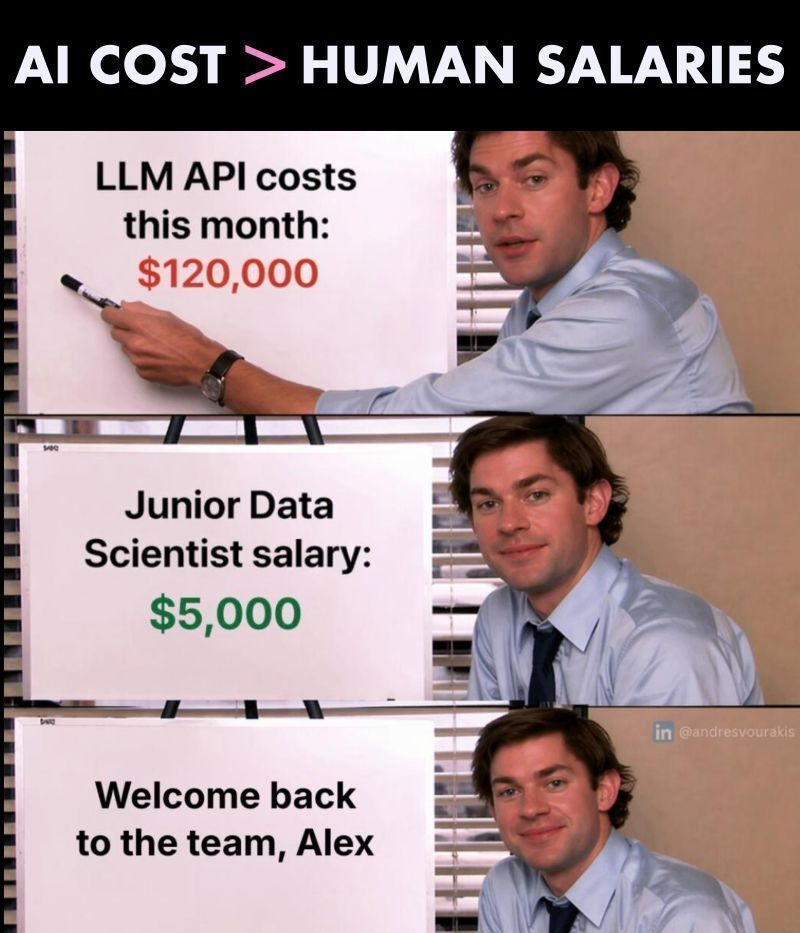
Back in 2015, we were optimizing our time like responsible engineers—spending 8 hours automating a 5-minute task because efficiency mattered, dammit. Fast forward to 2026, and here we are dropping $740 on AI tokens to recreate what we could've done in 5 minutes ourselves. The irony? We've gone from over-engineering solutions to over-spending on them. At least when we wasted time building automation scripts, we learned something and owned the code. Now we're just burning through API credits faster than a junior dev can max out the rate limit. The real kicker is we're still avoiding the manual work—we've just found a more expensive way to do it. Progress, I guess?

Tech Never Works For Long

Tech Never Works For Long
When you work in IT, you develop trust issues with technology that would make a therapist weep. This person has gone full Amish-mode in their own home, rejecting every "smart" device like they're debugging their entire life. Mechanical locks? Check. Mechanical windows? Absolutely. OpenWRT routers? Of course—because when you've seen what happens behind the curtain, you're not letting some manufacturer's backdoor-riddled firmware anywhere near your network. And smart home devices? Those little data-harvesting gremlins can stay at Best Buy where they belong. The ultimate irony: spending your entire career making technology work for others while your own home looks like it time-traveled from 1985. It's not paranoia when you KNOW exactly how everything breaks, gets hacked, or phones home to corporate overlords. The cobbler's children have no shoes, but the IT worker's house has no IoT vulnerabilities!

Sketchy Grape Site Cookies

Sketchy Grape Site Cookies
Someone just pushed a cookie named "kkk" to production with httpOnly and secure flags. One dev has the sudden realization that maybe, just maybe , naming your cookies after hate groups isn't the best look before launch. The other dev? Zero concerns. "Users never see cookie names" is technically true, but that's the kind of energy that leads to variables like "temp_n****r_array" sitting in your codebase until some poor intern discovers it during an audit. Sure, cookie names are hidden from end users, but your browser dev tools, security researchers, and that one nosy developer at the company acquiring you will absolutely see it. Nothing says "professional engineering team" like explaining why your auth cookies sound like a Klan rally.

I Am Tired Boss

I Am Tired Boss
You know you've crossed into true software development territory when you're staring at a 1000+ line markdown file generated by Claude, trying to convince yourself that copy-pasting AI output counts as "productivity." Opus 4.6 promised you the world, hallucinated half of it, and now you're debugging imaginary functions and nonexistent APIs at 2 AM. The real kicker? You started with a simple feature request. Three hours and one massive AI-generated file later, you're questioning your career choices and wondering if that barista job is still available. But hey, at least you can tell your standup tomorrow that you "integrated AI into the workflow" while conveniently leaving out the part where you spent 4 hours untangling its fever dreams. Welcome to modern development: where the AI does the typing and you do the suffering.

The Future Of Coding

The Future Of Coding
The entire AI coding assistant hype cycle summarized in one beautiful progression. We started with "low code" platforms promising to democratize development, then went full circle to "no code" because why even bother learning syntax? Then someone decided we needed "vibe code" (whatever that means—probably just prompting an AI with vibes only). Next came the AI coding agents that were supposed to replace us all, but surprise: they generated mountains of absolute garbage code that nobody could maintain. Turns out when AI writes your codebase, you suddenly need MORE developers to fix the mess, not fewer. And the pricing? Yeah, those enterprise AI agent subscriptions hit different when you realize you're paying premium rates to create technical debt. The punchline? We're all crawling back to just writing regular code ourselves like we should've been doing all along. Sometimes the old ways exist for a reason.

Coding Is Dead

Coding Is Dead
Three lines of JavaScript so abstract it makes Marxist theory look straightforward, and somehow ChatGPT turned it into a $50K MRR SaaS. The code literally just says "make product, sell product, reinvest profit" – which is either the world's most efficient business model or someone discovered that VCs don't actually read code before writing checks. The real genius here is convincing an AI that business.produce(capital) is valid syntax. Meanwhile, the rest of us are debugging why our authentication middleware breaks on Tuesdays while someone's out here getting rich with pseudocode that wouldn't pass a linter. The "// our strategy" comment really ties it together – nothing says "disruptive startup" like a TODO comment masquerading as business strategy.