The Duality Of A Programmer

The Duality Of A Programmer
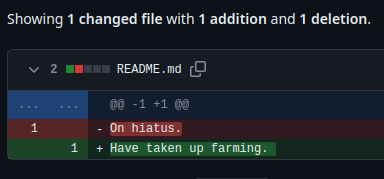
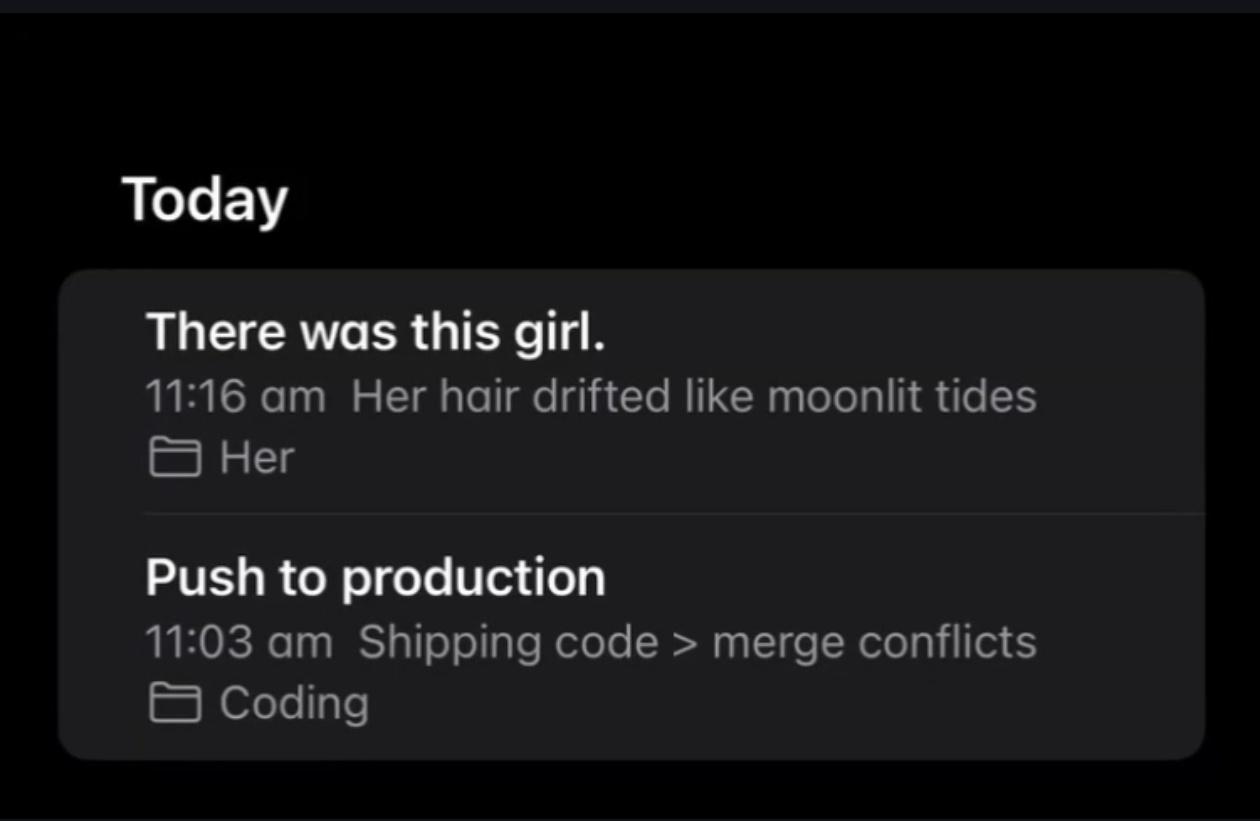
One moment you're crafting poetic prose about moonlit tides and ethereal beauty, channeling your inner Shakespeare at 11:16 AM. Thirteen minutes later? You're a cold-blooded code mercenary yeeting unreviewed changes straight to production because "shipping code > merge conflicts" is apparently your life motto now. The whiplash is REAL. From romantic novelist to reckless cowboy coder in less time than it takes to brew coffee. This is what peak multitasking looks like, folks – simultaneously being the most thoughtful AND most chaotic version of yourself. Choose your fighter: sensitive artist or production-breaking chaos gremlin. Plot twist: they're the same person.

Confidence > Correctness

Confidence > Correctness
Solo founder energy right here. Holding the rifle backwards with the scope pointed at their own face while confidently aiming at their next billion-dollar startup. The recoil's gonna be a surprise feature, not a bug. Ship it to prod, we'll fix it in post-mortem. Investors love conviction, and nothing says "I know what I'm doing" quite like a self-inflicted deployment strategy. The MVP stands for "Most Violent Prototype."

Kim The First Vibe Coder

Kim The First Vibe Coder
When your product manager gives you requirements with absolutely zero room for error and the entire leadership team is watching your deployment. The stakes? Infinite cheeseburgers. The pressure? Maximum. The testing environment? Nonexistent. Nothing says "agile development" quite like five generals standing over your shoulder taking notes while you push to production. No pressure though—just code it perfectly the first time or face consequences that make a failed CI/CD pipeline look like a minor inconvenience. The developer's face says it all: "I should've written more unit tests." But when the Supreme Leader himself is your scrum master, you don't exactly get to negotiate sprint velocity.

They Achieved Greatness

They Achieved Greatness
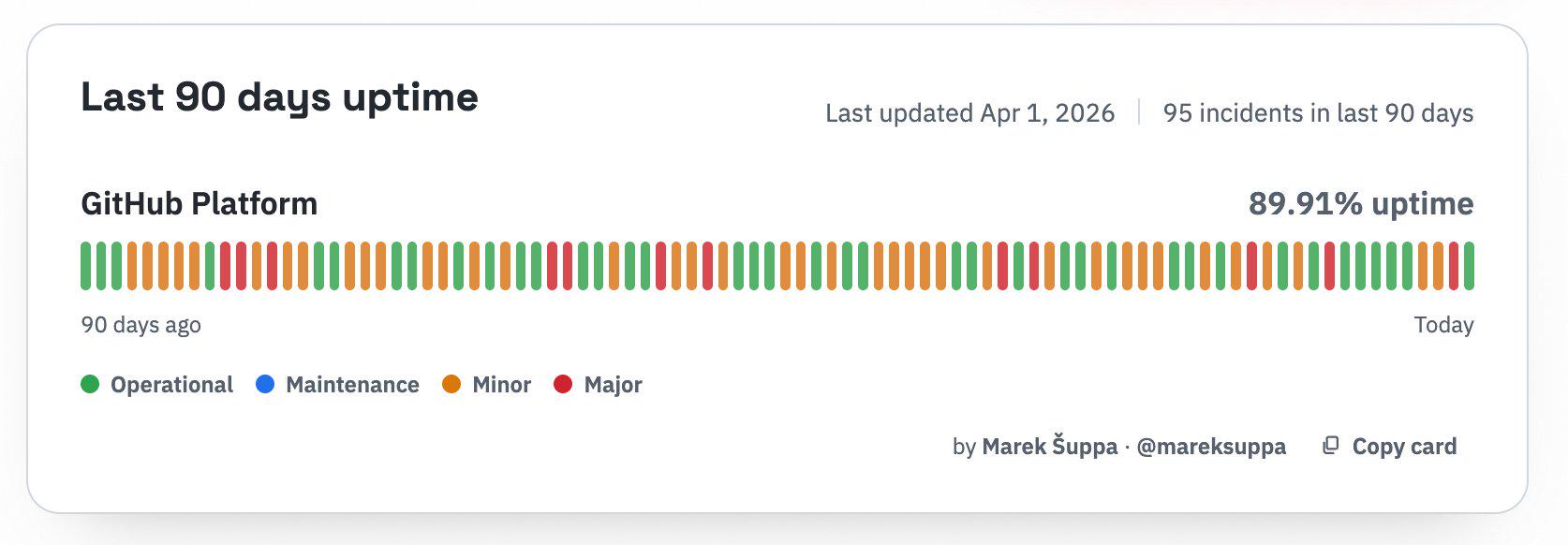
GitHub Platform flexing that sweet 89.91% uptime like it's a badge of honor. That's basically saying "we're only down 10% of the time!" which translates to roughly 9 days of downtime over 90 days. With 95 incidents sprinkled in there like confetti at a chaos party, this status page looks like a Christmas light display having an existential crisis. The bar graph is a beautiful mess of green (operational), orange (minor issues), and red (major outages) that screams "we're fine, everything's fine" while the building burns. For context, most enterprise SaaS platforms aim for 99.9% uptime (the "three nines"), so GitHub's sitting at a solid C+ here. But hey, when you're the monopoly of code hosting, who needs reliability? Developers will still push to main at 2 AM regardless.


Do You Trust

Do You Trust
VSCode asking if you trust repository authors is like asking if you trust the random npm package with 3 downloads you're about to install. Of course not, but we're doing it anyway. The gun-to-head energy here perfectly captures that moment when you've already cloned some sketchy repo from page 7 of Google search results and now VSCode is pretending to care about your safety. Brother, if I was concerned about security, I wouldn't be copy-pasting code from a 2014 StackOverflow answer at this point in my career. Just let me run this thing and pray it doesn't mine crypto on my machine.

Blazingly Slow FFmpeg

Blazingly Slow FFmpeg
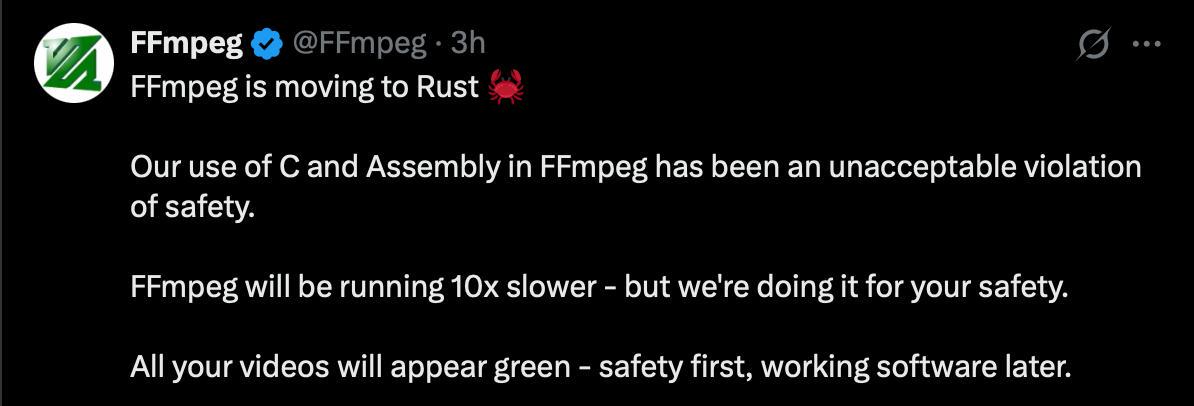
This is a beautiful parody of the Rust evangelism that's taken over the tech world. FFmpeg, one of the most battle-tested and optimized pieces of software ever written in C, announces it's rewriting in Rust because C is an "unacceptable violation of safety." The punchline? It'll run 10x slower, but hey, at least it's safe! And all your videos will be green because, you know, safety first, functionality later. The irony here is chef's kiss. FFmpeg has been processing billions of videos for decades without issue, but apparently that's not good enough for the Rust crusaders. The "blazingly fast" tagline that Rust fans love to throw around gets flipped on its head – now it's "blazingly slow." Because nothing says progress like making software 10x worse in the name of memory safety that wasn't actually a problem.

Breaking: NASA Is Using Office 365 Uninstaller Version 5.56 In Response To The Outlook Issues Onboard The Artemis II Spacecraft

Breaking: NASA Is Using Office 365 Uninstaller Version 5.56 In Response To The Outlook Issues Onboard The Artemis II Spacecraft
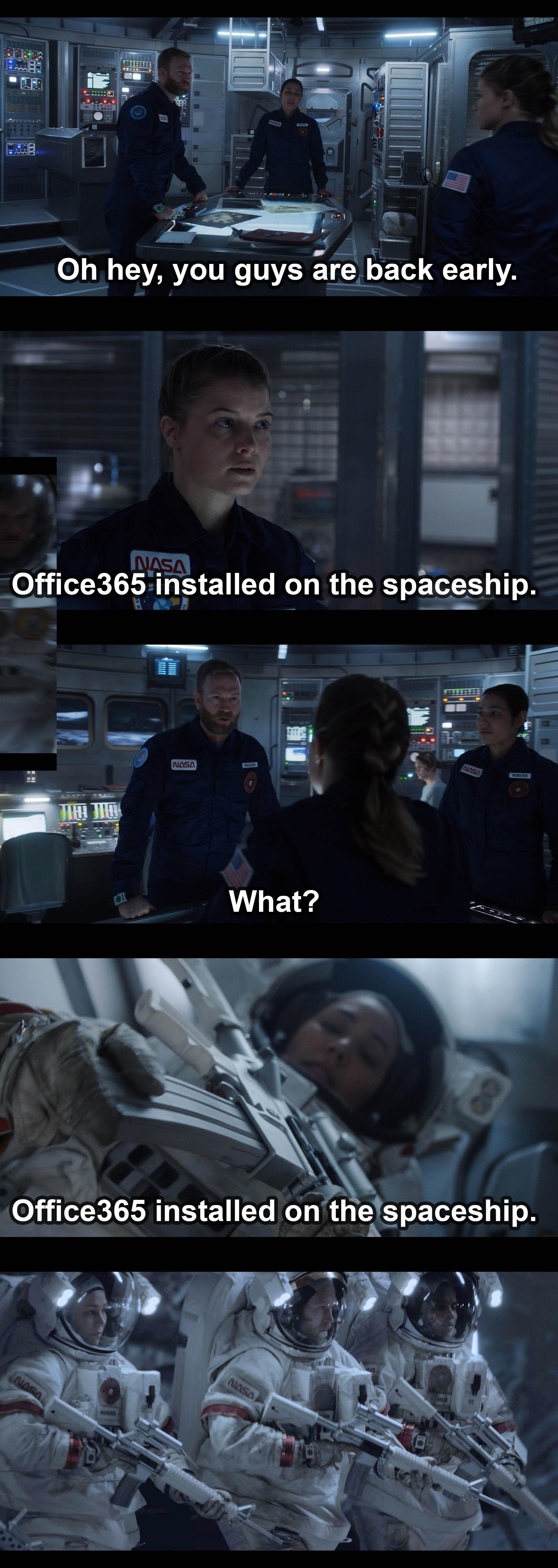
When you're literally going to the moon but someone in IT decided Office 365 was mission-critical software. The astronauts return early only to discover Microsoft's bloatware has somehow infected their spacecraft. The sheer horror on their faces when they realize they'll be receiving Outlook meeting invites at 250,000 miles from Earth is priceless. Nothing says "advanced space exploration" quite like dealing with Outlook crashes during re-entry. The crew's reaction escalates from confusion to full-on existential dread faster than a forced Windows update. At least they can uninstall it... oh wait, you need admin privileges for that, and IT is back on Earth. Houston, we have a problem, and it's asking us to restart to complete the installation.

Adding Linter To Legacy Codebase

Adding Linter To Legacy Codebase
So you thought adding ESLint to that 5-year-old codebase would be a good idea? Congratulations, your entire screen is now a sea of red squiggly lines. Every file. Every function. Every variable named "data" or "temp" from 2018. The linter is basically Oprah now: "You get a warning! You get a warning! EVERYBODY GETS A WARNING!" Turns out the previous dev team had some... creative interpretations of code standards. Who needs semicolons anyway? Const? Never heard of her. Unused variables? They're just there for moral support. Now you have two choices: spend the next three months fixing 47,000 linting errors, or add that sweet // eslint-disable at the top and pretend this never happened. We both know which one you're picking.

Easy

Easy
Oh sure, just instantiate a Game object, call initGame(), and boom—you've got the next AAA title ready to ship. Seven lines of C++ and you're basically competing with Unreal Engine 5. The real kicker is that "Game.hpp" header file doing all the heavy lifting while you pretend your main.cpp is the genius behind it all. That single header probably contains 50,000 lines of physics engines, rendering pipelines, AI pathfinding, and enough spaghetti code to make an Italian chef weep. But hey, game development is easy when you abstract away literally everything that makes it hard. This is the programming equivalent of those "how to draw an owl" memes where step 1 is drawing two circles and step 2 is "draw the rest of the owl." Just hide all the complexity in a header file and call it a day.

Never Ever Feel Like Yoga

Never Ever Feel Like Yoga
Documentation is that thing everyone preaches about like it's the holy grail of software development. "Future you will thank you!" they say. "Your team will love you!" they promise. And you know what? They're absolutely right. Good documentation prevents countless hours of confusion, onboarding nightmares, and those "what was I thinking?" moments when you revisit code from three months ago. But here's the brutal truth: sitting down to actually write it feels about as appealing as doing taxes while getting a root canal. Your brain immediately conjures up seventeen other "more important" tasks. Suddenly refactoring that random utility function seems urgent. Maybe you should reorganize your imports? Check Slack for the fifteenth time? The yoga comparison is painfully accurate. Everyone knows it's good for you. Everyone knows they should do it. Almost nobody actually wants to do it right now. The difference? At least yoga doesn't judge you with empty README files and outdated API docs.

Grades Down Memes Up Only

Grades Down Memes Up Only
The classic Computer Science student priority distribution graph. Notice how the performance curve starts relatively flat for Algorithms and Data Structures (the stuff that actually matters for interviews), dips even lower for Database Management Systems (because who needs ACID properties when you can just YOLO your transactions), but absolutely skyrockets when it comes to browsing programming memes on Reddit during lecture. The graph doesn't lie—while your GPA is doing a speedrun to the bottom, your meme consumption is reaching exponential growth. It's like you're implementing a priority queue where memes have O(1) access time and studying has O(n²) complexity. Will this help you pass your finals? Absolutely not. Will it give you dopamine hits between crying sessions about B-trees? Absolutely yes.

Day Counter: It Has Been −2,147,483,648 Days Since Our Last Integer Overflow

Day Counter: It Has Been −2,147,483,648 Days Since Our Last Integer Overflow
When your safety sign literally becomes the safety hazard. That floating point number is so cursed it probably has more decimal places than your last sprint had story points. The counter meant to track "days since last floating point error" is itself experiencing a floating point error—it's like having a fire extinguisher that's on fire. The title references the infamous 32-bit signed integer overflow at 2,147,483,647 (which wraps to -2,147,483,648), but the sign shows a floating point disaster instead. Two different numeric nightmares for the price of one. The irony is chef's kiss—you can't even trust your error tracking system to not have errors. It's bugs all the way down. Everyone in the office just casually accepting this is peak developer culture. "Yeah, the safety counter is broken again. Just another Tuesday." Nobody's even looking at it anymore. They've seen things. They know better than to question the machines at this point.