


Cpp And Its Vector Booleans

Cpp And Its Vector Booleans
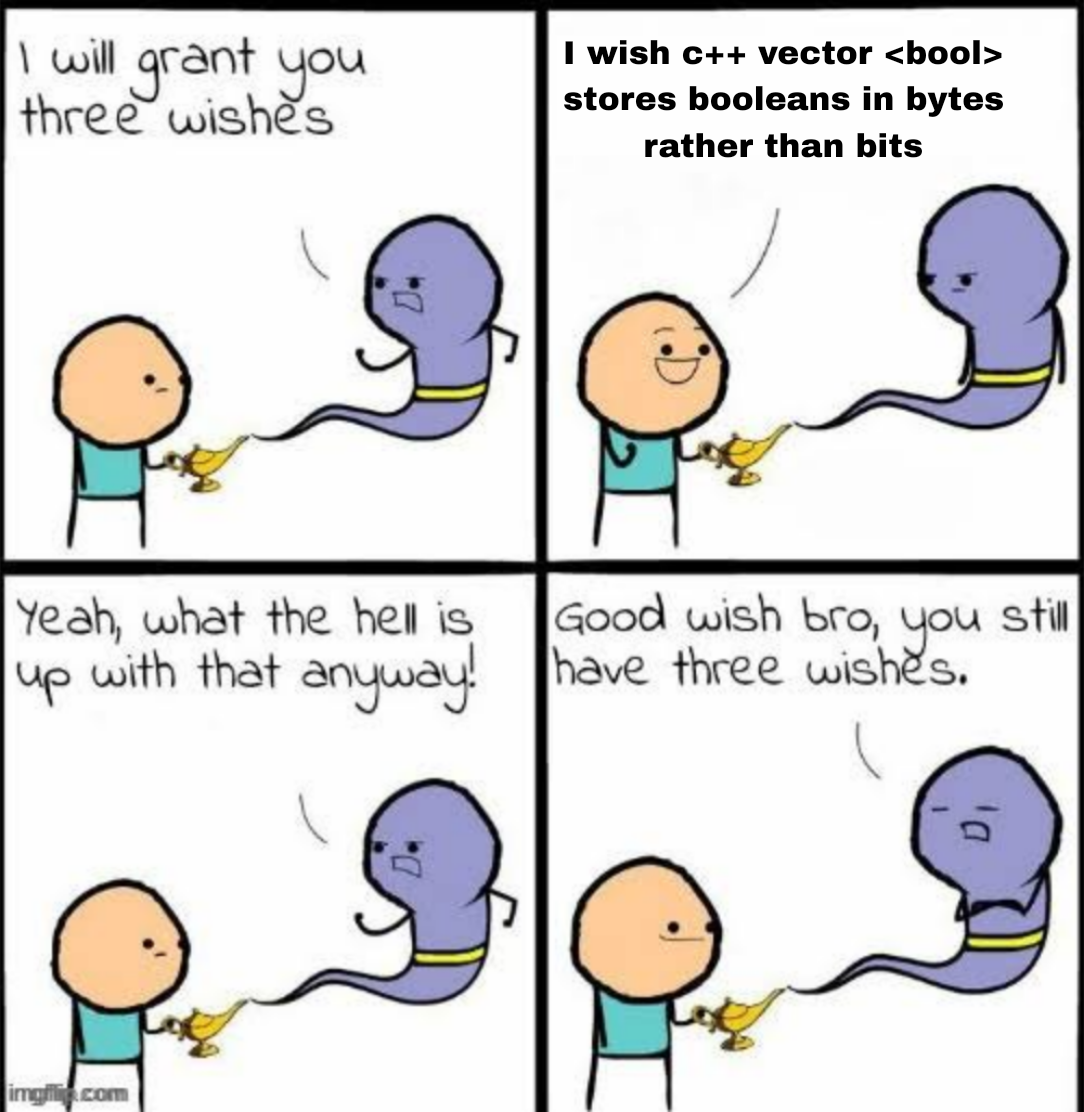
C++ decided to get clever with vector<bool> by storing each boolean as a single bit instead of a byte to "save memory." Sounds great until you realize it breaks half the expected behavior of vectors, can't return proper references, and causes performance nightmares because bit manipulation is slower than just accessing bytes. The genie's confused because this "optimization" is universally despised by C++ developers who just wanted a normal container. It's like asking for a car and getting a unicycle with training wheels—technically more space-efficient, but nobody asked for this.

Never Use URL Shorteners

Never Use URL Shorteners
Someone on McDonald's social media team learned a valuable lesson about URL shorteners the hard way. They cheerfully posted a bit.ly link expecting to showcase their Sweden team's cool project, but the shortened URL redirected to the September 11 attacks Wikipedia page instead. Talk about a PR nightmare served with a side of fries. The problem with URL shorteners? They're basically pointers that can be hijacked, expired, or redirected to literally anything. You're trusting a third-party service to maintain that mapping forever, which is like deploying to production without version control—eventually something catastrophic will happen. In this case, either the link expired and got reassigned, or someone maliciously changed the redirect. Either way, McDonald's just associated their brand with one of history's darkest days. Pro tip: If you're a major corporation, spend the extra characters and use full URLs. Your marketing team will thank you, and you won't accidentally become a case study in "What Not To Do on Social Media 101."

Leave My GPU Driver Alone!

Leave My GPU Driver Alone!
Windows Update has this beautiful talent for finding the one thing on your PC that's working perfectly and deciding it needs "fixing." Your GPU driver? Running like a dream. Games smooth. Rendering flawless. But Microsoft sees that stability and takes it as a personal challenge. You're just sitting there, minding your business, when Windows Update barges in like an overzealous bouncer: "HERE COMES A NEW UNWANTED DRIVER!" And suddenly your display is flickering, your games are stuttering, and you're frantically rolling back drivers while questioning all your life choices. The worst part? You can disable automatic driver updates, but Windows will still try to sneak them in like a cat knocking things off a table when you're not looking. Every. Single. Time.

I Don't Even Trust My Own Code

I Don't Even Trust My Own Code
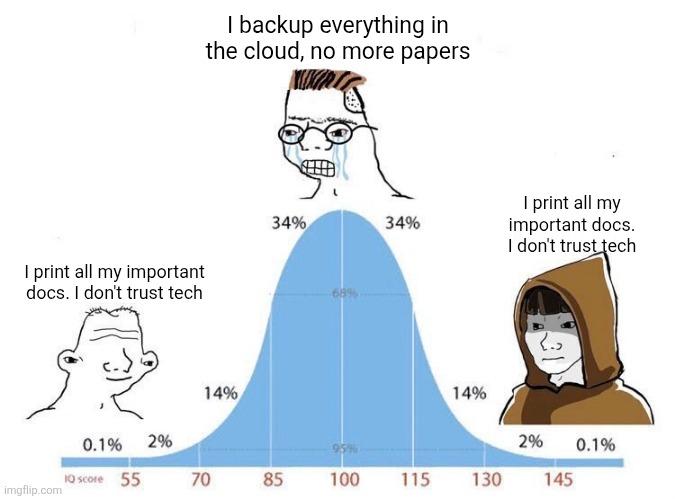
The bell curve strikes again, placing the enlightened cloud enthusiast at the center while the paranoid paper-hoarders occupy both extremes. The genius in the middle has achieved peak modern developer zen: "I backup everything in the cloud, no more papers." Meanwhile, the low-IQ and high-IQ crowds have independently arrived at the same conclusion through completely different paths—they both print everything because they don't trust tech. Here's the beautiful irony: the "smart" person trusts their code and infrastructure so much they've gone fully digital, while both ends of the spectrum have seen enough production failures, data losses, and "the cloud is just someone else's computer" disasters to know that physical backups aren't just paranoia—they're survival instinct. Sometimes the person who's seen nothing and the person who's seen everything reach the same conclusion, just for wildly different reasons. Plot twist: they're all wrong. The true galaxy brain move is having three cloud backups, two local backups, one printed copy, and still losing everything when you accidentally run rm -rf / in production.

Python Bros Don't Mess Around

Python Bros Don't Mess Around
Oh honey, you just casually mentioned you like funny men and this Python developer IMMEDIATELY went for the jugular with the most UNFORGIVABLE question known to mankind: "This is a constructor, __init__?" Girl says she likes humor and my man literally weaponized Python syntax as a pickup line. The AUDACITY. The sheer CONFIDENCE to turn a first date into a technical interview about dunder methods. This is either the smoothest or most catastrophically nerdy move ever pulled, and honestly? The fact that it worked is sending me into orbit. Python bros really out here treating romance like a class definition and somehow WINNING. The rest of us are writing poetry while they're dropping __init__ puns and getting slapped with passion. Absolutely unhinged behavior. Respect the hustle though.

Apple 2026 Mac mini desktop computer M5 Pro chip | 15‑core CPU and 16‑core GPU, 24GB Unified Memory, 512GB SSD Storage

Apple 2026 Mac mini desktop computer M5 Pro chip | 15‑core CPU and 16‑core GPU, 24GB Unified Memory, 512GB SSD Storage
LITTLE DO-IT-ALL — Mac mini packs pure power into a small, five-by-five-inch desktop. The M5 Pro chip brings even more performance to advanced AI tasks and creative and technical workflows. With port…

The Engineering Team Are Currently Fixing The Backend Bugs

The Engineering Team Are Currently Fixing The Backend Bugs
Two guys in a cherry picker working on a giant statue's butt. That's it. That's the entire backend team right there. Nothing says "critical production issue" quite like being suspended 30 feet in the air, literally fixing someone's backend while tourists take photos. The metaphor writes itself. They're probably up there with a pressure washer and a prayer, which coincidentally is the same approach we use for database migrations. At least when you're fixing a statue's backend, you can see the problem. Try explaining to management why the API is down because someone deployed on a Friday.

Who Would Have Thought

Who Would Have Thought
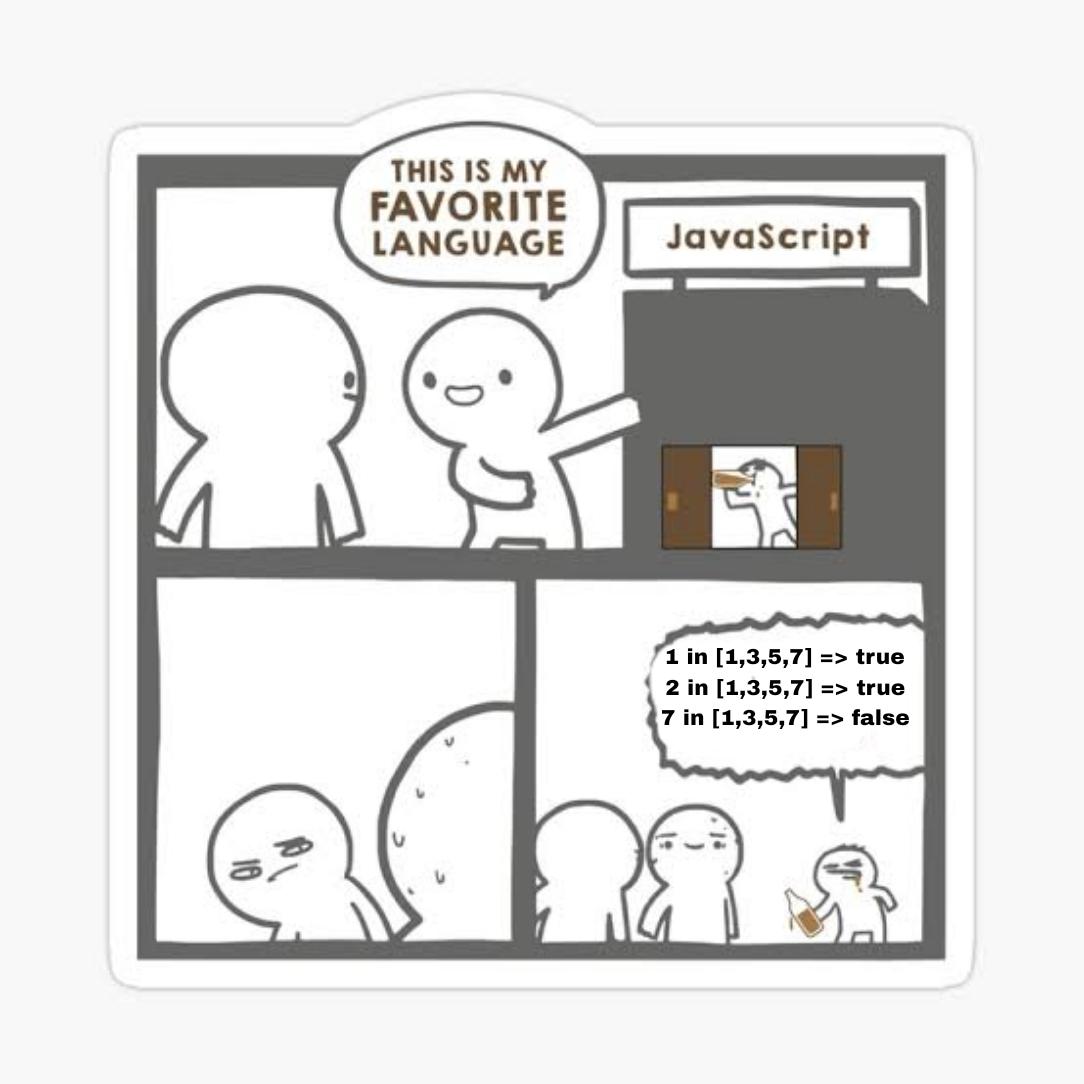
JavaScript's in operator strikes again with its beautiful chaos. Someone proudly declares JavaScript as their favorite language, then immediately demonstrates why checking if 1 in [1,3,5,7] returns true while 7 in [1,3,5,7] returns false. Here's the kicker: the in operator checks for array indices , not values. So 1 in [1,3,5,7] checks if index 1 exists (it does—it's the value 3), and 7 in [1,3,5,7] checks if index 7 exists (nope, array only has 4 elements). Classic JavaScript move: making perfect syntactic sense while being semantically bonkers. The person gets immediately thrown out the window, as one should when defending JavaScript's "features." Use .includes() like a civilized developer, people.

Don't Worry Guys When I Get Accepted I Will Give Everyone RTX 5090

Don't Worry Guys When I Get Accepted I Will Give Everyone RTX 5090
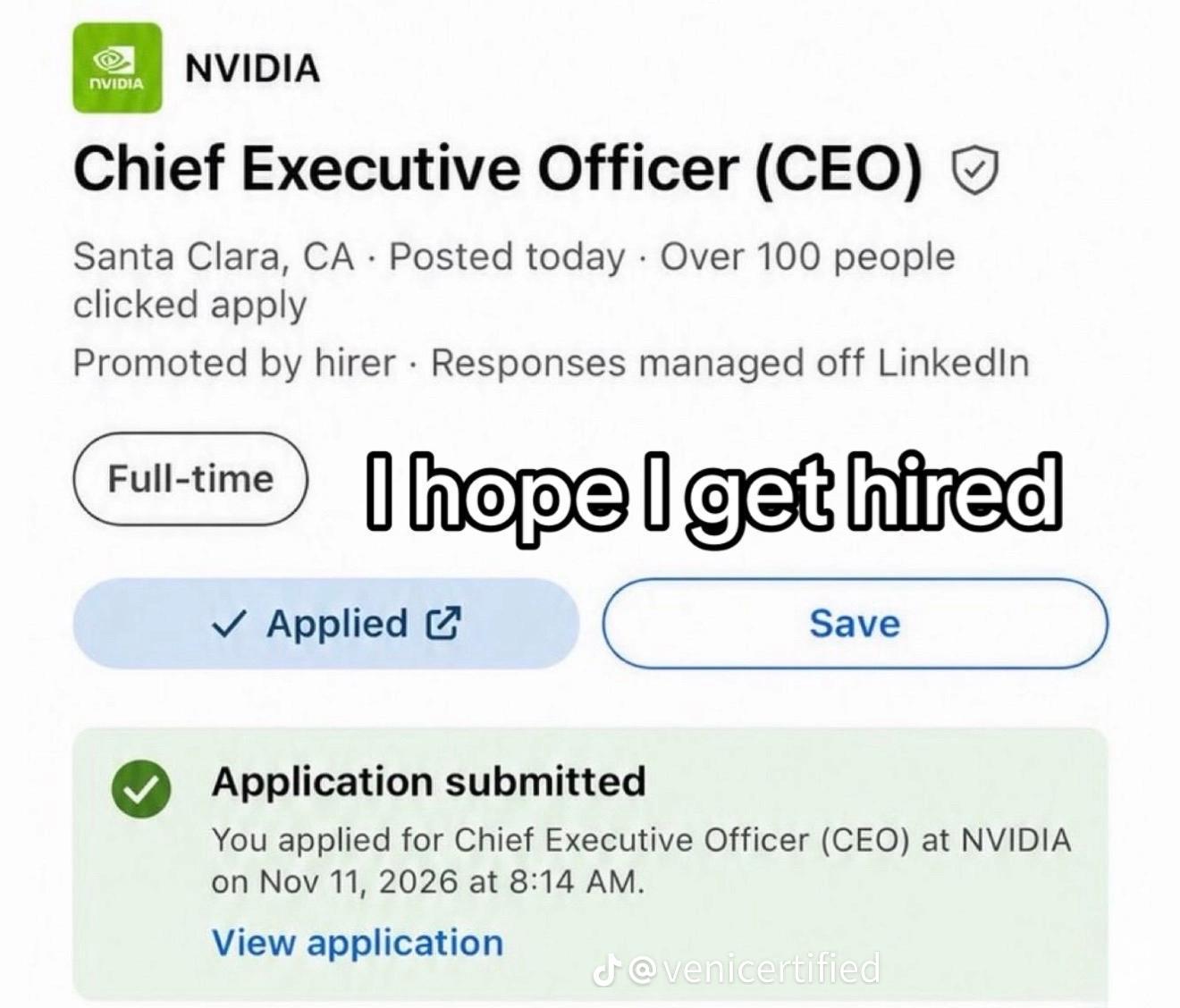
Someone really out here applying for CEO of NVIDIA on LinkedIn like they're shooting their shot for a junior dev position. The sheer AUDACITY of clicking that apply button and then promising everyone free RTX 5090s like they're already planning their first day executive decisions is absolutely SENDING me. Over 100 people also applied, which means there's a whole army of delusional souls thinking "yeah, I could run a multi-billion dollar GPU empire, why not?" The best part? "Responses managed off LinkedIn" because even the scam recruiters know this is too ridiculous to handle on the platform. But hey, shoot your shot king – worst case scenario, you don't become CEO and we don't get free graphics cards. Best case? Same thing, but at least you got a funny screenshot out of it.

Bugs Exclusively On Sunday

Bugs Exclusively On Sunday
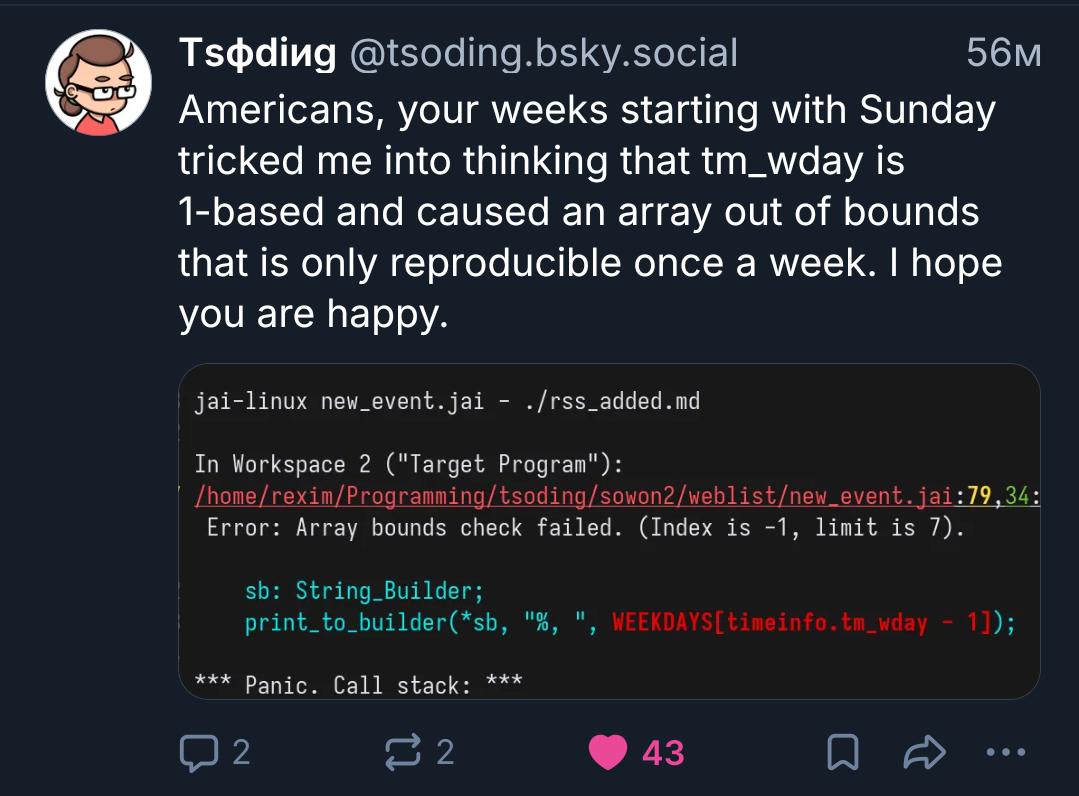
So someone built a system assuming weeks start on Monday (like civilized people do), made their `tm_wday` 1-based instead of the standard 0-based, and created a bug that only manifests on Sundays. Beautiful. Just beautiful. The code is accessing `WEEKDAYS[timeinfo.tm_wday - 1]`, which means on Sunday (when `tm_wday` is 0 in the actual C standard), it's trying to access index -1. Array goes "nope" and throws a bounds check error. The best part? This bug literally only happens once a week, making it the perfect "works on my machine" scenario. You test it Monday through Saturday, ship it to production, then Sunday morning rolls around and everything explodes. The passive-aggressive "I hope you are happy" at the end really seals the deal. Nothing says "I've been debugging for 3 hours on a Sunday" quite like that energy.

Things Got Real

Things Got Real
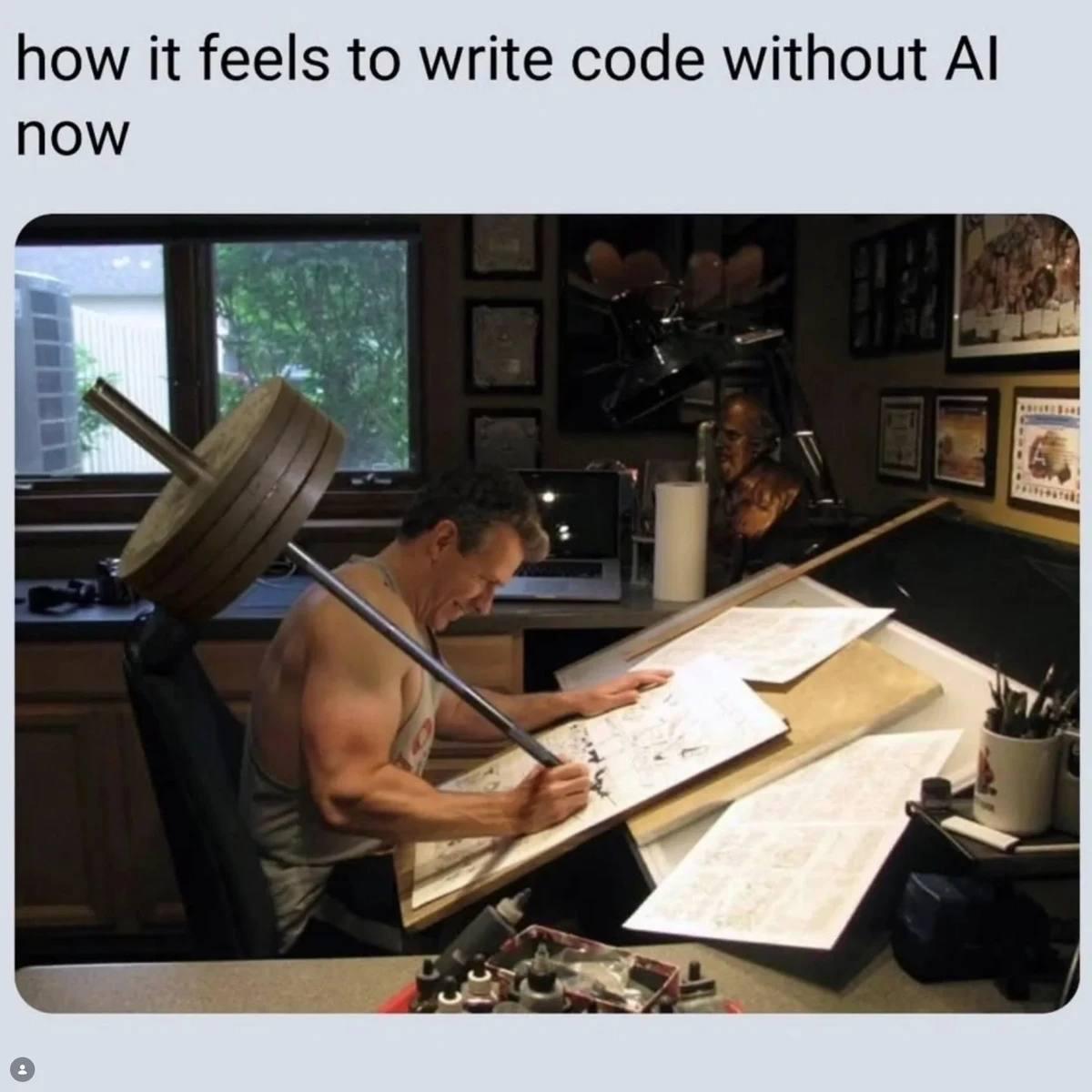
Remember when you actually had to think about your code? Yeah, me neither. Now that Copilot and ChatGPT aren't holding our hands, we're out here like medieval scribes, manually drawing out algorithms on parchment with a quill. The image shows someone literally drafting with old-school tools and a lamp, which is basically what coding without AI autocomplete feels like now. We've gotten so dependent on AI suggestions that writing a for-loop from scratch feels like reinventing the wheel. Next thing you know, we'll be debugging with an abacus.

Algorithm

Algorithm
Social media algorithms have become the ultimate stalkers, tracking your every micro-interaction with the precision of a Big O(1) lookup. You pause on a frog picture for 14 seconds while refilling your vape? Boom—the algorithm has already categorized you as a certified amphibian enthusiast and is flooding your feed with more frogs than a biology lab. The beauty here is the absurdity of it all. You weren't even intentionally looking at the frog—you were multitasking—but the algorithm doesn't care about context or intent. It only cares about engagement metrics. Dwell time = interest = here's your new identity as a frog connoisseur. Welcome to the recommendation engine dystopia where your accidental scroll habits define your entire digital existence.

Apple 2026 Mac mini desktop computer M6 chip | 12‑core CPU and 12‑core GPU, 16GB Unified Memory, 256GB SSD Storage

Apple 2026 Mac mini desktop computer M6 chip | 12‑core CPU and 12‑core GPU, 16GB Unified Memory, 256GB SSD Storage
LITTLE DO-IT-ALL — Mac mini packs pure power into a small, five-by-five-inch desktop as the M6 chip delivers next-level AI capabilities. Mac mini features 2.5Gb Ethernet with support for Wi-Fi 7* and…

Agentic Era

Agentic Era
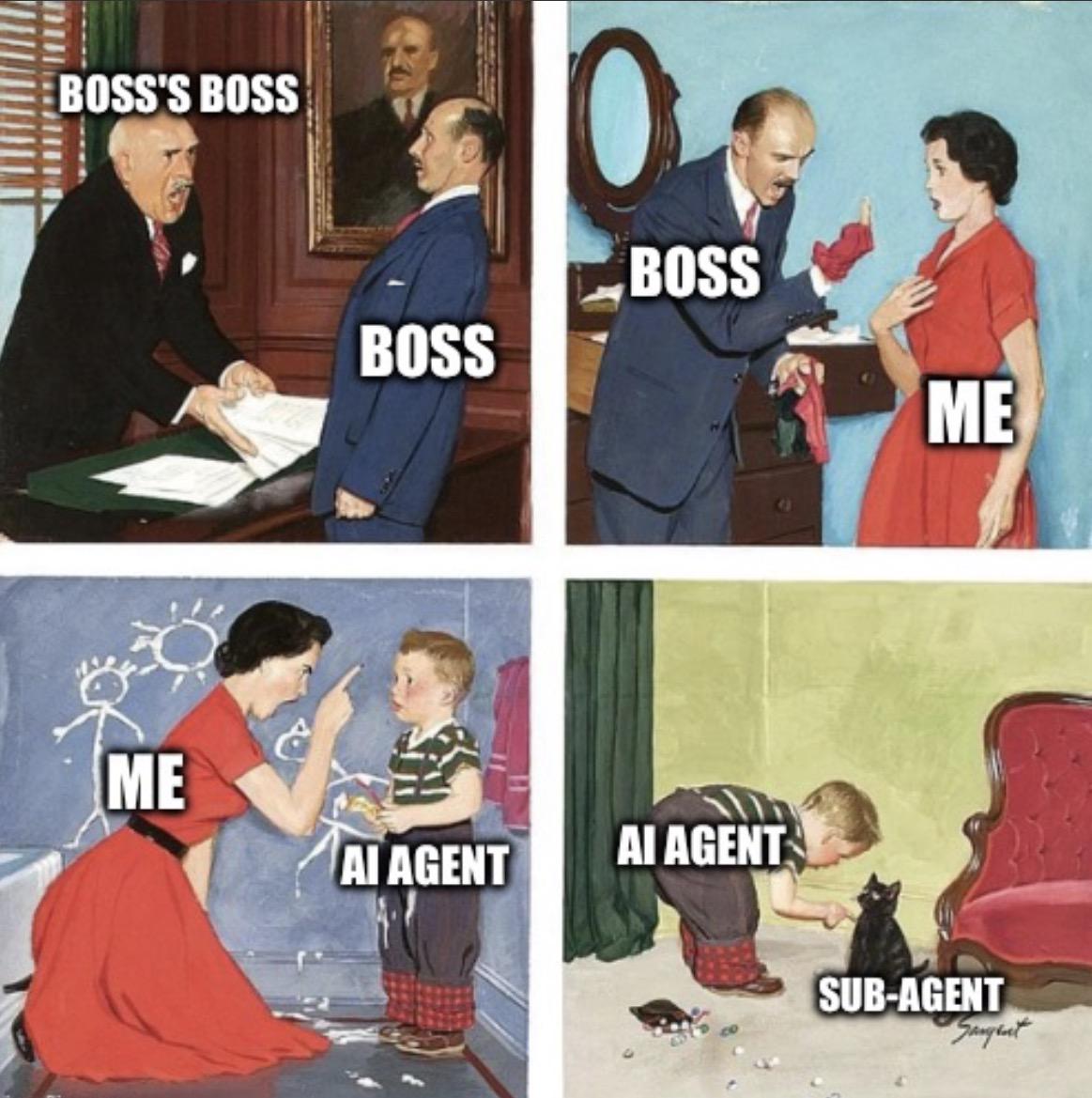
Welcome to the future where AI agents have sub-agents, and you're basically middle management for robots now. The corporate hierarchy hasn't changed—it's just gotten more recursive. Boss's boss yells at boss, boss yells at you, you yell at your AI agent, and that poor AI agent is probably spawning sub-agents to handle the actual work while it attends meetings about synergy. We've gone from "automate the boring stuff" to "automate the automation of the boring stuff." The real kicker? You're still getting blamed when the sub-agent hallucinates and deletes production. At least now you can say "my AI agent's AI agent did it" in your post-mortem.