

Claude Wilding

Claude Wilding
Claude just got asked to execute a command that looks like someone fell asleep on their keyboard while simultaneously having a stroke. We're talking grep, regex wildcards, piping through awk, redirecting to files, more awk with arrays, then casually sorting and grabbing the last 20 lines with head. This is the kind of one-liner that would make even a seasoned Unix wizard squint at their terminal for a solid minute. And the response? "Yeah go for it dude." No questions asked. No "wait, what does this do?" No safety checks. Just pure blind trust in the AI overlord. This is either peak confidence or peak laziness, and honestly, in our industry, those two are basically the same thing. The real joke is we've all been there—copy-pasting Stack Overflow answers we don't fully understand, running npm packages with 47 dependencies from developers we've never heard of, and now just letting AI execute cursed bash incantations. What could possibly go wrong? 🙃

Give Me One Reason I Shouldn't Take It. I'll Wait.

Give Me One Reason I Shouldn't Take It. I'll Wait.
That moment when you realize your two-week notice period is basically a free shopping spree at the company's intellectual property store. The company's desperately holding onto their precious source code like it's the One Ring, while you're standing there with the moral flexibility of Gandalf on a budget. Sure, there's that pesky thing called "legal consequences" and "professional ethics," but who needs those when you've got commit access and a USB drive? Nothing says "smooth exit" quite like potential litigation and a permanent spot on every tech company's blacklist. But hey, at least you'll have something to show your lawyer.

The Convenience Foodchain

The Convenience Foodchain
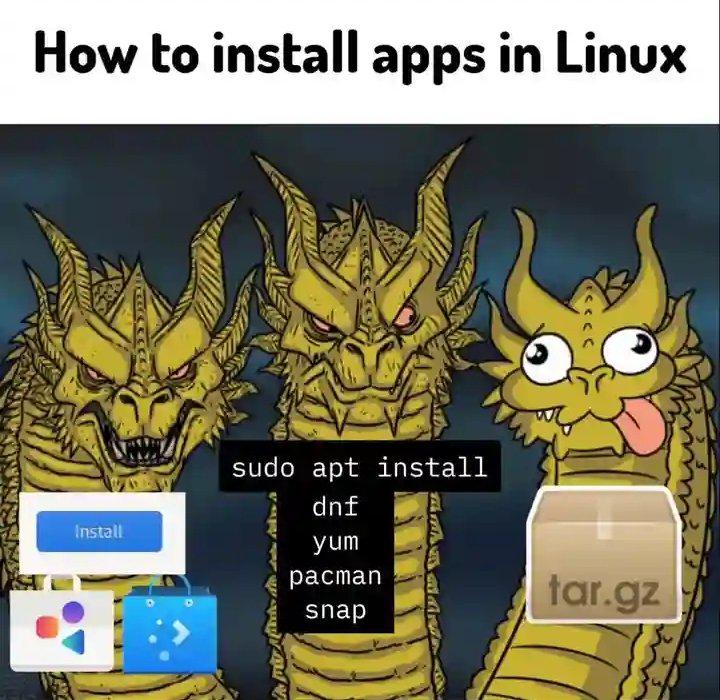
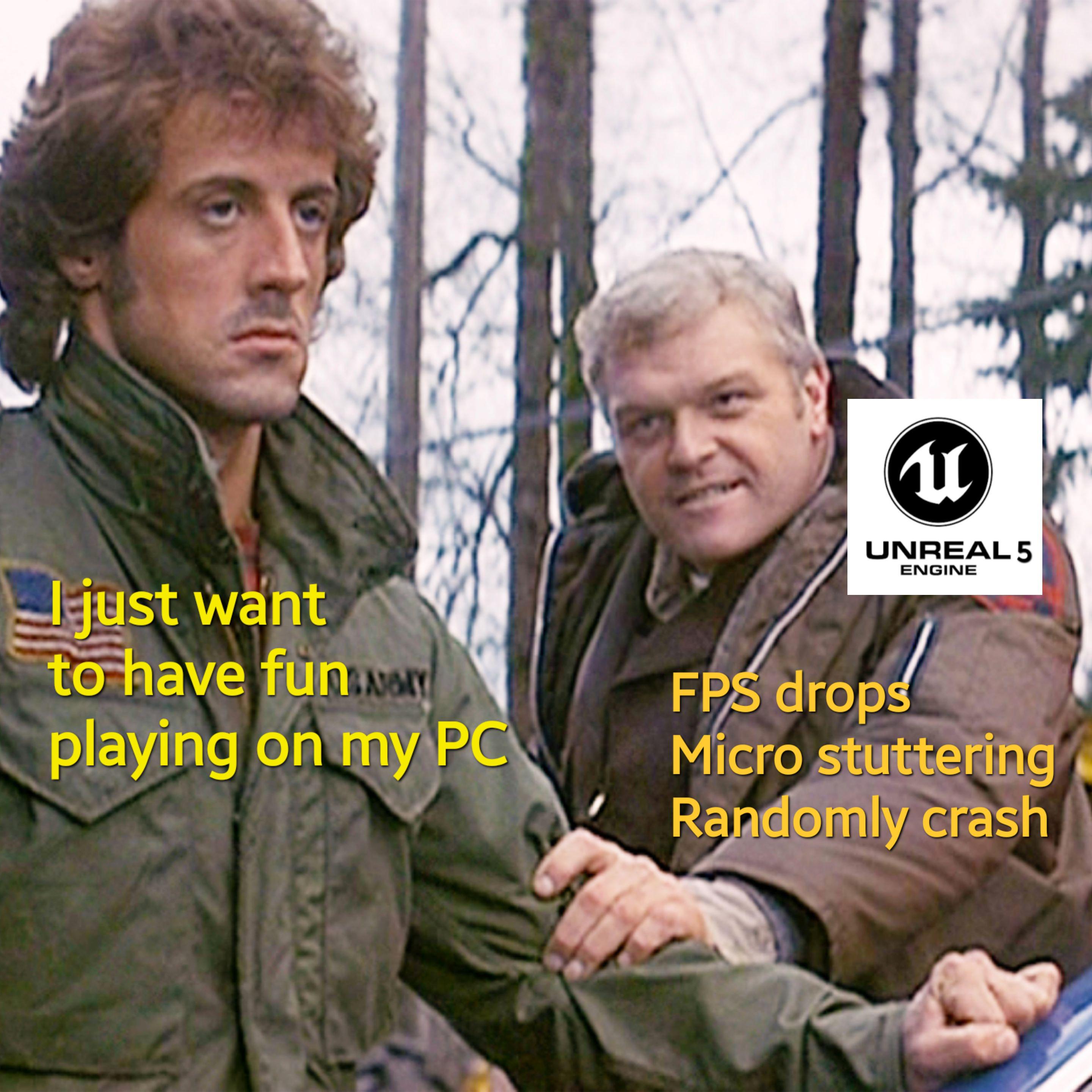
Console gamers are living their best life with plug-and-play simplicity. Windows gamers? They've seen some things—driver issues, random crashes, the occasional "why won't this game launch" existential crisis. But Linux gamers? They're out here compiling their own graphics drivers, wrestling with Wine compatibility layers, and Googling obscure forum posts from 2009 just to get a game running at 30fps. The hierarchy of suffering is real: the more control you want over your system, the more your soul gets crushed in the process. Console gamers are innocent children, Windows gamers are battle-scarred veterans, and Linux gamers are basically digital masochists who enjoy pain as a hobby.

Vibe Coders Won't Understand

Vibe Coders Won't Understand
You know you've written cursed code when you leave a comment that's basically a hostage note for future developers. Someone wrote code so convoluted that even they forgot how it works, and now they're warning others: "Don't touch this. 254 hours have already been sacrificed to this demon." It's the developer equivalent of finding a sealed tomb with warnings carved into the entrance—except instead of ancient curses, it's just spaghetti logic that somehow still runs in production. The best part? They're asking you to increment the counter when you inevitably fail too. It's not a bug tracker, it's a monument to human suffering.

Whose Sql Is It Anyway

Whose Sql Is It Anyway
The database naming wars have reached peak absurdity. MySQL? Boring. YourSQL? Getting spicy. But Y'ALLSQL? Now we're cooking with gas. Someone really looked at the entire SQL ecosystem and thought "you know what's missing? Southern hospitality." Because nothing says enterprise-grade database management like a y'all thrown in there. Can't wait for the next version: Y'ALL'D'VE'SQL for those complex conditional queries. Fun fact: MySQL is actually named "My" after co-founder Michael Widenius's daughter My. So technically, we've been using someone's daughter's SQL all along. Y'allSQL is just democratizing the possessive pronoun game.

Read Only

Read Only
Finally achieved that perfect state where everything works exactly as intended. No further modifications allowed. Touch nothing. Breathe carefully. The house has been deployed to production and any changes require a full sprint planning meeting and three layers of approval. Your kids wanting to move a chair? That's a breaking change. Someone leaving shoes by the door? File a pull request. The mental model of treating your living space like a codebase with strict version control is both deeply relatable and mildly concerning. chmod 444 reality.txt

How Do You Pronounce It?

How Do You Pronounce It?
The tech world's most pointless debate that somehow causes more arguments than tabs vs spaces. Is it "day-ta" or "dah-ta"? The answer depends entirely on whether you went to school in the US or literally anywhere else on the planet. Liam's response is gold because your brain automatically reads both pronunciations differently in the same sentence. It's like that GIF/JIF war, except nobody's built an entire career around being pretentious about data pronunciation... yet. Fun fact: The Latin origin "datum" suggests "dah-ta" is technically more correct, but good luck explaining etymology to your PM during standup when they ask about the "day-ta pipeline."

The One And Only Measurement

The One And Only Measurement
So apparently the ONLY scientifically valid metric for measuring code quality is WTFs per minute during code review, and honestly? The accuracy is TERRIFYING. Good code gets you maybe one confused "WTF" every few minutes. Bad code? You're drowning in a tsunami of "WTF IS THIS?!" and "DUDE WTF" faster than you can say "technical debt." It's like the difference between a gentle rain and a category 5 hurricane of confusion. Forget cyclomatic complexity, forget test coverage—if your teammate is muttering expletives at a rate that could power a small generator, you KNOW you've written some truly cursed garbage. The people have spoken, and they're screaming WTF.

Me A Irl

Me A Irl
You know that feeling when you're staring at your codebase trying to make sense of what past-you was thinking? That's the inflatable tube man energy right there. Just flailing around desperately hoping something will click. Then you look at the actual dependency graph of your project and it's this beautiful nightmare of spaghetti connections that would make a bowl of ramen jealous. Every service talks to every other service, circular dependencies everywhere, and you're just there begging the universe for a breakthrough moment. Spoiler alert: it never comes. You just add another line to the chaos and call it a day.

The Urge Is So Real

The Urge Is So Real
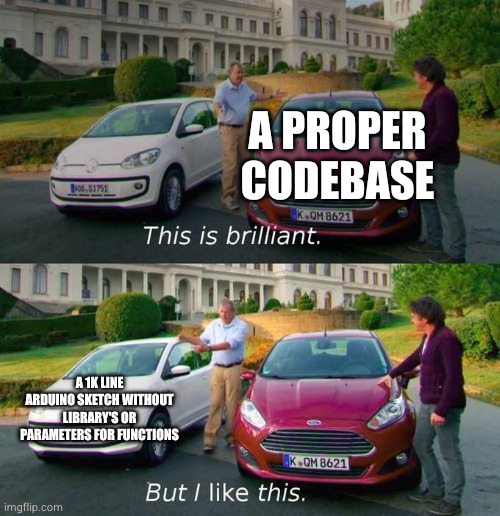
Production is on fire, users are screaming, and your manager is breathing down your neck about that critical bug. But wait—is that a nested if statement from 2018? Some variable names that make zero sense? A function that's doing seventeen things at once? Every developer knows that moment when you open a file to fix one tiny bug and suddenly you're possessed by the spirit of clean code. The rational part of your brain is yelling "JUST FIX THE BUG AND GET OUT" but your fingers are already typing "git checkout -b refactor/everything-because-i-have-no-self-control". Spoiler alert: you're gonna hit that refactor button, spend 4 hours renaming variables and extracting functions, accidentally break three other things, and then sheepishly revert everything at 6 PM. We've all been there. Some of us are still there.

One Big Mac Coming Up, Sir

One Big Mac Coming Up, Sir
Customer walks into McDonald's and politely orders a Big Mac. McDonald's employee, being the absolute OVERACHIEVER they are, responds with the hexadecimal equivalent: FF:FF:FF:FF:FF:FF . Because why use simple human language when you can flex your networking knowledge and serve up a broadcast MAC address instead? Nothing says "here's your burger" quite like addressing EVERY device on the local network simultaneously. The customer's face says it all – they just wanted a sandwich, not a lesson in layer 2 networking protocols. Fun fact: FF:FF:FF:FF:FF:FF is the broadcast MAC address that sends packets to all devices on a network segment. So technically, EVERYONE is getting that Big Mac. Communist burger distribution at its finest.

Microsoft Always Doing Me Dirty

Microsoft Always Doing Me Dirty
Every single time. You just need to nudge that image a millimeter to the left. Simple, right? Word's already sweating. You reassure it—and yourself—that nothing bad will happen. Just a tiny adjustment. But deep down, you both know the truth. The moment you touch that image, Word unleashes chaos. Text that was perfectly formatted? Now it's on page 47. Your carefully crafted tables? Scattered across dimensions. The image itself? Probably embedded in the footer now. And your page breaks? They've achieved sentience and are actively working against you. We've sent rovers to Mars, trained AI to write code, but Microsoft Word's image positioning remains humanity's greatest unsolved mystery. Just use LaTeX at this point—or better yet, Google Docs and accept your fate as a cloud peasant.