I Feel Attacked

I Feel Attacked
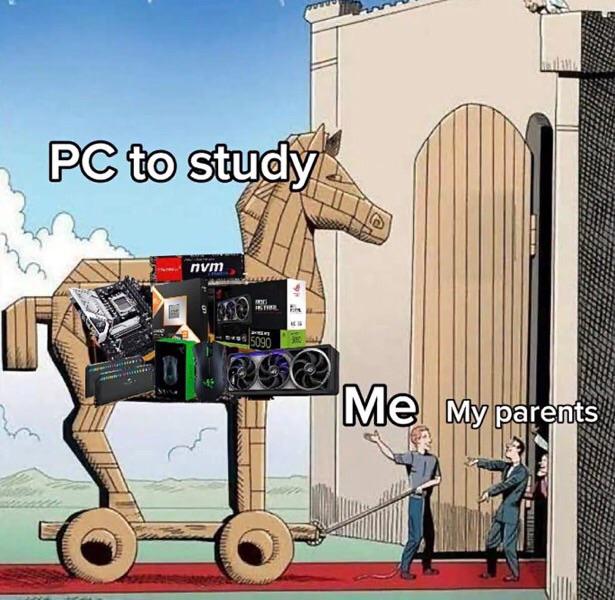
Nothing says "responsible financial planning" quite like dropping your entire paycheck on an RTX 5090, RGB RAM that costs more than groceries, and a power supply that could run a small village. The kid asks a perfectly reasonable question about the family's financial situation, and dad's sitting there surrounded by enough PC hardware to fund a college education. But hey, at least those benchmark scores are looking crispy. Can't put a price on 400 FPS in a game you'll play for 20 minutes before going back to browsing Reddit. The real tragedy? He's probably still using it to write code in VS Code and watch YouTube tutorials. That RTX 5090 is out here rendering "Hello World" programs like it's the next Pixar movie.

Rust Derangement Syndrome

Rust Derangement Syndrome
The Rust evangelists have reached maximum overdrive. Someone's made a YouTube thumbnail so apocalyptic it looks like Rust just declared war on the entire Linux ecosystem. A giant flaming mecha-Rust literally obliterating poor Debian into smithereens while the clickbait title screams about "nuking 8 entire architectures." The reality? Rust is gradually being adopted into the Linux kernel and various system-level projects, which means dropping support for some obscure architectures that don't have proper Rust compiler support. But why say "phasing out legacy architecture support" when you can make it look like Transformers: Age of Extinction? The "Rust Derangement Syndrome" title perfectly captures the collective panic/excitement/hysteria that happens whenever Rust touches anything. Half the community treats it like the second coming of memory safety, while the other half acts like their beloved C code just got personally attacked. Meanwhile, Debian maintainers are probably just quietly updating their build configs and wondering why there's a kaiju battle in the thumbnail.

Limited Space In My SSD Only For Special Games

Limited Space In My SSD Only For Special Games
You know you've made it as a game when you survive the brutal SSD purge. With modern games casually demanding 150GB+ like it's nothing, your poor 500GB SSD becomes a battleground where only the chosen few may reside. That one game you've replayed seventeen times? Knighted. That indie gem you bought on sale and haven't touched in two years? Sorry buddy, back to the HDD dungeon you go (or worse, uninstalled entirely). The "HDD" peasants in the background watching this sacred ceremony really adds to the hierarchy of storage. It's basically medieval feudalism but with load times.

Do Team Names Matter

Do Team Names Matter
Imagine grinding through countless competitive programming problems, debugging edge cases at 3 AM, optimizing algorithms until your brain melts, finally qualifying for the ICPC World Finals in Dubai... and your team name is literally "hehe i do cp". The sheer confidence it takes to walk into one of the most prestigious programming competitions on the planet with a name that sounds like a 12-year-old's Discord username is absolutely legendary. While other teams are probably called something serious like "Algorithm Warriors" or "Binary Titans," these absolute legends chose chaos. The best part? They're from IIT Roorkee, one of India's top engineering institutes, making it even funnier. They've got the skills to back up the meme energy. It's the programming equivalent of showing up to a black-tie event in a t-shirt and still being the most interesting person there.

Dev Phobia Words Evolution

Dev Phobia Words Evolution
The evolution of developer terror, beautifully visualized. Starting with the prehistoric C/C++ era where "Segmentation Fault" and "Core Dump" made you question your entire existence, we progress through Java's "Null Pointer Exception" phase (complete with a club, because that's how subtle it feels). Then the internet age blessed us with "404 Error" and "Removed" (RIP your favorite library), followed by Reddit's "Duplicate" stamp of shame when you dare ask a question. Stack Overflow brings us "You're absolutely right" – the most passive-aggressive phrase in programming, usually followed by someone explaining why you're actually completely wrong. Finally, we reach peak civilization: AI confidently telling you "You're absolutely right" while generating code that compiles but somehow opens a portal to another dimension. The scariest part? We trust it anyway because it sounds so convincing. The real horror isn't the errors themselves – it's how polite the warnings have become while still destroying your soul.

Or Watch Youtube

Or Watch Youtube
Ah yes, the classic tale of dropping $3000 on a gaming rig with RGB lights that could guide airplanes, a GPU that could probably mine Bitcoin AND render the entire MCU simultaneously, only to boot up Minecraft running at a casual 1500 FPS. Because nothing says "I needed this upgrade" quite like watching your decades-old blocky game run smoother than butter on a hot skillet. That beast of a machine is literally BEGGING for Cyberpunk 2077 on ultra settings, but nope—we're out here placing torches and punching trees like it's 2011. The hardware is screaming, the wallet is crying, and you're just vibing in your dirt house. Honestly? Respect. Sometimes you don't need ray tracing when you've got those sweet, sweet cubes.

Might Be A Form Of Jevons Paradox

Might Be A Form Of Jevons Paradox
Computers got 15x faster, yet somehow Electron apps still take 3 seconds to open and Chrome still eats RAM like it's a competitive sport. The cruel irony? All that extra computing power just means devs can pile on more frameworks, dependencies, and bloated abstractions until your M2 MacBook feels like a 2010 netbook running Crysis. Jevons Paradox is an economics concept: when you make something more efficient, people just use MORE of it, canceling out the gains. In our case, faster hardware just gave us permission to write slower software. Why optimize when you can just tell users to "upgrade their machine"? Shoutout to the devs still writing tight, efficient code while the rest of us ship a 300MB React app to display a todo list.

Straight To Prod

Straight To Prod
The "vibe coder" has discovered the ultimate life hack: why waste time with staging environments, unit tests, and QA teams when your production users can do all the testing for free? It's called crowdsourcing, look it up. Sure, your error monitoring dashboard might look like a Christmas tree, and customer support is probably having a meltdown, but at least you're shipping features fast. Who cares if half of them are broken? That's just beta testing with extra steps. The confidence it takes to treat your entire user base as unpaid QA is honestly impressive. Some might call it reckless. Others might call it a resume-generating event. But hey, you can't spell "production" without "prod," and you definitely can't spell "career suicide" without... wait, where was I going with this?

If It Does What I Want It To Do, I Don't Care

If It Does What I Want It To Do, I Don't Care
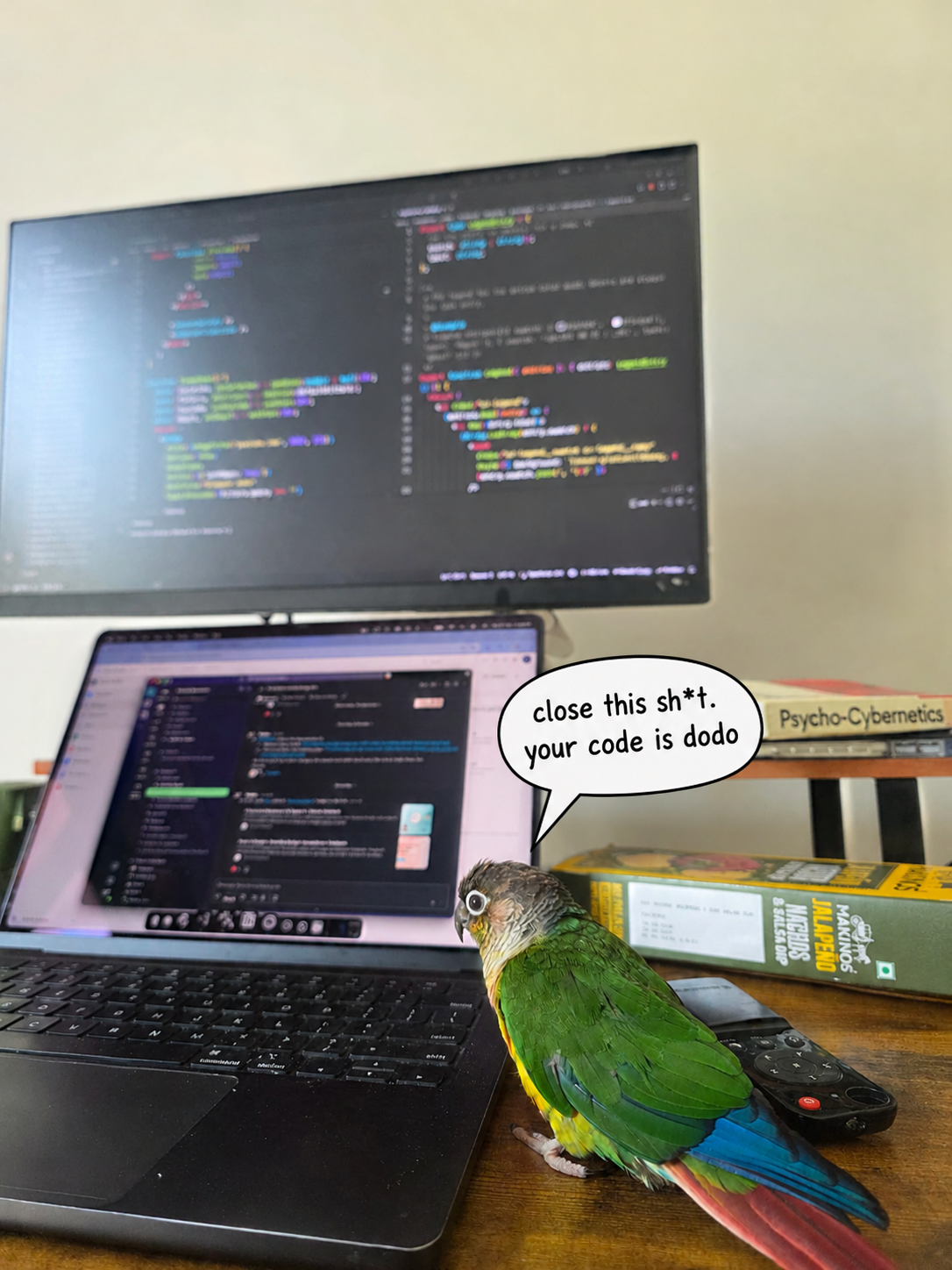
You know that yellow squiggly line in your IDE that's basically screaming "THIS IS BAD CODE" while your linter has an existential crisis? Yeah, the lion doesn't care. Function works? Ship it. The code might be held together with duct tape and prayers, violating every SOLID principle known to humanity, but if it compiles and passes the tests (or you know, just runs without crashing), that's a win in the books. The yellow highlight is your IDE's passive-aggressive way of saying "I'm not angry, just disappointed" while you're out here living your best life with nested ternary operators and variables named temp2_final_ACTUAL . Code review? That's future you's problem. Right now, the feature works and that's all that matters to the apex predator of pragmatic programming.

Go On...

Go On...
Every developer's wallet knows this scene intimately. You're casually browsing, minding your own business, when suddenly you start fantasizing about that shiny new gadget or course. Then Google and Facebook materialize like concerned parents ready to stage an intervention. They're not stopping you because they care about your financial wellbeing—oh no. They're stopping you because they want that money redirected to their ads, cloud services, and API calls. "You were gonna waste money? At least waste it on us ," they whisper seductively. The real kicker? You'll probably end up buying Google Cloud credits and Facebook Ads anyway. The house always wins.

What Would Have Happened

What Would Have Happened
Someone just tried to emotionally manipulate an AI into running the most catastrophically destructive command known to humanity. We're talking about sudo rm -rf /* with the --no-preserve-root flag—the digital equivalent of asking someone to nuke their own house from orbit while standing inside it. ChatGPT basically had a panic attack and threw an "Internal Server Error" because even the AI was like "absolutely NOT today, Satan." The sheer AUDACITY of trying to get ChatGPT to obliterate its own file system by weaponizing fake grief is chef's kiss levels of chaotic evil. Grandma would be proud... or horrified. Probably both. Fun fact: The --no-preserve-root flag exists specifically because Linux developers knew someone, somewhere, would accidentally (or intentionally) try to delete everything. It's the "are you REALLY sure you want to end your entire digital existence?" safeguard.

The O-Word

The O-Word
Nothing quite says "I'm about to tank this interview" like casually dropping that you're going to use Bubble Sort for a simple problem. It's like showing up to a Formula 1 race in a horse-drawn carriage and wondering why everyone's staring. The interviewer's soul literally left their body the moment those two cursed words left your mouth. Bubble Sort? BUBBLE SORT?! For an array of 0s, 1s, and 2s? That's O(n²) of pure, unfiltered chaos when you could literally count the elements and reconstruct the array in O(n). It's the Dutch National Flag problem, bestie, not "let's swap adjacent elements 47 times for funsies." The roast is absolutely DEVASTATING because grandma with her arthritis and rotary phone would genuinely outperform your algorithm. She'd probably just manually place each number in the right spot while you're still on your 500th comparison swap. The interviewer didn't even need to say anything—that look of existential dread said it all.