Dlss 5, Poised To Change The Game

Dlss 5, Poised To Change The Game
NVIDIA's DLSS (Deep Learning Super Sampling) is supposed to use AI to upscale low-resolution images into crispy high-res glory. Emphasis on "supposed to." Judging by these results, DLSS 5 has achieved something remarkable: it's gone backwards. The "off" version looks like a decent Renaissance painting, while "on" looks like someone let their grandmother loose with MS Paint after three glasses of wine. It's the infamous botched restoration of "Ecce Homo" all over again. You know your AI upscaling has issues when turning it ON makes things objectively worse. Maybe the neural network needs a few more epochs. Or therapy.

AGI Is Here

AGI Is Here
So NVIDIA's out here claiming they've achieved AGI (Artificial General Intelligence) - you know, the holy grail of AI that can think, reason, and do literally everything a human can do - and everyone's losing their minds! But then you peek behind the curtain and it's just... another LLM. A fancy autocomplete machine that's really good at predicting the next word but still can't figure out how many R's are in "strawberry." The tech industry's hype machine strikes again, slapping the "AGI" label on what's essentially a beefed-up chatbot running on a thousand GPUs. Classic NVIDIA move: revolutionary branding, evolutionary technology.

Modern Games

Modern Games
PC gamers proudly flex their RTX 4090s and think they're ready to dominate any game, only to discover that modern AAA titles are optimized about as well as spaghetti code written during a hackathon. You've got a GPU that could render the entire observable universe, but the game still stutters because it demands 24GB of VRAM to load a single texture of a rock. Game devs have basically decided that VRAM is infinite and optimization is a myth passed down by ancient programmers. Why compress textures when you can just ship 150GB of uncompressed 8K assets that nobody will notice anyway? The real kicker is watching your $2000 GPU get brought to its knees by a game that looks marginally better than something from 2015. Meanwhile, the Nintendo Switch is running entire open-world games on what's essentially a smartphone chip from 2015, proving that optimization is indeed possible when you actually care about it.

Callback

Callback
When documentation writers decide to write a 200-word essay about the "second argument of the setState() function" instead of just calling it what it literally is: a callback. You know, that thing developers have been calling callbacks since the dawn of asynchronous programming? The React docs are out here writing thesis statements about "powerful mechanisms for handling state updates and executing code after the state has been updated and the component has re-rendered" when they could've just said "callback function runs after state updates." That's it. Three words. Done. The frustration is real because this verbose documentation style makes you feel like you're reading a legal contract when you just want to know what parameter goes where. Sometimes simplicity beats eloquence, especially when you're debugging at 2 AM.

Frontend And Backend Devs Unite Through JSON

Frontend And Backend Devs Unite Through JSON
Frontend devs and backend devs might have their differences—one's obsessing over pixel-perfect margins while the other's optimizing database queries at 3 AM—but they both bow down to the same lord and savior: JSON. It's the universal peace treaty, the lingua franca of web development, the one thing that lets React talk to Node without starting a war. Meanwhile, the fullstack developer is just sitting there with both arms in a death grip, forced to maintain both sides of the handshake simultaneously. They're the poor soul who has to debug why the frontend is sending camelCase while the backend expects snake_case, then fix it on both ends while everyone else is at lunch. The price of knowing too much is eternal context-switching and no one to blame but yourself.

Bruh She Didn't Think This Type Of Experimenting

Bruh She Didn't Think This Type Of Experimenting
The classic miscommunication between normies and Linux power users. She's thinking "experimenting" means trying new restaurants or spontaneous weekend trips. He heard "experimenting" and immediately thought she wanted someone who compiles their own kernel, has 47 different window managers installed, and spends Friday nights tweaking i3 config files. The dude's completely oblivious to her actual intentions because he's too busy mentally explaining his Arch setup and why he uses dwm with custom patches. Meanwhile she's realizing that "experimenting" to a Linux enthusiast means something entirely different—like maybe testing out NixOS or finally switching from X11 to Wayland. The tragedy here is that both parties think they're on the same page, but one's reading a romance novel and the other's reading the ArchWiki.

Maxerals

Maxerals
Someone clearly had a stroke while typing "Minerals" and just committed it anyway. The best part? It's in a Cost struct right next to the correctly spelled "Minerals" field. So now we've got both minerals AND maxerals in our economy system, because apparently one wasn't enough. Either this is the most creative typo that made it past code review, or there's a parallel universe where maxerals are a legitimate resource type. My money's on the developer being three energy drinks deep at 2 AM and the reviewer just clicking "Approve" without reading.

If Something Is Free, You Are The Product

If Something Is Free, You Are The Product
That sketchy free VPN promising to "protect your privacy" is basically selling your browsing history to the highest bidder faster than you can say "data breach." Sure, you're not paying with money—you're just paying with every single website you visit, your location data, and probably your firstborn's social security number. The absolute AUDACITY of these services acting like they're doing you a favor while literally monetizing your entire digital existence. They're out here running a full-blown surveillance operation disguised as a security tool. It's like hiring a bodyguard who secretly films you 24/7 and sells the footage to tabloids. Pro tip: If you actually care about privacy, pay for a reputable VPN. Your data is worth way more than that $5/month subscription, trust me.

What Is Wrong With My Code

What Is Wrong With My Code
So you wrote a function that returns void, then proceeded to return null, and wrapped a println statement in a let binding that does absolutely nothing. This is what happens when you copy-paste code from three different languages and hope the compiler just figures it out. The function signature screams Rust or Kotlin, the println looks like Rust, but that return null? That's your brain on Java. Pick a lane, my friend. The compiler is not a therapist—it won't help you work through your identity crisis.

AI Cannot Replace Human Commit Messages

AI Cannot Replace Human Commit Messages
Here we have the beautiful evolution of developer desperation captured in three git commits. Starting with the brutally honest "it didn't" (because why waste words when two will do?), progressing to "fixed the wrong thing, this should work" (the classic developer optimism mixed with self-awareness), and finally landing on "update kustomization" (an actual descriptive commit message? Who are you and what did you do with the real developer?). AI would probably generate something like "feat: implement user authentication module with JWT tokens and refresh logic" while humans give you the raw, unfiltered truth: it broke, I panicked, I fixed something else, maybe it works now? This is the kind of commit history that makes git blame sessions absolutely legendary. The title claims AI can't replace human commit messages, and honestly? They're right. No AI would ever have the audacity to commit "it didn't" to production. That takes a special kind of human courage (or deadline pressure).

How To Make Money As A Programmer

How To Make Money As A Programmer
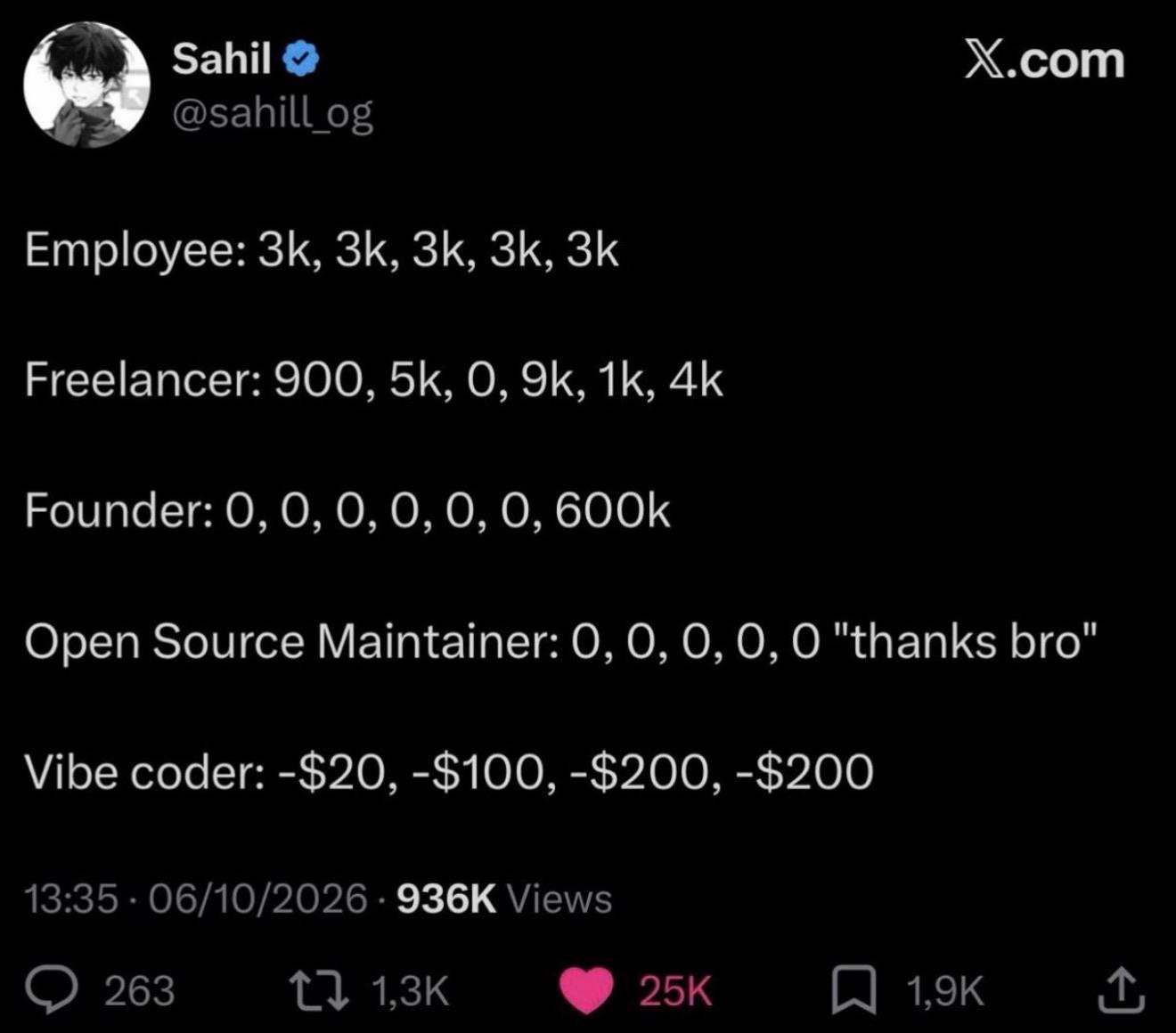
The harsh reality of tech salaries hitting different when you realize your gaming rig is worth more than your monthly paycheck. Someone finally discovered the ancient programmer secret: forget the side hustles, forget the freelance gigs, just sell the RGB monstrosity you built during lockdown. We spend thousands on water-cooled behemoths with enough RGB to power a small rave, telling ourselves it's "for work" and "compiling faster." Then when rent's due, suddenly that $1,500 Facebook Marketplace listing looks real attractive. The tears are because they know they'll be coding on a 2012 ThinkPad for the next six months. The cycle continues: get paid → build dream PC → emergency happens → sell PC → suffer → get paid → repeat. It's the circle of life, but with worse thermals.

No Slop Mode Activated

No Slop Mode Activated
That moment when you finally commit to the Linux-only lifestyle and nuke your Windows partition like you're burning bridges with an ex. No more dual-booting safety nets, no more "just in case I need to run that one program." You're all in now, baby. The frog in formal attire really captures that sense of dignified accomplishment—like you've just made a mature, calculated decision that definitely won't backfire when you need to fill out a PDF form or your WiFi driver stops working. Welcome to the club of people who unironically say "I use Arch btw" at parties. Fun fact: The average Linux user spends more time configuring their system than actually using it, but at least you're doing it without Microsoft spying on you. Probably. Maybe. You hope.