

Small Quick Fix

Small Quick Fix
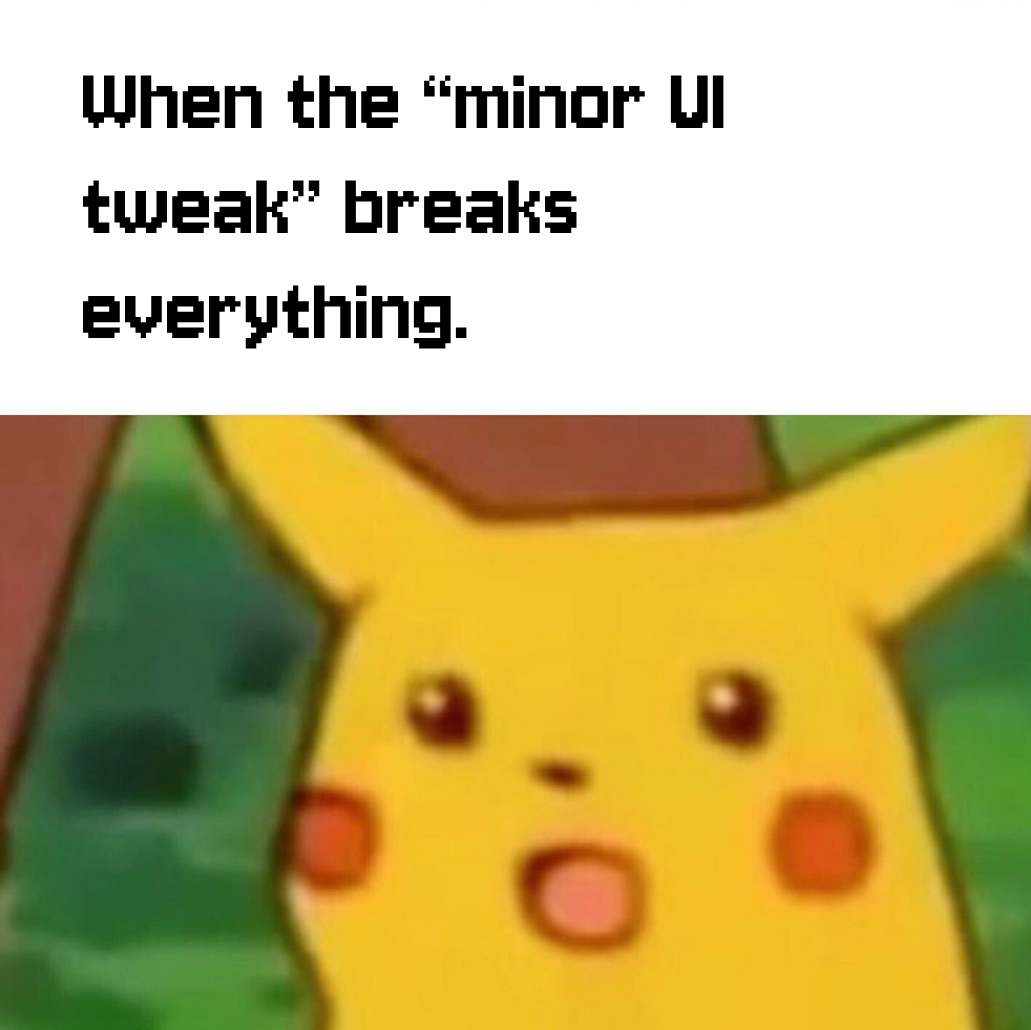
You fix a typo in a comment. One character. Maybe even just a period. Your CI/CD pipeline proceeds to run the entire test suite—1800 tests—because apparently we don't trust ourselves with punctuation anymore. You sit there, cigarette in mouth, watching the build logs scroll by like you're waiting for the heat death of the universe. The tests pass. Of course they pass. It was a comment. Comments don't execute. But here we are, 15 minutes later, having burned through enough compute cycles to mine half a Bitcoin, all to confirm that changing "teh" to "the" didn't break production.

Just Use AI For Everything Bros Hit Hard

Just Use AI For Everything Bros Hit Hard
So you stayed #1 on the AI leaderboard for a whole quarter? Congrats, here's your prize: existential dread and the realization that nothing matters anymore. The rapid descent from optimistic cartoon character to haunted Victorian photograph perfectly captures the soul-crushing journey of watching your "revolutionary AI startup" become just another commodity in an oversaturated market. Turns out slapping GPT-4 into your app and calling it "AI-powered" doesn't guarantee eternal dominance. Who knew? The burnout is real when you realize you're competing with 10,000 other companies doing the exact same thing, and the only differentiator is who can burn through VC money faster.

I Went All Out With This Feature

I Went All Out With This Feature
The holy trinity of developer excuses, ranked by confidence level. Algorithm: "I could explain it, but do you really have 3 hours and a whiteboard?" Translation: it works, don't touch it. Heuristic: "It's not a bug, it's a feature based on vibes and trial-and-error." You threw stuff at the wall until something stuck, and now you're calling it a strategy. Machine Learning: The ultimate get-out-of-jail-free card. Even the model doesn't know why it works. You trained it on some data, sacrificed a GPU to the tech gods, and now it spits out answers. Is it right? Maybe. Can you explain it? Absolutely not. But hey, it's "learning," so who are we to question the black box? Slap any of these labels on your code and suddenly you're not writing spaghetti—you're doing "advanced computer science."

How's The Job Search Going

How's The Job Search Going
Job hunting in tech: where you accidentally train the algorithm to think you hate every opportunity that exists. You dismiss one "Senior dotnet-ontwikkelaar" position because you don't speak Dutch, and suddenly the platform's like "noted, you clearly despise all backend roles forever." The real kicker? Half these jobs are probably the same role reposted by different recruiters, but you've now told the algorithm to hide ALL of them. Meanwhile, you're desperately refreshing the page wondering why there are no new postings. It's like playing whack-a-mole with your career prospects, except the moles are fighting back and winning. Pro tip: That "We won't show you this job again" button is basically a commitment ceremony. Choose wisely, because the job market isn't exactly overflowing with "AI-Driven Software Development Consultant" positions that you can afford to ghost.

SHOKZ OpenMove - Open-Ear Bluetooth Sport Headphones, Bone Conduction Wireless Earphones, Sweatproof for Running and Workouts, with Sticker Pack, Grey

SHOKZ OpenMove - Open-Ear Bluetooth Sport Headphones, Bone Conduction Wireless Earphones, Sweatproof for Running and Workouts, with Sticker Pack, Grey
Open-Ear Headphones - Experience unmatched comfort with our lightweight, secure fit, featuring an earbud-free design for all-day listening without ear fatigue.(Rebranded version of AfterShokz OpenMov…

Explaining Virtual Machines

Explaining Virtual Machines
When you're trying to explain VMs to non-technical folks and they just can't grasp the concept of running a computer inside a computer. So you show them this picture and suddenly everything clicks. It's literally a van inside a van inside a truck – virtualization at its finest. The hypervisor is doing some serious Inception-level work here. Props to whoever orchestrated this logistical nightmare just to make a perfect visual metaphor for nested virtualization. Docker containers would be like a backpack inside the van inside the van inside the truck.

But I Only Asked It To Fix Our Todos

But I Only Asked It To Fix Our Todos
Half a billion dollars. In one month. Because someone forgot to set API rate limits on Claude. You know that junior dev who kept asking Claude to "just refactor this one more time" and "maybe make it cleaner"? Yeah, turns out they were running it in a loop. For 30 days straight. On the company dime. Every tech lead's nightmare: giving the team AI access without proper guardrails. It's like handing out corporate credit cards at a Vegas buffet. Sure, the code probably looks pristine now, but was it worth the GDP of a small nation? Pro tip: Set. Usage. Limits. Or enjoy explaining to the CFO why your todo app cost more than a SpaceX launch.

That Could Have Been Me

That Could Have Been Me
You spend nights building that beautiful open source library, pour your soul into it, make it public for the good of humanity... and then some VC-backed startup just yoinks it, slaps a proprietary license on it, and suddenly they're swimming in cash while you're still debugging on a 2015 MacBook. The rage is real. That moment when you realize your MIT license was basically a "please monetize my work" invitation. Should've gone with AGPL, but hindsight is 20/20 and your GitHub stars don't pay rent. The guy punching the air perfectly captures that specific flavor of developer betrayal—not angry enough to sue (legal fees > your net worth), but definitely angry enough to passive-aggressively tweet about it at 3 AM.

The AI Said All Tests Pass And I Believed It

The AI Said All Tests Pass And I Believed It
Trusting AI-generated test results without verification is like believing your code works because it compiled successfully. Sure, the AI confidently declared "all tests pass," but did it actually write meaningful tests, or did it just check if true === true ? Meanwhile, production is literally on fire, but hey, the tests passed, right? The serene "this is fine" energy while everything burns around you perfectly captures that moment when you realize the AI's test coverage was about as thorough as testing a calculator app by only checking if it turns on. Trust, but verify—especially when your QA department is a large language model that thinks edge cases are just suggestions.

Loading I Think Funny Gift for IT Nerds Engineers T-Shirt

Loading I Think Funny Gift for IT Nerds Engineers T-Shirt
Are you a proud IT science nerd or geek? Computer hardware and software is your hobby? Are you obsessed with technical inventions in the computer industry or are you working in technical support? The…

A Count Is A Count, Right?... Right?

A Count Is A Count, Right?... Right?
Someone wrote a function called GetEmployeeCount that deletes all employees from the database, executes it, rolls back the transaction, and returns the result. Technically, ExecuteNonQuery() does return the number of affected rows, so you'd get your employee count. Just, you know, with a brief moment of existential terror for the entire database before the rollback kicks in. It's like counting how many people are in a room by kicking everyone out and seeing how many complained, then using a time machine to undo it. Sure, it works. But your DBA is going to have questions when they see those transaction logs.

Relatable Humor

Relatable Humor
Nothing quite like scrolling through programming memes and having a good laugh at jokes about merge conflicts, production bugs, and Stack Overflow dependency. Then you realize every single one is just a thinly veiled cry for help documenting your actual lived experience from yesterday. That forced smile while sipping coffee, nodding along like "haha yeah, semicolons am I right?" when you literally spent 6 hours debugging a semicolon yesterday and questioned your entire career path. We're all just collectively coping through memes at this point.

Documentation: Then Vs Now

Documentation: Then Vs Now
Reading someone else's documentation? Absolute pleasure. Clear explanations, helpful examples, beautifully structured. You're nodding along like "wow, they really thought of everything." But the moment you have to write docs for your own code? Suddenly you're staring into the void, questioning every life choice that led you here. What seemed crystal clear when you wrote it at 2 AM now feels like ancient hieroglyphics. "How do I even explain this function that does... uh... things?" The existential dread sets in as you realize future-you will be cursing present-you for this half-baked README. Pro tip: If your documentation just says "it works, trust me" you're doing it wrong. But also, we've all been there.

Server Vs. Zombies

Server Vs. Zombies
When the real horror isn't the undead horde breaking down your door, it's the thought of your dev server credentials getting leaked on some sketchy forum. Because nothing says "apocalypse" quite like having your staging environment exposed to the internet with admin/admin as the login. The zombies are being oddly polite about it though—at least they're giving you a heads up instead of just dumping everything on Pastebin. Professional courtesy among the undead, I guess. Still beats getting a Shodan alert at 3 AM because someone left port 3000 open to the world. Pro tip: If zombies can find your dev server, so can hackers. Maybe rotate those credentials before the next wave hits.