...And The Two Hard Problems

...And The Two Hard Problems
The famous Phil Karlton quote gets the Harry Potter treatment it deserves. "There are only two hard problems in computer science: cache invalidation and naming things" – but throw in "off by one errors" and you've got the holy trinity of developer suffering. Voldemort showing up as "I AM LORD VOLDEMORT" is chef's kiss because naming things is literally his entire villain origin story. The Deathly Hallows symbols representing the three problems? Brilliant. Because just like those magical artifacts, these problems will haunt you until the end of your career. Cache invalidation will make you question reality itself. Naming things will have you staring at a variable for 20 minutes. And off-by-one errors? They're why your loop always misses that last element or mysteriously crashes with an index out of bounds. The Elder Wand couldn't fix these even if it tried.

Status Codes Cortisol Level

Status Codes Cortisol Level
Your body's stress response mapped to HTTP status codes is painfully accurate. 200s and 404? Whatever, just another Tuesday. But those 4xx client errors and especially the 5xx server errors? That's when your heart rate spikes and you start questioning your career choices. Notice how 404 is basically chill - it's not your fault the user can't type a URL correctly. But 500? 503? That's YOUR code burning down in production while users are screaming and your phone won't stop buzzing. The 429 (Too Many Requests) sitting at medium stress is chef's kiss - you're getting hammered but at least your rate limiting is working as intended. The real kicker is 302 being low stress. Redirects just work, they're the reliable friend in the HTTP status family. Meanwhile 501 (Not Implemented) is maxing out because someone just discovered a feature you promised six months ago that doesn't actually exist yet.

Disable Mouse Click

Disable Mouse Click
You know your UI design is absolutely galaxy-brained when you need to use your mouse to click a checkbox that disables... mouse clicking. It's like putting the fire extinguisher inside the burning room and locking the door. The Windows 98 devs really sat in a meeting, looked at this dialog, and said "Ship it!" Nobody questioned the paradox. Nobody suggested maybe using a keyboard shortcut. They just went straight to lunch and left us with this beautiful monument to circular logic. It's the software equivalent of "Press any key to continue" when your keyboard is unplugged. Chef's kiss to the UX team on that one.

Just Read The F***ing Docs

Just Read The F***ing Docs
Oh, the beautiful journey from arrogant newbie to humble documentation reader! You start out thinking you're some kind of code whisperer who can just *divine* how everything works by staring at it intensely enough. "Docs are for stupid people," you declare with the confidence of someone who's never encountered a poorly-named function with 47 optional parameters. But then reality hits like a truck made of cryptic error messages, and suddenly you're on both sides of the bell curve, reluctantly admitting that yes, the docs are confusing, yes, they're written like they were translated through five languages by someone who hates you personally, but YES, you absolutely have to read them anyway because the alternative is spending six hours debugging something that's literally explained in paragraph three. The real kicker? Both the enlightened souls on the edges of the curve are suffering equally, just with different levels of self-awareness about their suffering. Welcome to programming, where RTFM isn't advice—it's a lifestyle.

Tmux My Beloved

Tmux My Beloved
You know you've ascended to a higher plane of existence when your terminal workflow goes from chaotic screaming to serene elegance. Before tmux, you're juggling 47 terminal windows, accidentally closing the one running your production deploy, and generally living in a state of panic. After tmux? You're splitting panes like a zen master, detaching sessions like you're Neo dodging bullets, and smugly watching your SSH connection drop while your processes keep running in the background. The transformation from terminal peasant to terminal aristocrat is real. You go from "wait which window was that in" to casually prefix-c'ing new windows while maintaining perfect composure. Your coworkers still using multiple terminal tabs? They wouldn't understand this level of enlightenment.

Let Him Cook

Let Him Cook
You know that moment when a Windows installer says "The wizard will now install your software" and you're like "wait, I didn't configure anything yet"? That's when you realize you're about to speedrun through 47 screens of settings you'll never get to customize. Gandalf here represents every developer who's ever frantically tried to stop an installer mid-flight because they forgot to uncheck "Install McAfee" or change the installation directory from C:\Program Files. The wizard doesn't wait for mere mortals. It installs when it's ready, not when YOU'RE ready. Also love how he's using a MacBook to deal with Windows installer problems. The irony is chef's kiss.

Someone's Not Going To Get A Seat On The Bus..

Someone's Not Going To Get A Seat On The Bus..
So someone ordered a "gaming chair" online and received what appears to be an actual bus seat with armrests. Not even a nice bus seat—we're talking the kind of public transit seating that's seen things you don't want to know about. The fabric pattern, the industrial gray padding, the utilitarian design... it's literally a seat ripped straight from public transportation. The seller probably thought "well, technically people DO sit on buses while gaming on their phones, so it counts as a gaming chair, right?" Peak marketplace logic. Somewhere out there, a bus is missing seat #47 and a developer is about to experience the worst posture of their debugging career. At least it's probably built to withstand the abuse of thousands of commuters, so it'll definitely survive a few rage quits.

THANDBLE Mac mini M4 Dock & Stand with 4K60Hz HDMI and DisplayPort, M.2 NVMe SSD Enclosure, 4 USB-A Ports, SD/TF Card Reader 9 in 1 Hub for Mac mini M4/M4 Pro - Silver

THANDBLE Mac mini M4 Dock & Stand with 4K60Hz HDMI and DisplayPort, M.2 NVMe SSD Enclosure, 4 USB-A Ports, SD/TF Card Reader 9 in 1 Hub for Mac mini M4/M4 Pro - Silver
【9 in 1 Multi-function Mac mini M4 Dock&Stand】THANDBLE solves the problem of insufficient ports exclusively for Mac mini M4, turning your host computer into a workstation by equipping 9 extra ports, …

Trust Me Its Mine

Trust Me Its Mine
When you're pair programming with an AI assistant and suddenly realize you need to claim credit for the code it just wrote. Nothing screams "totally my original work" like asking Claude to commit without attribution. The git history will just show your name, your commit message, your glory – while Claude sits there like an uncredited ghostwriter. It's the digital equivalent of copying your friend's homework but changing the font. Pro tip: at least use git commit --author="Claude <[email protected]>" if you want to keep your karma intact. But hey, who needs ethics when you've got that sweet, sweet green contribution graph to maintain?

Do Not Feed The Ouroboros

Do Not Feed The Ouroboros
So Claude opted you into their data sharing program to "make Claude better for everyone," then took one look at your code and immediately opted you back out. The AI literally reviewed your work and said "nah, we're good, please stop helping." The beautiful irony here is that if Claude is training on code generated by Claude, and your Claude-generated code is so bad they're rejecting it... they're basically admitting their own output isn't good enough to train on. That's the ouroboros eating itself right there—an AI model potentially poisoning its own training data with AI-generated garbage. Nothing says "quality code" quite like an AI company politely but firmly asking you to stop contributing to their dataset. It's like getting fired from being a volunteer.

Each Time The Arch Update Breaks, I'll Eat A Snack

Each Time The Arch Update Breaks, I'll Eat A Snack
Arch Linux users love to brag about running a bleeding-edge, minimalist distro that gives them ultimate control. The reality? Every sudo pacman -Syu is basically Russian roulette for your system. Graphics drivers? Gone. Display manager? Broken. Bootloader? Who knows, maybe it'll work tomorrow. The skinny guy represents the fantasy: a sleek, sophisticated power user with a perfectly tuned system. The reflection shows the truth: someone who's gained significant weight from stress-eating every time their system breaks after an update. Arch's rolling release model means you get the latest packages immediately, but also the latest bugs. No testing, no safety net, just pure chaos and snacks. Fun fact: The Arch Wiki is legendary for its documentation quality, which is ironic because you'll need to read it constantly to fix what broke this week.

Every Year This Tweet Becomes More And More Real

Every Year This Tweet Becomes More And More Real
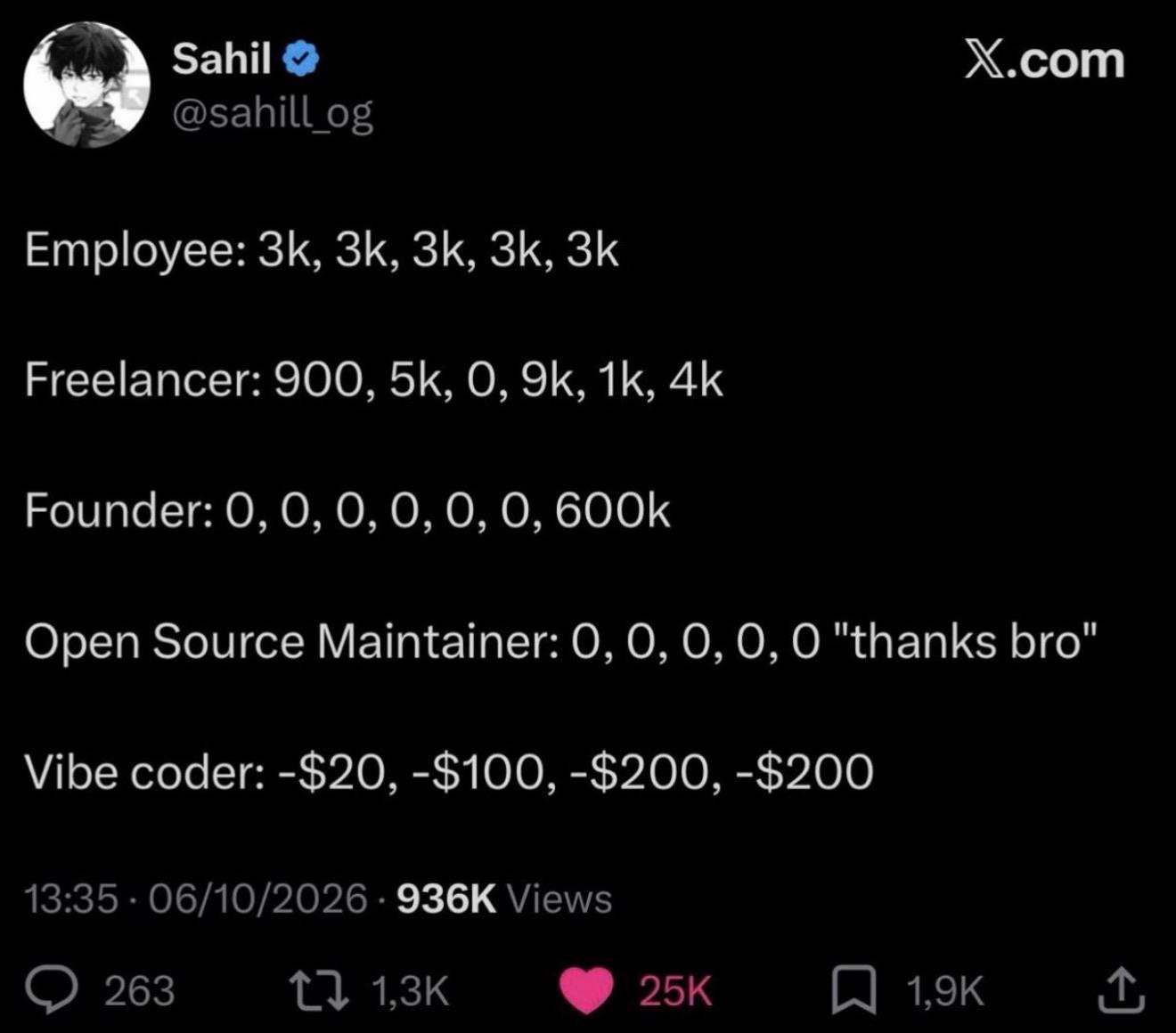
Turns out the real programming language was the documentation we read along the way. With AI code generation, low-code platforms, and frameworks so abstracted you're basically writing YAML configs, we've come full circle to just... describing what we want in plain English. Why learn Rust's borrow checker when you can just politely ask ChatGPT to fix your memory leaks? The industry's gone from "learn to code" to "learn to prompt engineer" faster than you can say "npm install." 11.4M views because everyone knows it's true but nobody wants to admit their job is becoming increasingly indistinguishable from talking to a very pedantic rubber duck.

Bro I Literally Told You This Is Not Good Idea

Bro I Literally Told You This Is Not Good Idea
You know that moment when your client insists on adding seventeen different features that completely contradict each other, and you're sitting there like "bestie, I promise you don't want this," but they're ADAMANT? And then you build exactly what they asked for because they're paying the bills, and suddenly the entire application is stuck in a tree, unable to move forward OR backward, just... existing in a state of pure architectural chaos? Yeah. That's what happens when you let users dictate technical decisions without any pushback. The developer tried to warn them, probably sent a whole essay in Slack about scalability concerns and user experience nightmares, but noooo—they wanted it THEIR way. Now look at this beautiful disaster, dangling precariously between branches of bad decisions and "but the user wanted it!" The app works, technically, but at what cost? AT WHAT COST?!