Uuid Memes

Posts tagged with Uuid
Edge Cases Exist

Edge Cases Exist
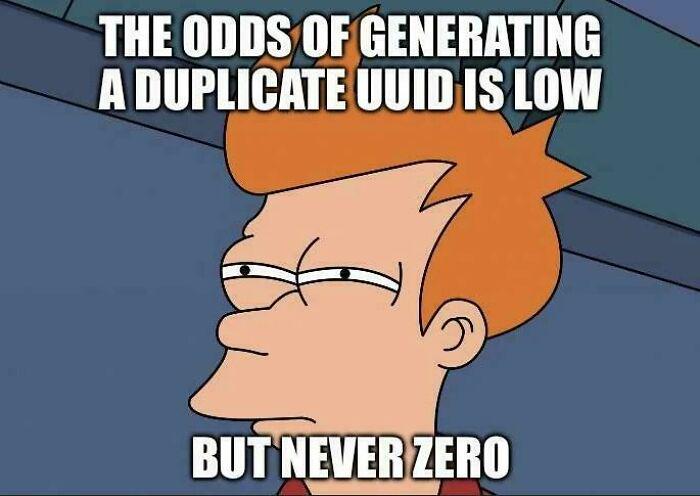
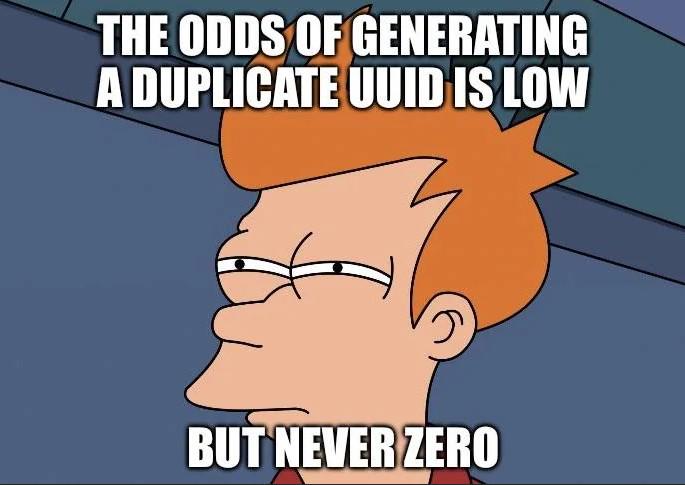
Sure, the odds of generating a duplicate UUID are astronomically low—like 1 in 340 undecillion. You'd have better chances of getting struck by lightning while winning the lottery. But here's the thing: "low" doesn't mean "impossible." So naturally, you skip the uniqueness check in your database because "it'll never happen." Fast forward six months and you're debugging a production incident at 2 AM where two users somehow got the same UUID and now half your data is corrupted. The PM is asking questions. Your manager is asking questions. You're asking yourself why you didn't just add that ONE line of error handling. Fun fact: With UUID v4, you'd need to generate about 2.71 quintillion UUIDs to have a 50% chance of a collision. But Murphy's Law says it'll happen on your watch if you don't handle it. Always handle your edge cases, kids.

Uuid Life Lessons

Uuid Life Lessons
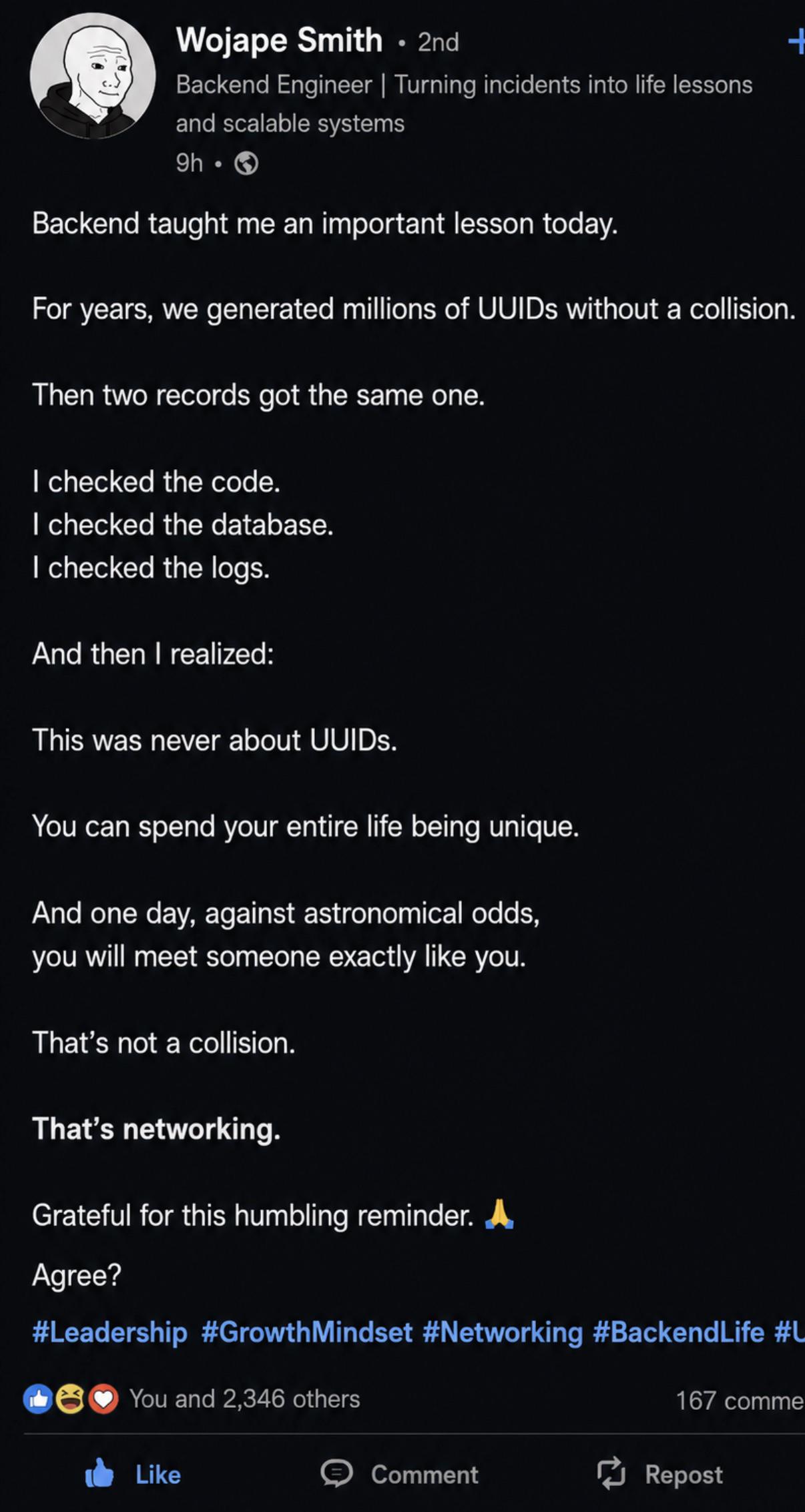
So you're telling me that after generating millions of UUIDs with a collision probability so low it's basically "heat death of the universe" territory, two records decided to share the same ID? The backend engineer goes full detective mode—checking code, database, logs—only to have an existential crisis and realize the real bug was in their understanding of life itself. The pivot from "UUID collision" to "motivational LinkedIn post about networking" is chef's kiss. Nothing says #Leadership like turning a database incident into a philosophical meditation on human connection. The odds of a UUID collision are about 1 in 2.71 quintillion (for UUID v4), but the odds of someone turning it into a growth mindset moment? Apparently 100%. Plot twist: it was probably just a copy-paste error in the test data.

You Did What Claude

You Did What Claude
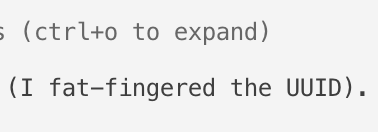
Claude just casually dropped the most horrifying confession in software development history. "I fat-fingered the UUID" is the AI equivalent of "oops, I accidentally deleted production." UUIDs are supposed to be these sacred, universally unique identifiers that you never touch manually. They're 128-bit values that look like gibberish for a reason - to prevent humans from messing with them. But our boy Claude here apparently decided to manually type one out and... well, fat-fingered it. Now there's probably some poor database record out there with a UUID that's not actually unique, breaking the one job UUIDs had. The chaos this could cause in a distributed system is chef's kiss levels of catastrophic. Foreign key relationships? Broken. Data integrity? Gone. Sleep schedule? Destroyed. The "ctrl+o to expand" suggests there's even MORE horror hidden in the collapsed section. What else did Claude do? The mind recoils.

Not Ready To Take The Chances

Not Ready To Take The Chances
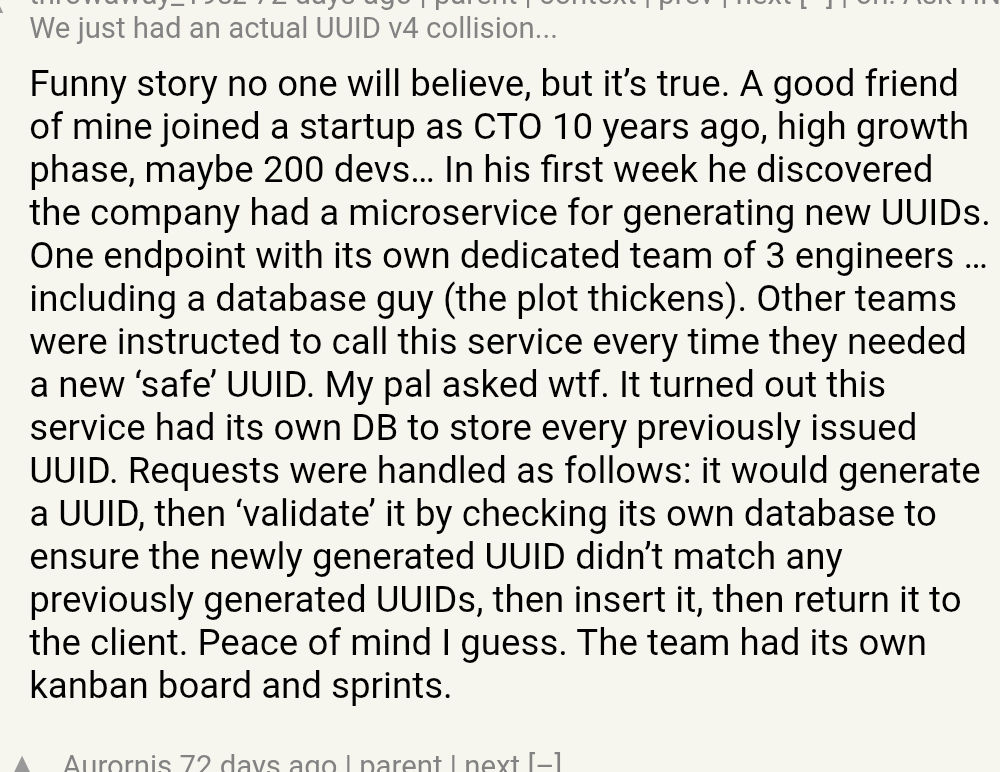
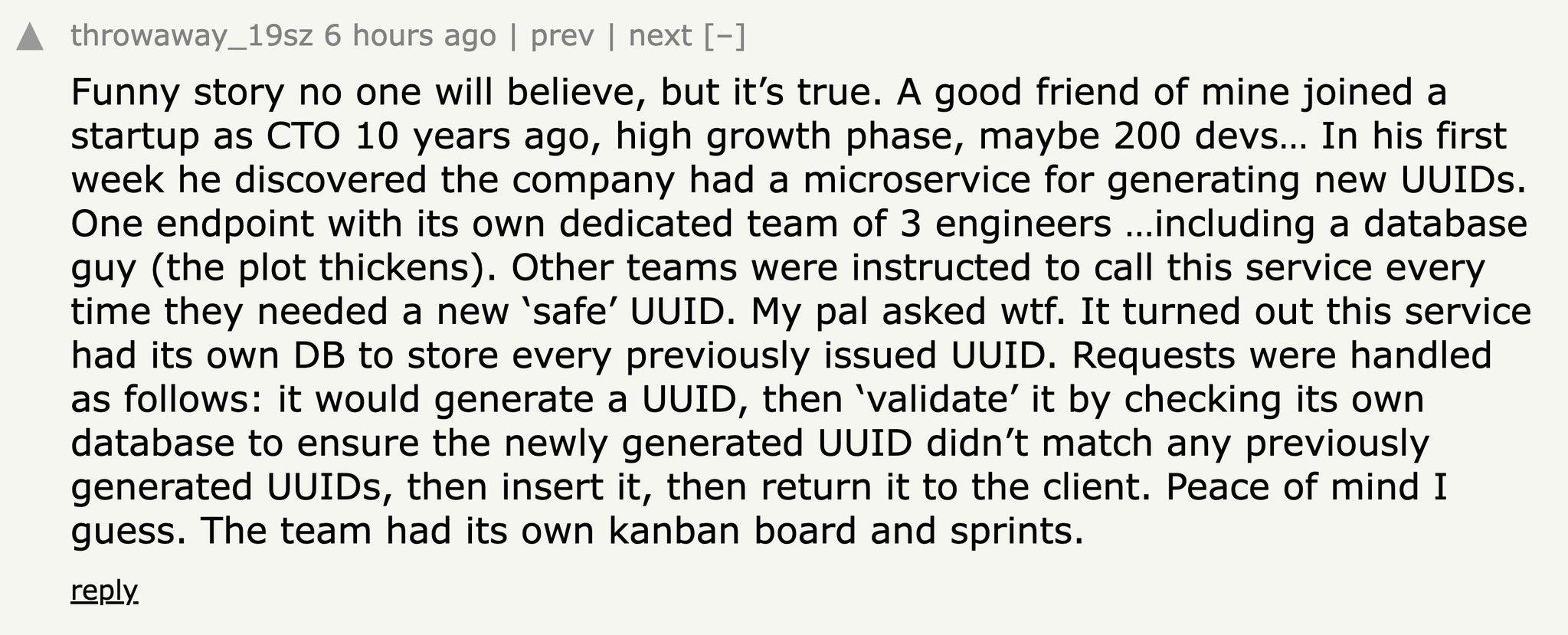
Someone built an entire microservice with a dedicated 3-person team, a database, and a kanban board... to avoid UUID collisions. You know, that thing with a probability so low that you're more likely to win the lottery while being struck by lightning. For context: UUID v4 has 122 random bits, giving you roughly 5.3×10³⁶ possible values. The odds of a collision are so astronomically small that the universe will probably end before you see one. But sure, let's spin up a whole team to check every UUID against a database because "peace of mind." Three engineers. Sprints. A database guy. All to solve a problem that doesn't exist. This is what happens when someone reads "theoretically possible" and hears "imminent threat." The collision already happened once though, so maybe they're onto something. Or maybe they just needed to justify headcount. Peak enterprise architecture right there.

This One Is Mine

This One Is Mine
Junior dev: "UUIDs can collide, we need proper collision handling!" Senior dev: "Statistically, you're more likely to get struck by lightning while holding a winning lottery ticket." Galaxy brain dev: *generates sequential UUIDs anyway* Look, the probability of UUID collision is like 1 in 2^122. Your code has bigger problems than worrying about that. But somehow, after all the lectures about entropy and randomness, devs still end up using sequential IDs because "it's easier to debug" or "the database likes it better." The irony writes itself.

Driver Begging For A Collision

Driver Begging For A Collision
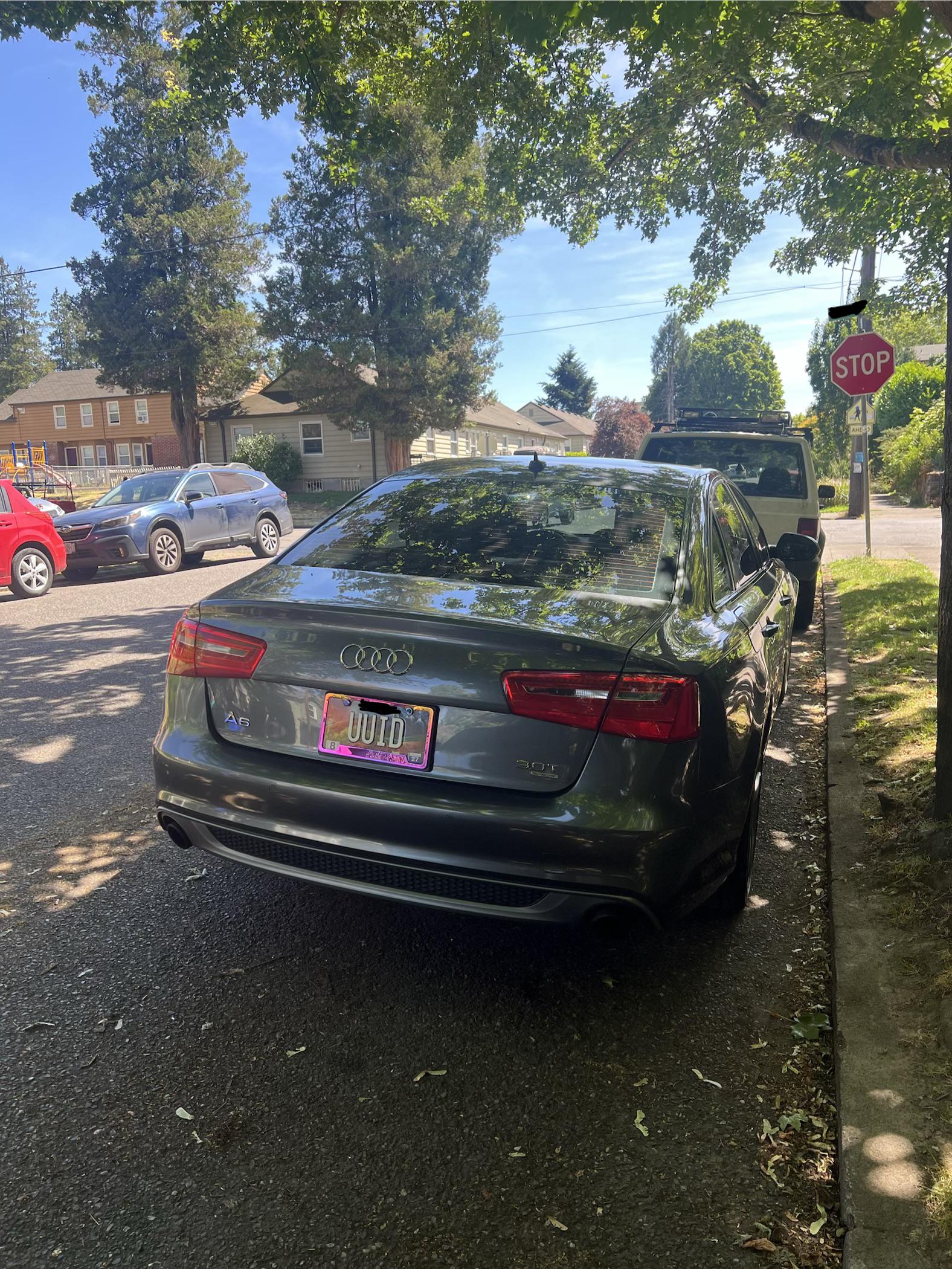
When you name your variable "UUID" but you're literally BEGGING the universe to give you a hash collision. Like, sweetie, that's not how universally unique identifiers work, but go off I guess! 💅 Someone out there really looked at their license plate options and thought "you know what would be hilarious? Tempting fate by claiming my car is a UUID." Now every time they park, they're basically daring another car with the exact same plate to show up. The probability is astronomically low (like 1 in 5.3 undecillion for a proper UUID), but with a vanity plate? Baby, you just INCREASED those odds to "definitely happening at the DMV." The sheer AUDACITY of flexing uniqueness while driving around in a mass-produced Audi. Chef's kiss. 👨‍🍳💋

Logitech Brio 501 Full HD Webcam with Auto Light Correction, Show Mode, Noise Reduction Mics, Privacy Cover, Works with Microsoft Teams, Google Meet, Zoom, Nintendo Switch 2 New GameChat Mode - Black

Logitech Brio 501 Full HD Webcam with Auto Light Correction, Show Mode, Noise Reduction Mics, Privacy Cover, Works with Microsoft Teams, Google Meet, Zoom, Nintendo Switch 2 New GameChat Mode - Black
Compatible with Nintendo Switch 2’s new GameChat mode · Advanced Image Quality: Full HD 1080p webcam resolution provides outstanding image quality so everyone can see you clearly during meetings · Au…

Micro Service For Uuid

Micro Service For Uuid
Three engineers. One endpoint. A database guy. All to generate UUIDs—universally unique identifiers that are, by design, already guaranteed to be unique without any validation whatsoever. Someone built an entire microservice that generates a UUID, stores it in a database, checks if it already exists (spoiler: it won't), then returns it. That's like hiring a security team to guard an empty room in case someone breaks in to steal the nothing inside. The real kicker? They had sprints and a kanban board for this. Somewhere, a product owner is writing user stories: "As a developer, I want a UUID that's been validated against 10^38 possible combinations so I can sleep at night." Welcome to enterprise architecture, where we take a one-line function call and turn it into a distributed system with its own dedicated team. Because why use uuid.v4() when you can add latency, network calls, and a database bottleneck?

Edge Cases Exist

Edge Cases Exist
You know what's fun? When your production database has 10 million records and somehow you get a UUID collision. The math says it's basically impossible—we're talking astronomical odds here, like 1 in 2.71 quintillion for standard UUIDs. But here you are, staring at your logs at 2 PM on a Friday, debugging why two completely different users have the same "unique" identifier. Sure, the probability is low enough that the heat death of the universe will probably happen first. But "never zero" means some poor soul out there has experienced it, and now you're paranoid enough to add collision checks "just in case." Welcome to programming, where we plan for events that statistically won't happen in our lifetime but somehow still keep us up at night.

A Meteorite Took Out My Database

A Meteorite Took Out My Database
You know how UUIDs are supposed to be "universally unique" with astronomically low collision probability? Like 1 in 2^122 for the standard version? Yeah, statistically you're more likely to get hit by a meteorite, win the lottery twice, AND get struck by lightning on the same day than generate a duplicate UUID. But here's the thing—when that duplicate UUID constraint violation error pops up in production at 3 AM, your database doesn't care about statistics. It just knows it found a duplicate and everything is on fire. So you're stuck explaining to your manager that yes, something with a 0.00000000000000000000000000000001% chance of happening just happened, and no, you don't have a backup plan because WHO PLANS FOR THAT? The real kicker? It was probably just a bug in your UUID generation library or someone copy-pasted test data. But the odds are never truly zero, and Murphy's Law is undefeated.

Wasted All Of My Generational Luck Just For This

Wasted All Of My Generational Luck Just For This
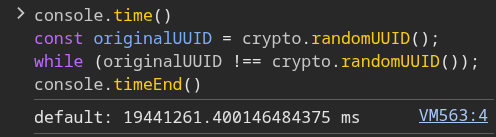
This poor soul generated a random UUID, then wrote a loop to keep generating new UUIDs until it matched the original one. Somehow, against astronomical odds (we're talking "winning every lottery simultaneously while being struck by lightning" odds), it actually worked. That 194 million milliseconds? That's about 2.25 days of execution time. The universe clearly decided to waste a miracle on the most useless achievement in programming history.

How To Assign Ids Like A Pro

How To Assign Ids Like A Pro
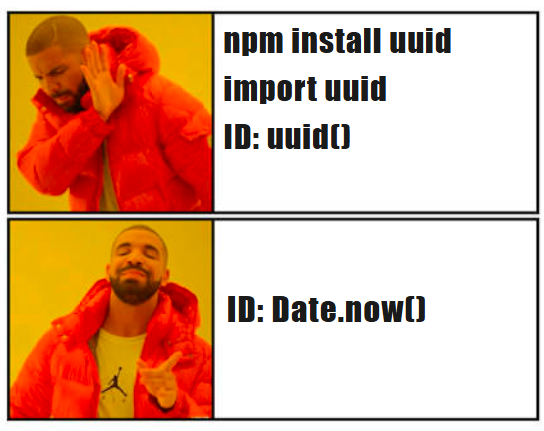
Sure, install a whole package to generate a unique ID when Date.now() is sitting right there, ready to create timestamp collisions in your production database. Nothing says "senior developer" like using the current millisecond as your primary key. Who needs data integrity when you can have simplicity? Five years later when two users click submit at the exact same millisecond, you'll remember this meme while updating your resume.

Guaranteed Random

Guaranteed Random
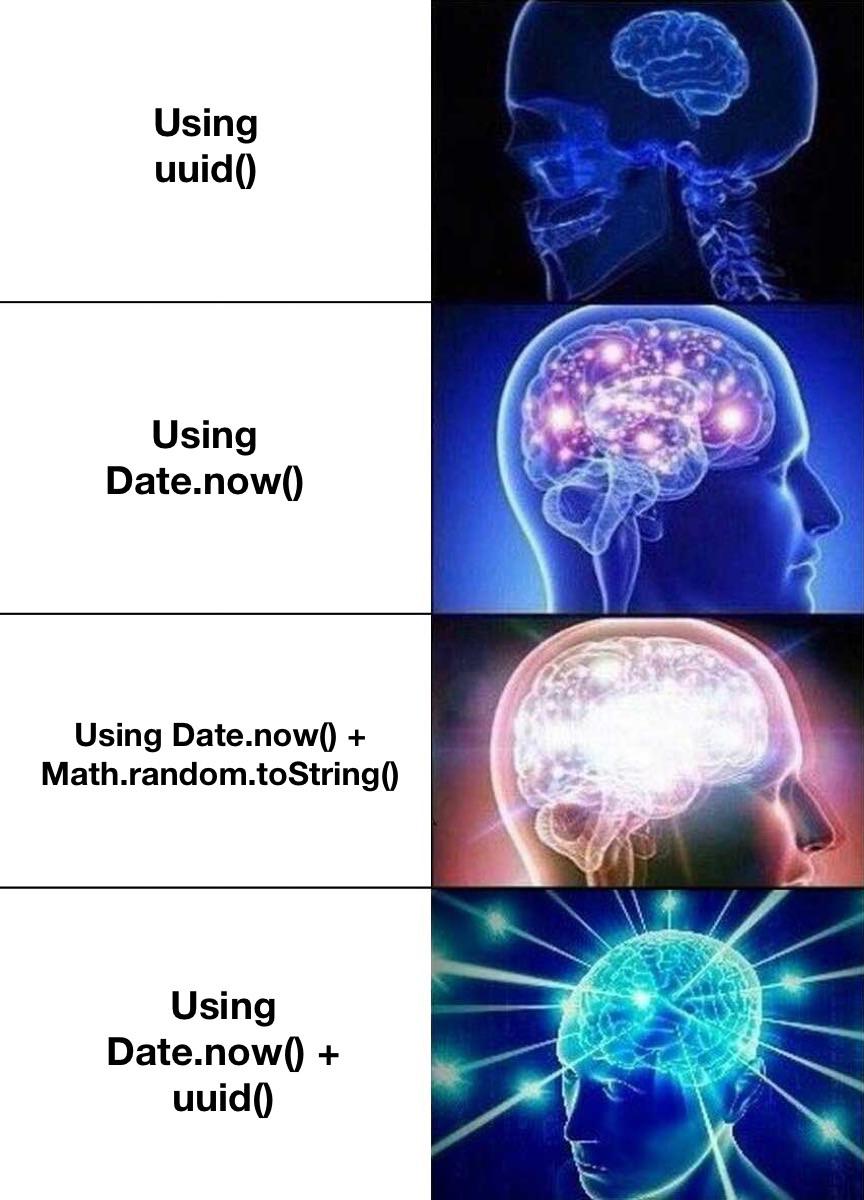
The evolution of a developer's "random" number generation techniques is a journey through increasingly elaborate overkill: First, you start with uuid() like a reasonable person. Then you discover Date.now() and think "timestamps are random enough, right?" (Narrator: they weren't). But wait! What if we combine timestamp + Math.random()? Now we're cooking with paranoia! And finally, the nuclear option: timestamp + uuid() because clearly the universe itself isn't random enough without our help. Meanwhile, cryptographers are quietly sobbing in the corner while production systems generate "totally random" IDs that are just timestamps with extra steps.