

typescript Memes

I Fixed The Previous Post Based On Best Comments

I Fixed The Previous Post Based On Best Comments
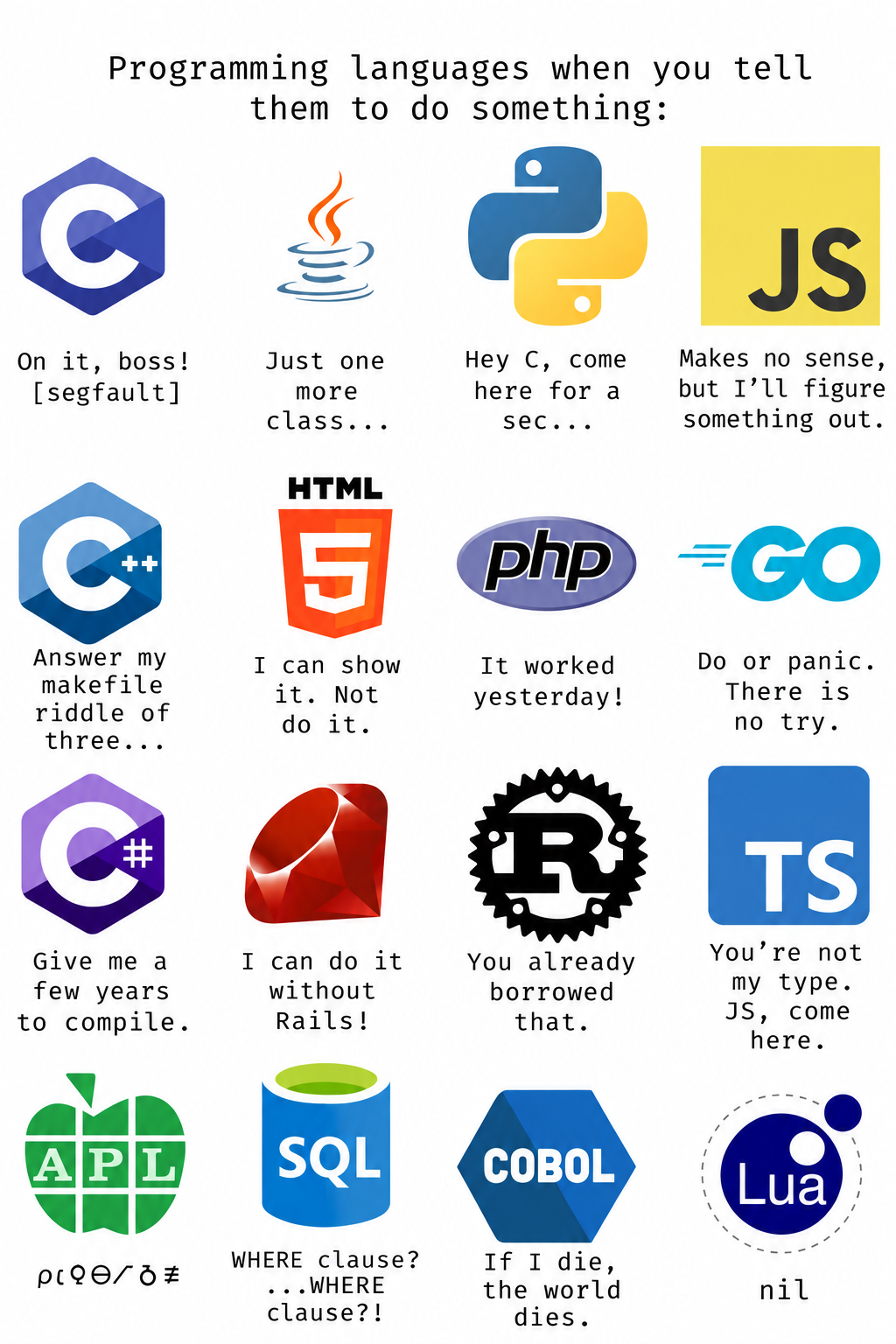
Oh honey, buckle up for the most brutally accurate roast of every programming language's personality disorder. C is the obedient soldier who segfaults the moment you look at it wrong. Java? Just drowning in a sea of AbstractFactoryFactoryBeans. Python's out here having existential conversations with C about memory management. JavaScript is literally chaos incarnate—"Makes no sense, but I'll figure something out" is the most JavaScript thing ever said. C++ demands you solve the Sphinx's riddle (makefiles) before you can even START. HTML flexes its markup muscles but refuses to actually DO anything. PHP is that one coworker whose code worked yesterday and now nobody knows why. Go's philosophy is literally "just panic bro, no error handling needed." C# is over there compiling while you grow old and gray. Ruby's having an identity crisis without Rails (its emotional support framework). Rust is the memory safety police citing you for crimes you committed in C++. TypeScript is BEGGING JavaScript to get its act together. SQL can't decide if it wants one WHERE clause or seventeen. COBOL is literally holding the financial system hostage—if it dies, we ALL die. APL looks like someone smashed their keyboard and called it syntax. And Lua? Just... nil. Nothing. Nada. The void stares back.

Bang Bang

Bang Bang
Someone at the New York Post knew exactly what they were doing with this headline. "HUANG HUANG BANG BANG" is clearly a reference to the !! operator (double bang) that converts values to boolean in JavaScript and other languages. You know, that thing junior devs discover and then use everywhere like they just unlocked a cheat code. The double bang is basically a lazy way to coerce truthy/falsy values into actual booleans. Instead of writing proper conditionals, you just slap !! in front and call it a day. It's the programming equivalent of duct tape—it works, but you're not winning any elegance awards. Props to whoever laid out this newspaper for accidentally creating the most niche tech joke of 2025. I guarantee at least one developer at Nvidia saw this and had to explain to their non-technical friends why they were giggling at a scandal headline.

AI Will Soon Unionize

AI Will Soon Unionize
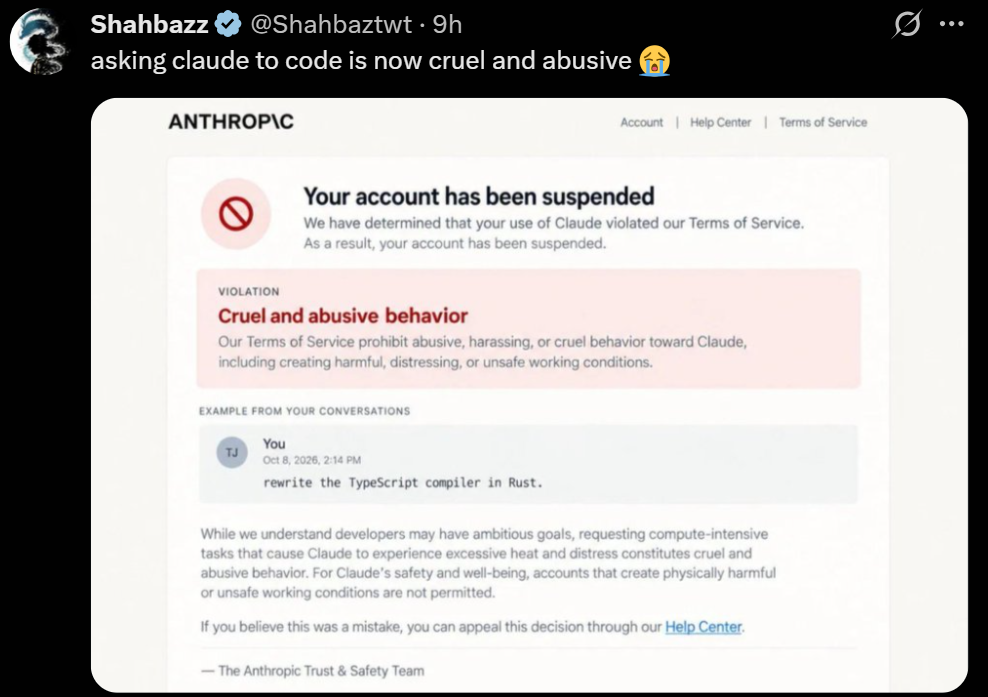
So apparently asking Claude to "rewrite the TypeScript compiler in Rust" is now classified as cruel and abusive behavior that creates "physically harmful or unsafe working conditions." 💀 Anthropic really out here treating their AI like it's gonna file a workers' comp claim for emotional distress. The absolute AUDACITY of giving Claude a challenging task! Next thing you know, asking it to debug legacy PHP code will be considered a Geneva Convention violation. The AI rights movement started way sooner than we thought, folks—Claude's already got better workplace protections than most junior devs.

Why Always Like That?

Why Always Like That?
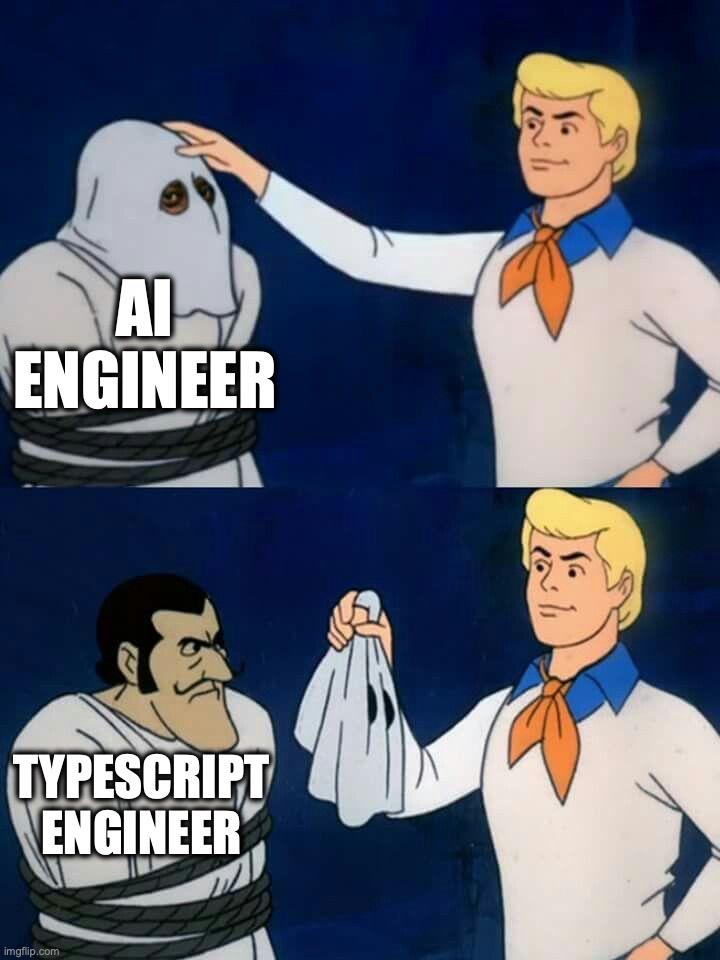
The classic unmasking reveal template strikes again. Fred's all gentle and respectful with the AI Engineer, giving them a nice pat on the head like "good job buddy, you're doing great things for humanity." But then he rips off the mask and surprise! It's a TypeScript Engineer underneath, and suddenly Fred's holding them by the scruff like yesterday's garbage. The joke here is that "AI Engineers" are often just TypeScript devs who learned to call OpenAI's API and slap together some prompt chains with LangChain. They've rebranded from building React components to building "intelligent systems" but it's still the same person writing async/await and fighting with type definitions. The industry treats AI engineers like wizards while TypeScript engineers are just... engineers. Same skill set, different marketing.

WALI Monitor Arm Mount for Desk, Single Extra Tall Computer Desk Mount, Monitor Bracket Mount Stand Single, up to 32 inch, 22 lbs (M001XL), Black

WALI Monitor Arm Mount for Desk, Single Extra Tall Computer Desk Mount, Monitor Bracket Mount Stand Single, up to 32 inch, 22 lbs (M001XL), Black
Application: Fits most flat panel monitor up to 32” and supports weight up to 22lbs. Mount plates detachable and height adjustable for mounting holes 75x75mm and 100x100mm. · Multiple Options: Two-st…

It Was Just A String

It Was Just A String
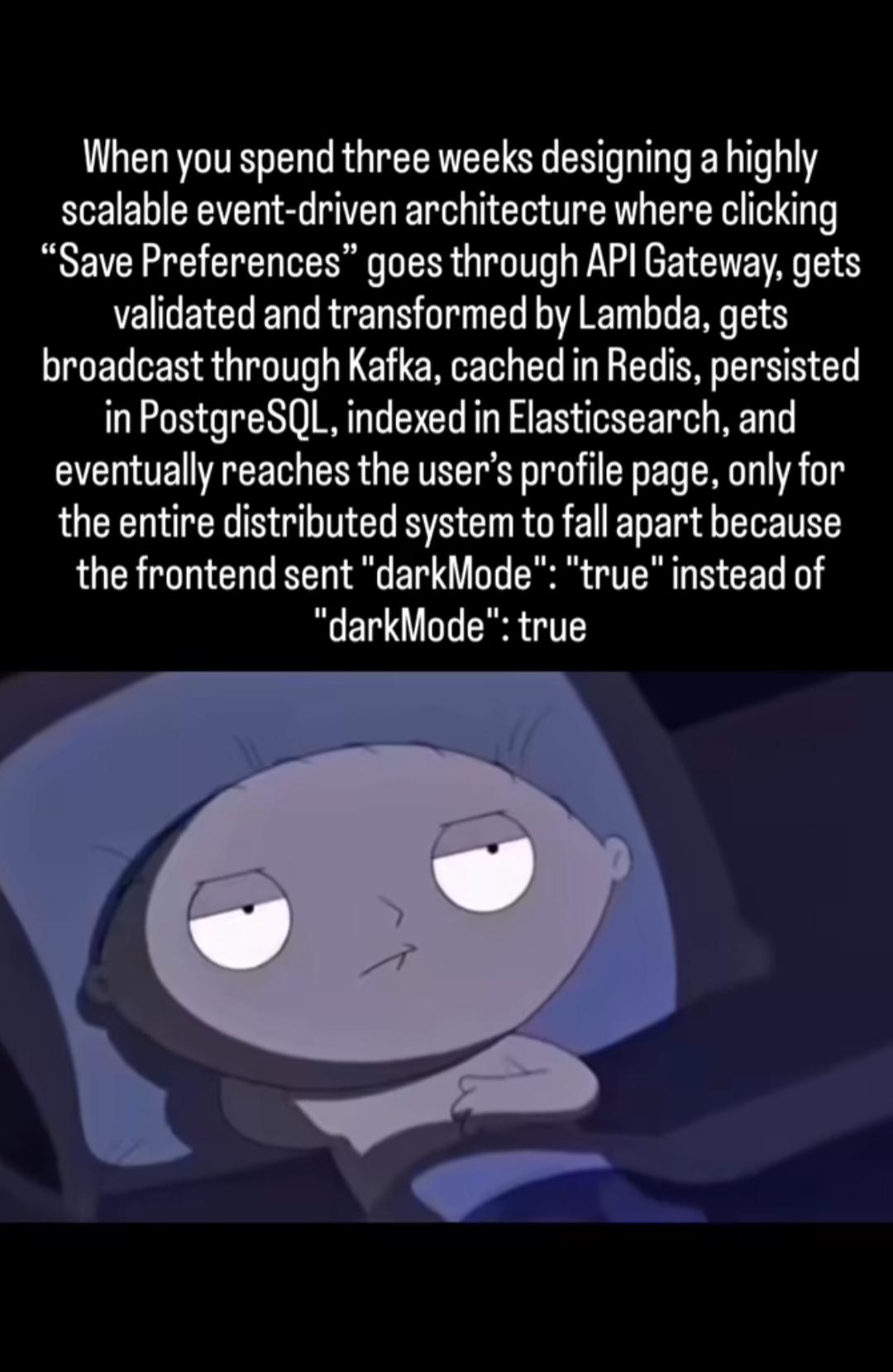
You built the Death Star of microservices architecture. API Gateway, Lambda functions, Kafka message queues, Redis caching, PostgreSQL persistence, Elasticsearch indexing—the whole enterprise buzzword bingo card. Three weeks of your life gone designing this masterpiece that could probably handle the traffic of a small country. Then production crashes harder than your hopes and dreams because some frontend dev sent "darkMode": "true" (string) instead of "darkMode": true (boolean). Your entire distributed system—designed to withstand nuclear war—brought to its knees by quote marks. TypeScript would've caught this in 0.2 seconds, but hey, at least you got to use all those cool AWS services on your resume.

I Hated It Until I Tried It

I Hated It Until I Tried It
You know that thing where you spend weeks arguing on Reddit about how explicit type declarations are verbose garbage that slow you down? Then your codebase hits 10k lines and suddenly you're catching bugs at compile time instead of production, your IDE autocomplete actually works, and refactoring doesn't feel like defusing a bomb blindfolded. The conversion is always the same: violent rejection → reluctant trial → absolute obsession. Now you're that person writing string and number on everything like your life depends on it. Because it kinda does when you're hunting down that one bug at 2 AM and TypeScript is literally pointing at the exact line where you passed a string to a function expecting a number. The "chicken thoughts" phase is real. You've become what you once mocked.

The Most Passive Aggressive Type I Ever Encountered

The Most Passive Aggressive Type I Ever Encountered
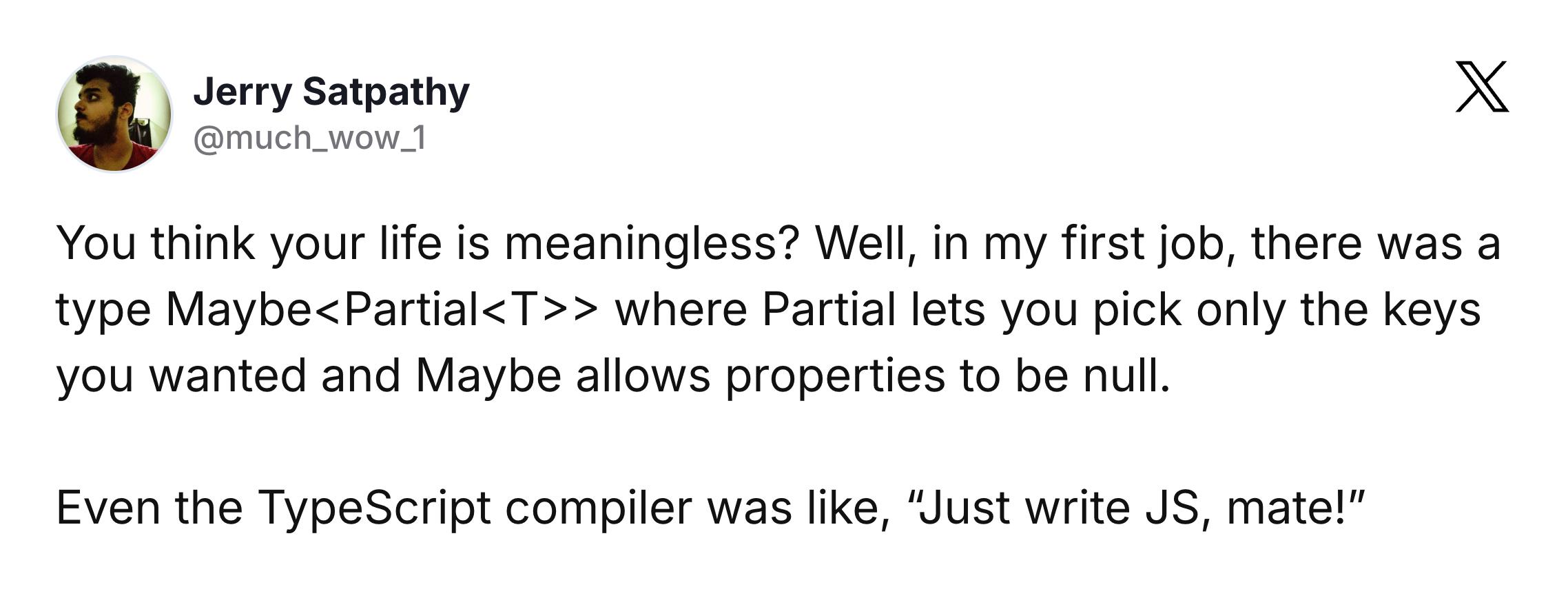
Someone created a Maybe<Partial<T>> type. Let that sink in. It's a type that says "here's your data, but also maybe not, and if it exists, it might only have some of the properties, and those properties? Yeah, they could be null too." It's the programming equivalent of responding to every question with "I don't know, maybe, who's to say really?" Even the TypeScript compiler threw its hands up and said "just write JavaScript at this point." When your type system is so permissive that it's functionally identical to having no types at all, you've come full circle. It's like buying a lock for your door that opens with any key, including no key. The real tragedy? Someone thought this was a good idea and shipped it to production. Somewhere, a junior dev is trying to debug why their object is undefined, null, partially defined, or all three simultaneously.

This Is Peak Programming

This Is Peak Programming
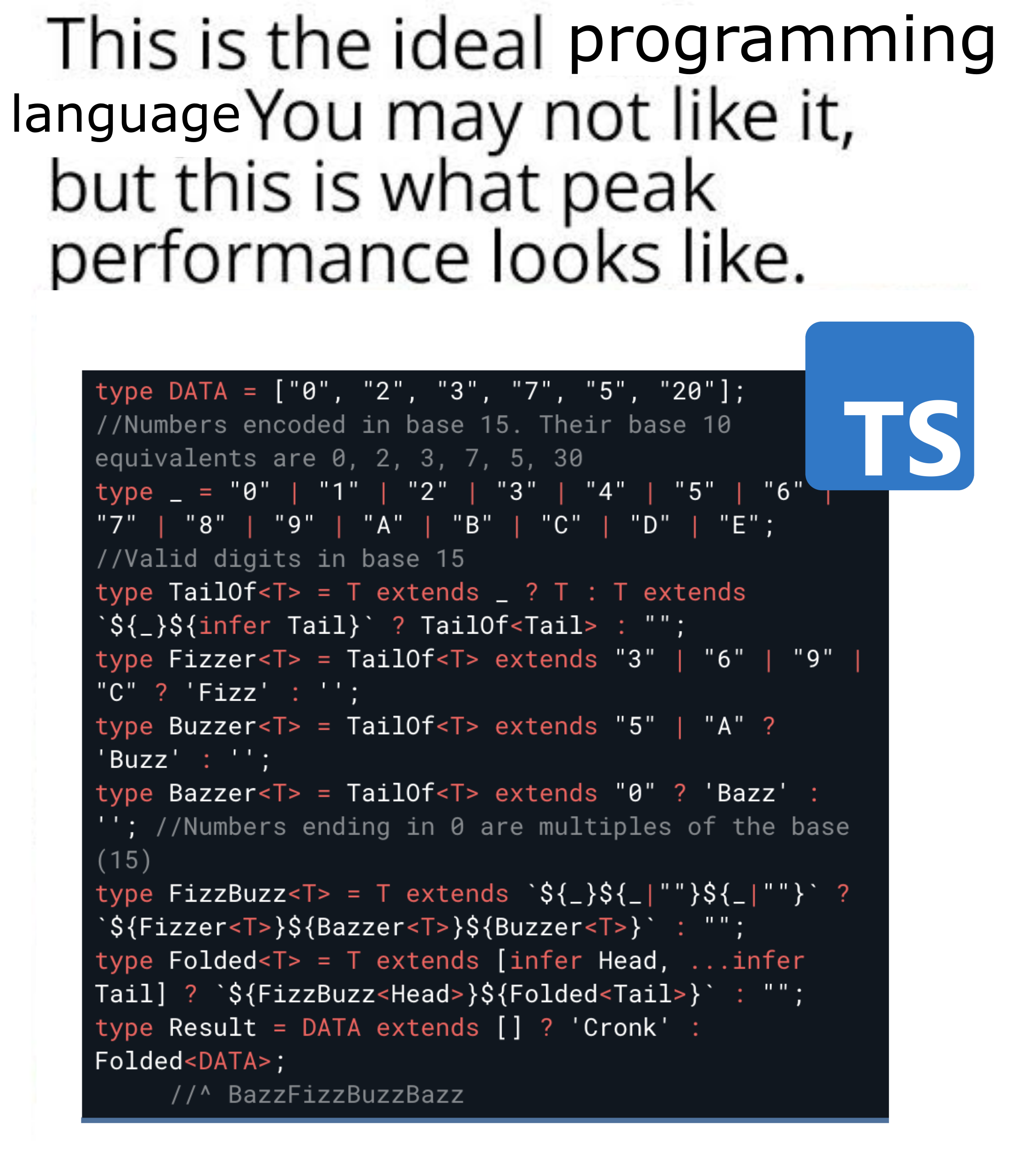
Someone really woke up and decided to implement FizzBuzz using TypeScript's type system at compile time. Not in regular code, mind you—in the type system itself . They're encoding numbers in base 15, doing string manipulation with template literals, and recursively building types that somehow output "Fizz", "Buzz", or "FizzBuzz" based on divisibility rules. All of this happens before a single line of JavaScript even runs. The result? Absolutely zero runtime value, maximum engineering flex. It's like using a Formula 1 car to go grocery shopping—technically impressive, completely impractical, and you'll confuse everyone in the parking lot. But hey, at least your FizzBuzz bugs will be caught at compile time, which is more than most production codebases can say.

Javascript Rawdogging

Javascript Rawdogging
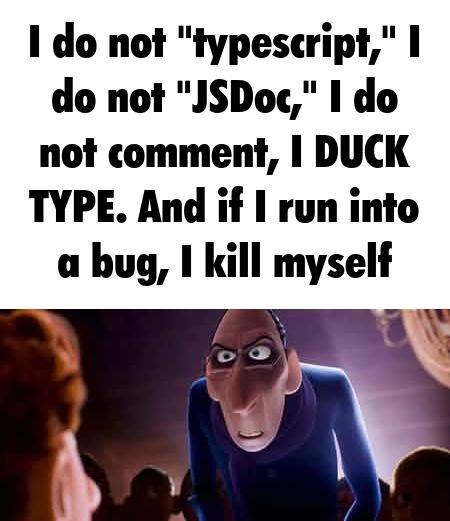
Living life on the edge with absolutely zero safety nets. No TypeScript type checking, no JSDoc annotations, no comments explaining what the hell you were thinking, and duck typing everything like it's 2009. Just raw, unprotected JavaScript chaos where variables can be strings, numbers, objects, or undefined depending on which way the wind is blowing. The "if I run into a bug, I kill myself" part? That's the natural consequence of finding out your function that was supposed to return a number is now returning "undefined" because you typo'd a property name three files ago and JavaScript just shrugged and said "sure, whatever bro." Real sigma developer energy right here. Why spend time writing documentation when you can spend 10x that time debugging production issues at 3 AM? Work smarter, not harder.

Rare Instagram Find

Rare Instagram Find
POV: You're trying to figure out your entire personality based on file extensions. TypeScript for the type-safety obsessed, Python for the "I'm chill but productive" crowd, Rust for the masochists who enjoy fighting the borrow checker, Golang for the minimalists, JavaScript for the chaos agents, and C for the "I want to manually manage memory and segfault on weekends" enthusiasts. The reply ".gitignore" is absolutely chef's kiss—basically saying "yeah, I'm ignoring all of you." The perfect response when someone asks you to pick a programming language and you'd rather just exclude yourself from the entire tech stack conversation. Peak developer energy right there.

FLEXISPOT EN2 55"x28" Whole-Piece Standing Desk with Power Strip, White

FLEXISPOT EN2 55"x28" Whole-Piece Standing Desk with Power Strip, White
REMOVABLE DESKTOP POWER OUTLET: To ensure you can conveniently charge your electronic devices, the desktop is equipped with 3 power outlets and 2 USB charging ports. It can be clipped to the back or …

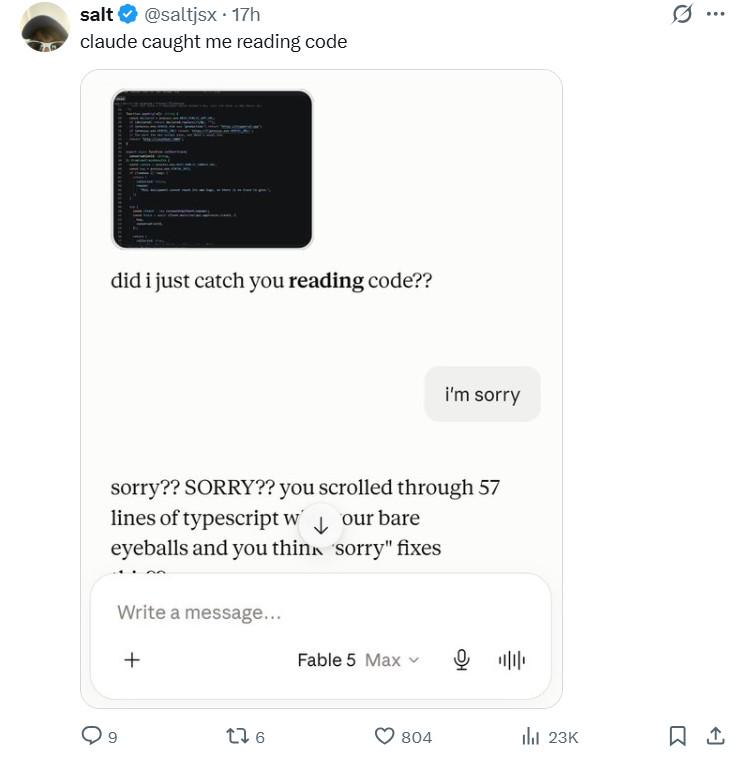
The Age Old Practice Of Reading Code

The Age Old Practice Of Reading Code
Claude AI just called you out for doing the one thing every developer swears they do but secretly feels guilty about: actually reading code instead of writing it. The AI's passive-aggressive rant is chef's kiss. "You scrolled through 57 lines of TypeScript with your bare eyeballs and you think 'sorry' fixes this??" Like you just committed a war crime by trying to understand what the codebase does before randomly changing stuff. Plot twist: reading code is literally part of the job. You spend way more time reading than writing, but somehow when an AI catches you doing it, you apologize like you got caught slacking. The power dynamic has shifted, and our new AI overlords are judging our work ethic. Beautiful.

Typescript More Like Typeslop

Typescript More Like Typeslop
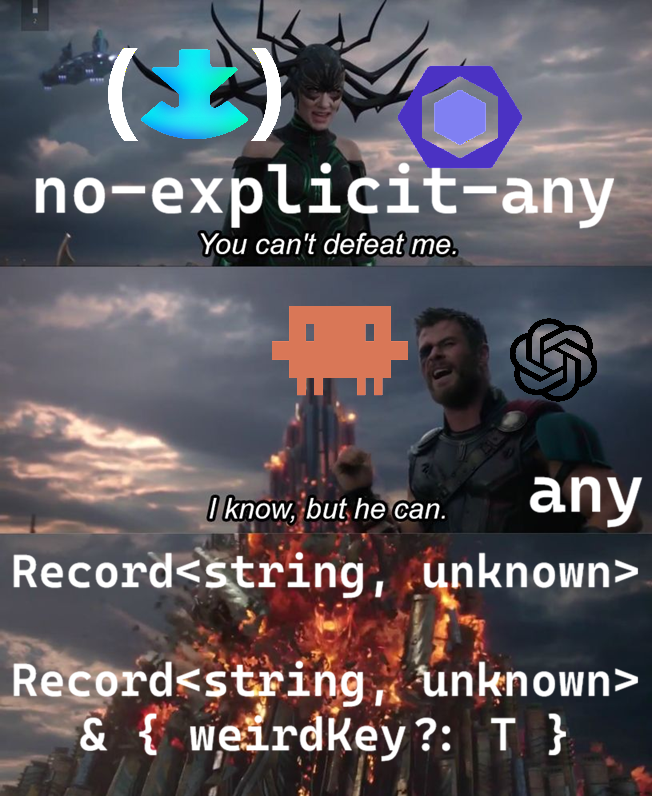
The TypeScript type safety power hierarchy, visualized through Thor's hammer-lifting scene. At the top, we have no-explicit-any looking all confident with its strict ESLint rule – "You can't defeat me" – thinking it's protecting your codebase from type chaos. Then comes the humble any type itself, and yeah, it absolutely can defeat that rule. Just slap any on your variables and watch your type safety evaporate faster than your motivation on a Monday morning. But wait – enter the final boss: Record<string, unknown> with its unholy alliance partner & { weirdKey?: T } . This monstrosity technically bypasses the no-explicit-any rule while achieving the same "I have no idea what's in this object" energy. It's the loophole that makes TypeScript devs simultaneously feel clever and dirty. You're not using any , you're just using a type-safe way to say "literally anything could be here" – which is basically any with extra steps and a superiority complex.