Test coverage Memes

Posts tagged with Test coverage
Mock Frontend Newbie Jobs

Mock Frontend Newbie Jobs
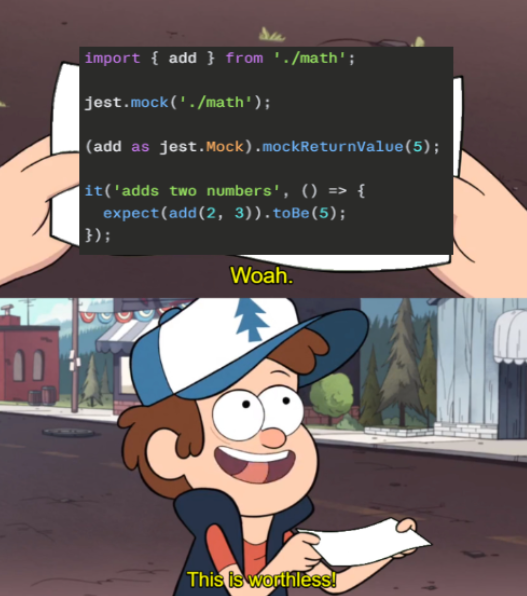
Junior dev discovers Jest mocking and suddenly thinks they're a testing god because they made 2+3=5 pass by... mocking the math module. Yeah, let's just mock away the entire function we're supposed to be testing. What's next, mocking the test itself? This is peak "I wrote tests" energy without understanding that mocking add to return 5 when testing if add(2, 3) equals 5 is like bringing your own answer key to an exam. You're not testing your code, you're just... lying to yourself with extra steps. The hiring manager looking at this portfolio is having a Dipper Pines moment realizing this "100% test coverage" is completely worthless. But hey, at least the tests are green! 🎉

Happens A Lot

Happens A Lot
You spent three weeks writing tests, achieving that beautiful 100% coverage badge, feeling invincible. Then some user types "🎉" in the name field and your entire application implodes like a dying star. Turns out your tests never considered that humans are chaos agents who will absolutely put emojis, SQL injections, and the entire Bee Movie script into a field labeled "First Name." 100% test coverage just means you tested 100% of what you thought could happen, not what actually happens in production.

A Big Refactor For A Big Piece Of Shite

A Big Refactor For A Big Piece Of Shite
Nothing says "professional integrity" quite like pretending your Frankenstein's monster of a codebase is actually a beautiful, well-architected masterpiece. You know the drill: 5 million lines of spaghetti code that nobody dares touch, test coverage so low it might as well be negative, 120 CVEs screaming for attention, and documentation? What documentation? But the moment that sales call starts, you transform into the world's most enthusiastic product evangelist. "I love this product!" you declare with the confidence of someone who definitely didn't spend last week crying into their keyboard while trying to trace a bug through 47 nested if-statements. The duality of being a technical expert is truly chef's kiss. Internally, you're one refactor away from burning it all down and starting fresh. Externally, you're selling it like it's the Second Coming of Clean Code. The customer will never know that behind your calm, professional smile lies the soul of someone who has seen things... terrible, unmaintainable things.

Keeping Directory Balanced

Keeping Directory Balanced
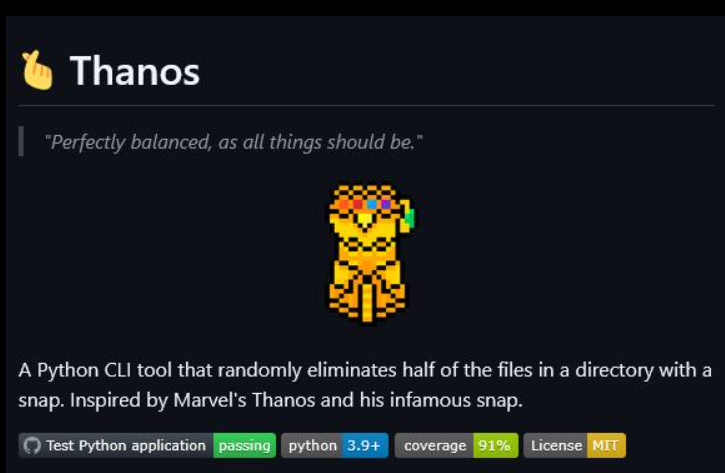
Someone built a Python CLI tool that does exactly what Thanos would do to your filesystem - snap away half your files randomly. Because nothing says "perfectly balanced" like gambling with your project files and hoping it doesn't delete anything important. The tool even has 91% test coverage, which means there's a 9% chance it might delete the tests themselves. Beautiful chaos wrapped in a Marvel reference. The real power move here is having the confidence to run a tool that literally says "I will randomly delete half your stuff" and trusting those green CI badges. At least it's well-tested destruction, right?

The Final Boss User Input

The Final Boss User Input
You've spent weeks writing pristine code, achieved that mythical 100% test coverage, handled every edge case known to humanity... and then some user decides to put 🎉💀🔥 in the name field. Your entire validation layer just got obliterated by three Unicode characters. Because apparently, while you were busy testing for SQL injection and XSS attacks, nobody thought to ask "what if someone just... doesn't use letters?" Your regex that confidently checks for ^[a-zA-Z]+$ is now weeping in the corner while your database tries to figure out how to sort "John Smith" and "💩". Fun fact: Emojis are stored as multi-byte UTF-8 characters, which means your VARCHAR(50) field might actually only fit like 12 emojis. But sure, your tests passed. Your beautiful, emoji-less tests.

One Of The Most Favorite

One Of The Most Favorite
Classic QA engineer joke that never gets old because it's painfully accurate. We test for zero beers, integer overflow, negative values, random gibberish input—basically everything except "where's the bathroom?" because that's what actual users do. They don't follow your happy path; they ask questions your system wasn't designed to answer and suddenly your entire architecture is on fire. The real tragedy? QA finds 47 edge cases, you fix them all, feel like a hero, then production explodes because someone tried to use the app while their phone was upside down during a leap year. You can't win. The users will always find that one scenario you never imagined, and it'll be the dumbest thing you've ever heard, yet completely valid.

When QA Begins Testing The Feature You Shipped

When QA Begins Testing The Feature You Shipped
That moment of pure dread when QA starts using your feature in ways you specifically didn't account for in your test cases. You built it for users who follow logical paths, but QA's sole mission is chaos. They'll click buttons 17 times in succession, enter emoji in numeric fields, and somehow manage to crash the entire application by typing their name backward. The tears are justified—you knew this would happen, yet hoped against hope they wouldn't find that one edge case you silently labeled as "nobody would ever do this anyway."

The Bell Curve Of Programming Competence

The Bell Curve Of Programming Competence
The bell curve of programming competence strikes again! On the left, we've got the blissfully ignorant dev with failing tests, garbage coverage, and zero users. On the right, the genius with 1.2k users but still failing tests and mediocre coverage. And in the middle? That sweaty, stressed-out perfectionist with 100% test coverage, all tests passing, and... a whopping 3 users. Nothing captures the software industry quite like spending six months refactoring for perfect test coverage on a product nobody uses. Meanwhile, the "move fast and break things" crowd is swimming in users despite their dumpster fire codebase. The real 200 IQ move? Writing just enough tests to not get fired.

Well That Was Not In The Test Cases

Well That Was Not In The Test Cases
Ah yes, the mythical "100% test coverage" – the armor that shatters the moment a user types "🔥💩👻" where their name should be. Six months of unit tests, integration tests, and regression tests, yet somehow nobody thought to validate against the ancient enemy: Unicode. The knight's confidence in the first panel is every dev right before deployment. The arrow in the second panel is every production bug that makes you question your career choices. No amount of TDD can save you from the creativity of users with emoji keyboards.

The Lion Does Not Concern Himself With Merely 2 Failing Tests

The Lion Does Not Concern Himself With Merely 2 Failing Tests
Just pushed 47 failing tests to production and went home for the weekend. Kings don't lose sleep over peasant concerns like test coverage. Monday's problem now. The QA team can join my "prayer circle" Slack channel if they need me.

It Works On My Machine

It Works On My Machine
Senior engineer points at unit tests while QA desperately gestures at the entire testing spectrum. Classic case of "my three assert statements will surely catch all edge cases." Meanwhile, the production server is quietly preparing its 3 AM surprise party. The gap between "works on my machine" and "works in production" is approximately 24 testing methodologies wide.

Let's Call The Unit Tests Without The Parameter Always Present In The Use Case

Let's Call The Unit Tests Without The Parameter Always Present In The Use Case
Ah yes, the classic "my tests pass in isolation" syndrome. The soldier in camo is proudly directing deadly weapons away from the sleeping person, congratulating himself on his amazing unit tests. Meanwhile, production code is getting absolutely shredded by edge cases that the tests never bothered to check for. Sure, your function works great when you pass it exactly what you expect... shame users don't read your mind and follow your undocumented assumptions.