

Stack trace Memes

Posts tagged with Stack trace
What Do You Need Such A Wide Screen For?

What Do You Need Such A Wide Screen For?
When someone asks why you need an ultrawide monitor, just show them this setup. That vertical monitor? That's for your segfault coredump stack traces—because nothing says "productive debugging session" like scrolling through 47 nested function calls to find out you dereferenced a null pointer on line 2. The ultrawide though? That's reserved exclusively for C++ template compiler errors. You know, those beautiful 500-character single-line error messages that start with error: no matching function for call to 'std::vector<std::map<std::string, std::shared_ptr<... and continue horizontally into the next dimension. Even with a 49-inch screen, you'll still need to scroll right to see where the actual problem is. The real question isn't why you need this setup—it's how C++ developers survived before ultrawide monitors existed. They probably just gave up and rewrote everything in Python.

Vibe Debugging

Vibe Debugging
You know that feeling when you're in the zone, writing beautiful code, feeling like a 10x developer? Yeah, that's vibe coding. Everything just flows, the tests pass on the first try, your variable names are poetic. Then production breaks at 2 AM and you're staring at stack traces that make no sense, questioning every life decision that led you to this moment. Welcome to vibe debugging, where the vibes are absolutely rancid and you're just randomly adding console.logs everywhere hoping something sticks. The transformation from confident developer to disheveled gremlin happens faster than you can say "but it worked on my machine." Your IDE is now just a canvas for print statements and your git history looks like a crime scene.

Please Don't Be My Code I Promise To Unit Test Next Time

Please Don't Be My Code I Promise To Unit Test Next Time
That sinking feeling when you're on-call and production goes down, and you start reading through the stack trace only to see familiar function names from that "quick fix" you pushed last week. You know, the one you shipped without tests because "it's just a small change, what could go wrong?" Now you're literally in a hole, praying to the tech gods that it's someone else's garbage code causing the outage. But deep down, you already know. That's YOUR NullPointerException. That's YOUR uncaught promise rejection. That's YOUR brilliant idea to refactor the entire authentication flow at 4 PM on a Friday. Every developer makes the same bargain: "Just let this one slide and I swear I'll write tests for everything from now on." Spoiler alert: they never do. The cycle continues until the next incident call.

I Love This Ad, Really Makes Me Want To Buy Their Product!

I Love This Ad, Really Makes Me Want To Buy Their Product!
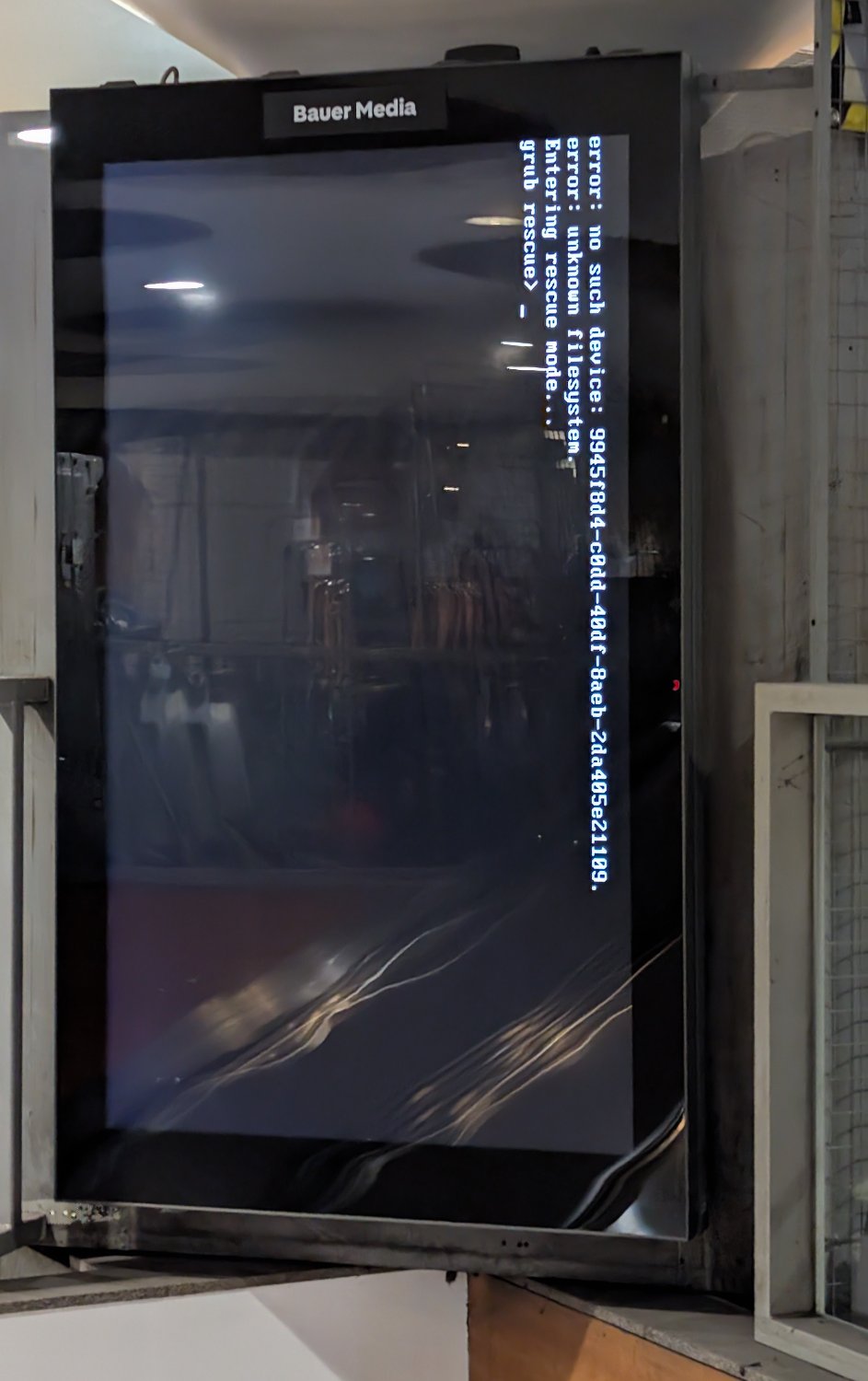
Nothing screams "professional advertising display" quite like a full stack trace plastered across a public screen for everyone to admire. The good folks at Bauer Media have graciously decided to share their internal error messages with the world—complete with what appears to be file paths and system details. It's like open-source, but for embarrassment. You know your deployment pipeline is rock solid when your digital billboard doubles as a debugging terminal. Someone's production environment is having a moment, and instead of showing whatever ad they were paid to display, they're giving us a masterclass in "things that should never be public-facing." At least they're transparent about their technical difficulties—literally. Pro tip: Error handling exists for a reason, and "display the entire error on a massive public screen" probably wasn't in the requirements document. But hey, free publicity is free publicity, right?

Thanks Server, Very Useful

Thanks Server, Very Useful
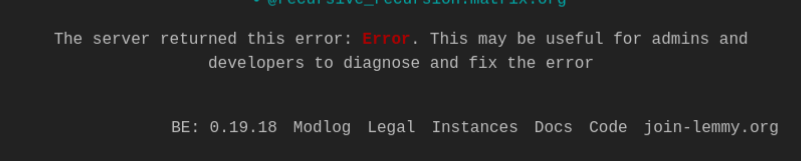
When your server graciously informs you that "The server returned this error: Error " you can feel the helpfulness radiating through your monitor. It's like asking someone what's wrong and they respond with "something." The message claims this "may be useful for admins and developers to diagnose and fix the error" which is technically true in the same way that knowing "a problem exists somewhere in your codebase" is useful. Sure, it narrows it down from "literally everything in the universe" to "something on this server," but that's about where the utility ends. Time to dig through logs, add debug statements everywhere, sacrifice a rubber duck to the coding gods, and question every life choice that led you to this moment. At least the error message is in a nice red color to match your rising blood pressure.

Been There Done That

Been There Done That
You start debugging with such optimism. "I'll just trace this back real quick," you tell yourself. Five stack traces later, you're staring at code written during the Bush administration (pick one), discovering that your "simple bug" is actually the consequence of a design decision made when dinosaurs roamed the earth. The horror sets in when you realize the original developer probably retired, moved to a farm, and is now living their best life while you're here, unraveling their ancient sins. Fun fact: Studies show that 60% of debugging time is spent understanding what past-you or past-someone thought was a good idea. Spoiler alert: it wasn't.

Go On Now Git Opossum Sticker - Funny Retro Decal, 3 in

Go On Now Git Opossum Sticker - Funny Retro Decal, 3 in
Size: 3" x 2.5" · Durable waterproof and weather-resistant vinyl · Perfect for laptops, water bottles, tumblers, cars, and luggage. · Simple peel & stick application. Outdoor life - 3 -5 years. · Pri…

Been There Done That

Been There Done That
You start debugging with confidence, following the stack trace like a bloodhound on a scent. Function A calls Function B, which calls Function C... and then you arrive at some ancient piece of code that predates your entire tenure at the company. The commit history goes back to when people still used SVN. The original author left three companies ago. There are no comments. Variable names like x1 and temp2 everywhere. You realize with dawning horror that fixing this bug means understanding code written during the Obama administration, and suddenly that "quick fix" just became a week-long archaeological expedition through legacy hell.

Root Cause Analysis

Root Cause Analysis
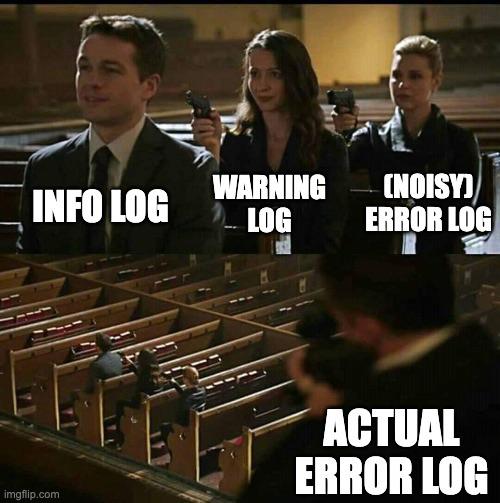
Three people pointing guns at one person? That's just a typical production incident investigation. INFO LOG and WARNING LOG are standing there looking all confident, while (NOISY) ERROR LOG thinks it's the culprit. But nope—buried beneath thousands of stack traces and repeated exceptions is the ACTUAL ERROR LOG, cowering in the corner like it's been there for weeks. The real pain starts when you're grepping through logs at 3 AM trying to find that one meaningful error message, but your logger decided to spam the same NullPointerException 47,000 times. Meanwhile, the actual root cause—a single line about a failed database connection—is sitting there at line 892,456, completely ignored. Good luck with that Ctrl+F, buddy.

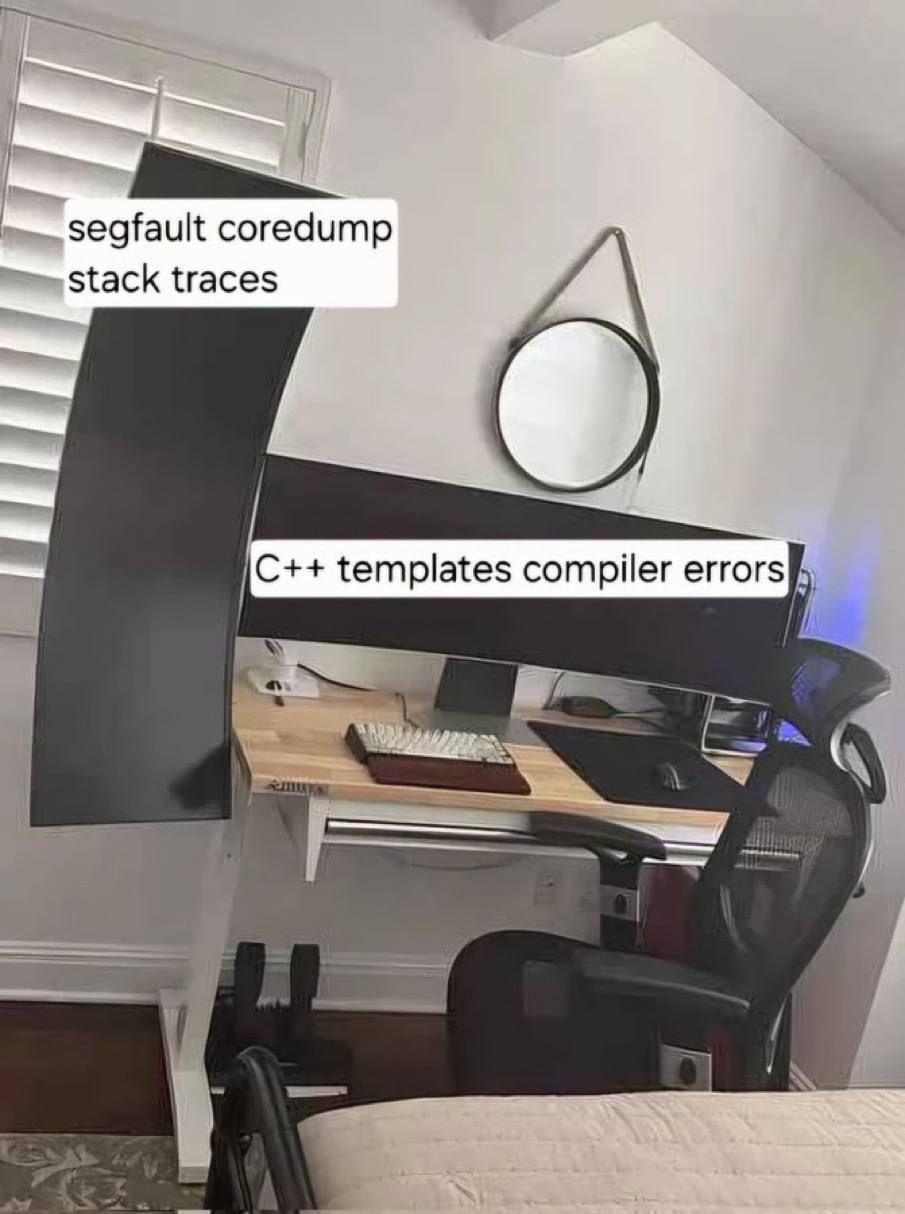
Assume T Pose For Dominance

Assume T Pose For Dominance
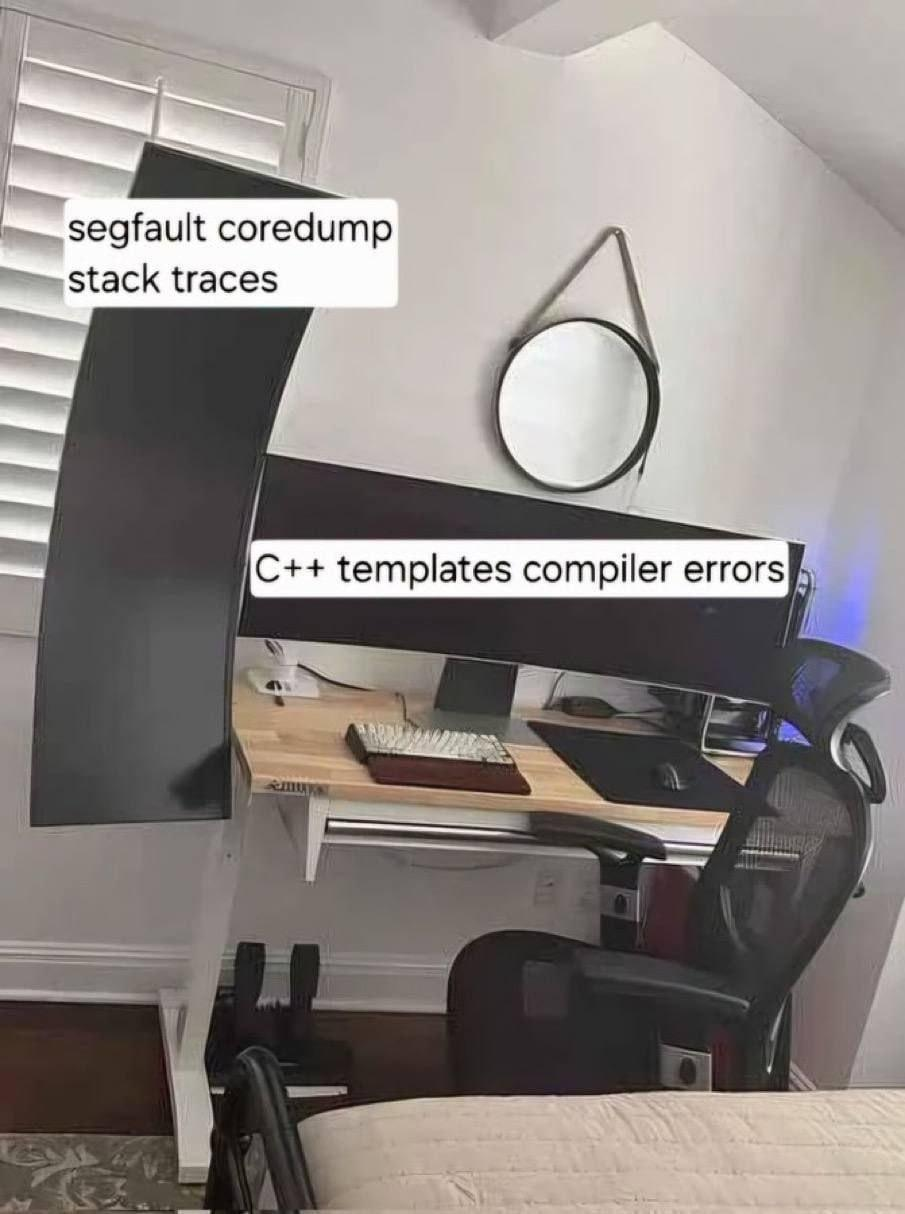
Someone's desk setup has achieved sentience and decided to assert dominance through structural engineering. The monitor's standing there in perfect T-pose formation, supported by what appears to be a combination of hope, prayer, and questionable physics. The labels are chef's kiss. Segfault coredumps and stack traces holding up one side, C++ template compiler errors doing the heavy lifting on the other. Both are known for their ability to produce walls of incomprehensible text that could physically support a monitor, so the physics checks out. Nothing says "I'm a senior developer" quite like using your most painful debugging experiences as literal load-bearing pillars. At least when this setup inevitably collapses, you'll get a fresh segfault to add to the collection.

Don't Need Fix Need Answers

Don't Need Fix Need Answers
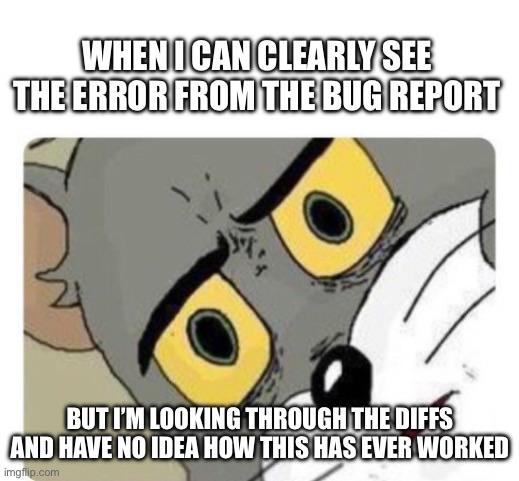
You know what's worse than not being able to fix a bug? Being able to see exactly what's wrong in the bug report but having absolutely zero clue how the code even produces that error in the first place. Like, the error message is crystal clear, the stack trace points right at the problem, but when you open the codebase it's like staring into the void. You're not even asking "how do I fix this?" anymore—you're asking existential questions like "how has this ever worked?" and "who wrote this?" (spoiler: it was you six months ago). The bug report is a map to treasure, except the treasure is buried in a codebase held together by duct tape and prayers.

We've All Felt This Pain

We've All Felt This Pain
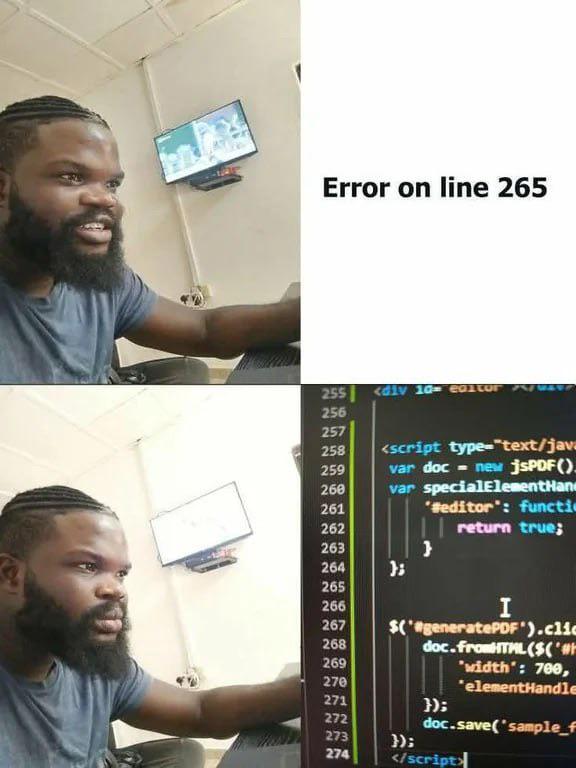
Error on line 265. Cool, let me just scroll down to check what's wrong. *Opens file* Line 274 is the last line. Nothing quite hits like your IDE confidently pointing you to a line number that doesn't exist. It's like getting directions from someone who's never been to the place. The error is somewhere in your code, probably a missing bracket or semicolon from 50 lines ago, but the stack trace decided to gaslight you instead. Time to play detective and work backwards through your entire file because apparently line numbers are just suggestions now.

Do You Ever Just Look At Your Error Message Like This

Do You Ever Just Look At Your Error Message Like This
You know that moment when your code crashes, you check the error message, and it's so cryptic and unhelpful that you just... stare at it with pure contempt? Like, thanks for telling me "undefined is not a function" for the 47th time today, but WHICH undefined? WHERE? The angry stare of betrayal when your error message gives you absolutely nothing to work with. You're not reading it anymore, you're just having a silent standoff with your terminal, wondering if intimidation will make it reveal more details. Spoiler: it won't.