

Rest-api Memes

Posts tagged with Rest-api
Status 200 For Everything

Status 200 For Everything
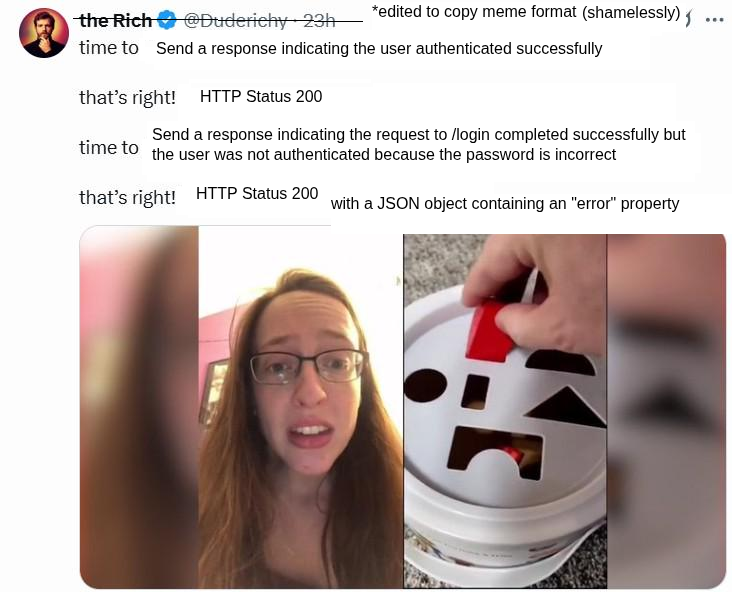
You know your API design is *chef's kiss* when every response returns a 200 OK, regardless of whether the user successfully logged in or their credentials were complete garbage. Why bother with proper HTTP status codes like 401 (Unauthorized) or 403 (Forbidden) when you can just slap a 200 on everything and bury the actual error deep inside a JSON object? It's like telling someone "Great job!" while handing them a letter that says they're fired. The meme format perfectly captures the absurdity—forcing the square peg of "authentication failed" into the round hole of "success status code." Frontend devs everywhere are crying into their keyboards because now they have to parse every response body to figure out what actually happened. HTTP status codes exist for a reason, folks. Use them.

Post For Everything

Post For Everything
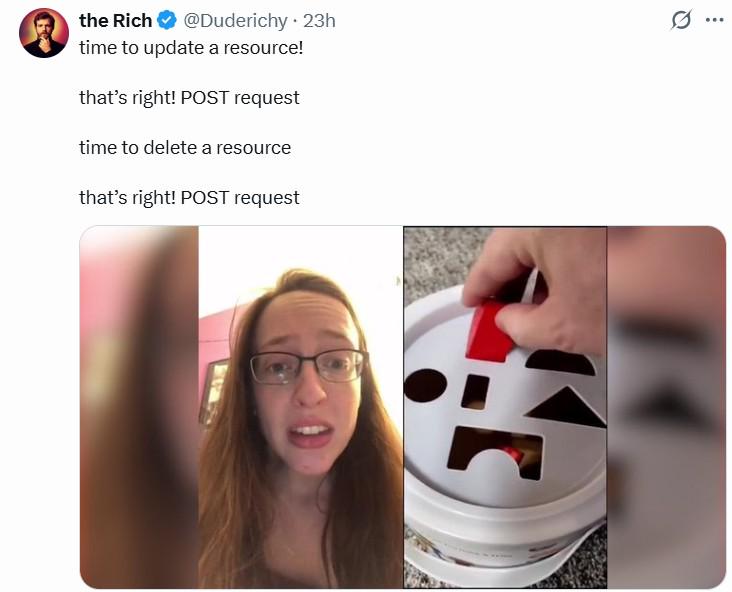
Someone clearly never got the memo about REST principles. Using POST for updates? Sure. Using POST for deletes? Bold choice. The shape-sorter toy comparison is chef's kiss—forcing a square peg (POST) through every hole regardless of whether GET, PUT, PATCH, or DELETE exists. It's like having a perfectly good toolbox but deciding the hammer works for everything. Your API consumers are crying somewhere, and your code reviewer just aged 10 years. But hey, at least it's consistent, right?

Update At Your Earliest Convenience

Update At Your Earliest Convenience
You know that third-party API you integrated six months ago? The one that promised "stable endpoints" and "backward compatibility"? Yeah, they just pushed their 47th breaking change this quarter. Your codebase is now a tangled mess of adapters, wrappers, and deprecated method calls that somehow still work but nobody knows why. The kid in the tuba perfectly captures what your integration layer looks like after chasing these "minor updates" and "improvements." What started as a simple REST call now requires authentication flows that changed three times, response formats that shifted from XML to JSON to "JSON but with extra steps," and documentation that was last updated when dinosaurs roamed the earth. Best part? Their changelog just says "various improvements and bug fixes." Cool, cool. Let me just rewrite my entire service layer real quick.

Why Is Our Json Deserializer Returning Empty Objects

Why Is Our Json Deserializer Returning Empty Objects
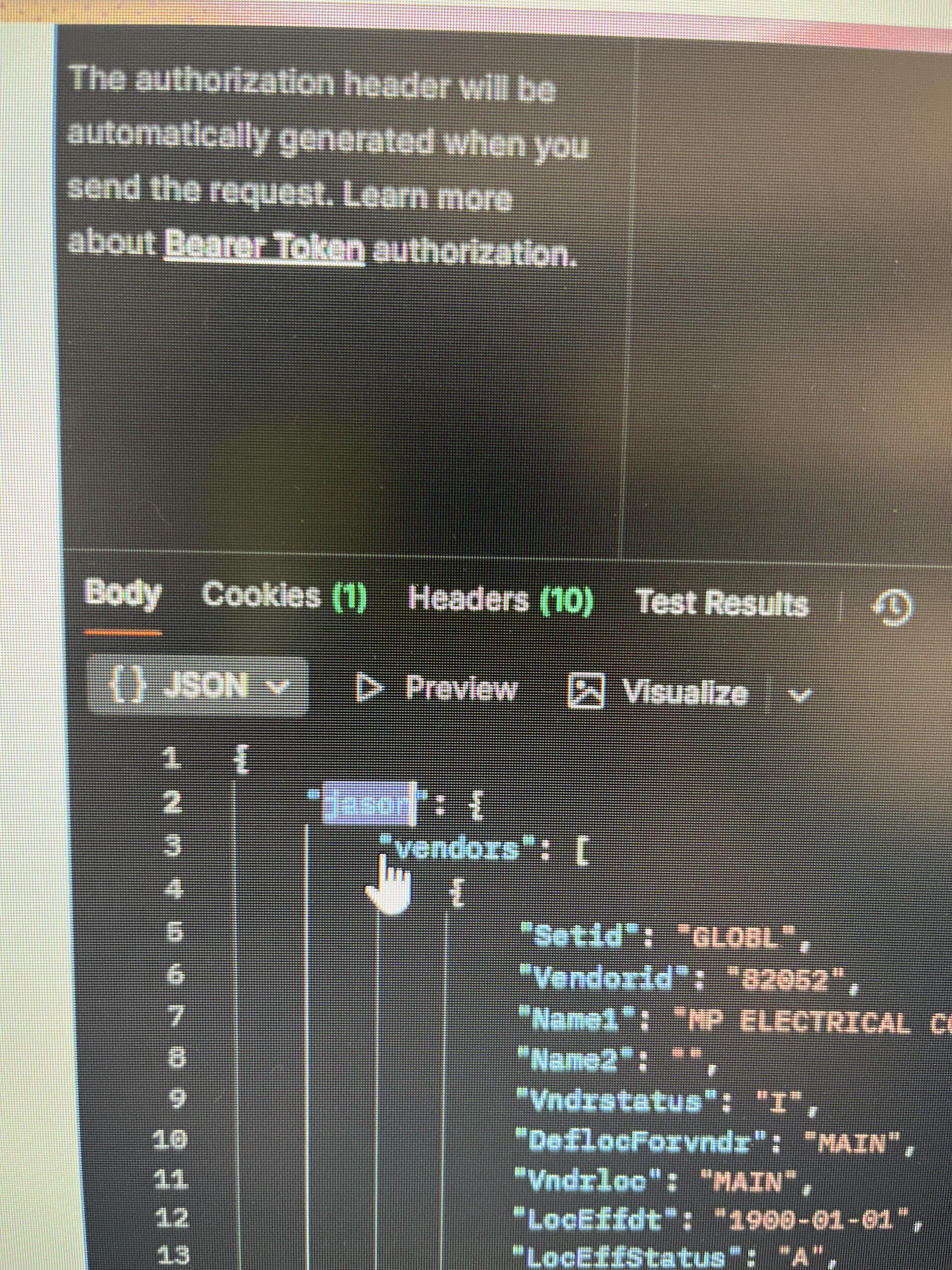
Someone's out here debugging their JSON deserializer while staring at a response body that's basically one giant array. Not an object. An array . The kind that starts with a bracket, not a curly brace. Deserializing an array into an object is like trying to pour water into a colander and wondering why your cup is empty. The type mismatch is right there, highlighted in blue, mocking you. But sure, let's spend another hour checking if the property names match. Pro tip: when your deserializer returns empty objects, maybe check if you're actually receiving what you think you're receiving. Revolutionary concept, I know.

Evo Lution

Evo Lution
Backend casually hands over a perfectly clean 200 OK response to Frontend. Simple, elegant, beautiful. Then Frontend reads the actual error message buried inside that 200 OK body and realizes Backend just wrapped a failure in success clothing. Classic backend move—technically correct (the best kind of correct) but absolutely infuriating for anyone trying to handle errors properly on the client side. Nothing says "I don't understand HTTP status codes" quite like returning 200 for literally everything. Bonus points if the error details are nested 5 levels deep in the JSON response under a key called "status" or "success: false". Because why use the protocol as intended when you can reinvent the wheel inside the response body?

Evil Illusion

Evil Illusion
Backend dev passes a note to Frontend dev, who reads it and sees "200 OK" - everything looks fine! But then Frontend takes a closer look and realizes the response body says "Error: something went wrong." Classic backend move right there. This is the API equivalent of your friend saying "I'm fine" while clearly not being fine. The HTTP status code says success, but the actual payload is screaming failure. It's like getting a beautifully wrapped gift box that contains nothing but disappointment and poorly documented error messages. Pro tip: If you're returning errors in a 200 response, you're not building a REST API - you're building a trust issue generator. Status codes exist for a reason, people! Use 4xx for client errors, 5xx for server errors, and save 200 for actual success. Your frontend devs will thank you, and you won't have to dodge coffee mugs at standup.

Time Saver

Time Saver
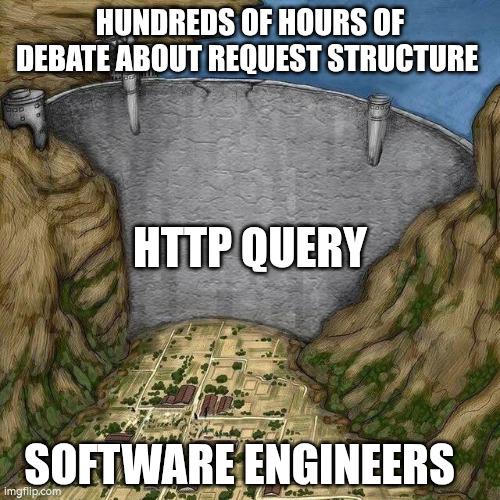
Software engineers will spend weeks architecting the perfect REST API with proper request validation, schema definitions, and documentation... then watch it all get obliterated when someone realizes they can just slap everything into query parameters and call it a day. The irony? After all those heated Slack debates about POST vs PUT, nested resources, and whether to use snake_case or camelCase, the solution that wins is literally the oldest trick in the HTTP book: ?param1=value&param2=value . Simple, ugly, and devastatingly effective. Bonus points if the query string ends up being 500 characters long and breaks every URL length limit known to mankind. Who needs elegant API design when you can just GET everything?

NordVPN

NordVPN
Encrypt your traffic on public Wi-Fi, stream from anywhere, and cover up to ten devices with one plan. 30-day money-back guarantee.

Create New

Create New
You know that feeling when you're being all romantic and supportive with your partner, and then they hit you with a "201 Created" status code? Yeah, that's the HTTP response that tells you a new resource was successfully created on the server. So basically, you're out here being a wholesome boyfriend, and she just casually drops that she's pregnant. The smile-to-panic pipeline has never been more accurately documented. REST APIs and relationship anxiety—name a more iconic duo, I'll wait.

Literally

Literally
Backend devs are out here cooking over literal fires in the trenches, debugging race conditions and optimizing database queries at 3 AM. Frontend gets the fancy restaurant with ambient lighting and Instagram-worthy aesthetics. Meanwhile, APIs? They're the impeccably dressed waitstaff making sure everything flows smoothly between the chaos and the glamour. The accuracy is painful. Backend is where the real work happens—messy, unglamorous, and absolutely critical. Frontend is all polish and presentation. And APIs? They're literally just serving data back and forth with a smile, making both sides look good while doing all the heavy lifting in between. REST in peace to anyone who's had to maintain all three.

Why Do Anything When LLM Can Do It

Why Do Anything When LLM Can Do It
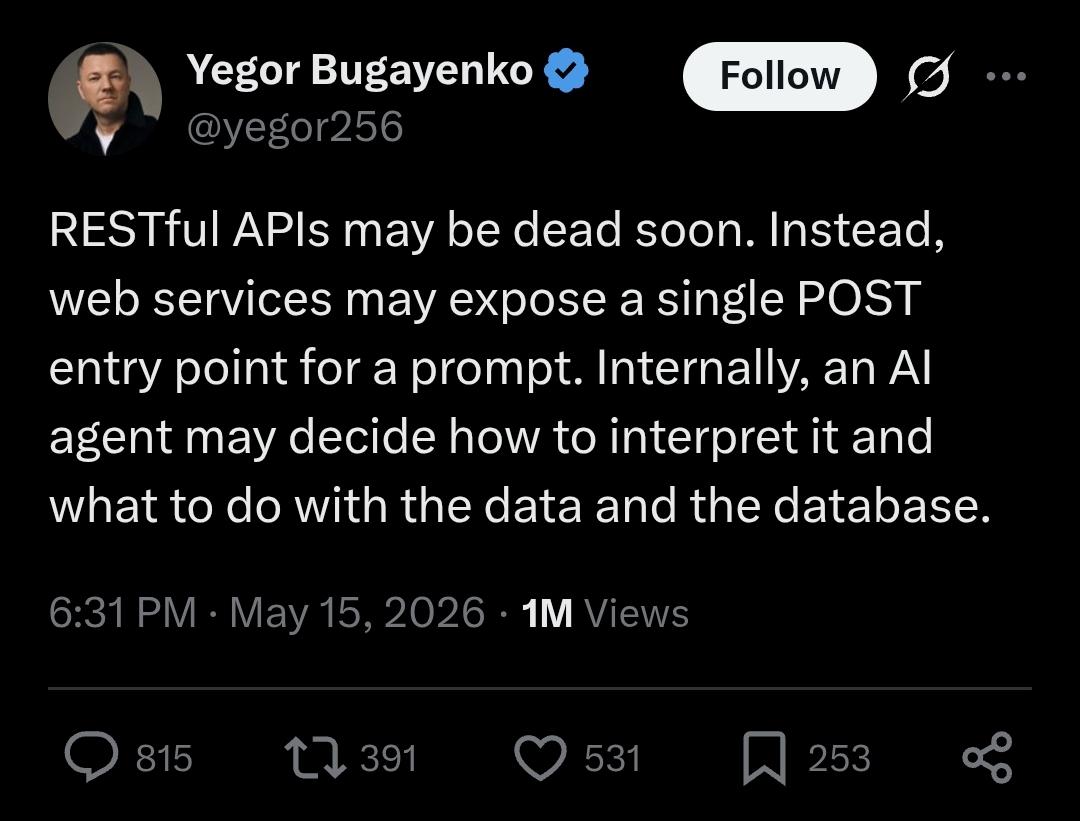
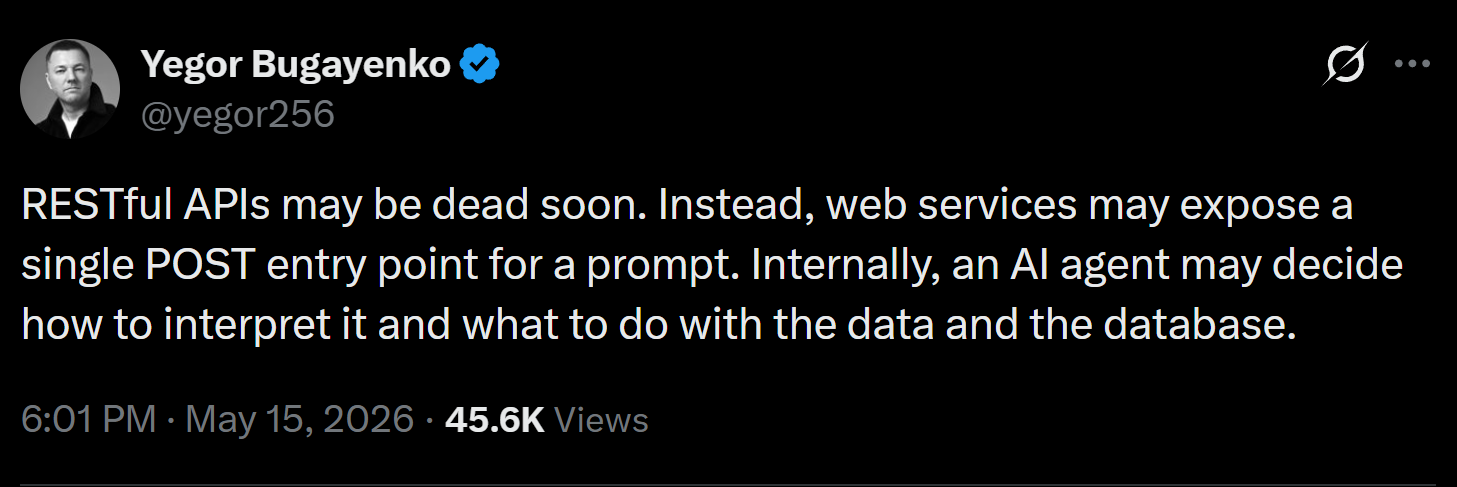
So we're just gonna let the AI decide what to do with our databases now? Cool, cool, cool. No need for structured endpoints, versioning, documentation, or any of that pesky software engineering discipline we've been doing for decades. Just yeet a natural language prompt at a POST endpoint and let the AI agent figure out whether you want to SELECT, UPDATE, or DROP TABLE. What could possibly go wrong? The beautiful irony here is that we spent years perfecting REST conventions—proper HTTP verbs, resource-based URLs, predictable status codes—only to throw it all away for "here's some words, good luck." It's like replacing a precisely calibrated API contract with a game of telephone where the other person is a statistical model that occasionally hallucinates. Can't wait for the incident postmortem: "The AI interpreted 'delete old records' as 'delete ALL records' because the prompt was ambiguous and we had zero type safety." But hey, at least we won't need API documentation anymore—just vibes and hope.

Re Inventing Graph Ql

Re Inventing Graph Ql
So we're just gonna let AI agents interpret our prompts and figure out what database queries to run? What could possibly go wrong? It's like GraphQL but with extra steps and existential dread. Instead of carefully crafted schemas and resolvers, we're literally handing the keys to the database to an LLM and saying "you figure it out, buddy." REST is dying so we can replace it with vibes-based API architecture where you just... ask nicely for data and hope the AI doesn't decide to DROP TABLE on a whim. The future is beautiful and terrifying.

EZTOOLS 926LED V3 Entry-Level 60W Soldering Station Iron Kit in Black with Temperature Control includes Helping Hands, Lead-Free Solder, 6 Soldering Tips, ESD-Safe Tweezers, Sleep Mode

EZTOOLS 926LED V3 Entry-Level 60W Soldering Station Iron Kit in Black with Temperature Control includes Helping Hands, Lead-Free Solder, 6 Soldering Tips, ESD-Safe Tweezers, Sleep Mode
Compact Soldering Station: This soldering iron features multi-functional design that integrates soldering iron holder, solder wire dispenser, tip cleaner, cleaning sponge into the station; saves desk…

For Real

For Real
You write one Express route handler and suddenly you're drawing system diagrams with boxes and arrows, talking about "separation of concerns" and "scalability patterns." Brother, it's a REST endpoint that returns user data from MongoDB. The delusion sets in fast when you start treating every CRUD API like you're building the next AWS. The funniest part? We've all been there. One successful deployment and you're updating your LinkedIn to "Full-Stack Software Architect | Cloud Native Enthusiast | Microservices Expert." Meanwhile the "architecture" is literally app.get('/users', async (req, res) => {...})