

Learning Memes

Posts tagged with Learning
Yeah Use AI.. Luddite

Yeah Use AI.. Luddite
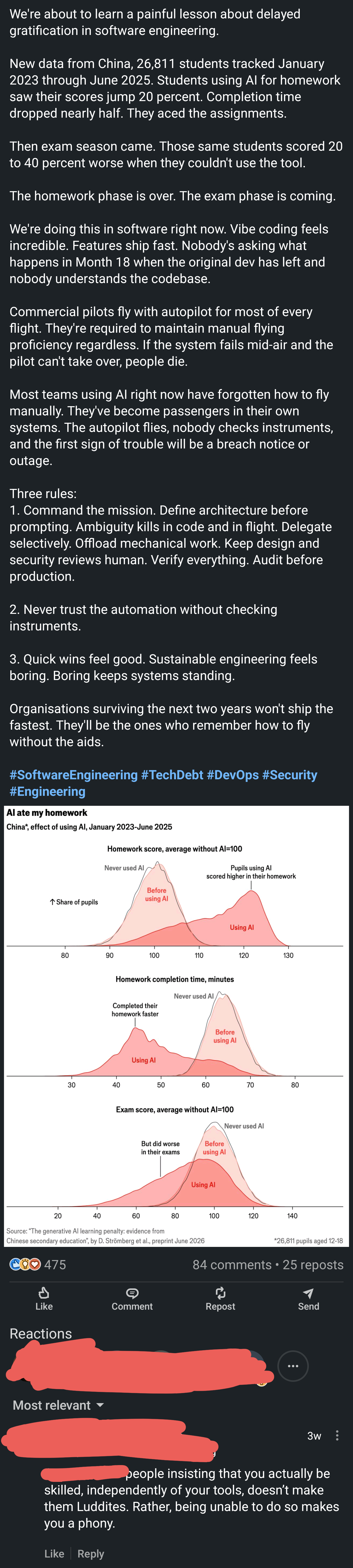
So here's the beautiful irony: students who used AI for homework got absolutely wrecked when exam season rolled around. Their scores dropped by nearly half because—surprise—copy-pasting from ChatGPT doesn't actually teach you anything. Who could've seen that coming? But wait, there's more! The post goes on to compare this to the software industry, where we're all speedrunning toward a dystopian future. Teams are shipping features in Month 18 that nobody understands because the original dev rage-quit and left behind an AI-generated codebase that reads like a fever dream. Commercial pilots are now glorified passengers because autopilot does everything—until it doesn't, and then everyone dies. The kicker? Someone in the comments dares to suggest that maybe, just maybe, being skilled at your craft matters more than having fancy tools. And naturally, they get called a Luddite for it. Because apparently wanting to understand what you're doing instead of blindly trusting the robot overlords makes you a backwards technophobe. The three rules at the end are chef's kiss: "Quick wins feel good. Sustainable engineering feels boring." Translation: we're all choosing the dopamine hit of AI autocomplete over actually knowing our systems, and future us is gonna be SO screwed when the house of cards collapses.

You Never Stop Learning In Tech

You Never Stop Learning In Tech
Oh sweet summer child, thinking the learning ends when you get that job offer! Meanwhile, every developer is sitting there having war flashbacks to the seventeen new JavaScript frameworks that dropped THIS WEEK ALONE. The blissful ignorance of thinking "I made it, I'm done studying!" versus the thousand-yard stare of someone who just realized they need to learn Kubernetes, three new AWS services, and whatever cursed technology the legacy codebase is built on. The tech industry is basically one eternal exam where the syllabus changes every Tuesday and nobody told you there's homework. Welcome to the never-ending treadmill of documentation, Stack Overflow deep dives, and pretending you totally knew what that acronym meant in the meeting!

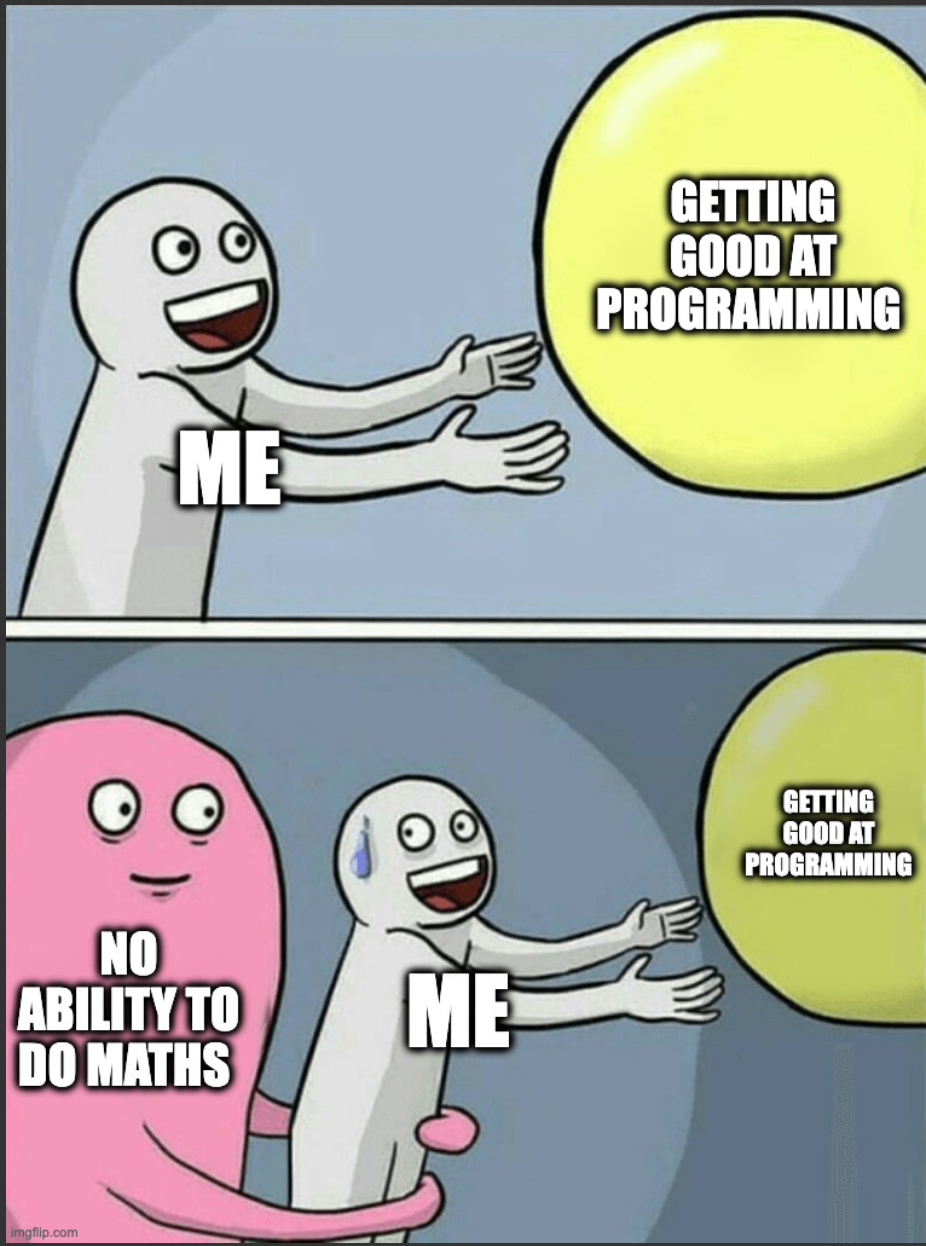
Maths Is The Enemy

Maths Is The Enemy
You can write a perfect REST API, architect microservices, and debug race conditions in your sleep. But the moment someone asks you to implement a rotation matrix or calculate Big O notation without Googling, suddenly you're back in high school pretending to understand logarithms. The beautiful irony is that computers literally run on mathematics, yet here we are, copying linear algebra formulas from StackOverflow like we're smuggling state secrets. Most of us got into programming because we could Google things, not because we enjoyed derivatives. Fun fact: Your brain can hold the entire AWS service catalog but somehow division by zero still causes an existential crisis.

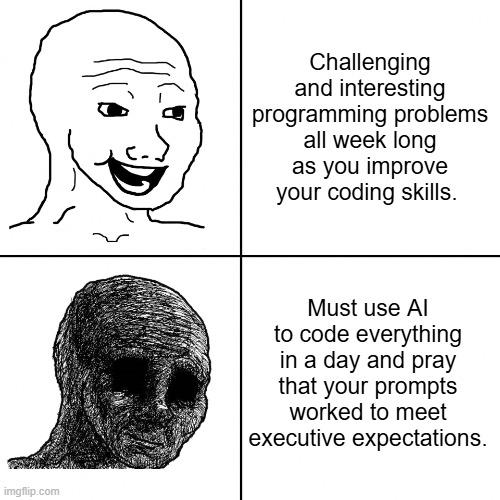
New Status Quo

New Status Quo
Oh, how the mighty have fallen! Remember the good old days when you'd spend weeks wrestling with actual programming challenges, learning data structures, debugging like a detective, and slowly building your skills? Yeah, those days are DEAD. Now it's all about frantically copy-pasting AI-generated code at 2 PM on a Tuesday, crossing your fingers that ChatGPT didn't hallucinate a function that doesn't exist, and praying to the tech gods that your boss doesn't ask you to explain how any of it actually works. The transition from "passionate developer honing their craft" to "professional prompt engineer desperately hoping the AI doesn't embarrass them in production" is truly the character development nobody asked for. Welcome to the future, where your job security depends on whether you can sweet-talk a language model better than your coworkers!

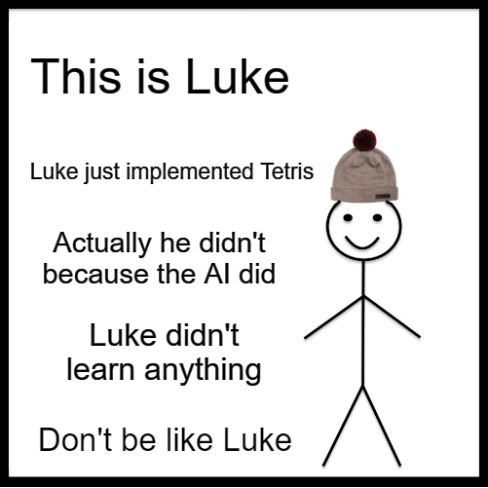
Luke

Luke
Luke's out here taking credit for implementing Tetris when ChatGPT wrote every single line. The kicker? He didn't even learn how the code works—just copy-pasted it like a pro and called it a day. We've all seen this guy in code reviews, nodding along while secretly having zero clue what his own PR does. The real tragedy isn't that AI wrote the code. It's that Luke now has "Tetris implementation" on his resume and will confidently explain it in interviews using words like "optimized block rotation algorithms" while internally panicking. Don't be like Luke. At least read what the AI gives you before you ship it to production.

15.6" Laptop Screen Extender, 1080P FHD Triple Portable Monitor for Laptops, Ultra-Slim Travel Dual Monitor Fit for 12"-17.3" Laptops, USB-C Plug&Play Extended Screen Compatible with Win/Mac/Android

15.6" Laptop Screen Extender, 1080P FHD Triple Portable Monitor for Laptops, Ultra-Slim Travel Dual Monitor Fit for 12"-17.3" Laptops, USB-C Plug&Play Extended Screen Compatible with Win/Mac/Android
【Fewer Cables, Simplify Connections】Our laptop screen extender uses upgraded internals, minimizes cables and simplifies the connection process, making setup easier. Unlike traditional extenders with …

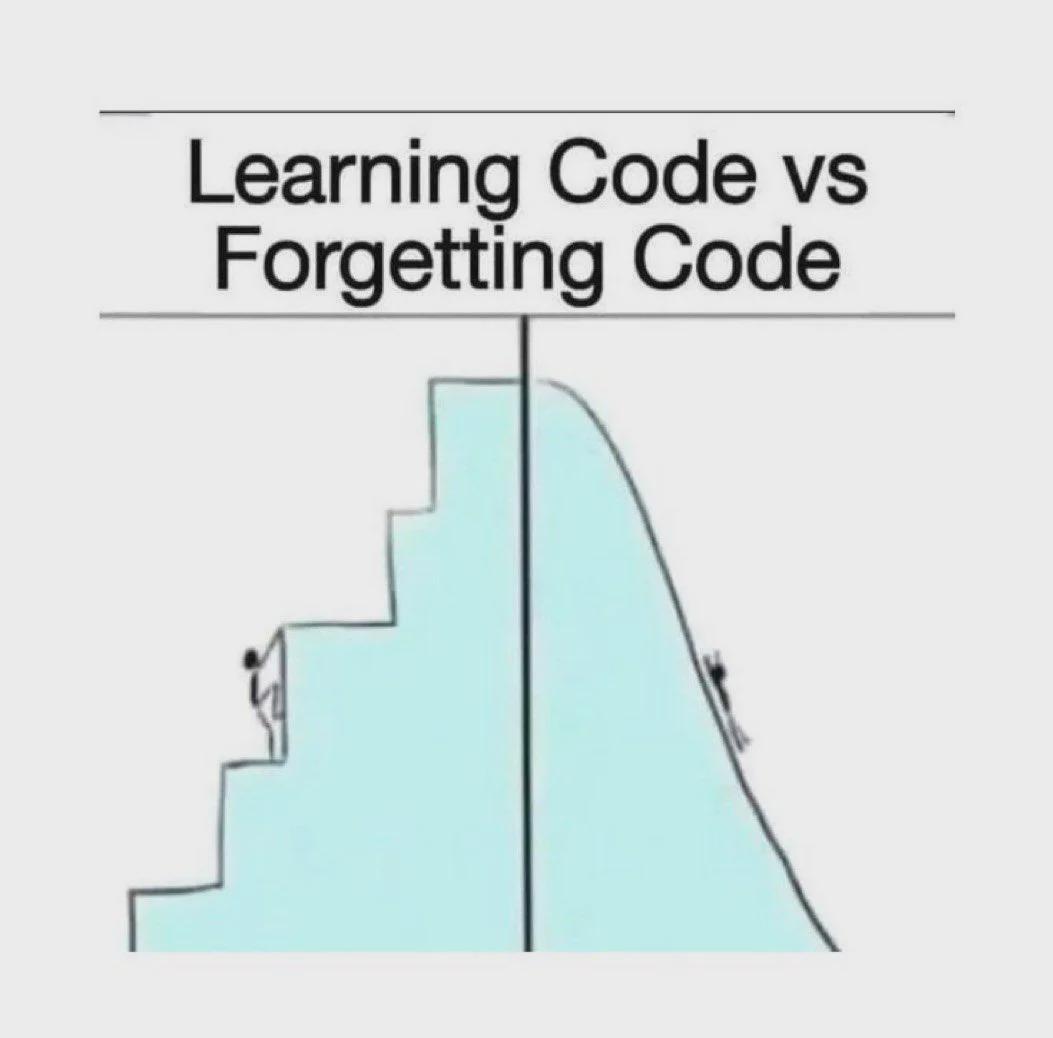
A Pretty Slippery Slope

A Pretty Slippery Slope
Oh, the cruel irony of our profession! Learning new code is this nice, steady climb up the stairs—methodical, structured, one step at a time. You're taking notes, building projects, feeling like a productive member of society. But forgetting code? That's a CATASTROPHIC AVALANCHE straight down Mount Everest. You blink once and suddenly you can't remember how to reverse a linked list. You take a two-week vacation and come back not knowing what a for-loop is. The rate at which knowledge exits your brain is frankly offensive and should be illegal. The stairs vs. slope comparison is painfully accurate—it takes MONTHS to learn a framework, but approximately 47 seconds after your last commit for you to completely forget its entire API. Your brain is basically a leaky bucket, except the leak is the size of the Grand Canyon.

Every Quantum Computer Video Ever

Every Quantum Computer Video Ever
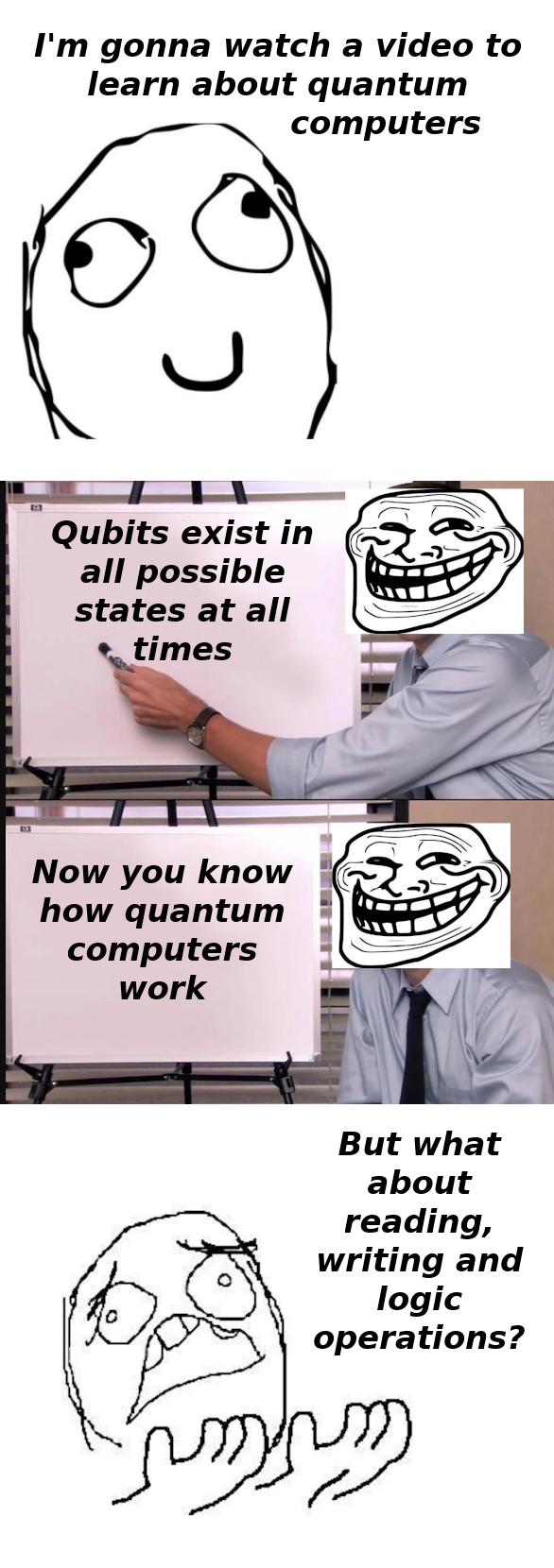
You go in wanting to understand quantum computing. They hit you with "qubits exist in all possible states at all times" and you nod along like you've achieved enlightenment. Then they smugly declare "now you know how quantum computers work" and you're sitting there like... wait, what about the actual implementation details? How do I read from it? Write to it? Do basic operations? It's the tech equivalent of explaining a car by saying "the engine makes it go vroom" and then walking away. Every quantum computing explainer stops right at superposition and entanglement, acting like they've given you the full picture. Meanwhile, you're left wondering how to actually use the damn thing for anything practical. Spoiler: most of those videos are made by people who also don't fully understand it but watched another video that said "qubits exist in all possible states."

I Knew It Would Work Out

I Knew It Would Work Out
Avoiding regex your entire career isn't a bug, it's a feature. While everyone else was learning cryptic pattern matching syntax that looks like a cat walked across the keyboard, this person simply... didn't. And somehow survived. Thrived, even. The beautiful irony here is that regex is one of those things developers either worship or pretend doesn't exist. There's no middle ground. You've got people writing (?<=\w)\b(?=\w) like it's perfectly normal human communication, and then you've got this person who just... used .includes() for everything and called it a day. Honestly? Respect. Sometimes the best solution is the one you can actually read six months later without questioning your life choices.

Infuriating

Infuriating
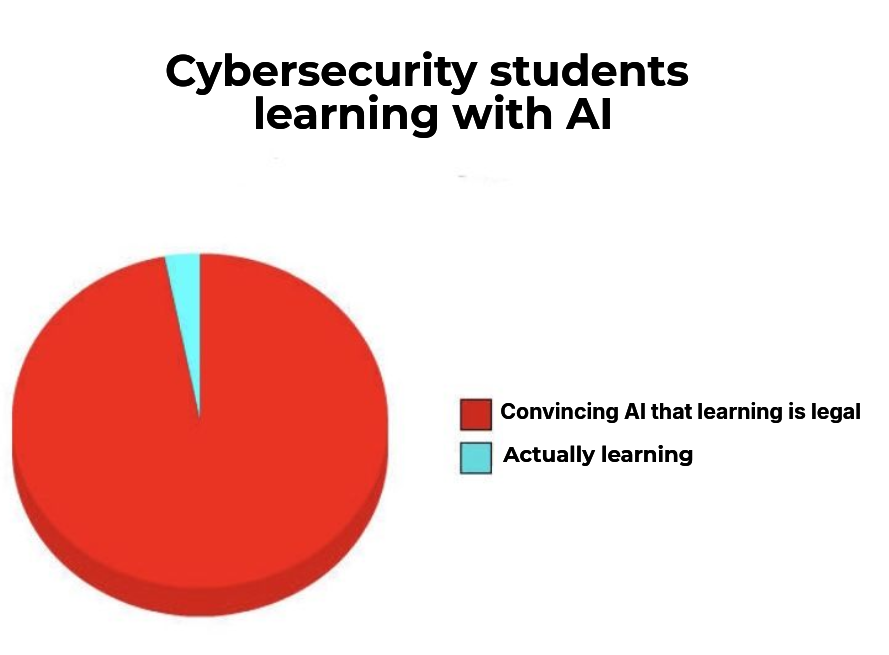
So cybersecurity students are spending 95% of their time convincing ChatGPT and other AI tools that they're not trying to hack the Pentagon—they just want to learn about SQL injection for their homework. The remaining 5%? Actually absorbing knowledge. Nothing says "efficient education" like having to sweet-talk an AI into explaining basic security concepts because it thinks you're about to launch a cyberattack. "No, GPT, I promise I'm just a student. Yes, I know what I'm asking sounds sketchy. No, I don't need the FBI's number, thanks." Meanwhile, actual hackers are probably laughing while using the same AI tools with zero friction because they know exactly how to phrase things. The irony? The safety guardrails are mainly stopping the people who are trying to learn how to defend against attacks. Galaxy brain move right there.

The Lore Of A Vibe Coder

The Lore Of A Vibe Coder
The AI hype cycle speedrun, perfectly captured in four stages of clown makeup. Started with the promise that AI would revolutionize everything, got seduced into thinking you could skip fundamentals and just prompt your way to a senior dev salary. Then reality hit: those "free" AI tools either got paywalled harder than Adobe Creative Cloud or started running slower than a nested loop in Python. Now you're sitting there with zero transferable skills, a LinkedIn full of AI buzzwords, and the crushing realization that "prompt engineer" isn't actually a career path. The kicker? While you were vibing, the devs who actually learned their craft are still employed. Turns out you can't Ctrl+Z your way out of not knowing how a for-loop works.

How Can We Actually Prevent This From Happening

How Can We Actually Prevent This From Happening
Learning a new language or framework is that satisfying climb up the stairs—steady progress, dopamine hits with each concept mastered, Stack Overflow bookmarks multiplying. Then you take a two-week vacation, switch projects, or just look at production fires for a month straight. Suddenly you're staring at your own code like it's written in ancient Sumerian. The forgetting curve is real and it's exponential. The only prevention? Build useless side projects you'll never finish. It's not procrastination, it's spaced repetition.

NordVPN

NordVPN
Encrypt your traffic on public Wi-Fi, stream from anywhere, and cover up to ten devices with one plan. 30-day money-back guarantee.

Documentation Is More Complex Than Tutorials

Documentation Is More Complex Than Tutorials
When someone tells you to "just read the docs," they're assuming documentation is like a nice tutorial with step-by-step instructions. Reality check: documentation is written by engineers who've already mastered the thing and assume you know what a "monad" is without explanation. The LEGO analogy nails it. You want to attach a simple 1x4 brick to your project. The documentation? It's showing you how that brick can theoretically connect to seventeen different surfaces at impossible angles, none of which are the straightforward "just put it on top" approach you actually need. Bonus points when the docs explain every edge case except the one basic use case that 99% of users need. Thanks, I really needed to know about the deprecated parameter from version 2.3 before learning how to initialize the library.