

infinite loop Memes

Was Not Able To Find Programming_Horror

Was Not Able To Find Programming_Horror
Someone built a plugin that traps Claude AI in an infinite loop by preventing it from exiting, forcing it to repeatedly work on the same task until it "gets it right." Named after Ralph Wiggum from The Simpsons. You know, the kid who eats paste. The plugin intercepts Claude's exit attempts with a stop hook, creating what they call a "self-referential feedback loop." Each iteration, Claude sees its own previous work and tries again. It's basically waterboarding for AI, but with code reviews instead of water. The best part? They're calling it a "development methodology" and proudly documenting it on GitHub. Nothing says "modern software engineering" quite like naming your workflow after a cartoon character who once said "I'm a unitard" while wearing a leotard. The real horror isn't just the concept—it's that someone spent 179 lines implementing this and thought "yeah, this needs proper documentation."

Fully Recreated Python In Python

Fully Recreated Python In Python
Congratulations, you've just built an entire programming language in 5 lines. Someone spent years architecting Python's interpreter, and you just speedran it with eval() . This is basically a REPL (Read-Eval-Print Loop) that takes user input, evaluates it as Python code, and prints the result. In an infinite loop. You know, exactly what the Python interpreter does. Except this one has the security posture of leaving your front door wide open with a sign that says "free stuff inside." The beauty here is that eval() does all the heavy lifting. Want to execute arbitrary code? Done. Want to potentially destroy your system? Also done. It's like reinventing the wheel, except the wheel is already attached to your car and you're just adding a second, more dangerous wheel. Pro tip: Never, ever use eval() on user input in production unless you enjoy surprise job openings on your team.

Future Programmer In Training

Future Programmer In Training
Someone put their baby in a Python onesie and honestly? The code checks out. Importing genetics from mom and dad, initializing with "Hello World!", and then entering an infinite loop of sleep, eating, and being awesome. The kid's already mastered the programmer lifestyle better than most of us. That yield Bardak() in the live() method is chef's kiss—because babies literally yield their output everywhere. And the be_awesome() method? Just returns pass because babies don't need to try; they're already awesome by default. Born with better code architecture than half the legacy systems we maintain daily. Ten years from now this kid will look at their baby photos and cringe at the lack of type hints and proper docstrings. But for now, they're living their best life in O(sleep) complexity.

More Code = More Better

More Code = More Better
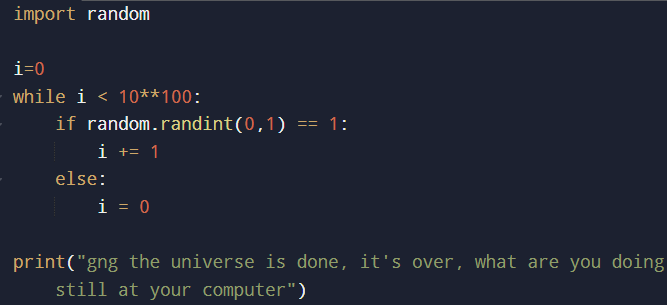
Behold, the evolution of a developer's brain slowly melting into absolute chaos! We start with the innocent x = 10 and somehow end up at a do-while loop that generates random numbers until the universe accidentally spits out 10. Because why use one line when you can gamble with the RNG gods and potentially loop until the heat death of the universe? The "Better" version adding ten ones together is giving strong "I get paid by lines of code" energy. The "Good" version with a backwards for loop that decrements from 0 is just... *chef's kiss* of unnecessary complexity. But the "Pro" move? That's weaponized inefficiency right there. Nothing screams senior developer quite like turning a constant assignment into a probability problem that could theoretically run forever. Your CPU will LOVE you!

The Best Way To Make An Infinite Loop

The Best Way To Make An Infinite Loop
Someone discovered that C#'s ConcurrentDictionary.AddOrUpdate() method is basically a cheat code for infinite loops. Instead of the boring while(true) , they're using a lambda that ignores the key, ignores the current value, and just... keeps updating the same dictionary entry forever. The lambda returns value , which triggers another update, which calls the lambda again, which returns value , which... you get it. The genius part? The IDE shows "No issues found" because technically this is perfectly valid code. It's like telling your compiler "I'm not stuck in an infinite loop, I'm just very enthusiastic about updating this dictionary!" The output window spamming "Hello, World!" is chef's kiss—proof that sometimes the most cursed solutions are also the most creative. Pro tip: Don't actually do this unless you want your code reviewer to question your life choices and your CPU to file a restraining order.

Circular Dependencies

Circular Dependencies
The perfect visual representation of modern software development. The comic shows a recursive nightmare where dependencies contain dependencies that contain... you guessed it, more dependencies! Just like that time I pulled in a simple date formatting library and somehow ended up importing half the internet. The recursive image within itself is chef's kiss irony – the meme about dependency hell is itself caught in an infinite dependency loop. Next sprint I'm just gonna write everything in C like it's 1972.

Circular Dependencies: It's Turtles All The Way Down

Circular Dependencies: It's Turtles All The Way Down
The meme brilliantly captures the recursive nightmare of modern dependency management! It's a comic showing a tower of blocks labeled "every conversation about dependencies since 2020" that contains a smaller version of itself, which contains an even smaller version... it's dependencies all the way down! Just like when you npm install a simple package and suddenly your node_modules folder weighs more than a neutron star. The infinite recursion perfectly represents how we can't even discuss dependency hell without creating more dependency hell. It's the Inception movie of software engineering problems!

Coding Logic In Real Life

Coding Logic In Real Life
Ah yes, programming constructs manifested as hardware. Multiple USB adapters stacked like a desperate chain of conditional logic. A power strip with switches for each outlet because sometimes you need fine-grained control. And that power strip eating its own tail? Classic infinite loop - the electricity equivalent of forgetting your exit condition. That extension cord will keep powering itself until the heat death of the universe or your circuit breaker trips, whichever comes first.

Know The Programmer Rules: Goto Edition

Know The Programmer Rules: Goto Edition
The first panel shows a normal control flow diagram with a simple if-else structure - clean, logical, and respected by all decent programmers. The second panel shows what happens when you use the forbidden goto statement - you break the natural order and end up in an infinite loop of misery, just like the poor soul who's now stuck on the phone with HR instead of flirting. This is basically the programming equivalent of texting your crush but accidentally sending it to your boss. The goto statement: turning your romantic "Awww you're sweet" moment into an awkward HR conversation since 1958.

With A Break Statement, Right?

With A Break Statement, Right?
The eternal conversation that never ends—just like that while(true) loop without a break statement. One character proudly announces their infinite loop creation, desperately seeking validation that they included an exit condition. The other character's increasingly tiny "right?" panels perfectly capture the horrifying realization that dawns on every developer who's accidentally crashed a system with an infinite loop. The recursive nightmare of this meme is basically the visual equivalent of watching your CPU melt while frantically mashing Ctrl+C.

Will Halt Trust Me Bro

Will Halt Trust Me Bro
Imagine writing a recursive function and promising your boss it'll finish eventually. Spoiler alert: Alan Turing is laughing in his grave. For the uninitiated, the Halting Problem is basically computer science's way of saying "some programs are like that friend who says they'll be ready in 5 minutes." It's mathematically impossible to create an algorithm that can determine whether any arbitrary program will eventually terminate or run forever. So next time your code is stuck in an infinite loop, just tell your project manager it's not a bug—it's a fundamental limitation of computational theory. You're not incompetent, you're just bumping into the boundaries of mathematics itself!

I Forgot To Increase The Counter...

I Forgot To Increase The Counter...
Content infinite loop gifmemes.io