Heisenbug Memes

Posts tagged with Heisenbug

Trying To Reproduce Bug

Trying To Reproduce Bug
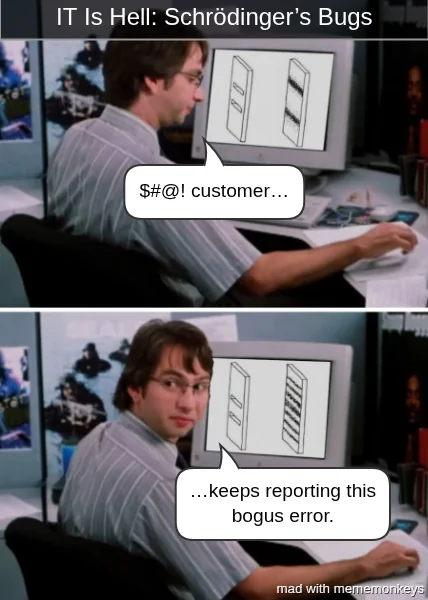
Oh, you sweet summer child thinking you can just recreate that production bug in your cozy little dev environment? THINK AGAIN. Nothing—and I mean NOTHING—compares to the absolute psychological devastation of watching a bug wreak havoc in production while refusing to show its face anywhere else. You'll click the same buttons, use the same data, sacrifice the same rubber duck to the debugging gods, and STILL get nothing. Meanwhile, production is out there living its best chaotic life, crashing and burning like it's auditioning for a disaster movie. The bug saw you coming with your debugger and said "not today, Satan." It's basically Schrödinger's bug—it only exists when you're not looking for it. Welcome to the Thunderdome of software development, where the bugs make the rules and your sanity is just a suggestion.

The Heisenbug Principle

The Heisenbug Principle
You know what's worse than a bug? A bug that only exists when customers are looking at it. The moment you fire up your debugger or add some logging statements, it vanishes into the quantum realm like it was never there. But the second you close your IDE and push to production? Boom, it's back, haunting your error logs and your dreams. The Heisenbug gets its name from Heisenberg's Uncertainty Principle in quantum physics—where observing a particle changes its behavior. Same energy here: the act of debugging literally changes the bug's behavior. Maybe it's a race condition that disappears when you slow things down with breakpoints. Maybe it's a timing issue that vanishes when you add console.log statements. Either way, you're stuck explaining to your manager why the bug only exists in production and nowhere else. Schrödinger would be proud. The bug is both there and not there until a customer observes it.

You Know What That Means

You Know What That Means
You've been chasing that ghost bug for hours, desperately trying to reproduce it one more time before you close the ticket. You follow the exact same steps, click the same buttons, enter the same data... and suddenly it works perfectly. The bug just vanishes into thin air like it was never there. Time to close the laptop and walk away slowly. We don't question miracles in this profession. The bug gods have smiled upon you today, and you're not about to tempt fate by investigating further. Ship it before the universe realizes its mistake.

When The Stars Align...

When The Stars Align...
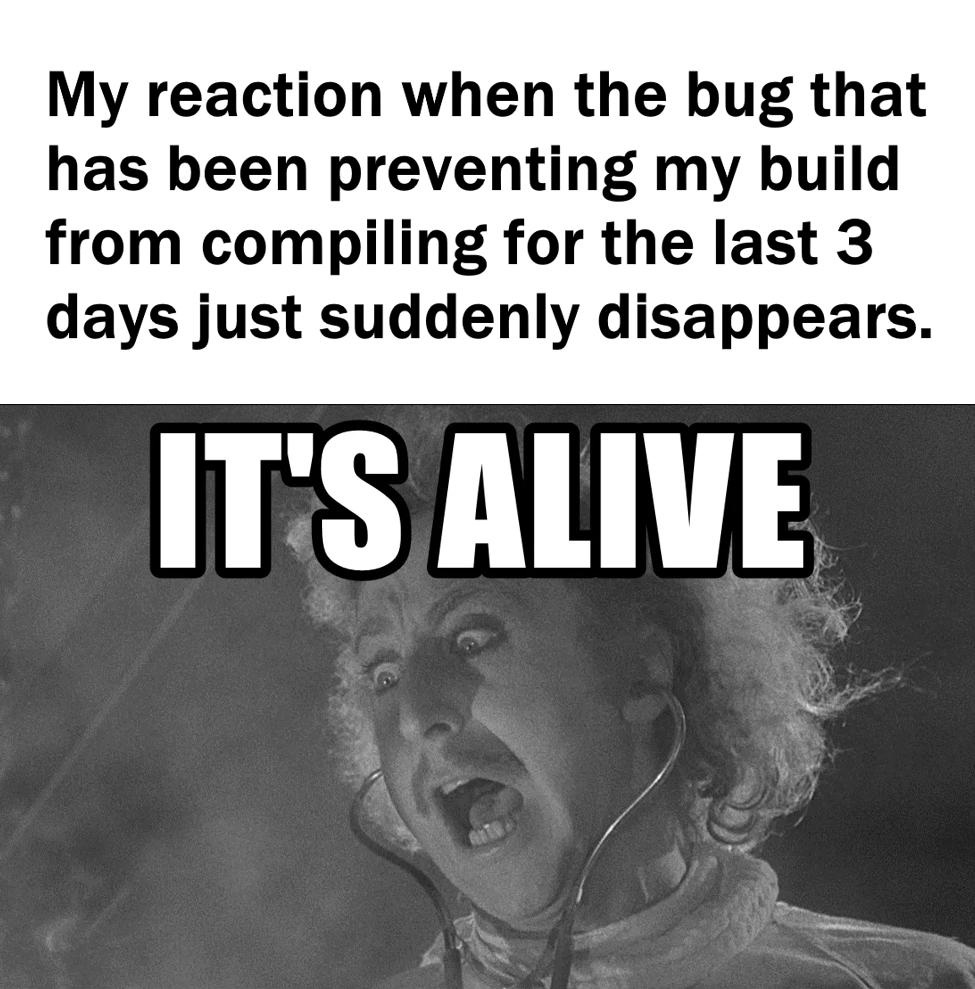
You spend three days wrestling with a build error that makes absolutely no sense. You've tried everything—cleared cache, deleted node_modules, sacrificed a rubber duck to the debugging gods. Then one morning you wake up, run the build command, and it just... works. No code changes. No updates. Nothing. The sheer terror of not knowing what fixed it is somehow worse than the bug itself. Did it fix itself? Was it a cosmic ray? A race condition that finally lost the race? You'll never know, and that uncertainty will haunt you forever. Because if you don't know what fixed it, it can come back at any moment. Sleep tight.

Computer Was Tired

Computer Was Tired
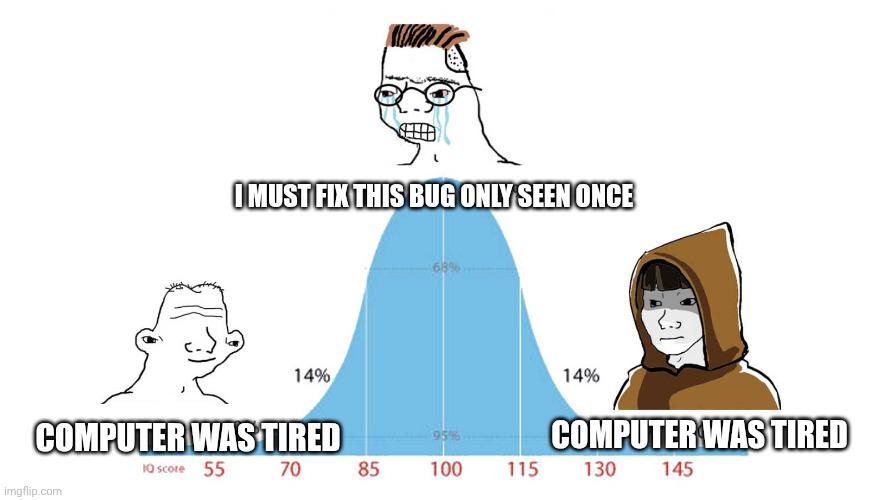
You know that one bug that appeared exactly ONCE during that demo with your boss, vanished into thin air, and now refuses to show itself no matter how many times you recreate the exact same conditions? Yeah, that one. The bell curve of IQ perfectly captures the beautiful duality of developer responses: the enlightened newbie and the battle-scarred veteran both shrug and say "computer was tired" because honestly? Sometimes the universe just glitches and there's no rational explanation. Meanwhile, the sweating middle-ground developer is having a full existential crisis trying to reproduce it, convinced they MUST find the root cause because their sanity depends on it. Spoiler alert: they won't find it. The computer was just having a bad day.

YEELIGHT Monitor Light Bar, Computer Monitor Lamp for Home Office Gaming, 250LM No Glare Eye-Care LED Screen Bar, Touch Control USB Reading Desk Lamp with Stepless Dimming for Flat & Curved Monitor

YEELIGHT Monitor Light Bar, Computer Monitor Lamp for Home Office Gaming, 250LM No Glare Eye-Care LED Screen Bar, Touch Control USB Reading Desk Lamp with Stepless Dimming for Flat & Curved Monitor
【Discover Ultimate Eye Care with YEELIGHT Monitor Light Bar】Protect your vision and elevate your workspace with the YEELIGHT ScreenBar. Our cutting-edge technology not only effectively filters out ha…

It Only Happens Sometimes

It Only Happens Sometimes
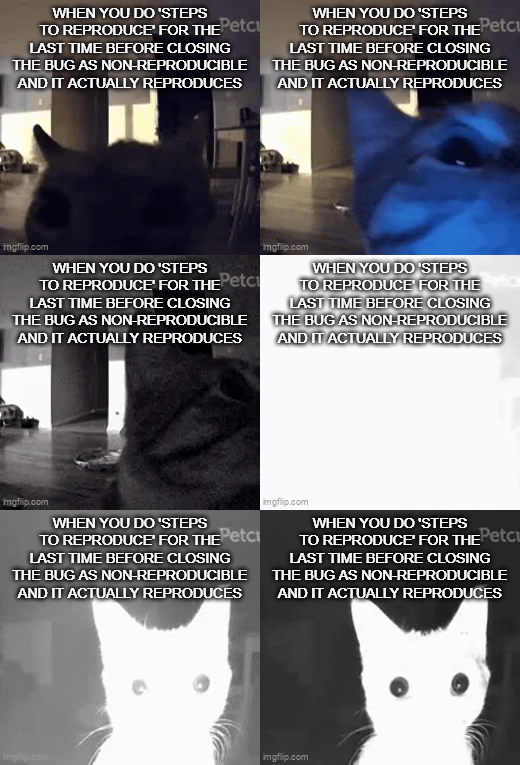
Welcome to the seventh circle of developer hell, where bugs are like ghosts that only appear when you're NOT looking. The client swears on their grandmother's grave that the bug happens "sometimes," which is developer-speak for "good luck reproducing this nightmare." You'll spend the next 47 hours frantically clicking buttons, refreshing pages, and questioning your entire existence while the bug smugly hides in the shadows. But the MOMENT you close your laptop and walk away? *Chef's kiss* - it appears for the client like clockwork. The panic in that cat's eyes? That's you realizing you can't fix what you can't reproduce, and your "works on my machine" defense is about to crumble faster than your will to live.

The Biggest Mystery Known To Mankind

The Biggest Mystery Known To Mankind
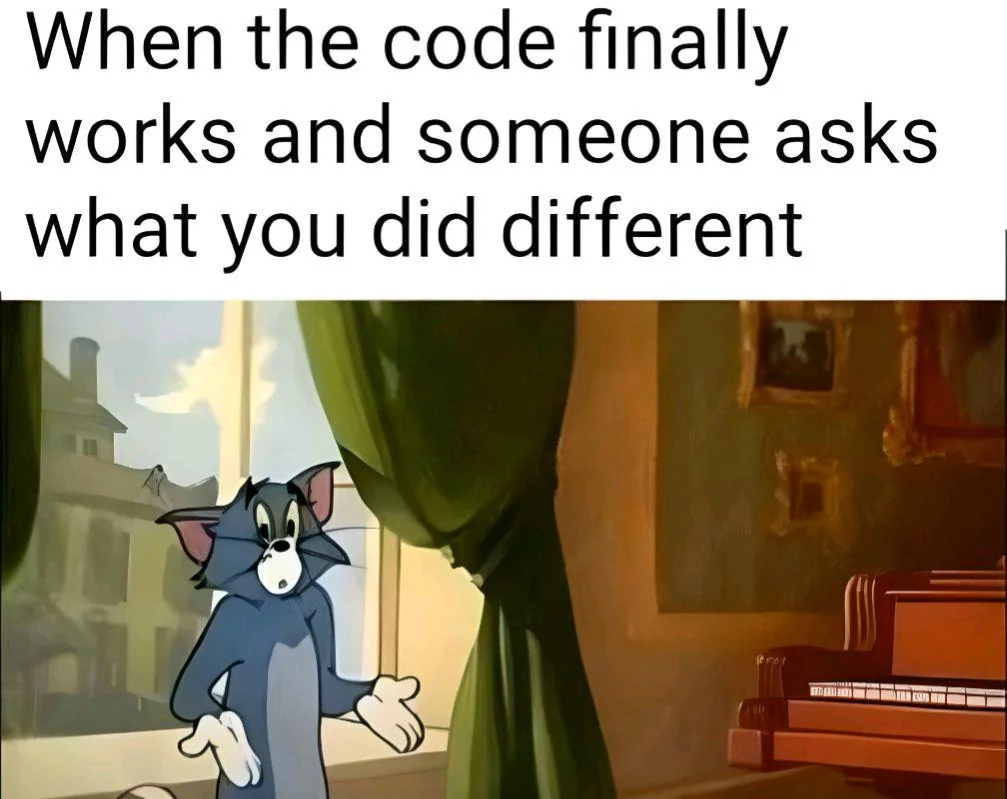
You spent three days debugging, sacrificed your sleep schedule, questioned your career choices, and suddenly it just... works. No clue what changed. Maybe you moved a semicolon. Maybe the compiler gods finally smiled upon you. Maybe Mercury is no longer in retrograde. Then your teammate casually asks "what did you do different?" and you're standing there like Tom, completely clueless, because honest to god you have NO idea. You didn't change anything meaningful. You just ran it again. The code fixed itself through sheer willpower and spite. The correct answer is "I have absolutely no idea and I'm terrified to touch it again" but instead you'll mumble something about "refactoring the logic" to sound professional.

When QA Finds A Bug And You Cannot Reproduce It

When QA Finds A Bug And You Cannot Reproduce It
QA shows you the bug. You open your terminal, ready to squash it. You run the code. Nothing. The bug has vanished into the void like it was never there. QA insists they saw it. You insist your machine works fine. The bug exists in a quantum superposition state—simultaneously there and not there until QA observes it again. Classic Heisenbug behavior. The moment you try to debug it, it disappears. Works on my machine™ has never felt so justified yet so infuriating. Now you're stuck in that awkward limbo where you can't fix what you can't see, but you know it's lurking somewhere, waiting to embarrass you in production.

Why Always

Why Always
You spend 4 hours hunting down a bug with print statements, breakpoints, and enough console.logs to deforest the Amazon. You're sweating, questioning your career choices, maybe even your entire existence. Then the moment you actually fire up the debugger with proper breakpoints and step-through... the bug just vanishes like it was never there. It's hiding. Mocking you. Probably sipping a margarita somewhere. The bug knows when you're watching. It's like Schrödinger's error - exists only when you're not properly observing it. The second you bring out the big debugging guns, it decides to take a vacation. Then you close the debugger and BAM, it's back, doing the cha-cha on your production server. Pro tip: bugs are sentient and they feed on developer tears. They've evolved to detect debugger tools and adapt accordingly. It's basically natural selection at this point.

NordVPN

NordVPN
Encrypt your traffic on public Wi-Fi, stream from anywhere, and cover up to ten devices with one plan. 30-day money-back guarantee.

Weird How It Always Works, Yet That One Boolean Decided To Be A Pain

Weird How It Always Works, Yet That One Boolean Decided To Be A Pain
You walk the debugger through your code like a patient therapist. "You're a boolean." Yup. "The breakpoint shows you're being set to true." Yup. "And if said boolean is true, then this actor will show a certain widget when clicked." That makes sense to me. "Then show the correct widget!" And suddenly the code decides to embrace chaos and work exactly once before retiring permanently. The logic is flawless. The debugger confirms everything. Yet somehow the widget has commitment issues. Classic case of Schrödinger's boolean—simultaneously true and "nah, not feeling it today." Probably cached somewhere in a parallel dimension or the boolean got garbage collected mid-explanation. Either way, you're now questioning your career choices and the fundamental nature of reality.

May Be It Was Just Having A Bad Day

May Be It Was Just Having A Bad Day
You know that special kind of existential dread when code that was broken yesterday suddenly works today without any changes? Like, did the compiler just wake up on the right side of the bed? Did the server finally get its morning coffee? The universe is gaslighting you into thinking you're a competent developer when really, your code is just playing psychological warfare. The worst part? You'll never know what was actually wrong. Was it a caching issue? A race condition that only manifests during Mercury retrograde? Did you accidentally fix it while rage-typing other code? Nope. You just sit there, sipping your drink with that "interesting" energy, pretending this is totally normal and you definitely meant for this to happen. Pro tip: Just commit it before the code changes its mind again. Don't ask questions. Don't investigate. Ship it and run.

Bug Always One Step Ahead

Bug Always One Step Ahead
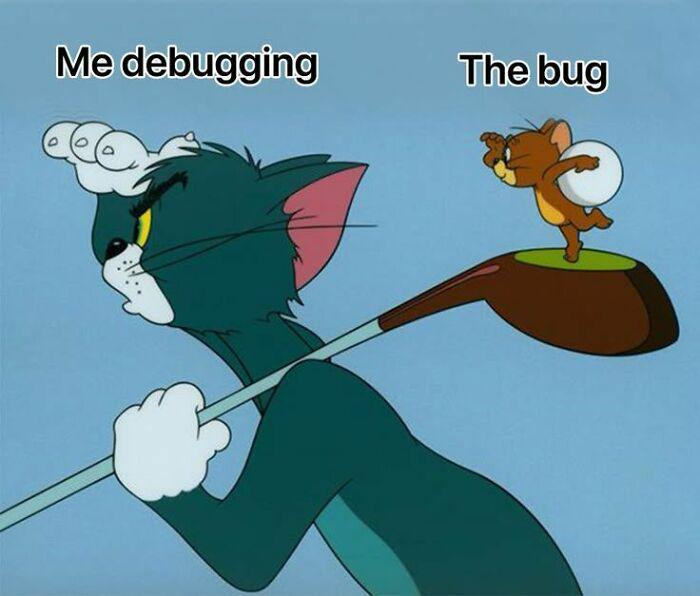
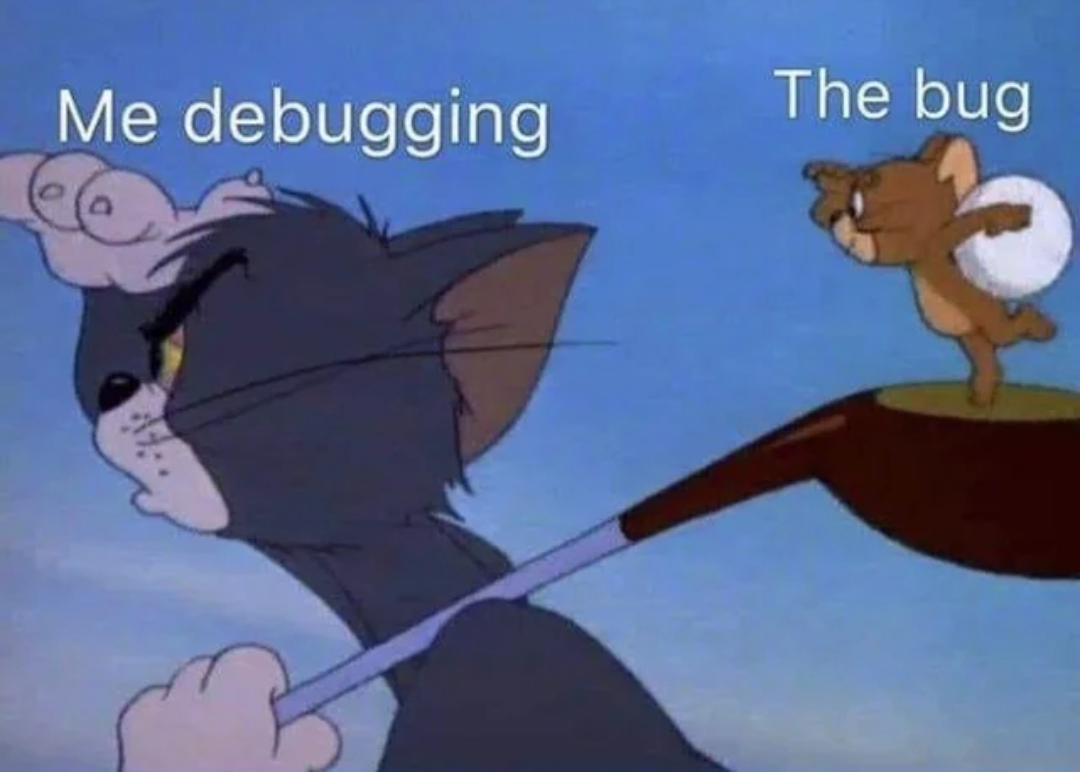
Just spent four hours tracking down what I thought was a critical production issue only to have it vanish the moment I added logging statements. The bug is literally Jerry the mouse—tiny, sneaky, and somehow always one step ahead of my debugging frying pan. And the worst part? Tomorrow it'll be back in a different function with a new disguise. The eternal Tom and Jerry chase continues, except I never get the satisfaction of actually catching the little menace.