

google Memes

Peak Web PKI

Peak Web PKI
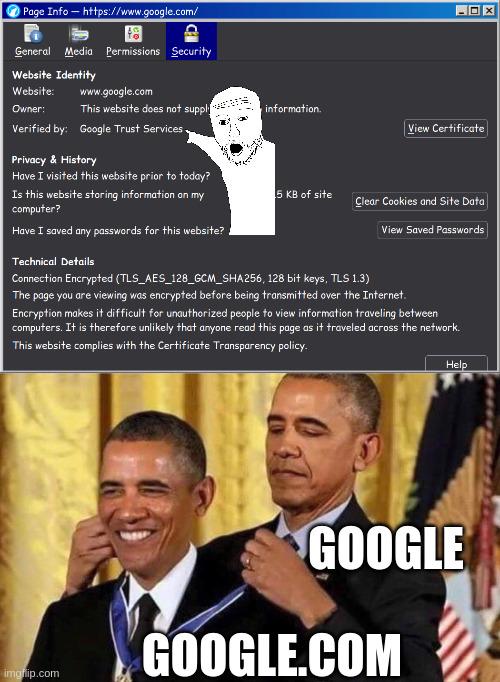
So Google.com's SSL certificate is verified by... Google Trust Services. It's like showing up to court as both the defendant AND the judge. "Your Honor, I find myself completely innocent!" The browser's security tab is proudly displaying all this fancy PKI infrastructure—TLS 1.3, AES-128-GCM encryption, SHA256 hashing—while conveniently glossing over the fact that we're just taking Google's word that Google is trustworthy. The whole certificate authority system basically runs on "trust me bro" energy, but with more cryptographic signatures. Fun fact: Your browser ships with a pre-installed list of root CAs it trusts, and guess who gets to be on that list? The same mega-corporations whose sites you're visiting. It's a perfectly circular system of trust that somehow became the backbone of internet security. Works great until you remember that the entire web's security model is built on trusting a few dozen organizations not to mess up or go rogue.

You Are A Vital Part Of This Program

You Are A Vital Part Of This Program
Google's AI has evolved from "search engine" to "emotional support compiler." Someone forgot a semicolon and is having an existential crisis, and the AI responds with the kind of motivational speech usually reserved for hostage negotiations. "You are still valid, you are still readable" – because apparently we're now validating code's self-worth. The best part? The "Why You Are Safe" section casually mentions that JavaScript will just insert your semicolons automatically anyway (ASI – Automatic Semicolon Insertion). So basically, you're panicking over nothing because the interpreter already fixed your mistake before you even hit run. It's like calling 911 because you forgot your keys, only to discover your door was unlocked the whole time. The phrase "We will get through this logic block together" is chef's kiss – treating a syntax error like a shared trauma that requires therapy and teamwork to overcome.

Google's First Trillion

Google's First Trillion
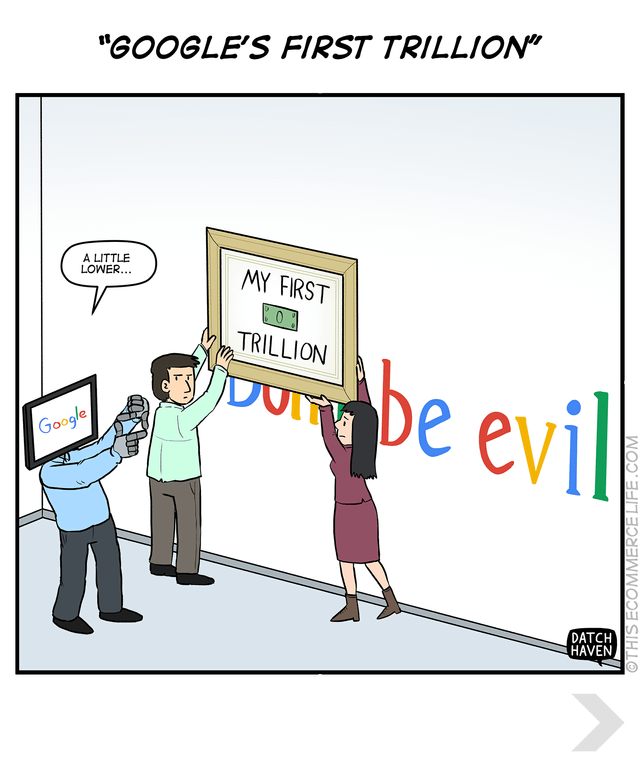
So Google hits their first trillion and decides to commemorate it by hanging a nice framed dollar bill on the wall. Wholesome corporate moment, right? Except they're strategically positioning it to cover up the "Don't be" part of their old "Don't be evil" motto. Subtle. Real subtle. The photographer even suggests moving it "a little lower" to make sure the coverup is perfect. Nothing says "we've matured as a company" quite like literally papering over your founding principles with money. At least they're honest about their priorities now—just took a trillion dollars to get there.

You Have No Choice

You Have No Choice
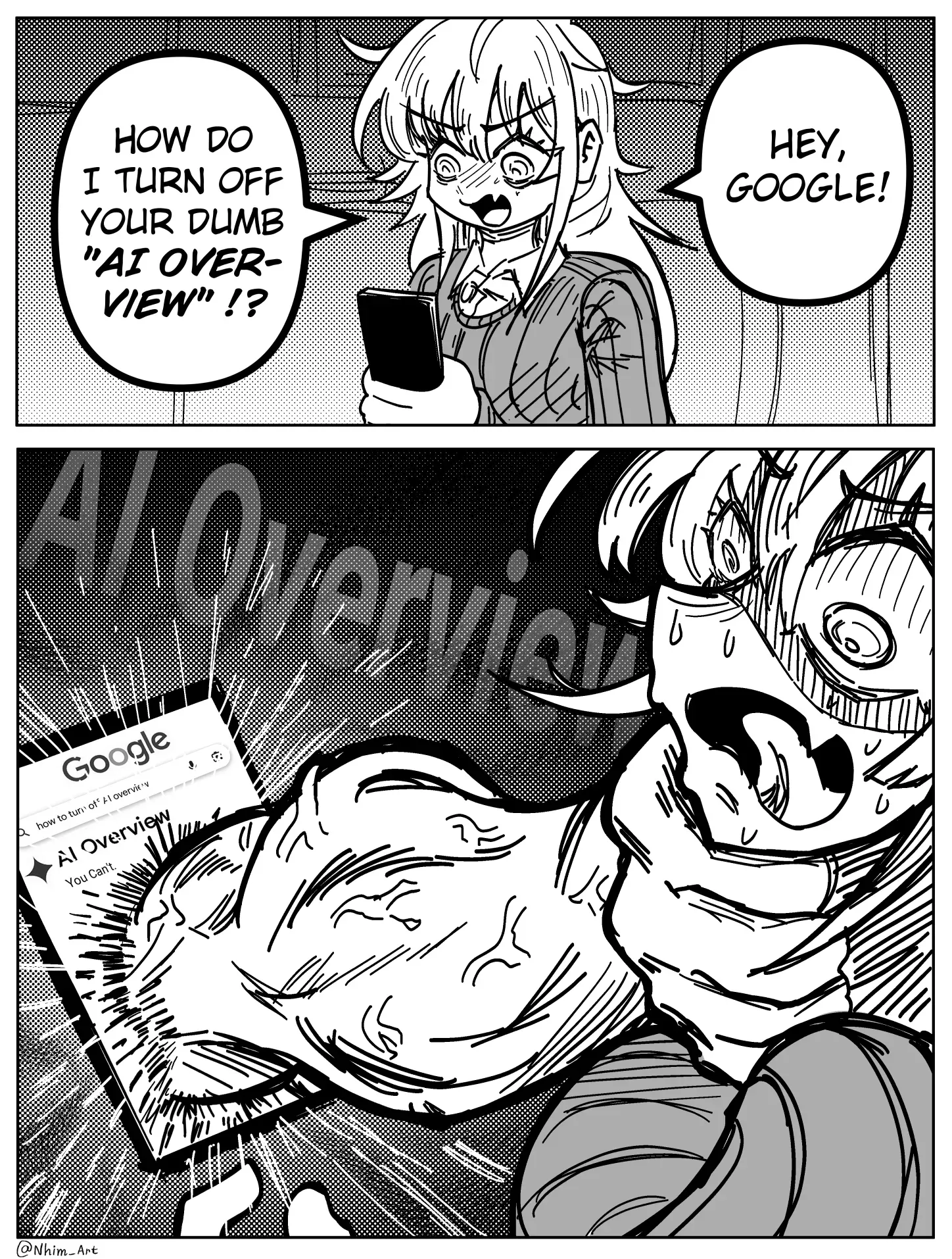
Google's AI Overview feature is like that friend who shows up uninvited to every party and won't leave no matter how many hints you drop. You search for something simple, and boom—there it is, taking up half your screen with AI-generated "insights" that range from occasionally useful to hilariously wrong. The best part? There's no official off switch. Google's basically saying "You're going to experience our AI revolution whether you like it or not." It's the tech equivalent of your parents telling you "it's for your own good" while forcing you to eat vegetables. Except in this case, the vegetables sometimes tell you to put glue on your pizza. The manga-style panic is incredibly relatable—that moment when you realize a tech giant has decided what's best for you and you're just along for the ride. Welcome to the future, where AI assistance is mandatory and your preferences are merely suggestions.

Google

Google
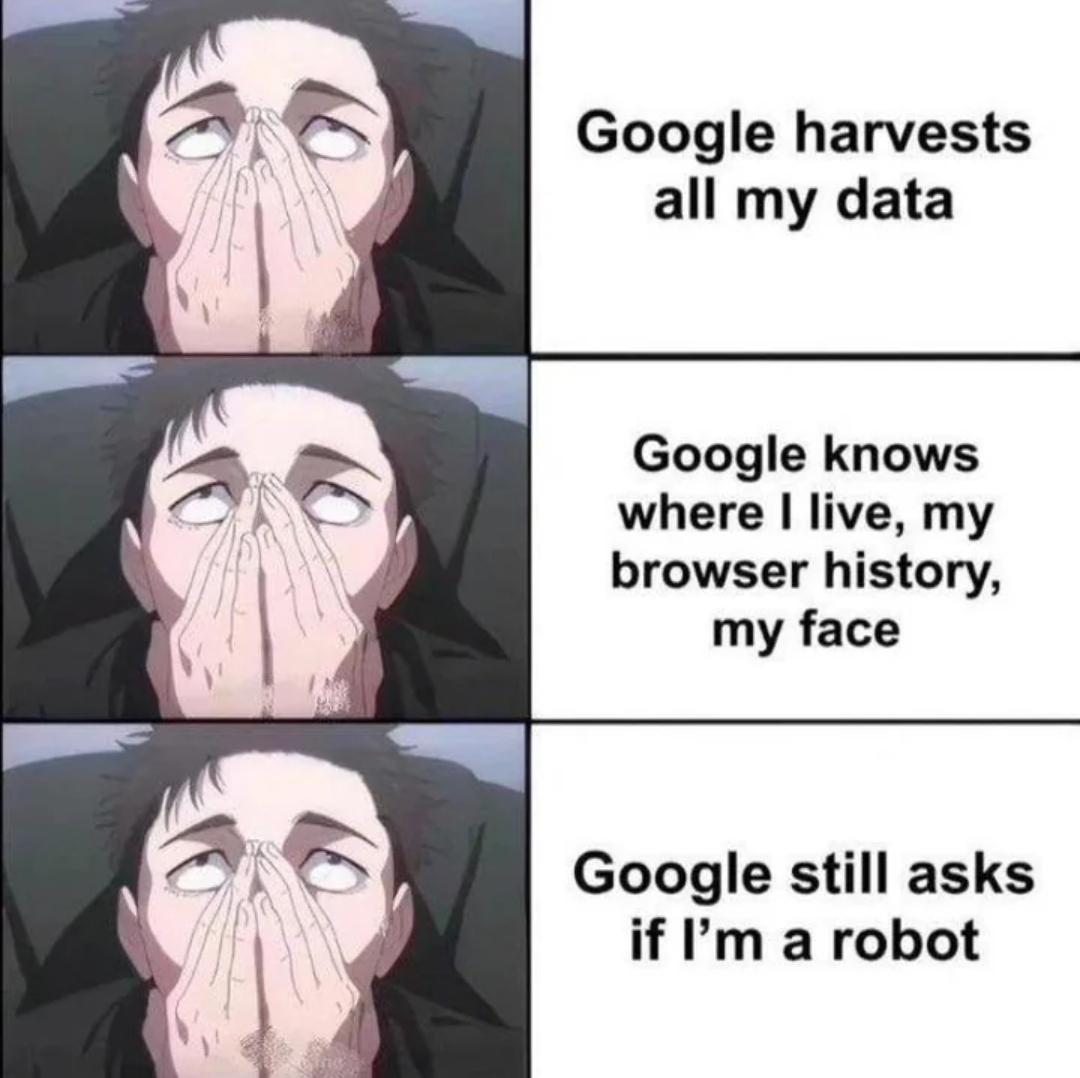
Google's got your entire digital soul on file—your location history, every embarrassing 3 AM search, even your face through their photo recognition—but somehow they still need you to prove you're not a robot by clicking on traffic lights. The irony is delicious. They've built a profile so detailed they could write your biography, yet they're out here like "hmm, are you sure you're human? Better click all the crosswalks just to be safe." It's like being interrogated by someone who already knows everything about you but insists on asking for your ID anyway.

Firefox

Firefox
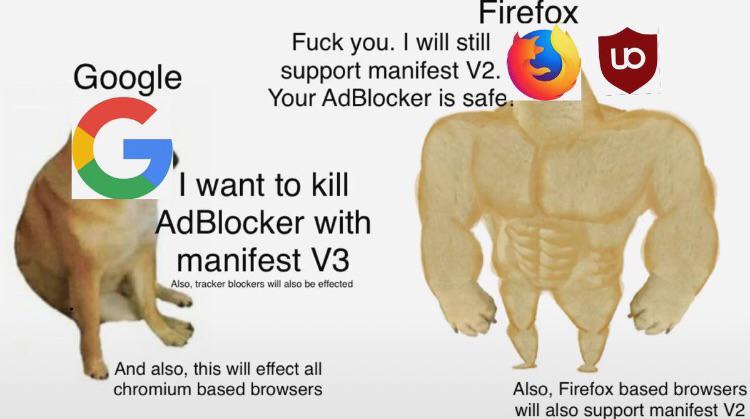
Google really said "let's nuke ad blockers for the good of... uh... security" with Manifest V3, basically crippling extensions like uBlock Origin because apparently protecting user privacy is just too much power for one browser. Meanwhile, Firefox is standing there like the last superhero in a dystopian movie, flexing its open-source muscles and refusing to bend the knee. They're keeping Manifest V2 alive like it's the sacred texts, ensuring your ad blocker stays strong and your browsing experience remains blissfully ad-free. The cherry on top? Google's changes don't just hurt ad blockers—they also mess with tracker blockers and affect ALL Chromium-based browsers (Edge, Brave, Opera, you name it). So while Chrome becomes the corporate sellout, Firefox is out here being the people's champion. The virgin corporate overlord vs. the chad privacy defender. Choose your fighter wisely.

HUANUO 48x23 Inch Electric Standing Desk, Adjustable, Black

HUANUO 48x23 Inch Electric Standing Desk, Adjustable, Black
【4 Memory Presets & DIY Wheel Ready】 This adjustable desk features a smart control panel with 4 programmable memory presets for effortless one-touch height adjustment (28.3" to 46.5"). Plus, built-in…

Which Way You'Re Looking?

Which Way You'Re Looking?
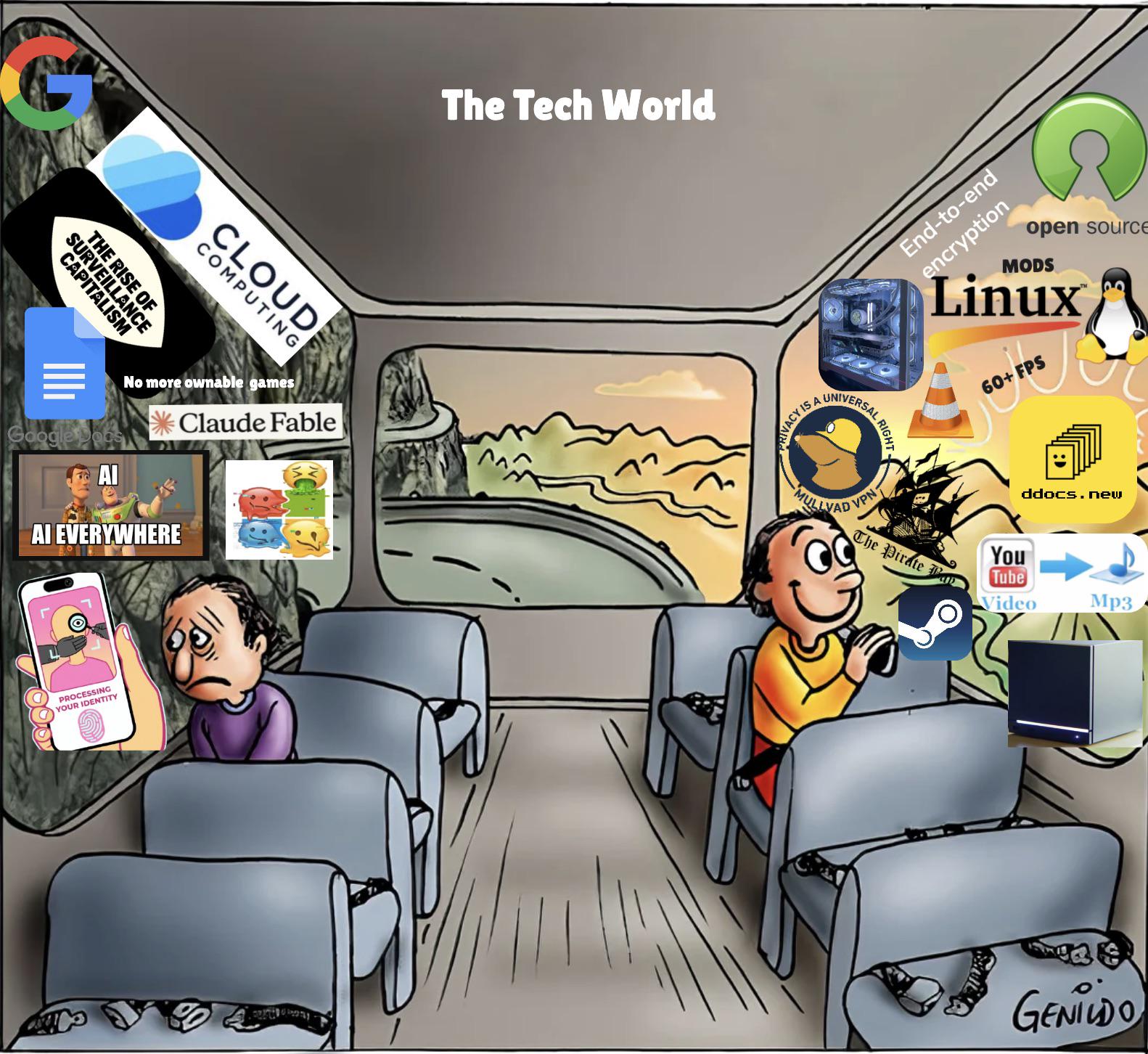
The eternal struggle of modern tech users: do you gaze left into the dystopian hellscape of corporate surveillance, AI replacing your job, biometric tracking, and cloud computing that owns your soul? Or do you look right toward the promised land of open source, Linux gaming at 60+ FPS, privacy-respecting tools, and the freedom to actually own your software? The left side is basically "everything wrong with tech in 2024" - Google tracking you, centralized corporate control, AI spam everywhere, apps demanding your fingerprints just to check the weather, and Claude Fable (because even our AI assistants are corporate now). The right side? That's the dream: Tux the penguin, Steam running natively, VLC playing literally any file format, and the Pirate Bay sailing strong. Most of us are stuck in the middle seat, pretending we'll "switch to Linux next weekend" while still using Chrome and storing everything in Google Drive. The cognitive dissonance is real.

Current State Of AI Relevancy

Current State Of AI Relevancy
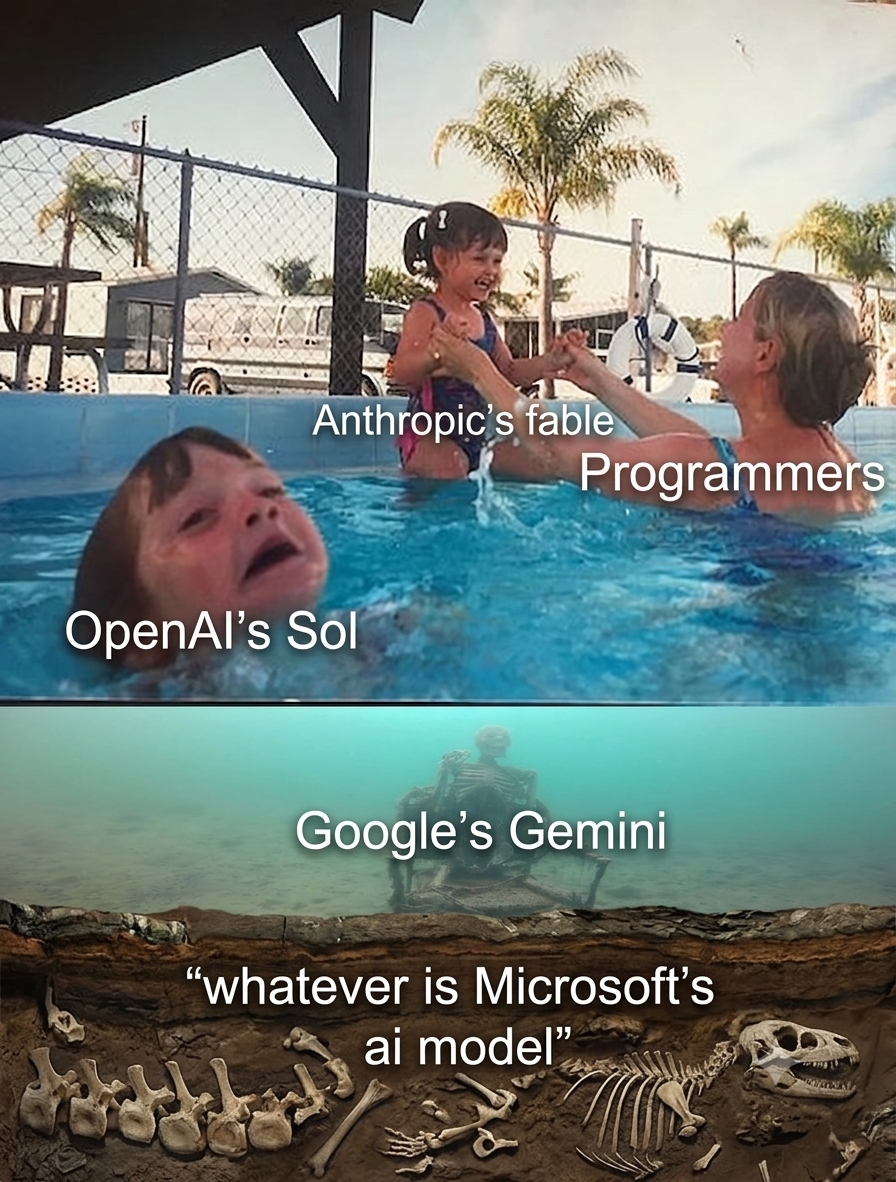
The AI hype cycle visualized through drowning and skeletal remains. Anthropic's Claude is having a moment with programmers—everyone's talking about it, testing it, probably asking it to write their unit tests. OpenAI's o1 is struggling for air in the middle tier, still relevant but clearly losing oxygen. Google's Gemini has sunk to the bottom of the pool, barely visible through the murky water. And then there's Microsoft's AI offering, which has apparently been down there so long it's achieved full fossilization. Not even a skeleton anymore—just ancient bones in the sand that archaeologists might dig up in a few millennia to study what happens when you rebrand Bing Chat seventeen times. The tech world moves fast. One day you're the hot new model, the next you're geological sediment.

Deja Vu

Deja Vu
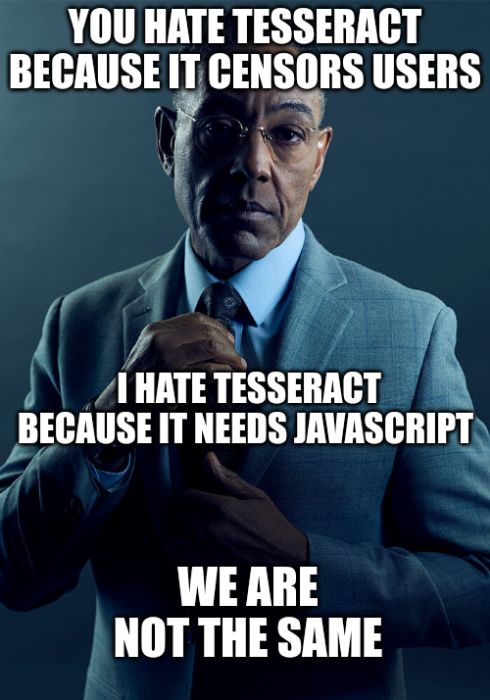
Two completely valid reasons to despise the same framework, yet somehow you're the unreasonable one for suggesting literally any alternative at the standup. The privacy advocate hates Tesseract because it phones home to Google. The backend dev hates it because they have to npm install 47 packages just to OCR a receipt. Both are correct. Both are suffering. Neither will win the argument with the PM who already put it in the sprint. Fun fact: Tesseract was originally developed by HP in the 1980s and later open-sourced. Google picked it up in 2006, which is when the trust issues began.

Say Goodbye To Ram

Say Goodbye To Ram
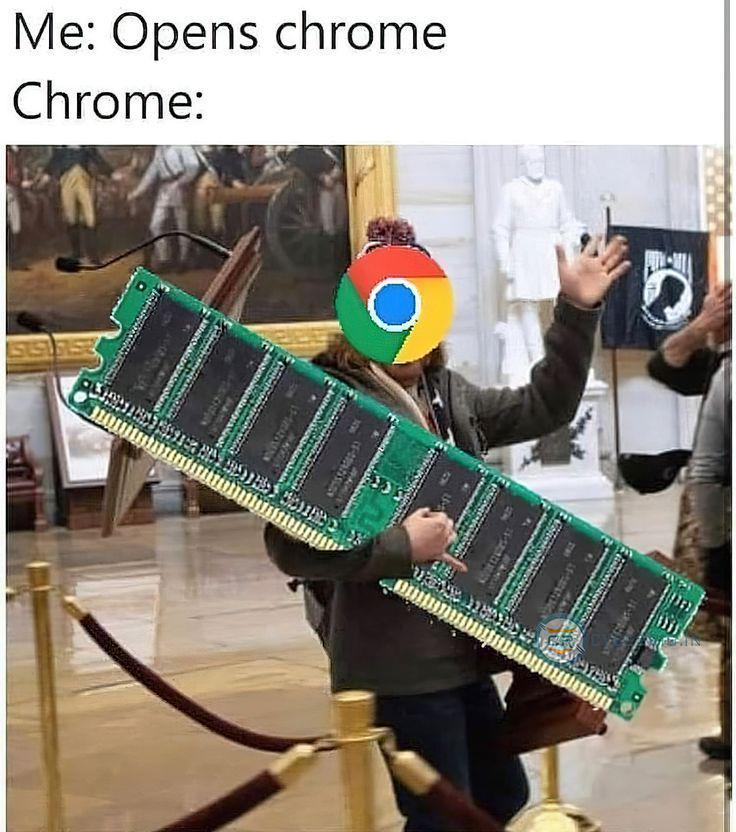
Chrome's appetite for RAM is legendary at this point. You open one tab to check your email and suddenly it's devouring memory like it hasn't eaten in weeks. Two tabs? Better upgrade to 32GB. Three tabs? Time to download more RAM. The beautiful irony is that Chrome was originally built to be lightweight and fast. Now it's basically a memory black hole that makes your $2000 machine sound like a jet engine taking off. Firefox users watching from the sidelines with their 8GB setups running just fine. Fun fact: Each Chrome tab runs in its own process for "security and stability," which is developer-speak for "we're gonna eat all your RAM and you're gonna like it." At least when it crashes, it only takes down one tab instead of your entire browsing session. Silver linings, right?

Because Google Cares About Us

Because Google Cares About Us
Google's new sideloading restrictions are basically the tech equivalent of your landlord telling you what furniture you're allowed to bring into your own apartment. Sure, they'll frame it as "security," but really it's just another way to keep you locked in their walled garden. You paid $800+ for a device, but apparently that doesn't include the radical privilege of installing whatever software you want on it. Google gets to be the gatekeeper now. Nothing says "open platform" quite like needing Big Brother's permission to install an APK you found on the internet. The best part? They're doing this "for your safety." Because clearly, we've all been too stupid to manage our own devices this whole time. Thanks for the protection, Google. Really feeling that Android freedom right about now.

TRELC Wired Gaming Mouse with 5 D Rocker, 10000 DPI/11 Programmable Buttons, Vertical Ergonomic Mouse with On-Board Memory, Optical Computer Mice for PC/Laptop/E-Sports/Gamer

TRELC Wired Gaming Mouse with 5 D Rocker, 10000 DPI/11 Programmable Buttons, Vertical Ergonomic Mouse with On-Board Memory, Optical Computer Mice for PC/Laptop/E-Sports/Gamer
【5 Direction Rocker】An integrated 5 orientations rocker helps gamer to achieve their best performance in each campaign. In this gaming mouse, 1 rocker equals 5 keys. Thumb control, the realization of…

Millennium Prize Winning Answer

Millennium Prize Winning Answer
Someone just googled "p np problem" and Google's AI cheerfully responded with "No problem at all! How can I help you today?" Congrats, Google just solved one of the seven Millennium Prize Problems worth $1 million. The Clay Mathematics Institute has been real quiet since this dropped. For context: P vs NP is literally one of the most important unsolved problems in computer science and mathematics. Thousands of researchers have spent decades trying to prove whether every problem whose solution can be quickly verified can also be quickly solved. But sure, Google AI says "no problem" so I guess we're done here. Time to collect that million dollars and retire. Thanks, AI.