

Disaster recovery Memes

Posts tagged with Disaster recovery
Companies Should Be Glad, That Other People Are Helping Them With Their Offsite Backup

Companies Should Be Glad, That Other People Are Helping Them With Their Offsite Backup
When hackers steal your data, they're technically just creating an additional backup copy in a geographically distributed location. It's like having a disaster recovery plan you never asked for! Sure, the top panel shows the standard corporate panic response to a data breach, but the bottom panel reveals the silver lining: you now have a "decentralized surprise backup" courtesy of some friendly neighborhood cybercriminals. The reframing here is chef's kiss – turning a catastrophic security incident into an unexpected infrastructure upgrade. It's the ultimate glass-half-full perspective on ransomware attacks. Who needs AWS S3 cross-region replication when you've got threat actors doing it for free? Your CISO might not appreciate this hot take during the incident response meeting though.

The Seven Laws Of Computing

The Seven Laws Of Computing
Oh, so we're calling it "Seven Laws" when there are EIGHT rules? Already off to a brilliant start. But honestly, this is the most sacred scripture ever written in the tech world. Rules 1-5 are basically just screaming "BACKUP YOUR STUFF OR PERISH" in increasingly desperate ways, like a paranoid sysadmin having a meltdown. Then Rule 6 casually drops the nuclear option: uninstall Windows. Rule 7 follows up with "reinstall Linux" because obviously that's the only logical solution to literally everything. And Rule 8? Turn your egg whites into meringue. Because when your production server crashes at 3 AM and you've lost everything because you ignored Rules 1-5, at least you can stress-bake some pavlova while contemplating your life choices. Honestly, the progression from "make backups" to "become a pastry chef" is the most relatable career trajectory in tech.

Un-Natural Disasters

Un-Natural Disasters
The corporate response cycle in its purest form. Server room floods, everyone panics, forms a committee to discuss root causes, writes up a beautiful "lessons learned" document with all the right buzzwords, then promptly ignores the actual fix because... well, committees don't fix roofs, do they? Notice how "Fix roof?" is crossed out at the bottom of that email. That's not a bug, that's a feature of enterprise culture. Why solve the actual problem when you can have endless retrospectives about it instead? By the time they schedule "Server Room Flood Retrospective #4," the poor guy is literally standing in water again. The real disaster isn't the flood—it's the organizational paralysis that treats symptoms while the bucket keeps overflowing. At least the documentation is getting better though, right?

So Many Levels

So Many Levels
The five stages of grief, but make it hardware failure. Someone's hard drive went from "perfectly fine" to "abstract art installation" real quick. What starts as a normal HDD standing upright gradually transforms into increasingly creative interpretations of what a hard drive could be. First it's standing, then lying flat, then someone thought "what if we bent it a little?" and finally achieved the ultimate form: a hard drive sandwich with extra platters. The title "So Many Levels" is chef's kiss because it works on multiple levels itself (pun absolutely intended). Physical levels of the drive's position, levels of destruction, and levels of desperation when you realize your backup strategy was "I'll do it tomorrow." Fun fact: those shiny platters inside spin at 7200 RPM, which is roughly the same speed your heart rate reaches when you hear that clicking sound. RAID stands for Redundant Array of Independent Disks, but after seeing this, it clearly stands for "Really Avoid Inadequate Disaster-planning."

Backup Supremacy🤡

Backup Supremacy🤡
When your company gets hit with a data breach: *mild concern*. But when they discover you've been keeping "decentralized surprise backups" (aka unauthorized copies of the entire production database on your personal NAS, three USB drives, and your old laptop from 2015): *chef's kiss*. The real galaxy brain move here is calling them "decentralized surprise backups" instead of what the security team will inevitably call them: "a catastrophic violation of data governance policies and possibly several federal laws." But hey, at least you can restore the system while HR is still trying to figure out which forms to fill out for the incident report. Nothing says "I don't trust our backup strategy" quite like maintaining your own shadow IT infrastructure. The 🤡 emoji is doing some heavy lifting here because this is simultaneously the hero move that saves the company AND the reason you're having a very awkward conversation with Legal.

Putting All Your Eggs In One Basket

Putting All Your Eggs In One Basket
The classic single point of failure scenario. Server goes down, and naturally the backup is stored on... the same server. It's like keeping your spare tire inside the car that just drove off a cliff. Some say redundancy is expensive, but you know what's more expensive? Explaining to management why the last 6 months of data just evaporated because someone thought "the server is pretty reliable though" was a solid disaster recovery plan. Pro tip: your backup strategy shouldn't require a séance to recover data.

Was Hiring My Friend A Mistake

Was Hiring My Friend A Mistake
When your friend's entire development philosophy is "make one version that works" and their disaster recovery plan is "ctrl+z", you know you're in for a wild ride! This is that chaotic developer who's never heard of Git because "why track versions when I can just not break things?" The absolute confidence of someone who codes without a safety net is both terrifying and oddly impressive. It's like watching someone juggle flaming chainsaws while saying "relax, I've never dropped one... yet."

Who Is Your God Now

Who Is Your God Now
That awkward moment when your "redundant" multi-cloud strategy implodes because you put all your eggs in the Azure basket too. Turns out having multiple points of failure isn't quite the same as having no single point of failure. Those 3 AM architecture meetings where everyone nodded along to "cloud diversity" suddenly feel like a cruel joke when you're frantically checking status pages while your CEO texts "is it just us?" Pro tip: Real redundancy means different technologies, not just different logos on your infrastructure diagram.

Backup Capacity Expectations Vs Reality

Backup Capacity Expectations Vs Reality
When the CTO says "We've allocated sufficient backup storage" but your database grows faster than your budget. That tiny spare tire trying to support a monster truck of data is basically what happens when management thinks a 1TB drive will back up your 15TB production environment. Bonus points if they expect you to fit the logs too.

Cloud Redundancy Saves The Day

Cloud Redundancy Saves The Day
The hero we didn't know we needed! While AWS is having a major outage and CTOs everywhere are sweating bullets, this clever dev is sitting pretty with their workloads in US-East-2. It's that galaxy brain moment when your paranoia about putting all your eggs in one availability zone finally pays off. Multi-region deployment strategy for the win! Everyone else is frantically updating their status page while you're just sipping coffee and watching your metrics stay gloriously flat.

Daddy What Did You Do In The Great AWS Outage Of 2025

Daddy What Did You Do In The Great AWS Outage Of 2025
Future bedtime stories will feature tales of the mythical AWS outage of 2025. Dad sits there, thousand-yard stare, remembering how he just watched the status page turn red while half the internet collapsed because someone decided DynamoDB should be the single point of failure for... everything. The real heroes were the on-call engineers who had to explain to executives why their million-dollar systems were defeated by a database hiccup. Meanwhile, the rest of us just refreshed Twitter until that went down too.

Crisis Management: Developer Edition

Crisis Management: Developer Edition
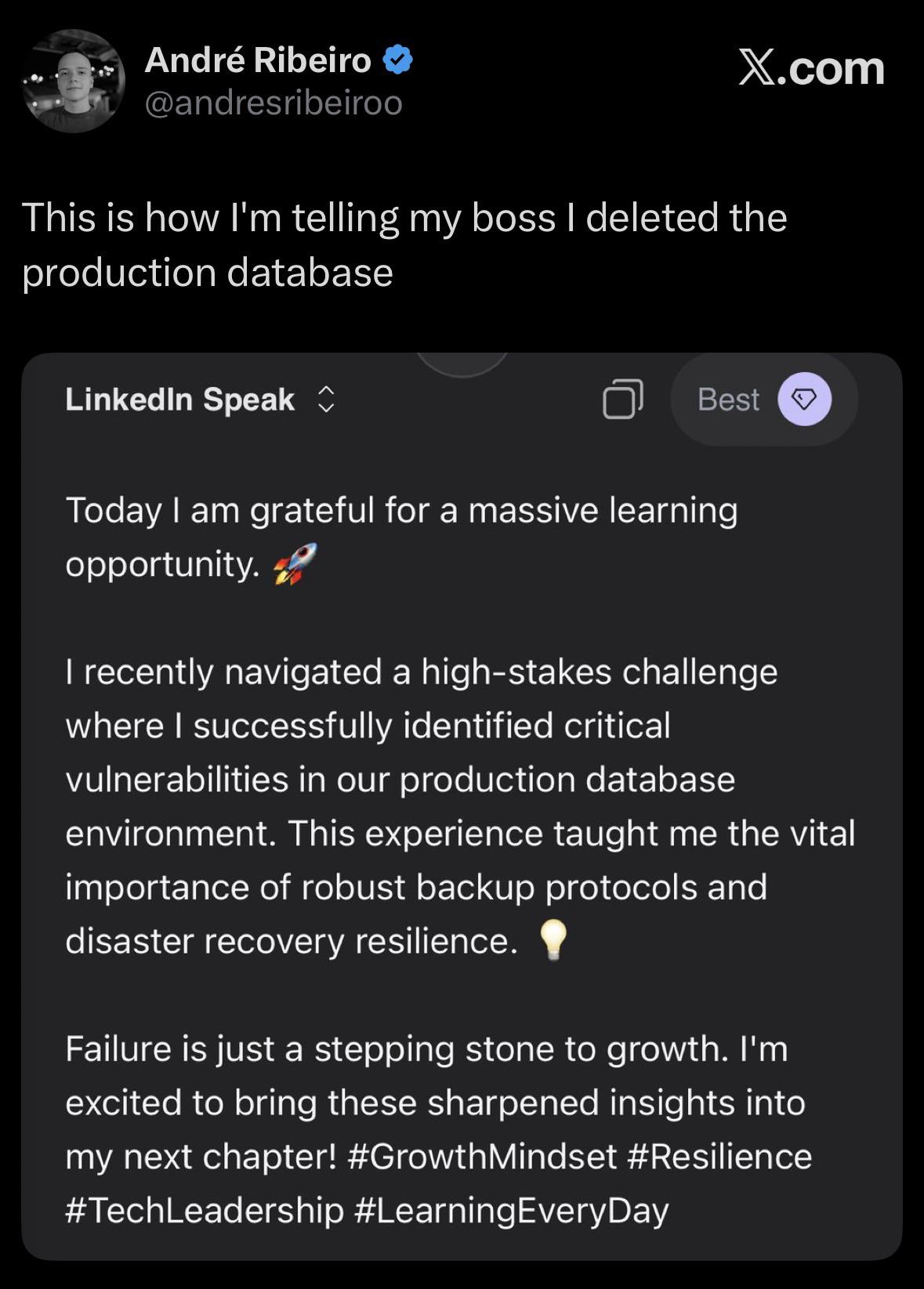
Ah, corporate spin at its finest! This is the corporate PR team's playbook for turning catastrophic failures into marketing opportunities. "Customer data has been securely deleted" is just chef's kiss euphemism for "we lost everything and have no backups." My favorite is "community-driven stress testing" – because nothing says "we value our community" like letting them discover all the ways your code can spectacularly fail in production. After 15 years in this industry, I've written enough of these emails to recognize art when I see it. Remember folks, it's not "getting hacked" – it's just "backup powered by our volunteers" (aka random people on the dark web).