

Data types Memes

Posts tagged with Data types
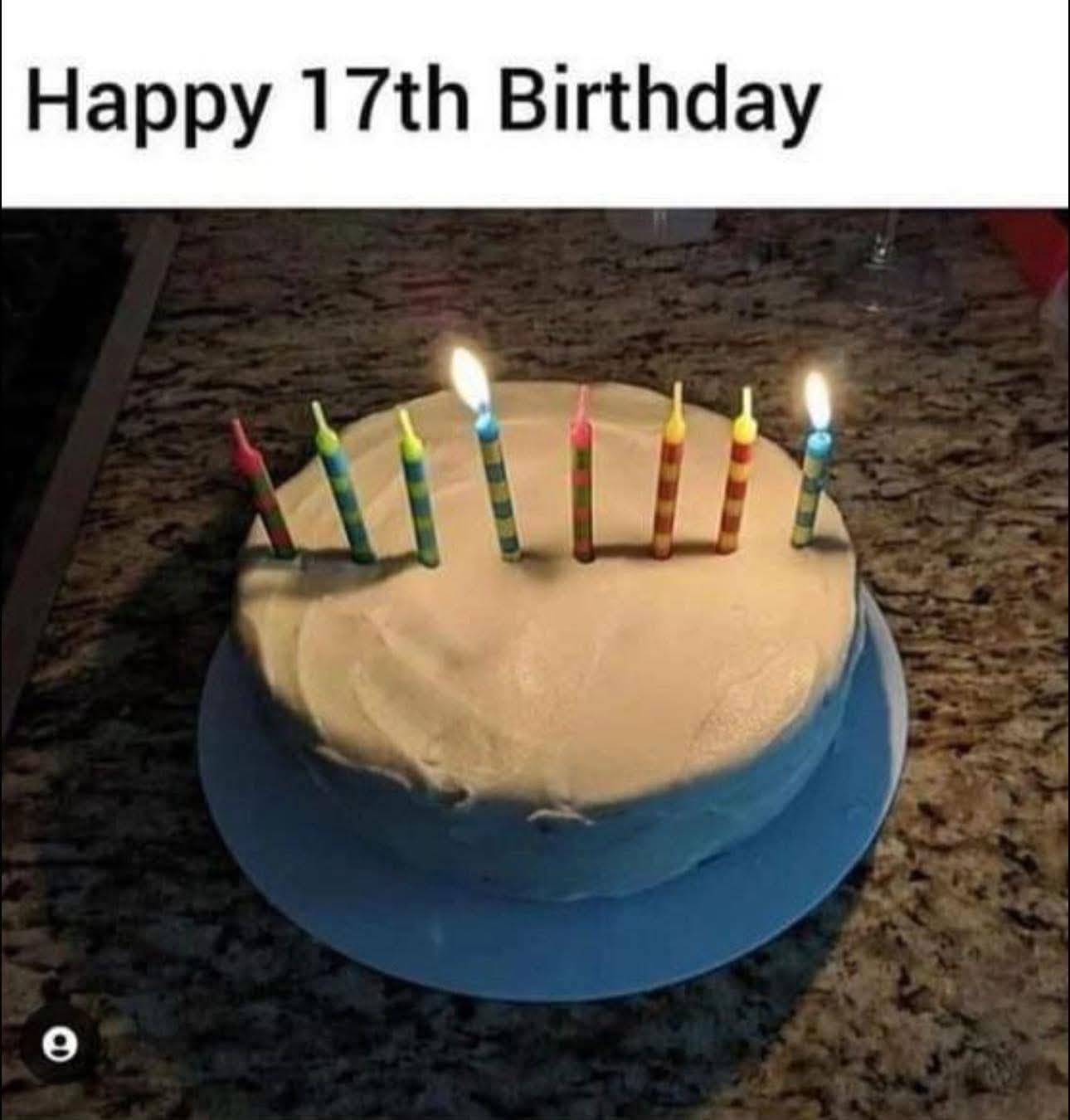
Don't Grow Older Than 255 Or Else It Will Overflow

Don't Grow Older Than 255 Or Else It Will Overflow
Someone's birthday cake just demonstrated the classic unsigned 8-bit integer overflow problem. They're celebrating their "17th" birthday, but with 256 candles arranged in binary format (well, sort of). The joke? If you store age as an unsigned byte (0-255), hitting 256 wraps you back to 0. So technically, they just became a newborn again. The candles are arranged in what looks like binary representation: 8 candles for 8 bits. Two are lit (representing 1s) and the rest are unlit (representing 0s). The person who made this cake either has a computer science degree or really wanted to avoid buying 256 individual candles. Smart optimization if you ask me—O(1) space complexity instead of O(n). Pro tip: Always use a 64-bit integer for age storage. You'll be safe until someone turns 18,446,744,073,709,551,616 years old, at which point integer overflow is the least of humanity's concerns.

Everybody Forgets The Time Part Of Datetime

Everybody Forgets The Time Part Of Datetime
Three different datetime formats, all equally wrong in their own special way. The first one at least tries to be logical with MM-DD-YYYY-hh-mm-ss, but then someone decided to shuffle the deck and put DD-MM-YYYY in the middle. The third one? YYYY-MM-DD leading the charge like it's ISO 8601's cool cousin. But notice what they all have in common? Those time components (hh, mm, ss) are getting progressively smaller and more forgotten, like they're being pushed off a cliff into irrelevance. Developers love to bikeshed about date formats until they're blue in the face, but the moment it comes to actually storing time precision? "Eh, just set it to 00:00:00 and call it a day." Then six months later someone files a bug because events scheduled for 2PM are showing up at midnight and everyone acts surprised. The time part isn't just decoration, folks—it's literally half the name.

No Need To Be Jealous

No Need To Be Jealous
The girlfriend is worried about her partner thinking of another woman, but he's actually deep in philosophical programming territory: if text is called a "string" (a sequence of characters), shouldn't a single character be called a "strand"? It's the kind of shower thought that keeps developers up at night. The terminology actually comes from early computing where strings were literally sequences of characters "strung together," but nobody bothered to make the naming convention perfectly consistent with the singular form. Classic programming nomenclature being delightfully arbitrary.

Find Your Place

Find Your Place
The hard truth that keeps memory-conscious developers up at night. A boolean only needs 1 bit to represent true or false, but because most systems can't address individual bits, it gets allocated a whole byte. That's 87.5% storage efficiency loss, which is basically the computing equivalent of buying a mansion to store a single shoe. Some languages try to optimize this with bit fields or packed structures, but let's be real—most of the time we're just casually wasting 7 bits per boolean like we're made of RAM. Which, to be fair, we kind of are these days. Storage is cheap, existential dread about inefficiency is free. The real tragedy? Those 7 bits could've been living their best life storing actual data, but instead they're just... there. Unemployed. Collecting dust. A monument to the gap between theoretical computer science and practical implementation.

Tell Me The Truth

Tell Me The Truth
The harsh reality that keeps systems engineers up at night: we're using an entire byte (8 bits) to store a boolean value that only needs 1 bit. That's an 87.5% waste of memory. It's like buying an 8-bedroom mansion just to store a single shoe. But here's the thing—computers can't efficiently address individual bits. Memory is byte-addressable, so we're stuck with this inefficiency unless you want to manually pack bits together like some kind of medieval bit-packing peasant. Sure, you could optimize it with bitfields or bit arrays, but at what cost? Your sanity? Readability? The ability to debug without wanting to throw your laptop out the window? So we accept this beautiful waste in exchange for simplicity and speed. Sometimes the truth hurts more than a segmentation fault.

Just A Simple Boolean Question

Just A Simple Boolean Question
You ask for a simple true or false , and suddenly you're parsing "Yes", "yeah", "Y", "true", "1", "ok", or my personal favorite: "success". The contract was clear—return a boolean. Instead, you get back a string that requires a whole new layer of validation logic. Now you're sitting there writing if (response.toLowerCase() === "true" || response === "1") like some kind of type-system archaeologist. Strong typing exists for a reason, people! The smugness on that kid's face? That's the exact energy of someone who just returned "False" with a capital F from an API endpoint.

Weather App Went Low Level

Weather App Went Low Level
When climate change gets so catastrophic that your weather app just gives up on human-readable formats and starts outputting raw binary. "Screw it, you figure it out," says the API. The temperature readings are literally 1° and 0° alternating like some kind of Boolean fever dream. It's not Celsius, it's not Fahrenheit—it's straight-up true and false weather. Your weather app just downgraded from a high-level API to assembly language because apparently the climate situation is now so dire it needs to be expressed in the most fundamental data type possible. Next update: weather forecasts delivered in machine code. "Partly cloudy" will be 0x4A3F2B .

Best Integer Type

Best Integer Type
Behold, the holy trinity of integer types in their natural habitat! INT32 is just vibing with a smooth brain, doing basic arithmetic like it's 1999. INT64 shows up with a galaxy brain, handling those bigger numbers like a responsible adult. But then INT54+SIGN bursts through the ceiling with cosmic enlightenment, achieving MAXIMUM EFFICIENCY by packing both the value AND the sign bit into a single integer type. It's like discovering fire, inventing the wheel, and landing on Mars all at once. The sheer elegance of explicitly acknowledging that yes, numbers can be negative too—revolutionary! Who knew that combining size with sign awareness would unlock the secrets of the universe?

A Straightforward Boolean Inquiry

A Straightforward Boolean Inquiry
The digital equivalent of asking "Do you want pizza or burgers?" and getting "Yes, that sounds great" as a response. Boolean questions expect TRUE or FALSE answers—not a dissertation on your favorite food groups. Yet somehow, non-technical folks keep responding with paragraphs when all you needed was a single bit of information. It's like asking if the light is on and getting back the entire history of electricity instead of just "yes." The compiler in my brain throws an exception every time.

Product Ownership 101

Product Ownership 101
THE AUDACITY! You ask a SIMPLE yes/no question and these monsters hit you with a dissertation! Boolean questions should return true or false, not the entire works of Shakespeare! Every developer has faced that moment of existential crisis when expecting a 1 or 0 and getting back someone's life story instead. It's like ordering a coffee and receiving an ocean - THANKS FOR DROWNING ME IN UNNECESSARY DATA! 💀

Finally A Real-World Example Of Why Null Is Scarier Than 0

Finally A Real-World Example Of Why Null Is Scarier Than 0
BEHOLD! The most DEVASTATING visual representation of null vs. zero in programming history! On the left, a toilet paper roll with ZERO paper left - inconvenient? Sure. But on the right? ABSOLUTE CHAOS! The roll is NULL - it doesn't even EXIST! You're sitting there, pants around ankles, desperately reaching for something that ISN'T EVEN THERE! This is EXACTLY what happens when your code tries to access a null reference - complete and utter existential panic! At least with zero you know you're screwed... with null, you don't even get THAT courtesy! 💀

Integer Overflow Saves Lives

Integer Overflow Saves Lives
When your sneaky request for "one more day" causes the judge's sentencing algorithm to wrap around into negative territory! The -32.768 years is exactly what happens when a 16-bit signed integer overflows from its maximum value (32,767) to its minimum (-32,768). Instead of extending your sentence, you've basically hacked the judicial system with an unhandled edge case. Free to go and grab another McD's drink while the court IT department frantically debugs their legacy C code!